Wir
Wir means we and is the subject in Wir sind mehrere Tage weg. It includes the speaker and at least one other person, for example when making a shared plan. The lowercase form wir appears later after während.
sind
sind means are in Wir sind mehrere Tage weg and in the question Sind die Balkontür und die Schlafzimmerfenster sicher verschlossen? It describes a current state or asks about one. Use it with wir or a plural subject.
mehrere
mehrere means several and modifies Tage in mehrere Tage. Use mehrere before a plural noun when referring to more than one without giving an exact number. Here it describes the length of the absence.
Tage
Tage means days in mehrere Tage. It is the plural form of Tag and is used here to express a period of time. The pattern mehrere + plural noun is useful for approximate amounts.
weg
weg means away in mehrere Tage weg. Together with sind, it describes being away from the apartment. Use sein + weg when talking about someone’s absence or location.
also
also means so or therefore in also lass uns die Wohnung noch einmal überprüfen. It connects the fact that they will be away with the suggestion that follows. Use it to introduce a consequence or practical next step.
lass
lass contributes the meaning let’s in lass uns die Wohnung noch einmal überprüfen. It addresses one person informally and introduces a joint suggestion. The reusable pattern is lass uns + infinitive.
uns
uns means us in lass uns die Wohnung noch einmal überprüfen. It shows that the suggested action includes the speaker and the other person. It regularly follows lass in a joint suggestion.
die
die means the in die Wohnung and Die Balkontür. It identifies specific items already relevant in the apartment. Use die before an identified noun or group of nouns.
Wohnung
Wohnung means apartment in die Wohnung. It is the place the speakers are checking before leaving. Use Wohnung when referring to an apartment as a living space.
noch
noch contributes the meaning again in noch einmal überprüfen. In this dialogue, noch and einmal work together to show that the check will be repeated. Use the exact pattern noch einmal + infinitive for a repeated action.
einmal
einmal means once, but in noch einmal it contributes again or one more time. The full expression noch einmal überprüfen means to check again. It is useful when repeating a check or action.
überprüfen
überprüfen means check in die Wohnung noch einmal überprüfen. It is the infinitive after lass uns and names the suggested action. Use it with the thing being checked, such as die Wohnung.
Ich
Ich means I and is the subject in Ich habe die kleinen Geräte ausgesteckt. It presents the speaker’s own action or responsibility. The lowercase form ich appears after a verb in another line.
habe
habe is the auxiliary in Ich habe die kleinen Geräte ausgesteckt and Ich habe auch unseren Nachbarn gebeten. It helps report completed actions. Use Ich habe with a completed action when describing what you have done.
kleinen
kleinen means small in die kleinen Geräte. It describes the size of the appliances and appears directly before Geräte. Use an adjective before a noun to add a property such as size.
Geräte
Geräte means appliances or devices in die kleinen Geräte. It is the plural of Gerät and refers here to the small appliances that were unplugged. Use the plural form when referring to more than one device.
ausgesteckt
ausgesteckt means unplugged in Ich habe die kleinen Geräte ausgesteckt. With habe, it reports that the appliances were disconnected from the power. Use habe + ausgesteckt for a completed unplugging action.
und
und means and. Here it joins the two actions in Ich habe die kleinen Geräte ausgesteckt und den Herd ausgeschaltet. Use it to connect items or actions in a list.
den
den means the in den Herd. It identifies the specific stove being discussed in the apartment. It appears directly before Herd in the phrase den Herd ausgeschaltet.
Herd
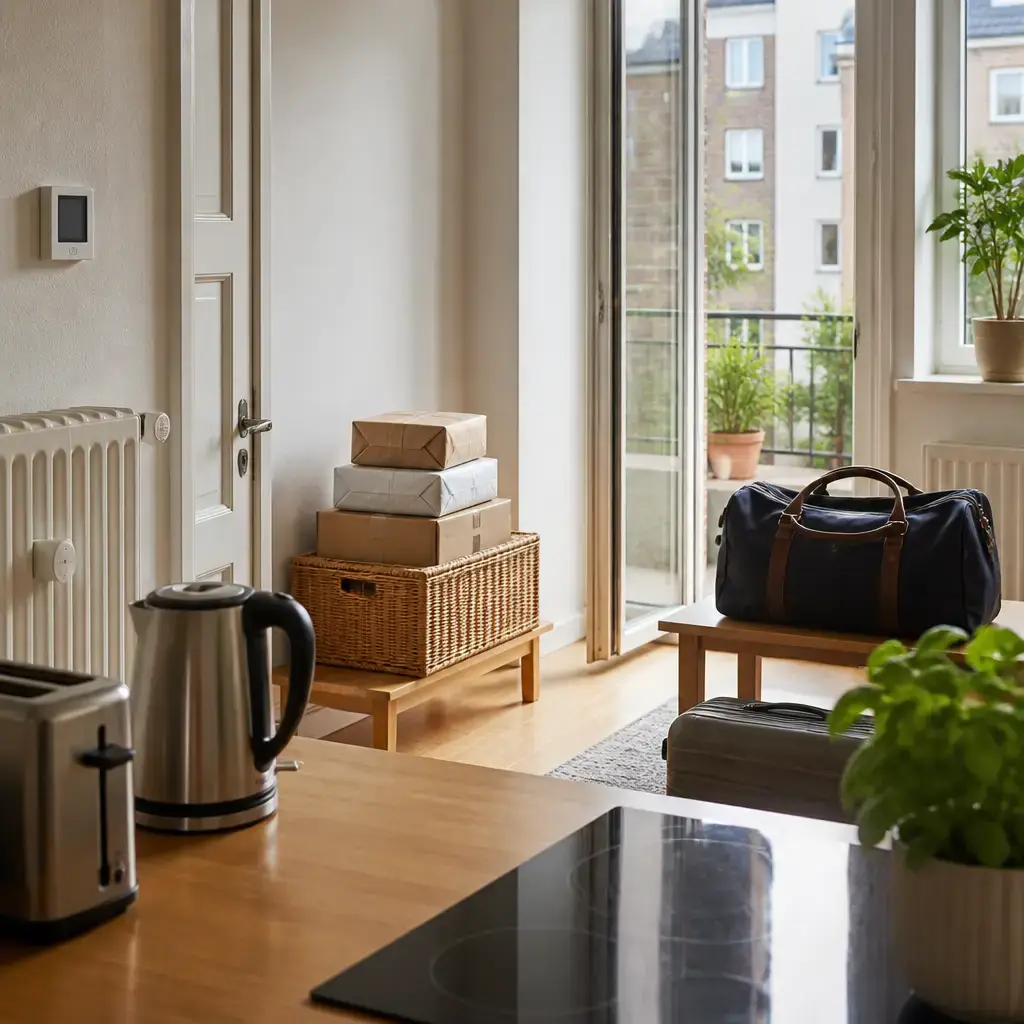
Herd means stove in den Herd ausgeschaltet. It is the kitchen appliance that was turned off. In this dialogue it occurs with ausgeschaltet to describe the completed safety check.
ausgeschaltet
ausgeschaltet means turned off in den Herd ausgeschaltet. With habe, it reports that the stove was switched off. Use habe + ausgeschaltet when describing a completed switch-off action.
Balkontür
Balkontür means balcony door in Die Balkontür ist abgeschlossen. It is one of the apartment’s access points being checked. Use it when confirming the condition of the balcony door.
Schlafzimmerfenster
Schlafzimmerfenster means bedroom windows in die Schlafzimmerfenster. It refers to the windows in the bedroom that are being checked for security. The exact phrase die Schlafzimmerfenster is used when asking about them.
sicher
sicher means secure in sicher verschlossen. Together with verschlossen, it asks whether the doors and windows are securely closed and locked. Use sicher before a describing word when emphasizing that something is safely secured.
verschlossen
verschlossen means closed and locked in sicher verschlossen. It describes the required condition of the balcony door and bedroom windows. Use it with sind when asking whether several items are secured.
ist
ist means is in Die Balkontür ist abgeschlossen. It links the singular balcony door with its current condition. Use ist + a description to state the condition of one thing.
abgeschlossen
abgeschlossen means locked in Die Balkontür ist abgeschlossen. It confirms that the balcony door has been secured. Use ist abgeschlossen to report that a door is locked.
schaue
schaue means look or check in und ich schaue jetzt noch einmal im Schlafzimmer nach. Together with nach, it describes checking the bedroom. Use the full construction schaue jetzt noch einmal im Schlafzimmer nach when checking a place again.
jetzt
jetzt means now in ich schaue jetzt noch einmal im Schlafzimmer nach. It places the checking action in the present moment. Use it to announce an action that is happening immediately.
im
im means in the in im Schlafzimmer. It locates the checking action inside the bedroom. Use im before a place noun when describing an action taking place there.
Schlafzimmer
Schlafzimmer means bedroom in im Schlafzimmer. It names the room that is checked again. Use it after im to say that something happens in the bedroom.
nach
nach completes the checking meaning in ich schaue jetzt noch einmal im Schlafzimmer nach. It is part of the separated construction schaue ... nach, rather than meaning after here. Use the complete construction when looking around or checking on a place.
Sollen
Sollen means should in Sollen wir das Thermostat niedriger einstellen? It asks whether the speakers ought to take a joint action. Use Sollen wir + infinitive to suggest or discuss an action.
das
das means the in das Thermostat. It identifies the specific thermostat that should be adjusted. Here it is an article before Thermostat, not the pronoun for it.
Thermostat
Thermostat means thermostat in das Thermostat niedriger einstellen. It is the control whose setting the speakers want to lower. Use it with einstellen when talking about adjusting the control.
niedriger
niedriger means lower in das Thermostat niedriger einstellen. It describes a reduction in the thermostat setting. Use it with einstellen when asking for a lower setting.
einstellen
einstellen means set or adjust in das Thermostat niedriger einstellen. It is the infinitive after Sollen wir and names the proposed action. Use it with a control such as das Thermostat.
während
während means while in während wir weg sind. It introduces a situation happening during the time of the speakers’ absence. Use während before a clause describing the simultaneous period.
Stell
Stell means set or adjust in Stell es niedriger ein. It is an informal instruction to one person. Because einstellen is separable here, the rest of the verb appears at the end in Stell es niedriger ein.
es
es means it in Stell es niedriger ein. It refers back to das Thermostat and avoids repeating that noun. Use es when the thing being adjusted has already been identified.
ein
ein is the separated part of einstellen in Stell es niedriger ein. It completes the meaning set or adjust and does not mean in here. In this imperative, it appears at the end of the instruction.
aber
aber means but in aber nicht so niedrig, dass die Wohnung zu kalt wird. It introduces a restriction on the instruction to lower the thermostat. Use it to add a limit or contrast.
nicht
nicht means not in nicht so niedrig, dass die Wohnung zu kalt wird. It negates the degree expressed by so niedrig. Use nicht so + adjective to say that something should not reach a certain degree.
so
so means to this degree in nicht so niedrig, dass die Wohnung zu kalt wird. It connects the degree of lowering with the result that follows. The reusable construction is so + adjective, dass + result clause.
niedrig
niedrig means low in nicht so niedrig. It describes the thermostat setting and is limited by nicht so. Use it with einstellen or zu when describing how low a setting or level is.
dass
dass means that in so niedrig, dass die Wohnung zu kalt wird. It introduces the result of lowering the thermostat too far. Use dass after a degree expression to state its consequence.
zu
zu means too in zu kalt. It shows that the apartment would reach an excessive degree of cold. Use zu + adjective to describe an undesirably high degree.
kalt
kalt means cold in die Wohnung zu kalt wird. It describes the temperature of the apartment. Use zu kalt when saying that a place has become colder than is acceptable.
wird
wird means gets or becomes in die Wohnung zu kalt wird. It describes the apartment changing into the state of being too cold. Use wird + adjective to describe a change of state.
auch
auch means also in Ich habe auch unseren Nachbarn gebeten. It adds another preparation to the earlier checks. Use it when adding information that belongs to the same situation.
unseren
unseren means our in unseren Nachbarn. It shows that the neighbor is connected to the speakers. Use a possessive form before a person or thing when expressing that relationship.
Nachbarn
Nachbarn means neighbor in unseren Nachbarn. It identifies the person who was asked to receive the packages. The exact form Nachbarn is related to the citation form Nachbar and appears here in the phrase unseren Nachbarn.
gebeten
gebeten means asked in Ich habe auch unseren Nachbarn gebeten, alle Pakete anzunehmen. It reports a request made to the neighbor. The construction links the person asked with the action they were requested to perform.
alle
alle means all or any in alle Pakete. It refers to the complete set of packages that may arrive. Use alle before a plural noun when including the whole group.
Pakete
Pakete means packages in alle Pakete. It is the plural of Paket and refers to deliveries the neighbor should receive. Use it with alle when referring to all of the packages.
anzunehmen
anzunehmen means to accept or receive in alle Pakete anzunehmen. It names the action requested from the neighbor regarding the packages. Use the exact construction gebeten, alle Pakete anzunehmen to report such a request.
Dadurch
Dadurch means through that or as a result in Dadurch wirkt die Wohnung bewohnt. It refers to the package arrangement described just before. Use it at the start of a sentence to connect an action with its result.
wirkt
wirkt means seems or appears in wirkt die Wohnung bewohnt. It describes how the apartment comes across to an observer. Use wirkt + a description to say how something appears.
bewohnt
bewohnt means occupied or lived in in wirkt die Wohnung bewohnt. It describes the impression that people still live in the apartment. Use wirkt bewohnt when an occupied appearance is the communicative purpose.
fühle
fühle means feel in Jetzt fühle ich mich besser dabei, wegzufahren. With mich, it describes the speaker’s own emotional state. Use the reflexive pattern fühle ich mich + description to express how you feel.
mich
mich means myself or me in fühle ich mich besser. It is the reflexive part of the expression for describing the speaker’s own feeling. Use ich fühle mich when reporting your personal state.
besser
besser means better in fühle ich mich besser dabei, wegzufahren. It shows that the speaker feels improved or more at ease after the checks. Use sich besser fühlen for an improved personal state.
dabei
dabei means about it or in connection with it in besser dabei, wegzufahren. It connects the speaker’s feeling with the action of leaving. Use dabei with a following action when explaining how someone feels about doing it.
wegzufahren
wegzufahren means leaving or going away in dabei, wegzufahren. It names the departure that now feels easier after the apartment checks. It is the infinitive form used after dabei in this expression.
Diese
Diese means this in Diese Checkliste. It points to the specific checklist the speakers have just used. Use it before a noun when identifying a particular item.
Checkliste
Checkliste means checklist in Diese Checkliste. It refers to the list of apartment checks and arrangements. Use it when describing an organized set of things to verify.
hat
hat is the auxiliary in Diese Checkliste hat etwas Zeit gekostet. It helps report the completed fact that the checklist required time. Use it with a singular subject and a completed action.
etwas
etwas means a little or some in etwas Zeit. It expresses an unspecified small amount of time. Use etwas before a noun such as Zeit when the amount is not exact.
Zeit
Zeit means time in etwas Zeit gekostet. It is the resource required by the checklist. The expression Zeit kosten describes an activity that requires time.
gekostet
gekostet means taken or cost in Diese Checkliste hat etwas Zeit gekostet. With Zeit, it says that the checklist required some time. The exact form gekostet is the completed form used with hat.
sie
sie means it in sie war es wert and refers back to Diese Checkliste. It allows the speaker to discuss the checklist without repeating the noun. Use it to refer to a previously named item.
war
war means was in sie war es wert. It states the checklist’s value after the work was completed. Use the phrase war es wert to evaluate an effort positively.
wert
wert means worth in sie war es wert. Together with war es, it says that the time and effort were worthwhile. Use the construction etwas war es wert when saying that an action was worthwhile.