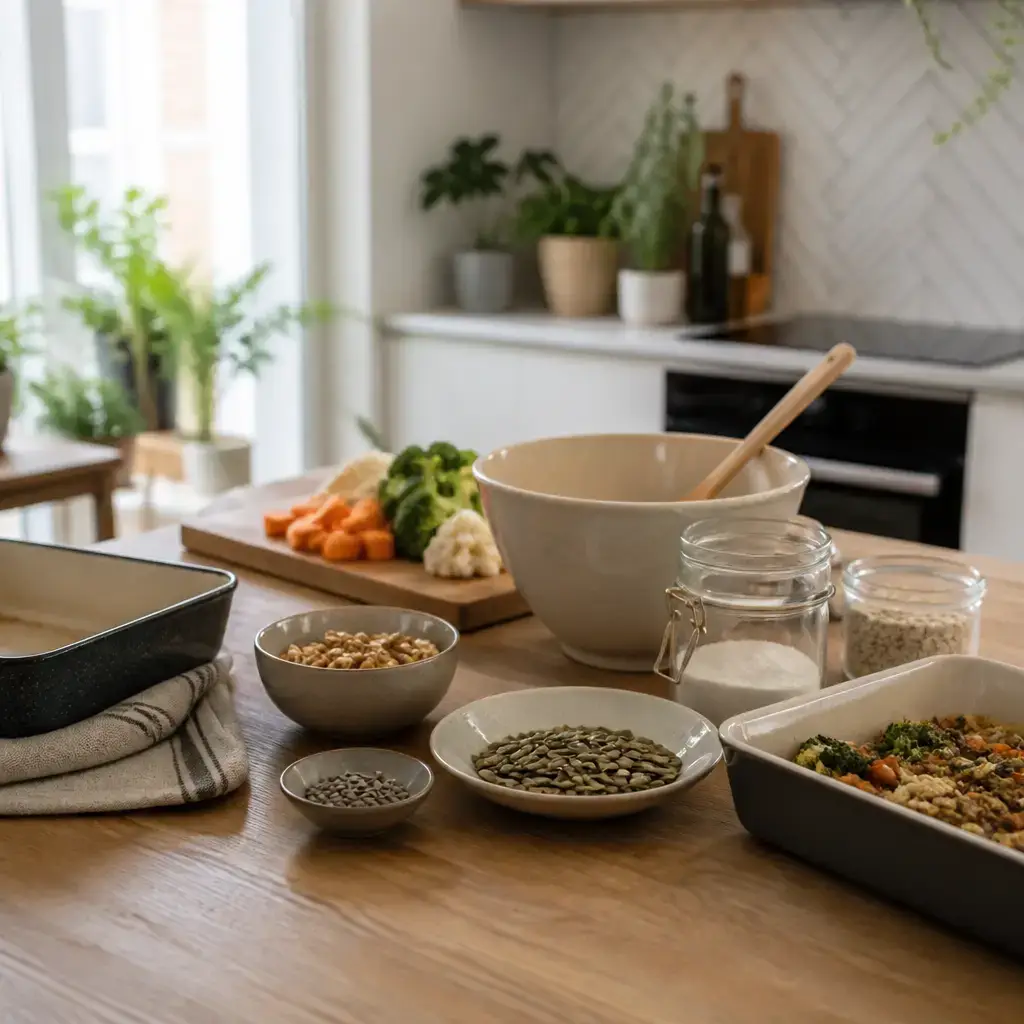
Bevor
"Bevor" means before and introduces the time condition for checking the ingredients. In "Bevor wir mit dem Kochen anfangen", it is useful when one action must happen before another.
wir
"wir" means we, referring to the people who are cooking together. In "wir ... anfangen" it is the group carrying out the action, so use it for a shared activity.
mit
In "mit dem Kochen anfangen", "mit" means with and introduces the activity that is being started. The reusable pattern is "mit ... anfangen" for starting an activity.
dem
In "mit dem Kochen", "dem" is the form of the definite article used after "mit". Together with "mit", it identifies the activity of cooking as what is being started.
Kochen
"Kochen" means cooking in "mit dem Kochen anfangen". Here the verb is used as the name of an activity, a common way to refer to starting or continuing cooking.
anfangen
"anfangen" means start in "mit dem Kochen anfangen". It is used with "mit" followed by the activity that is beginning, so the pattern is "mit etwas anfangen".
sollten
"sollten" expresses a recommendation: the speakers think they should check the ingredients. It is the form used with "wir" in "sollten wir ... prüfen", a useful pattern for suggesting a shared action.
die
In "die Zutaten", "die" means the and introduces the ingredients being checked. It is also used in "die möglichen Ersatzprodukte"-type noun phrases to identify specific plural or feminine nouns.
Zutaten
"Zutaten" means ingredients, the items needed for the recipe. In "die Zutaten prüfen", it is the object of the checking action, a useful pattern for discussing recipe preparation.
und
"und" means and and connects the ingredients with possible substitute products in the same check. Use it to join two related items or actions.
mögliche
"mögliche" means possible in "mögliche Ersatzprodukte", referring to substitutes that could be used. It comes directly before the noun it describes, as in this practical cooking phrase.
Ersatzprodukte
"Ersatzprodukte" means substitute products or replacement ingredients. In "mögliche Ersatzprodukte prüfen", it refers to alternatives considered when an original ingredient cannot be used.
prüfen
"prüfen" means check or examine in "die Zutaten und mögliche Ersatzprodukte prüfen". It follows "sollten" here, and the same infinitive can be used after modal expressions for checking something carefully.
Das
In "Das Rezept", "Das" means the and introduces the recipe being discussed. Its capital letter is required because it begins the sentence.
Rezept
"Rezept" means recipe, the set of cooking instructions that specifies the ingredients. In "Das Rezept sieht Walnüsse vor", it is the subject that specifies what is needed.
sieht
In "sieht Walnüsse vor", "sieht ... vor" means calls for or specifies; it does not mean simply sees. This separable-verb pattern is useful for saying what a recipe or plan requires.
Walnüsse
"Walnüsse" means walnuts, the ingredient named by the recipe. In "sieht Walnüsse vor", it is the ingredient that the recipe specifies.
vor
In "sieht Walnüsse vor", "vor" is the separated part of the expression "vorsehen" and helps give it the meaning calls for or specifies. Its meaning here comes from the whole expression "sieht ... vor".
ein
In "ein Gast", "ein" means a or one and introduces one particular guest. It is used directly before the noun in this statement about the guest's allergy.
Gast
"Gast" means guest, referring to one person attending the meal. In "ein Gast hat eine Nussallergie", it is the person whose condition affects the ingredient choice.
hat
"hat" means has in "ein Gast hat eine Nussallergie". It is used to state that someone has a condition or possession, followed by what the person has.
eine
In "eine Nussallergie", "eine" means a or one and introduces the allergy that the guest has. It comes before the feminine noun describing the condition.
Nussallergie
"Nussallergie" means nut allergy, the condition that makes walnuts unsafe for the guest. It is a compound noun combining the idea of nuts with an allergy.
Dann
"Dann" means then and presents the consequence of the guest's allergy. In "Dann sollten wir ...", it is useful for moving from a situation to the recommended response.
vollständig
"vollständig" means completely and emphasizes that the walnuts should be left out without exception. It modifies "weglassen" in "vollständig weglassen".
weglassen
"weglassen" means leave out or omit in "die Walnüsse vollständig weglassen". The reusable pattern is "etwas weglassen" when an ingredient or other item should not be included.
Geröstete
"Geröstete" means toasted or roasted in "Geröstete Samen". It describes the seeds directly before the noun and identifies how they have been prepared.
Samen
"Samen" means seeds, the proposed replacement for walnuts. In "Geröstete Samen würden ... geben", it is the ingredient that can add texture to the dish.
würden
"würden" presents a possible result: the toasted seeds would give the dish some crunch. In "würden ... geben", it is a useful way to describe what an option could provide.
Gericht
"Gericht" means dish, referring to the prepared food. In "dem Gericht ... geben", it is the food receiving the added texture.
trotzdem
"trotzdem" means still or nevertheless and shows that the seeds can add crunch despite leaving out the walnuts. Use it to connect an unexpected or continuing result with the previous situation.
etwas
"etwas" means some or a little in "etwas Biss". Here it indicates an unspecified amount of crunch or texture, a useful pattern before a substance or quality.
Biss
"Biss" means bite or crunch in the cooking expression "etwas Biss geben". Together, "dem Gericht etwas Biss geben" means to give the dish a crunchy texture.
geben
In "dem Gericht ... etwas Biss geben", "geben" means give or add, with the dish receiving the added quality. The pattern is "jemandem oder etwas etwas geben", with the thing added after the recipient.
Lass
"Lass" means let in "Lass uns ... verwenden" and introduces a suggestion to do something together. It is used with "uns" and an infinitive to propose a shared action.
uns
"uns" means us in "Lass uns stattdessen Samen verwenden". Together with "Lass", it identifies the people who should carry out the suggested action.
stattdessen
"stattdessen" means instead and marks seeds as the replacement for walnuts. It is useful when choosing one option in place of another.
verwenden
"verwenden" means use in "Samen verwenden". It follows "Lass uns" here, and the pattern "etwas verwenden" is useful for naming the ingredient or tool being used.
den
In "den Hinweis", "den" means the and introduces the specific note that should remain visible. It appears before the masculine object of "lassen" in this phrase.
Hinweis
"Hinweis" means note or notice, referring here to the written allergy information. In "den Hinweis auf die Allergie sichtbar lassen", it is the information being kept visible.
auf
In "der Hinweis auf die Allergie", "auf" means about or concerning and links the note to the allergy. The reusable pattern is "ein Hinweis auf etwas" for a note concerning something.
beim
"beim" means while or during the and is the contracted form used in "beim Kochen". It introduces the activity during which the allergy note should remain visible.
sichtbar
"sichtbar" means visible in "den Hinweis ... sichtbar lassen". With "lassen", it describes the state in which the note is to remain.
lassen
In "den Hinweis sichtbar lassen", "lassen" means leave or keep something in a stated condition. The pattern "etwas sichtbar lassen" is useful when an item must remain easy to see.
Da
"Da" means since or as and introduces the reason for following the measurements closely. In "Da es sich um ein gebackenes Gericht handelt", it starts a causal subordinate clause.
es
In "es sich um ein gebackenes Gericht handelt", "es" is part of the expression used to say what something is or concerns. Its meaning is tied to the whole construction "es handelt sich um".
sich
In "es sich um ein gebackenes Gericht handelt", "sich" is part of the reflexive expression "es handelt sich um". The complete expression means it is or it concerns, rather than describing a separate action by itself.
um
In "es handelt sich um ein gebackenes Gericht", "um" belongs to the construction "sich um etwas handeln", meaning to concern or be about something. Its contribution is understood together with the complete expression.
gebackenes
"gebackenes" means baked in "ein gebackenes Gericht" and describes the type of dish. It appears directly before "Gericht" as part of the noun phrase.
handelt
In "es handelt sich um ein gebackenes Gericht", "handelt sich um" means is or concerns. This fixed expression is useful for identifying what something is about.
genau
"genau" means exactly or closely in "sich genau an die Mengenangaben halten". It emphasizes careful adherence to the stated quantities.
an
In "sich an die Mengenangaben halten", "an" belongs to the pattern "sich an etwas halten", meaning adhere to or follow something. The complete construction is used for following instructions or rules.
Mengenangaben
"Mengenangaben" means measurements or quantity specifications, referring to the amounts listed in the recipe. In "sich an die Mengenangaben halten", these are the instructions being followed.
halten
In "sich an die Mengenangaben halten", "halten" contributes to the meaning follow or adhere to. The full reflexive pattern "sich an etwas halten" is important; the word does not mean simply hold here.
Haben
"Haben" means have in the question "Haben wir genug Milch?". It comes first because this is a yes-or-no question about whether the needed amount is available.
genug
"genug" means enough and expresses a sufficient quantity in "genug Milch". It can be placed directly before a noun to ask or state whether there is a sufficient amount.
Milch
"Milch" means milk, the ingredient whose quantity is being checked. In "genug Milch", it names the substance for which sufficiency is being considered.
oder
"oder" means or and presents the alternative question of buying more milk. Use it to connect two possible choices or situations.
soll
"soll" expresses should or am I supposed to in "soll ich mehr kaufen?". With "ich", it asks whether buying more is the appropriate next action.
ich
"ich" means I and identifies the speaker as the person who might buy more milk. In "soll ich ... kaufen?", it is the person being asked to take the action.
mehr
"mehr" means more and refers to an amount greater than what is already available. In "mehr kaufen", it specifies that the additional purchase would be of the same ingredient.
kaufen
"kaufen" means buy in "mehr kaufen". It follows "soll" as the action being considered, a common pattern for asking whether one should purchase something.
aber
"aber" means but and contrasts having enough milk with the need to check its date. It is useful for adding a condition or caution after an otherwise reassuring statement.
prüf
"prüf" means check and gives a direct instruction to one person in "prüf ... das Datum". It is the informal command form used when telling someone what to do.
der
In "vor der Verwendung", "der" means the and introduces the use of the milk as the time reference. Together with "vor", the phrase means before use.
Verwendung
"Verwendung" means use or usage in "vor der Verwendung". The phrase refers to the time before the ingredient is used, which is when the date should be checked.
Datum
"Datum" means date, referring here to the date printed on the milk. In "das Datum prüfen", it is the information that should be checked before use.
wirken
"wirken" means appear or seem in "Die Zutaten wirken ... sicher". It describes how the ingredients look or seem rather than making an absolute claim about them.
jetzt
"jetzt" means now and places the ingredients' safe and ready appearance at the current moment. It is useful for marking a change or status at the time of speaking.
sicher
"sicher" means safe in "sicher und bereit". Here it describes the apparent safety of the ingredients after the checks.
sind
"sind" means are in "sind bereit" and links the ingredients to their current state. It is the form used with the plural subject "Die Zutaten".
bereit
"bereit" means ready in "Die Zutaten ... sind bereit". It describes ingredients that are prepared and available for the next cooking step.
Diese
"Diese" means this in "Diese Kontrolle" and points to the check just described. It is placed directly before the noun to identify that specific check.
Kontrolle
"Kontrolle" means check or inspection, referring to the review of ingredients, substitutions, quantities, and dates. In "Diese Kontrolle sollte uns helfen", it is the action expected to reduce risks.
sollte
"sollte" expresses an expected or recommended benefit: the check should help avoid risks. It is used with "Diese Kontrolle" and the infinitive "helfen".
helfen
"helfen" means help in "sollte uns helfen". It is followed here by "zu vermeiden", giving the pattern "jemandem helfen, etwas zu tun".
Allergierisiken
"Allergierisiken" means allergy risks, the dangers the ingredient check is intended to prevent. In "Allergierisiken zu vermeiden", it is the risk being avoided.
zu
In "zu vermeiden", "zu" marks the infinitive used after "helfen". The phrase "helfen, etwas zu vermeiden" means help to avoid something.
vermeiden
"vermeiden" means avoid in "Allergierisiken zu vermeiden". It is used with the thing that should not occur or should be kept away from the cooking process.
dafür
In "dafür sorgen, dass ...", "dafür" refers to the result that should be ensured. Together, "dafür sorgen, dass" means make sure that something happens.
sorgen
In "dafür sorgen, dass das Gericht richtig schmeckt", "sorgen" contributes to the meaning make sure or ensure. The reusable construction is "dafür sorgen, dass" followed by the result to be achieved.
dass
"dass" means that and introduces the result clause after "dafür sorgen". It connects the act of ensuring with the desired outcome for the dish.
richtig
"richtig" means properly or right in "richtig schmeckt". It describes the desired way the dish should taste.
schmeckt
"schmeckt" means tastes in "dass das Gericht richtig schmeckt". It describes the taste of the dish, with "richtig" expressing that the result is as it should be.