Mein
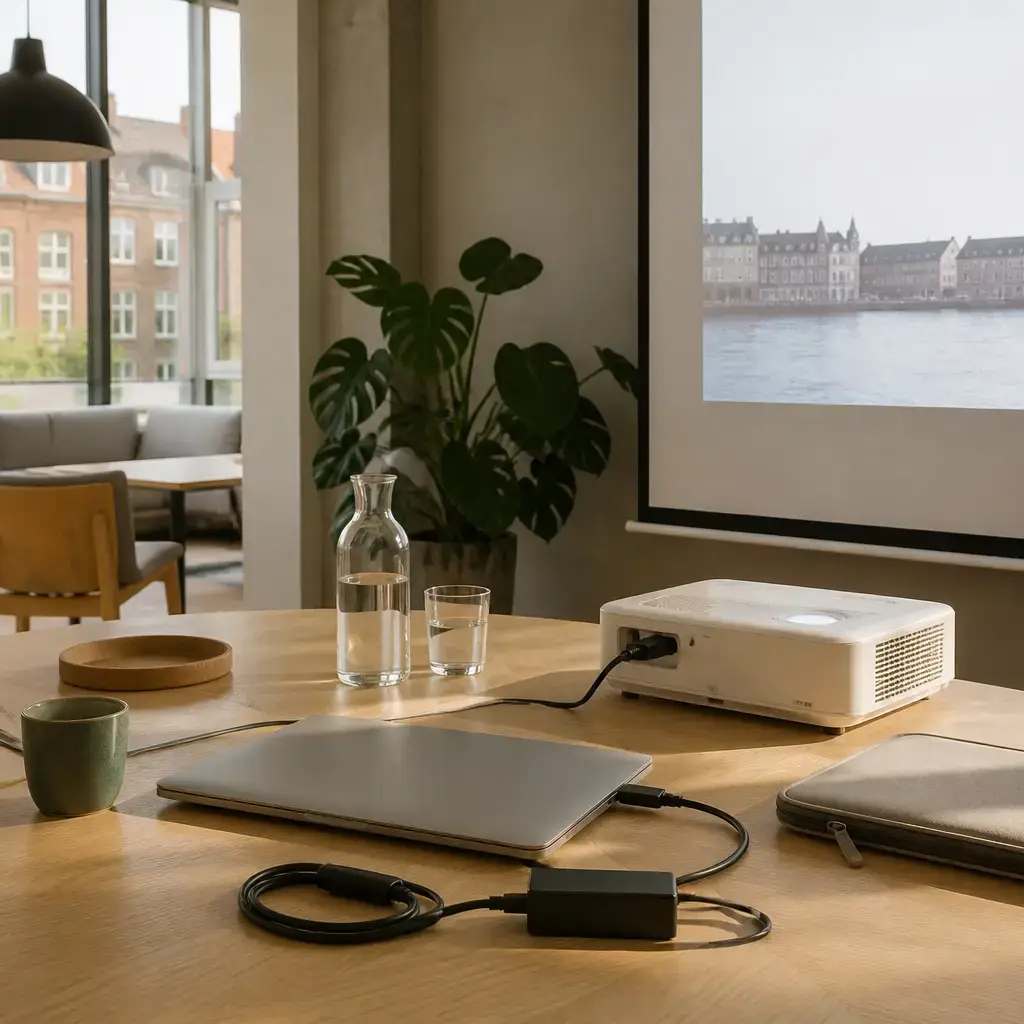
‘Mein’ means ‘my’ in ‘Mein Laptop-Adapter’ and identifies the adapter as belonging to the speaker. The citation form is mein; ‘Mein’ is capitalized here because it begins the sentence. Use it before a noun when identifying something as yours, for example with a personal item. You would use this when telling someone that your equipment is missing.
Laptop-Adapter
‘Laptop-Adapter’ means a laptop adapter, the device missing before the presentation. It is a compound noun made from Laptop and Adapter and is capitalized as a German noun. A reusable pattern is to name the device after a possessive word, as in ‘mein Laptop-Adapter’. You would use it when asking to borrow or return the equipment.
fehlt
‘Fehlt’ means ‘is missing’ in ‘Mein Laptop-Adapter fehlt’. It is the present form of fehlen used for something that is not available where it is needed. Use the pattern ‘[something] fehlt’ to say that an item is missing. You would use it when reporting that a cable, document, or other necessary object is not there.
und
‘Und’ connects ‘Mein Laptop-Adapter fehlt’ with ‘meine Präsentation beginnt bald’, adding another related fact. It corresponds to ‘and’ and joins words, phrases, or complete clauses. Use it to link two pieces of information in one statement. Here it connects the missing equipment with the approaching presentation.
meine
‘Meine’ means ‘my’ in ‘meine Präsentation’ and identifies the presentation as belonging to the speaker. The citation form is mein; ‘meine’ is the form used before this noun in the dialogue. Use a possessive word before a noun when stating ownership or association. You would use it when talking about your presentation, appointment, or document.
Präsentation
‘Präsentation’ means ‘presentation’, the event that is about to begin. It is a German noun and is capitalized. A useful pattern is ‘meine Präsentation’ when referring to your own presentation. You would use it when discussing a talk, business presentation, or class presentation.
beginnt
‘Beginnt’ means ‘starts’ in ‘meine Präsentation beginnt bald’. It is the present form of beginnen used for the scheduled start of the presentation. Use the pattern ‘[event] beginnt’ to say that an event starts. You would use it when giving someone information about an approaching meeting or event.
bald
‘Bald’ means ‘soon’ and shows that the presentation will start after only a short time. It is placed after the verb in ‘meine Präsentation beginnt bald’. Use it with an event or action that is expected in the near future. You would use it when warning someone that there is little time left.
Ich
‘Ich’ means ‘I’ and identifies the speaker as the subject of ‘Ich habe einen’. The citation form is ich; this occurrence is capitalized because it begins the sentence. Use it before a verb when saying what you yourself have, do, or plan. Here the speaker offers an adapter.
habe
‘Habe’ means ‘have’ in ‘Ich habe einen’ and says that the speaker possesses or has an adapter available. It is the first-person present form of haben. Use it before an object to say that you have something, as in ‘Ich habe einen’. You would use it when offering an available item to another person.
einen
‘Einen’ means ‘one’ here and stands for one adapter in ‘Ich habe einen’. It is the form of ein used for the masculine object represented by the omitted noun. Use a form like ‘Ich habe einen’ when the object is already clear from the conversation. Here it avoids repeating Laptop-Adapter.
den
‘Den’ refers back to the adapter in ‘einen, den du benutzen kannst’ and introduces the description ‘that you can use’. In this sentence it is a relative pronoun connecting the adapter with the following clause. Use it after a noun or pronoun when adding information about that item. Here the added information explains that the adapter is usable by the other person.
du
‘Du’ means ‘you’ and identifies the person who can use the adapter. It is the subject of ‘du benutzen kannst’ in the relative clause. Use it when speaking informally to one person. Here the speakers are addressing each other directly and informally.
benutzen
‘Benutzen’ means ‘use’ in ‘den du benutzen kannst’. It is the infinitive that names the action the other person can perform with the adapter. With a modal verb, the infinitive stays at the end of the clause. You would use it when talking about using equipment, software, or another object.
kannst
‘Kannst’ means ‘can’ in ‘du benutzen kannst’ and expresses that the other person is able or permitted to use the adapter. It is the second-person form of können, with the infinitive benutzen at the end. Use ‘du kannst’ followed by an infinitive to describe what one person can do. Here it gives the offer practical conditions.
Aber
‘Aber’ means ‘but’ and introduces a condition or qualification to the offer. It contrasts having an adapter with needing to check whether it works with the laptop. Use it at the beginning of a clause when adding an opposing or limiting point. Here it prepares the suggestion to test the connection.
lass
‘Lass’ means ‘let’ in ‘lass uns prüfen’ and forms a suggestion that the speakers check something together. It is the informal imperative form of lassen used with uns and an infinitive. Use ‘lass uns’ plus an infinitive to suggest a joint action. Here the suggestion is to check the adapter before relying on it.
uns
‘Uns’ means ‘us’ in ‘lass uns prüfen’ and refers to the speaker and the person being addressed together. It is the pronoun used in the shared-action suggestion with lass. Use the pattern ‘lass uns’ plus an infinitive when proposing that both people do something. Here both speakers will check the adapter.
prüfen
‘Prüfen’ means ‘check’ in ‘lass uns prüfen’ and names the action being suggested. It is an infinitive following the suggestion pattern ‘lass uns’. Use it with an object or clause when checking whether something is correct or works. Here the thing to check is whether the adapter functions with the laptop.
ob
‘Ob’ means ‘whether’ in ‘ob er mit deinem Laptop funktioniert’ and introduces the question being checked indirectly. It begins a subordinate clause, so the conjugated verb appears at the end. Use ‘ob’ when checking whether a condition is true. Here the condition is whether the adapter works with the laptop.
er
‘Er’ means ‘it’ in ‘ob er mit deinem Laptop funktioniert’ and refers to the masculine noun Laptop-Adapter. Although er can also mean ‘he’, the context makes the adapter the referent. Use a pronoun like er to avoid repeating a masculine noun. Here it is the thing whose compatibility is being checked.
mit
‘Mit’ means ‘with’ in ‘mit deinem Laptop’ and identifies the laptop that the adapter is being tested with. It introduces the accompanying or compatible item in this context. Use ‘mit’ before the person or thing involved in an action or compatibility relationship. Here the adapter is checked together with the learner’s laptop.
deinem
‘Deinem’ means ‘your’ in ‘deinem Laptop’ and identifies the laptop as belonging to the person addressed. It is the form of dein used in this phrase after mit. Use a possessive word before a noun to identify whose item is meant. Here it distinguishes the other person’s laptop from the speaker’s equipment.
Laptop
‘Laptop’ means ‘laptop’ in ‘deinem Laptop’. It names the computer with which the adapter must work. German uses this borrowed noun as a capitalized noun. You would use it when discussing a computer, its connection, or its accessories.
funktioniert
‘Funktioniert’ means ‘works’ in ‘er mit deinem Laptop funktioniert’ and says that the adapter operates correctly with the laptop. It is the present form of funktionieren, placed at the end of the ob-clause. Use it with a device or system when checking whether it operates properly. Here it describes the result the speakers need to verify.
passt
‘Passt’ means ‘fits’ in ‘Er passt in den Anschluss’ and says that the adapter fits into the port. It is the present form of passen. Use the pattern ‘etwas passt in etwas’ when describing physical fit or compatibility with an opening. Here the adapter fits into the laptop connection.
in
‘In’ means ‘into’ in ‘passt in den Anschluss’ and introduces the port that receives the adapter. With passen, it describes where the object fits. Use it with a destination or container when saying that something goes or fits inside it. Here it connects the adapter with the port.
Anschluss
‘Anschluss’ means ‘port’ or ‘connection’ in ‘den Anschluss’. It refers to the laptop connection into which the adapter fits. It is a capitalized German noun. You would use it when discussing a device port, a connection, or connecting equipment.
muss
‘Muss’ means ‘must’ or ‘need to’ in ‘Ich muss den Projektor noch testen’ and expresses the speaker’s necessity to test the projector. It is the first-person form of müssen and is followed by the infinitive testen. Use ‘ich muss’ plus an infinitive to state something you need to do. Here testing is still required before the presentation.
der
‘Der’ is the definite article in ‘der Projektor’ and marks the named projector as the subject of the following action. It means ‘the’ here and agrees with Projektor in this phrase. Use it before a specific masculine noun. Here it identifies the particular projector at the workspace.
Projektor
‘Projektor’ means ‘projector’, the device used to display the presentation. It is a capitalized German noun in ‘den Projektor’. A useful pattern is ‘den Projektor testen’ when checking presentation equipment. You would use it when preparing a talk or checking a visual display.
noch
‘Noch’ means ‘still’ in ‘Ich muss den Projektor noch testen’ and shows that the testing remains to be done. It is placed before the infinitive phrase that describes the remaining action. Use it when an expected task has not yet been completed. Here the adapter fits, but the projector still needs testing.
testen
‘Testen’ means ‘test’ in ‘den Projektor noch testen’ and names the remaining check. It is the infinitive after muss. Use it with a device or function when verifying that it works before use. Here the speaker tests the projector before starting the presentation.
Mach
‘Mach’ means ‘do’ in ‘Mach das jetzt’ and is a direct informal instruction to carry out the action immediately. It is the imperative form of machen. Use it with an object such as das when telling one person to perform a known action. Here the known action is testing the projector.
das
‘Das’ means ‘it’ or ‘that’ in ‘Mach das jetzt’ and refers to the testing action just mentioned. It is a pronoun here, not an article before a noun. Use it when the action or object is clear from the context. Here it stands for testing the projector.
jetzt
‘Jetzt’ means ‘now’ and makes the instruction immediate in ‘Mach das jetzt’. It is a time adverb placed after the object in this command. Use it when an action should happen at the current moment. Here the speaker wants the test completed before pressure increases.
kleine
‘Kleine’ means ‘small’ in ‘kleine Probleme’ and describes problems that may initially seem minor. It appears before the plural noun Probleme in the phrase. Use an adjective before a noun when describing its size or degree. Here it emphasizes that even minor technical issues can become more difficult.
Probleme
‘Probleme’ means ‘problems’ in ‘kleine Probleme’. It refers to technical difficulties that could interfere with the presentation. It is the plural form of Problem. You would use it when discussing faults, complications, or difficulties that need attention.
werden
‘Werden’ means ‘become’ or ‘get’ in ‘Probleme werden ... schwieriger’ and describes a change in the problems’ level of difficulty. It is the plural present form of werden, agreeing with Probleme. Use ‘werden’ with an adjective when something changes into a new state. Here the problems become harder under pressure.
unter
‘Unter’ means ‘under’ in ‘unter Druck’ and introduces the condition of pressure. The phrase describes the circumstances in which small problems become more difficult. Use it in expressions that describe being affected by a condition or influence. Here the condition is time or performance pressure.
Druck
‘Druck’ means ‘pressure’ in ‘unter Druck’. It refers to the stressful situation surrounding the upcoming presentation. It is a capitalized German noun. The reusable expression ‘unter Druck’ describes acting while stressed or hurried, as in this warning about technical problems.
schwieriger
‘Schwieriger’ means ‘harder’ or ‘more difficult’ in ‘werden ... schwieriger’. It compares the problems’ later difficulty with their earlier, smaller difficulty. It is the comparative form of schwierig. You would use it when saying that a task or situation becomes more difficult than before.
Bild
‘Bild’ means ‘image’ or ‘picture’ in ‘Das Bild wird richtig angezeigt’. In this scene it refers to the presentation image on the projected screen. It is a capitalized German noun. You would use it when checking what appears on a screen or display.
wird
‘Wird’ helps form the passive expression ‘wird richtig angezeigt’, meaning that the image is being displayed correctly. It is the singular present form of werden used with the participle angezeigt. Use this structure when focusing on what is displayed rather than on who displays it. Here the speaker reports the visible result of the projector test.
richtig
‘Richtig’ means ‘correctly’ in ‘wird richtig angezeigt’ and describes the way the image appears on the screen. It modifies the display action rather than naming the image itself. Use it when confirming that something is shown, connected, or done correctly. Here it confirms that the presentation image looks right.
angezeigt
‘Angezeigt’ means ‘displayed’ or ‘shown’ in ‘Das Bild wird richtig angezeigt’. It is the participle used with wird to describe what happens to the image. Use it with a screen, program, or device when information appears visibly. Here it describes the image appearing correctly through the projector.
also
‘Also’ means ‘so’ or ‘therefore’ in ‘also sind wir startklar’ and introduces the conclusion from the successful check. It connects the correct display with being ready to begin. Use it to state a consequence or conclusion. Here the working equipment means the speakers are ready.
sind
‘Sind’ means ‘are’ in ‘sind wir startklar’ and links the subject wir with the state startklar. It is the plural present form of sein. Use it with an adjective or status expression to describe a group’s current condition. Here it describes the speakers as ready.
wir
‘Wir’ means ‘we’ in ‘sind wir startklar’ and refers to the speaker and the person addressed together. It is the subject of the clause. Use it when describing a shared state or action involving yourself and others. Here both people are ready for the presentation.
startklar
‘Startklar’ means ‘ready to start’ in ‘wir startklar’ and says that everything is prepared for the presentation. It functions as a status description after sind. Use it when equipment, people, or a process is ready to begin. Here the successful screen test establishes that they can start.
Speichere
‘Speichere’ means ‘save’ or ‘store’ in ‘Speichere sicherheitshalber eine Kopie’. It is an informal imperative telling one person to save a copy. Use it with an object and a location when instructing someone to save digital information. Here the instruction concerns a backup of the presentation slides.
sicherheitshalber
‘Sicherheitshalber’ means ‘just in case’ or ‘as a precaution’ and explains why a backup copy should be saved. It modifies the whole instruction ‘Speichere ... eine Kopie’. Use it when recommending a preventive action against a possible problem. Here it prepares for a device or presentation failure.
eine
‘Eine’ means ‘a’ or ‘one’ in ‘eine Kopie’ and introduces one copy of the slides. It is the form used before the feminine noun Kopie in this phrase. Use it before a singular countable noun when referring to one non-specific item. Here it specifies the backup copy to be saved.
Kopie
‘Kopie’ means ‘copy’ in ‘eine Kopie deiner Folien’. It refers to a duplicate version of the presentation slides. It is a capitalized German noun. You would use it when talking about backups, duplicated documents, or saved versions.
deiner
‘Deiner’ means ‘your’ in ‘deiner Folien’ and identifies the slides as belonging to the person addressed. It is the form of dein used in this possessive phrase. Use it before a noun when specifying whose material is meant. Here it identifies the slides that should be copied.
Folien
‘Folien’ means ‘slides’ in ‘deiner Folien’ and refers to the presentation pages shown on the screen. It is the plural form of Folie. Use it when discussing presentation content, saving slides, or preparing a talk. Here the slides are the material that needs a backup copy.
auf
‘Auf’ means ‘on’ in ‘auf einem zweiten Gerät’ and identifies the device where the copy should be stored. With a stationary storage location, it is followed here by a form meaning ‘on a device’. Use it to name the surface or device on which something is placed or saved. Here it specifies the backup location.
einem
‘Einem’ means ‘a’ or ‘one’ in ‘einem zweiten Gerät’ and introduces the device used for storage. It is the form of ein used in this phrase after auf for a location. Use it before a singular noun when identifying one unspecified item in such a phrase. Here it refers to one additional device.
zweiten
‘Zweiten’ means ‘second’ in ‘einem zweiten Gerät’ and distinguishes the backup device from the first device. It appears before Gerät as part of the location phrase. Use it when numbering or distinguishing an additional item. Here the second device provides protection if the main device fails.
Gerät
‘Gerät’ means ‘device’ in ‘einem zweiten Gerät’. It refers to another piece of electronic equipment where the slide copy can be stored. It is a capitalized German noun. You would use it for a computer, tablet, or other electronic device without specifying the exact type.
werde
‘Werde’ means ‘will’ in ‘Ich werde eine Kopie ... speichern’ and introduces the speaker’s future plan. It is the first-person present form of werden used with the infinitive speichern at the end. Use ‘ich werde’ plus an infinitive to state a planned future action. Here the speaker accepts the backup recommendation.
anderen
‘Anderen’ means ‘another’ or ‘other’ in ‘einem anderen Gerät’ and identifies a device different from the one already being used. It appears before Gerät in the storage phrase. Use it when distinguishing one item from an earlier-mentioned item. Here it refers to an additional device for the copy.
speichern
‘Speichern’ means ‘save’ or ‘store’ in ‘eine Kopie ... speichern’. It is the infinitive completing werde and names the planned action. Use it with a file or copy and a location such as a device. Here the speaker plans to save the presentation copy before starting.
bevor
‘Bevor’ means ‘before’ in ‘bevor ich anfange’ and introduces the action that must happen later than saving the copy. It begins a subordinate clause, with the conjugated verb at the end. Use it to order two actions in time. Here saving happens before the presentation begins.
anfange
‘Anfange’ means ‘start’ or ‘begin’ in ‘bevor ich anfange’. It is the first-person form of the separable verb anfangen used at the end of the subordinate clause. Use it after a time word such as bevor when describing when you begin an activity. Here it refers to starting the presentation.
Könntest
‘Könntest’ means ‘could’ in ‘Könntest du den Adapter ... zurückbringen?’ and makes the request polite rather than presenting it as a direct command. It is the second-person form of können used in a conditional-style request. Use ‘Könntest du’ followed by an infinitive to ask one person politely to do something. Here the speaker asks for the adapter to be returned later.
Adapter
‘Adapter’ means ‘adapter’ in ‘den Adapter zurückbringen’. It refers back to the laptop adapter that was lent. It is a capitalized German noun. You would use it when asking someone to bring back, use, or connect the equipment.
nach
‘Nach’ means ‘after’ in ‘nach der Sitzung’ and places the return after the session. It introduces the later event used as a time reference. Use it before an event when saying that something happens afterward. Here the adapter should be returned once the session is over.
Sitzung
‘Sitzung’ means ‘session’ in ‘nach der Sitzung’. It refers to the meeting or presentation session taking place before the adapter is returned. It is a capitalized German noun. You would use it for a formal meeting, work session, or scheduled sitting.
zurückbringen
‘Zurückbringen’ means ‘bring back’ or ‘return’ in ‘den Adapter zurückbringen’. It is the infinitive completing the polite request introduced by Könntest. Use it with an object when asking someone to return something to its previous place or owner. Here the requested object is the borrowed adapter.
brauche
‘Brauche’ means ‘need’ in ‘Ich brauche ihn später’ and says that the speaker requires the adapter at a later time. It is the first-person present form of brauchen. Use ‘ich brauche’ followed by an object and often a time expression to state a need. Here the later need explains why the adapter should be returned.
ihn
‘Ihn’ means ‘it’ in ‘Ich brauche ihn später’ and refers to the masculine noun Adapter. It is the object of brauche. Use it to avoid repeating a masculine noun that is already clear from the conversation. Here it refers specifically to the borrowed adapter.
später
‘Später’ means ‘later’ in ‘Ich brauche ihn später’ and places the speaker’s need at a time after the current session. It is a time adverb. Use it when an action or need will occur at a later time without specifying exactly when. Here it explains the requested return time.
gebe
‘Gebe’ means ‘give’ in ‘Ich gebe ihn zurück’ and is part of the expression for giving the adapter back. It is the first-person form of geben. With zurück at the end, it describes returning something to another person or place. Here the speaker promises to return the adapter.
zurück
‘Zurück’ means ‘back’ in ‘gebe ihn zurück’ and completes the separable verb meaning ‘give back’. It is placed at the end of the main clause. Use it with a verb of giving or bringing when something is returned. Here it marks the adapter’s return to the person who lent it.
sobald
‘Sobald’ means ‘as soon as’ in ‘sobald die Sitzung endet’ and says that the return will happen immediately after the session ends. It introduces a subordinate time clause with the verb at the end. Use it to connect an action to the earliest point after another event. Here the session’s end triggers the return.
die
‘Die’ is the definite article in ‘die Sitzung’ and means ‘the’. It introduces the specific session that both speakers know about. Use it before a specific noun when referring to an identified event or thing. Here the session is the subject of the clause after sobald.
endet
‘Endet’ means ‘ends’ in ‘die Sitzung endet’. It is the present form of enden and describes when the session finishes. Use it with an event, meeting, or period that comes to an end. Here it provides the time condition for returning the adapter.
Dann
‘Dann’ means ‘then’ in ‘Dann musst du dir ... Gedanken machen’ and links the conclusion to the previous promise. It indicates the consequence that follows from returning the adapter. Use it at the beginning of a sentence to show what happens next or as a result. Here the completed return removes one concern.
musst
‘Musst’ means ‘must’ or ‘have to’ in ‘musst du dir ... Gedanken machen’ and expresses what the other person no longer needs to do. It is the second-person form of müssen and is followed by the infinitive machen at the end. Use ‘du musst’ plus an infinitive to describe an obligation or necessity. Here the sentence says the listener has one fewer worry.
dir
‘Dir’ refers to ‘you’ in ‘musst du dir um eine Sache weniger Gedanken machen’ and marks the person whose thoughts or worries are involved. It is used with the expression involving Gedanken machen, rather than directly naming the worried object. Use the appropriate pronoun with this pattern to say who has the concern. Here the concern belongs to the person addressed.
um
‘Um’ means ‘about’ in ‘um eine Sache weniger’ and introduces the matter that is the subject of concern. It is part of the pattern involving Gedanken machen. Use it before the thing someone is concerned about. Here that matter is one fewer thing.
Sache
‘Sache’ means ‘thing’ or ‘matter’ in ‘um eine Sache weniger’. It refers broadly to one practical concern connected with the presentation and equipment. It is a capitalized German noun. You would use it when referring to an unspecified matter or item in a general way.
weniger
‘Weniger’ means ‘less’ or ‘fewer’ in ‘eine Sache weniger’ and shows that the listener has one concern fewer than before. It modifies the quantity of Sache. Use it after a noun to express a reduced number or amount. Here returning the adapter removes one item from the list of things to worry about.
Gedanken
‘Gedanken’ means ‘thoughts’ in ‘sich um eine Sache weniger Gedanken machen’, and in this context it refers to worries or concerns. It is part of the expression with Gedanken machen; the whole expression conveys being concerned about something. Use it with the relevant person and topic when talking about worries. Here the returned adapter means one less concern.
machen
‘Machen’ means ‘make’ in its basic sense, but in ‘musst du dir um eine Sache weniger Gedanken machen’ it completes the expression for having thoughts or worries about something. It is the infinitive after musst. Use it with Gedanken and the person concerned when expressing that someone is worrying or thinking about a matter. Here the speaker says the listener will have one less worry.