Kann
“Kann” means “can” or “could” here and starts a polite request for permission in “Kann ich mir deine Bohrmaschine leihen”. It is the form of können used with ich in a question. You can reuse “Kann ich ...?” when asking whether you may do something, for example when borrowing an item.
ich
“ich” means “I” and is the person asking to borrow the drill in “Kann ich mir deine Bohrmaschine leihen”. It identifies the speaker as the subject of the question. This pronoun is used whenever the speaker refers to themself.
mir
“mir” means “to me” or “for myself” in the construction “mir ... leihen”, showing that the speaker wants to borrow the drill for themself. It is the dative form used with the reflexive borrowing construction. The pattern “sich etwas leihen” is useful when someone borrows something for themself.
deine
“deine” means “your” and describes the drill in “deine Bohrmaschine”. It is the possessive form used before this noun. Use it to identify something belonging to the person being addressed.
Bohrmaschine
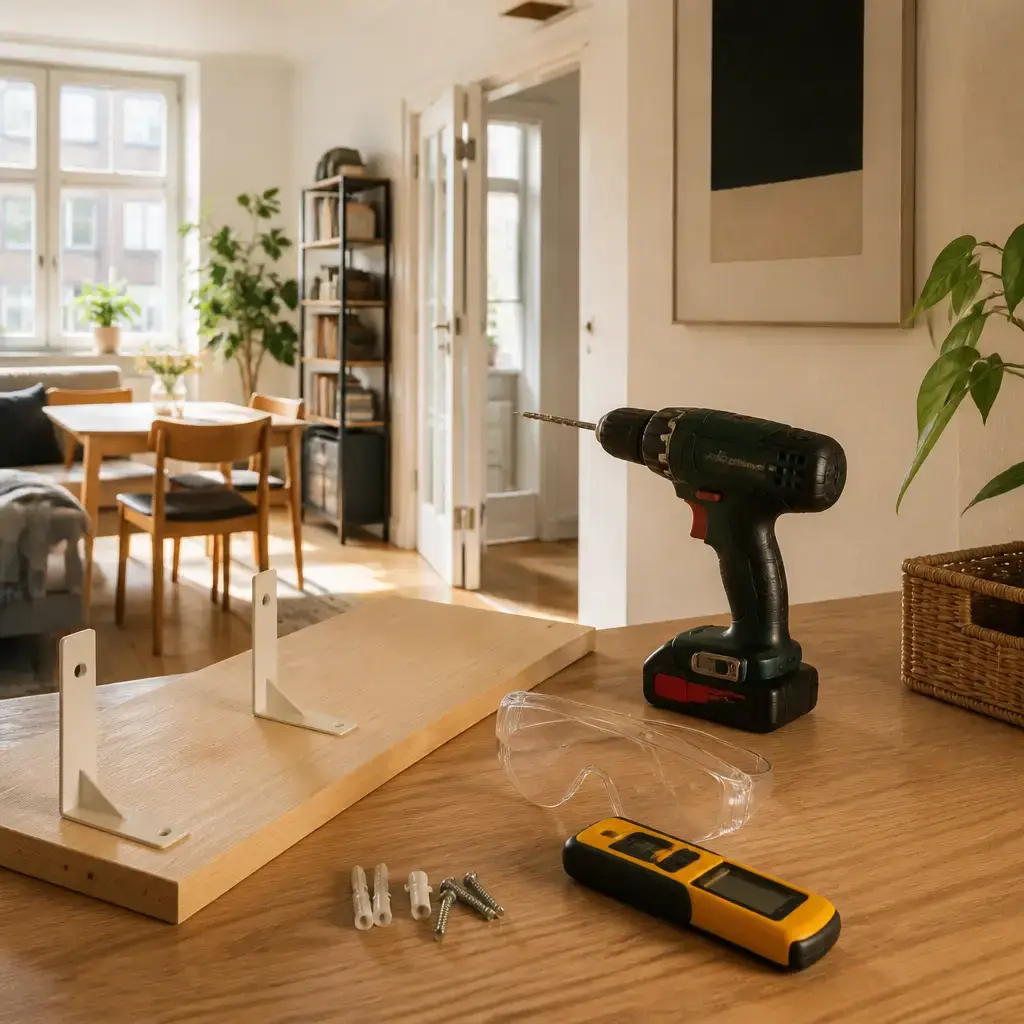
“Bohrmaschine” means “drill”, the tool that A wants to borrow. It is the object of “leihen” in “deine Bohrmaschine leihen”. This noun is useful when discussing drilling, repairs, or tools.
leihen
“leihen” means “to borrow” in “mir deine Bohrmaschine leihen”. With “mir”, the construction expresses borrowing something for oneself. The reusable pattern is “sich etwas leihen” when taking an item temporarily from another person.
um
“um” introduces the purpose of the borrowing in “um ein kleines Regal anzubringen”. Together with the following infinitive, it means “in order to”. Use “um ... zu” to explain the purpose of an action.
ein
“ein” means “a” in “ein kleines Regal”, introducing one unspecified shelf. It is the article used before the noun in this phrase. The same type of article introduces an unspecified object when its exact identity is not important.
kleines
“kleines” means “small” and describes the shelf in “ein kleines Regal”. Its form belongs to this noun phrase and matches “Regal”. Adjectives in similar phrases describe the size or other property of an object.
Regal
“Regal” means “shelf” here, specifically the shelf that A wants to put up. It is the object being attached in “ein kleines Regal anzubringen”. This noun is useful when talking about storage or furniture.
anzubringen
“anzubringen” means “to put up” or “to attach” in “um ein kleines Regal anzubringen”. It is the infinitive used after “um” to state the purpose. The pattern “um etwas anzubringen” can describe attaching another object for a practical purpose.
Das
“Das” means “that” or “it” in “Das kannst du”, referring to the requested borrowing rather than to a physical object. It makes the reply refer back to the previous request. This form can point back to something just mentioned when giving permission or confirmation.
kannst
“kannst” means “can” or “are allowed to” in “Das kannst du”. It is the form of können used with du and gives permission in this reply. The pattern “Das kannst du” can confirm that someone may do the action under discussion.
du
“du” means informal singular “you” and refers to the person who wants to borrow the drill. It is the subject in “Das kannst du”. Use it when addressing one person informally.
Hast
“Hast” means “have” in the question “Hast du schon einmal mit einer Bohrmaschine gearbeitet?”. It is the form of haben used to ask about the other person’s past experience. Questions with “Hast du ... gearbeitet?” ask whether someone has done something before.
schon
“schon” means “already” or, with “einmal”, “ever before” in “schon einmal”. It helps ask whether the experience has happened at any time up to now. The combination “schon einmal” is useful when asking about previous experience.
einmal
“einmal” means “once” in “schon einmal”, referring to one previous occasion. Together, “schon einmal” asks whether something has happened before. This combination is common when checking someone’s experience with an activity.
mit
“mit” means “with” in “mit einer Bohrmaschine gearbeitet”. It connects the action of working with the tool being discussed. Use “mit” when describing working with or using a tool or device.
einer
“einer” means “a” or “one” before “Bohrmaschine” in “mit einer Bohrmaschine”. Its form is used in this phrase after “mit”. The pattern “mit einer ...” introduces an unspecified tool or object used in an activity.
gearbeitet
“gearbeitet” means “worked” and, with “mit einer Bohrmaschine”, means worked with or used a drill. It is the participle of arbeiten used with “Hast” in the question. The pattern “mit etwas gearbeitet” describes practical experience with a tool or material.
Nur
“Nur” means “only” and limits the amount of experience in “Nur einmal”. It shows that A has used a drill on just one occasion. Use it before a quantity or time expression when limiting information.
daher
“daher” means “therefore” or “so” and connects the limited experience with the request for instructions. It shows that the need for help follows from having worked with a drill only once. This word can link a reason to its practical consequence.
würden
“würden” means “would” in “würden mir grundlegende Anweisungen helfen”. It presents the requested instructions as something that would be helpful, making the request less direct. The pattern “würden mir ... helfen” is useful when politely explaining what support would help.
grundlegende
“grundlegende” means “basic” or “fundamental” and describes the instructions in “grundlegende Anweisungen”. It specifies that A needs introductory guidance rather than advanced information. This adjective can describe simple essential guidance in a practical situation.
Anweisungen
“Anweisungen” means “instructions” in “grundlegende Anweisungen”. It refers to the guidance B can give before A uses the drill. The citation form is Anweisung; the dialogue form is its plural form. Use this noun for directions about how to do something.
helfen
“helfen” means “help” in “würden mir ... helfen”, where the instructions would be helpful to A. The person helped appears with “mir”, while the helpful thing is “Anweisungen”. The pattern “etwas hilft jemandem” is useful for describing what provides assistance.
Prüfe
“Prüfe” means “check” and gives a direct instruction in “Prüfe zuerst”. It is the imperative form of prüfen used when telling one person what to do. Use this form when giving someone a practical check to perform.
zuerst
“zuerst” means “first” and tells A to check the wall before doing the other safety steps. It places the action at the beginning of the sequence. This adverb is useful for ordering instructions.
was
“was” means “what” as part of the construction “was für eine Wand”. The whole construction asks what kind of wall it is, rather than asking about a separate object. Use “was für ...” when asking about the type or kind of something.
für
“für” contributes to the question “was für eine Wand”, which means “what kind of wall”. Here it is part of the fixed question pattern and does not mean that the wall is intended for something. This pattern is useful when asking someone to identify a type or category.
eine
“eine” means “a” or “one” in “was für eine Wand”, referring to one unspecified wall being identified. It introduces the noun “Wand” inside the question. Similar article forms introduce one unspecified item in a description or question.
Wand
“Wand” means “wall” in “was für eine Wand es sich handelt”. B wants A to identify the wall material or type before drilling. This noun is useful when discussing rooms, construction, or mounting something.
es
“es” is the formal “it” in the construction “es sich handelt”; it does not refer to a separate object here. The phrase “um was für eine Wand es sich handelt” asks what kind of wall it is. This form is used in this impersonal construction when identifying what something is.
sich
“sich” is the reflexive part of “es sich handelt” in “um was für eine Wand es sich handelt”. It belongs to the construction “sich handeln um” rather than adding a separate meaning by itself. The full construction is useful when asking what something concerns or what kind of thing it is.
handelt
“handelt” means “is” or “concerns” within “um was für eine Wand es sich handelt”. It is the form of handeln used with “es” in the construction “es handelt sich um”. Use that construction to identify or describe what something is about.
und
“und” means “and” and connects the instruction to check the wall with the instruction to wear safety glasses. It joins two actions in the same advice. Use it to link related instructions or actions.
trage
“trage” means “wear” in “trage eine Schutzbrille”. It is the imperative form of tragen, telling one person to put on and use the safety glasses. This form is useful in direct safety instructions about clothing or protective equipment.
Schutzbrille
“Schutzbrille” means “safety glasses” or “protective glasses”. It is the protective equipment B tells A to wear before drilling. This noun is useful when discussing eye protection during practical work.
mache
“mache” contributes to the expression “Ich mache mir Sorgen”, which means “I am worried” or “I have concerns”. It is the first-person form of machen, but the meaning here comes from the full construction with “mir” and “Sorgen”. Use “sich Sorgen machen” to express concern about a possible problem.
auch
“auch” means “also” and adds the concern about electrical wires to the other issues already being discussed. It signals that this is an additional worry. Use it to add another related fact or concern.
Sorgen
“Sorgen” means “worries” or “concerns” in “Ich mache mir auch Sorgen”. Together with “mir” and “mache”, the phrase says that A is worried. The citation form is Sorge; the dialogue form is plural. The pattern “sich Sorgen machen” is useful when expressing concern about a risk.
dass
“dass” means “that” and introduces the content of A’s worry in “dass ich elektrische Leitungen treffe”. It connects the concern with the possible event causing it. Use it to introduce a clause explaining what someone thinks, fears, or knows.
elektrische
“elektrische” means “electrical” and describes the wires in “elektrische Leitungen”. It identifies the type of lines that might be behind the wall. This adjective is useful when specifying equipment or wiring connected with electricity.
Leitungen
“Leitungen” means “wires” or “lines” in this context, specifically electrical wires inside or behind the wall. It is the object that A is afraid of hitting. The citation form is Leitung; the dialogue form is plural. Use this noun for wires or other lines that carry something such as electricity.
treffe
“treffe” means “hit” in “dass ich elektrische Leitungen treffe”. It is the first-person form of treffen inside the clause describing the feared result. The pattern “etwas treffen” is useful when saying that an action may hit a particular object.
Verwende
“Verwende” means “use” in “Verwende diesen Detektor”. It is an imperative telling one person to use the detector before drilling. This form is useful for direct instructions about using a tool or device.
diesen
“diesen” means “this” and points to the particular detector being offered in “diesen Detektor”. Its form belongs to the noun phrase with “Detektor”. Use it when identifying one specific nearby item.
Detektor
“Detektor” means “detector”, the device B recommends for checking for wires before drilling. It is the object of “Verwende”. This noun is useful when referring to a device that detects something without directly seeing it.
bevor
“bevor” means “before” and introduces the action that must happen first in “bevor du irgendwo bohrst”. It makes the safety check a condition before drilling. Use it to order one action before another.
irgendwo
“irgendwo” means “anywhere” in “bevor du irgendwo bohrst”. It makes the instruction apply to every possible drilling location, not just one named spot. Use it when the exact place is unspecified.
bohrst
“bohrst” means “drill” in “bevor du irgendwo bohrst”. It is the form of bohren used with du in the subordinate clause. The pattern “bevor du ... bohrst” can place a safety step before drilling.
werde
“werde” means “will” in “Ich werde die Stelle überprüfen”. It is the first-person form of werden used as a future auxiliary with “überprüfen”. The pattern “Ich werde ...” is useful for stating a planned action.
die
“die” means “the” in “die Stelle” and identifies the specific spot that A plans to inspect. It introduces a known or clearly selected place. Use this definite article when the listener can identify the item from the context.
Stelle
“Stelle” means “spot” or “place” in “die Stelle überprüfen”. It refers to the exact location where the holes may be marked and drilled. This noun is useful when discussing a particular position for an action.
überprüfen
“überprüfen” means “to check” or “to inspect” in “Ich werde die Stelle überprüfen”. It is the infinitive used after “werde” to state the planned inspection. The pattern “etwas überprüfen” is useful for checking a location, object, or detail.
Löcher
“Löcher” means “holes” in “die Löcher markiere”. These are the holes A plans to make in the wall. The citation form is Loch; the dialogue form is plural. This noun is useful when discussing drilling or openings in a surface.
markiere
“markiere” means “mark” in “bevor ich die Löcher markiere”. It is the first-person form of markieren and describes indicating the hole locations before drilling. The pattern “etwas markieren” is useful when marking positions or boundaries.
Bring
“Bring” means “bring” in “Bring die Bohrmaschine ... zurück”. It is an imperative telling one person to return the drill. Use this form when giving a direct instruction to bring an item somewhere.
bitte
“bitte” means “please” and softens the request “Bring ... zurück”. It signals that the instruction is polite rather than merely abrupt. Use it when making a courteous request.
zusammen
“zusammen” means “together” in “zusammen mit dem Ladegerät und den Bohrern”. It says that the drill should come back along with the charger and bits as one complete set. This word is useful when asking for several related items to be handled together.
dem
“dem” means “the” in “mit dem Ladegerät”, identifying the particular charger that belongs with the drill. Its form is used in this phrase after “mit”. Use the definite article to refer to a known item in a group of equipment.
Ladegerät
“Ladegerät” means “charger” in “mit dem Ladegerät”. It is one of the items B asks A to return with the drill. This noun is useful when discussing equipment used to recharge a device or tool.
den
“den” means “the” in “mit ... den Bohrern” and identifies the particular drill bits belonging with the equipment. Its form appears before the plural noun in this phrase after “mit”. Use it when referring to known items in the plural.
Bohrern
“Bohrern” means “drill bits” in “mit dem Ladegerät und den Bohrern”. It refers to the bits that should be returned together with the drill and charger. The citation form is Bohrer; the dialogue form is its plural form in this phrase. This noun is useful when discussing the interchangeable parts used for drilling.
zurück
“zurück” means “back” in “die Bohrmaschine ... zurück” and shows that the drill must be brought back to its owner. It contributes the return direction to the verb phrase. Use it with an action of bringing or giving something back.
Staub
“Staub” means “dust” in “den Staub abwischen”. It refers to the residue left on the drill after the work. This noun is useful when discussing cleaning after drilling or other dusty tasks.
abwischen
“abwischen” means “to wipe off” in “den Staub abwischen”. It describes removing the dust from the drill before returning it. The pattern “etwas abwischen” is useful for cleaning a surface or object.
sie
“sie” means “it” here and refers back to the feminine noun “Bohrmaschine” in “bevor ich sie zurückgebe”. It is the item A plans to return. This pronoun can refer back to a known feminine noun when avoiding repetition.
zurückgebe
“zurückgebe” means “return” or “give back” in “bevor ich sie zurückgebe”. It is the first-person form of zurückgeben inside the clause describing the planned return. The pattern “etwas zurückgeben” is useful when returning a borrowed item.
Lass
“Lass” means “let” in form, but in “Lass dir damit Zeit” the whole expression means “take your time”. It is the imperative form of lassen used as advice to proceed without rushing. This expression is useful when encouraging someone to work carefully.
dir
“dir” means “to you” or “for yourself” in “Lass dir damit Zeit”. It identifies the person who should allow themself enough time. The pattern “sich Zeit lassen” is useful when advising someone not to hurry.
damit
“damit” means “with it” in “Lass dir damit Zeit”, referring to the drilling task or the tool being used. It specifies what the person should take time with. Use it to refer back to an activity or object already understood from context.
Zeit
“Zeit” means “time” in the expression “Lass dir damit Zeit”. The full expression advises A to work slowly and carefully. This noun is useful in advice about allowing enough time for a task.
Sicherheit
“Sicherheit” means “safety” in “Sicherheit ist wichtiger als Schnelligkeit”. It names the priority that should guide the drilling work. This noun is useful when discussing avoiding danger or following protective measures.
ist
“ist” means “is” and links “Sicherheit” with the comparison “wichtiger als Schnelligkeit”. It is the form of sein used with the singular subject “Sicherheit”. Use it to state what something is or how it compares.
wichtiger
“wichtiger” means “more important” in “Sicherheit ist wichtiger als Schnelligkeit”. It compares the priority of safety with the priority of speed. The form comes from wichtig and is used before “als” in this comparison. Use the pattern “X ist wichtiger als Y” to state that one priority matters more than another.
als
“als” means “than” and introduces the second side of the comparison in “wichtiger als Schnelligkeit”. It connects safety with speed in the statement of priority. Use it after a comparative form when comparing two things.
Schnelligkeit
“Schnelligkeit” means “speed” in “Sicherheit ist wichtiger als Schnelligkeit”. It names the quality that should be less important than safety in this situation. This noun is useful when discussing how fast an action is performed.