Entschuldigung
Entschuldigung is used here to politely get someone’s attention before asking for help. It is a common way to begin a question to a staff member or stranger.
gibt
In gibt es, gibt asks whether something exists or is available, so the question means whether there is an accessible route. The reusable pattern is Gibt es ...? for asking whether something is available or present.
es
In gibt es, es is the placeholder referring to the thing whose existence is being asked about. Together with gibt, it forms the common question pattern Gibt es ...?
einen
einen introduces one specific route as the object of the question: einen barrierefreien Weg. This form is used before the masculine noun Weg in this expression.
barrierefreien
barrierefreien describes the route as accessible, meaning usable without barriers for someone who may need step-free access. Here it directly modifies Weg in einen barrierefreien Weg.
Weg
Weg means a way or route in this dialogue, specifically a route through the station. It is useful for asking about a route to a destination, as in einen Weg zum Bahnsteig.
zum
zum expresses movement or direction to the platform in zum richtigen Bahnsteig. It combines the meaning of to with the article used before Bahnsteig.
richtigen
richtigen identifies the platform as the correct one for the traveler’s train. It modifies Bahnsteig in zum richtigen Bahnsteig.
Bahnsteig
Bahnsteig means platform, the place where the traveler boards the train. It is used here after zum to name the destination of the route.
Der
Der introduces Aufzug as the subject of the sentence and means the. It is used here before the masculine noun Aufzug.
nächstgelegene
nächstgelegene identifies the elevator that is closest to the current location. It directly describes Aufzug in Der nächstgelegene Aufzug.
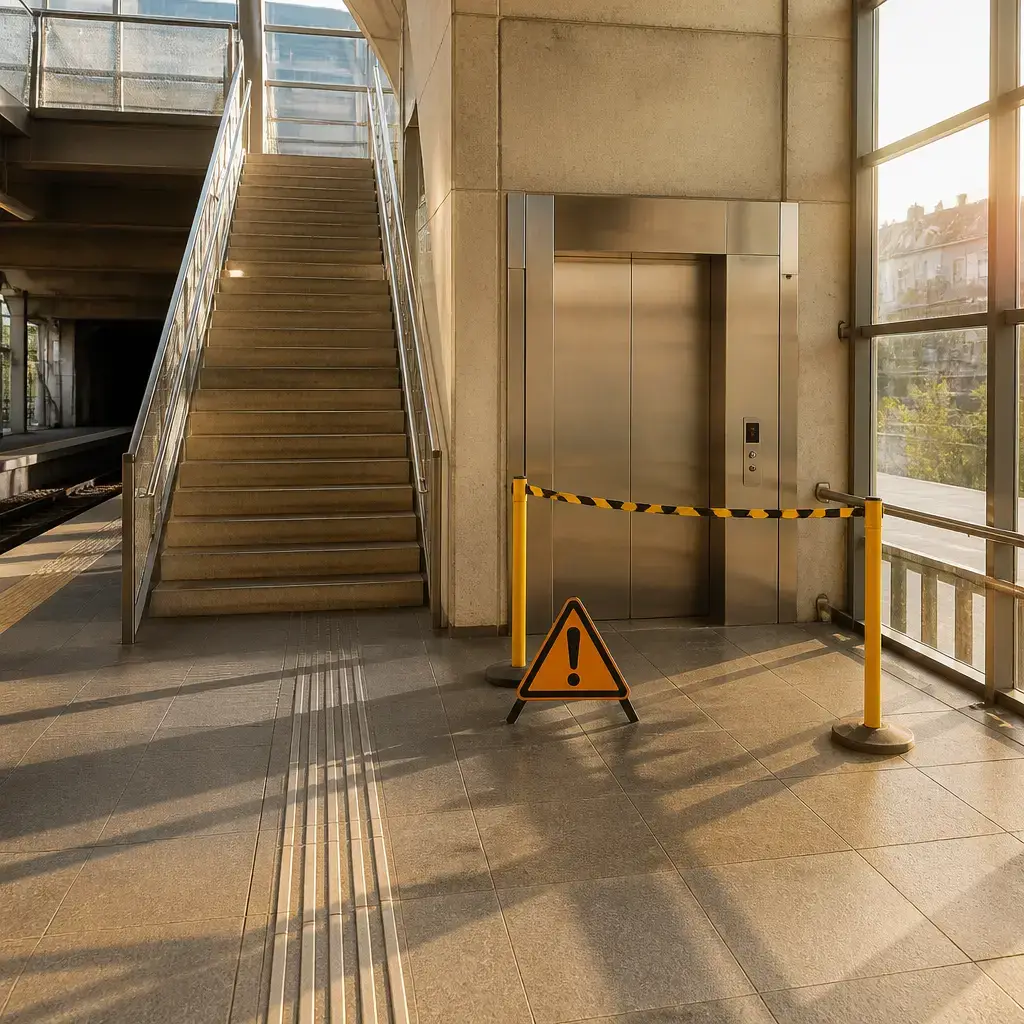
Aufzug
Aufzug means elevator, the facility that is unavailable because of maintenance. It is the subject in Der nächstgelegene Aufzug ist ... .
ist
ist links the elevator with its current condition, closed. The pattern ist geschlossen describes the present state of something.
gerade
gerade means currently or at the moment here, emphasizing that the elevator is closed now. It is placed before wegen Wartungsarbeiten geschlossen in the sentence.
wegen
wegen introduces the reason for the closure: Wartungsarbeiten. It is useful for explaining why a service or place is unavailable.
Wartungsarbeiten
Wartungsarbeiten means maintenance work, the reason the elevator is closed. It follows wegen to give the cause of the current problem.
geschlossen
geschlossen describes the elevator’s state as closed or not available for use. With ist, the expression ist geschlossen states that condition directly.
Das
Das refers back to the alternative route or situation just described and means that in Das könnte ... schwierig sein. It lets the speaker comment on the whole preceding suggestion.
könnte
könnte expresses a possibility: the route might be difficult with the suitcase. The pattern Das könnte ... sein is useful for making a cautious assessment.
mit
mit introduces the circumstance or thing involved in the difficulty, here the suitcase. The phrase mit meinem schweren Koffer means with my heavy suitcase.
meinem
meinem shows that the suitcase belongs to the speaker: meinem schweren Koffer. It is the possessive form used before Koffer in this phrase.
schweren
schweren describes the suitcase as heavy, explaining why the extra route may be difficult. It modifies Koffer in mit meinem schweren Koffer.
Koffer
Koffer means suitcase, the piece of luggage that makes the longer route difficult. It is used after mit to identify what the speaker is carrying.
schwierig
schwierig describes the alternative route as difficult for the speaker in this situation. It is completed by sein in Das könnte ... schwierig sein.
sein
sein completes the expression Das könnte ... schwierig sein and means be. It follows könnte in this statement about a possible difficulty.
Benutzen
Benutzen gives a direct instruction to use the alternative elevator. At the beginning of the sentence, it functions as a polite formal instruction to a traveler.
Sie
Sie addresses the traveler formally as you. It is used with the formal instruction Benutzen Sie ... and later in the staff member’s other instructions.
den
den introduces the specific elevator being recommended in den Aufzug. It means the before the masculine noun Aufzug in this instruction.
am
am locates the elevator at or by the north entrance in am nördlichen Eingang. It combines the meaning of at with the article used before Eingang.
nördlichen
nördlichen identifies the entrance as the northern one. It modifies Eingang in am nördlichen Eingang.
Eingang
Eingang means entrance, the location used to identify the alternative elevator. It appears in am nördlichen Eingang to specify where that elevator is.
bedeutet
bedeutet explains what using the alternative elevator involves: it means an additional short walk. The pattern Das bedeutet ... is useful for stating the consequence of a choice.
kurzen
kurzen describes the walk as short in einen kurzen Fußweg. It modifies Fußweg in the explanation of the route’s consequence.
Fußweg
Fußweg means a walk or walking distance. In Das bedeutet einen kurzen Fußweg, it describes the extra distance caused by using the alternative elevator.
Könnten
Könnten begins a polite request asking whether the staff member can help. The pattern Könnten Sie ...? is useful when making a courteous request to someone formally.
mir
mir identifies the person who would receive the help, the speaker. In mir die Richtung zeigen, it means to me and occurs with zeigen.
die
die introduces Richtung, the direction that the speaker is asking the staff member to show. It means the in die Richtung.
Richtung
Richtung means direction, here the direction toward the alternative elevator. It is used with zeigen in die Richtung zeigen.
zeigen
zeigen means show or point out in mir die Richtung zeigen. The reusable construction is to show someone a direction, with the person and the direction both stated.
oder
oder connects two alternatives in the question: asking for directions or following the signs independently. It means or and introduces the second possibility.
kann
kann asks whether the speaker is able to follow the signs easily. In kann ich ... folgen, it expresses ability or possibility.
ich
ich is the speaker who may follow the signs. It is the subject of kann ich den Schildern leicht folgen.
Schildern
Schildern means signs, specifically the station signs the traveler can use for navigation. It appears in den Schildern after folgen.
leicht
leicht means easily here and describes how the speaker may follow the signs. It is placed before folgen in kann ich den Schildern leicht folgen.
folgen
folgen means follow in relation to the station signs. The reusable pattern is den Schildern folgen, meaning to follow the signs.
Gehen
Gehen gives the formal instruction to go past the ticket machines. It begins a route instruction addressed to Sie.
an
In an den Fahrkartenautomaten vorbei, an contributes to the route expression meaning past the ticket machines. It works together with vorbei to describe passing a reference point.
Fahrkartenautomaten
Fahrkartenautomaten means ticket machines, the station objects the traveler should pass. It is the reference point in an den Fahrkartenautomaten vorbei.
vorbei
vorbei completes an ... vorbei and means past, telling the traveler to go beyond the ticket machines. This expression is useful for giving directions through a place.
und
und links the two route instructions: go past the machines and follow the signs. It means and and joins the actions in the same direction sequence.
dann
dann means then and shows that following the blue signs happens after passing the ticket machines. It is useful for ordering steps in directions.
blauen
blauen identifies the signs by their blue color. It modifies Schildern in den blauen Schildern.
Werde
Werde helps form a question about whether the speaker will reach the train in time. The pattern Werde ich ...? asks about a future result.
Zug
Zug means train, the vehicle the traveler is trying to catch. It is the destination object of erreichen in den Zug erreichen.
noch
noch means still here, asking whether the traveler will still be able to catch the train. It highlights that there may still be enough time despite the detour.
erreichen
erreichen means reach or catch in Werde ich den Zug noch erreichen. It is used with the destination object den Zug when asking whether someone will get to it in time.
bevor
bevor introduces the time condition that must come first: the train departing. It means before and starts the clause bevor er abfährt.
er
er refers back to Zug, which is treated as masculine in German. In bevor er abfährt, it is the subject that will depart.
abfährt
abfährt describes the train leaving or departing. It appears in the subordinate clause bevor er abfährt to state the deadline for reaching the train.
Wenn
Wenn introduces the condition for having enough time: the traveler must leave now. The pattern Wenn ..., ... is useful for stating what happens if a condition is met.
jetzt
jetzt means now and sets the time for leaving. In Wenn Sie jetzt losgehen, it makes immediate departure the condition.
losgehen
losgehen means set off or leave, referring to beginning the walk through the station. It follows Sie in the conditional clause Wenn Sie jetzt losgehen.
sollten
sollten expresses the staff member’s expectation that the traveler will have enough time. In sollten Sie dort ... haben, it gives a reassuring prediction or recommendation.
dort
dort means there and refers to the destination where the traveler needs to arrive. It is used before genug Zeit haben to describe having enough time there.
genug
genug means enough and describes the amount of time available. The reusable pattern genug Zeit haben means to have enough time.
Zeit
Zeit means time, specifically the time remaining before the train leaves. It appears in the common expression genug Zeit haben.
haben
haben means have in genug Zeit haben, referring to possessing or having enough available time. The same pattern can be used whenever someone has enough time for an activity.
mache
In mache mich auf den Weg, mache contributes to the expression meaning set off or head out. It is used with the reflexive word mich and auf den Weg, not as a literal reference to making an object.
mich
mich is part of the expression mache mich auf den Weg and refers back to the speaker. Together with mache and auf den Weg, it describes the speaker setting off.
auf
In auf den Weg, auf is part of the expression sich auf den Weg machen, meaning to set off or head out. It should be learned together with mache mich and den Weg in this sentence.
dorthin
dorthin means to that place or in that direction and points toward the elevator or route just mentioned. In mache mich ... dorthin, it states where the speaker is heading.
Fragen
Fragen gives the formal instruction to ask for help if necessary. It is used at the beginning of the sentence with Sie understood as the person receiving the instruction.
Personal
Personal means staff, referring to the people working at the access point. The phrase das Personal am Zugang identifies whom the traveler should ask.
Zugang
Zugang means access point or entrance in this station context. In am Zugang, it identifies the location where the relevant staff are stationed.
unterwegs
unterwegs means on the way, while the traveler is moving toward the platform. It is useful for describing something that happens during a journey or route.
Hilfe
Hilfe means help, the assistance the traveler may need during the route. The phrase Hilfe brauchen means to need help.
brauchen
brauchen means need in Hilfe brauchen, stating that assistance may be necessary. The reusable pattern is something brauchen, such as Hilfe brauchen for needing help.