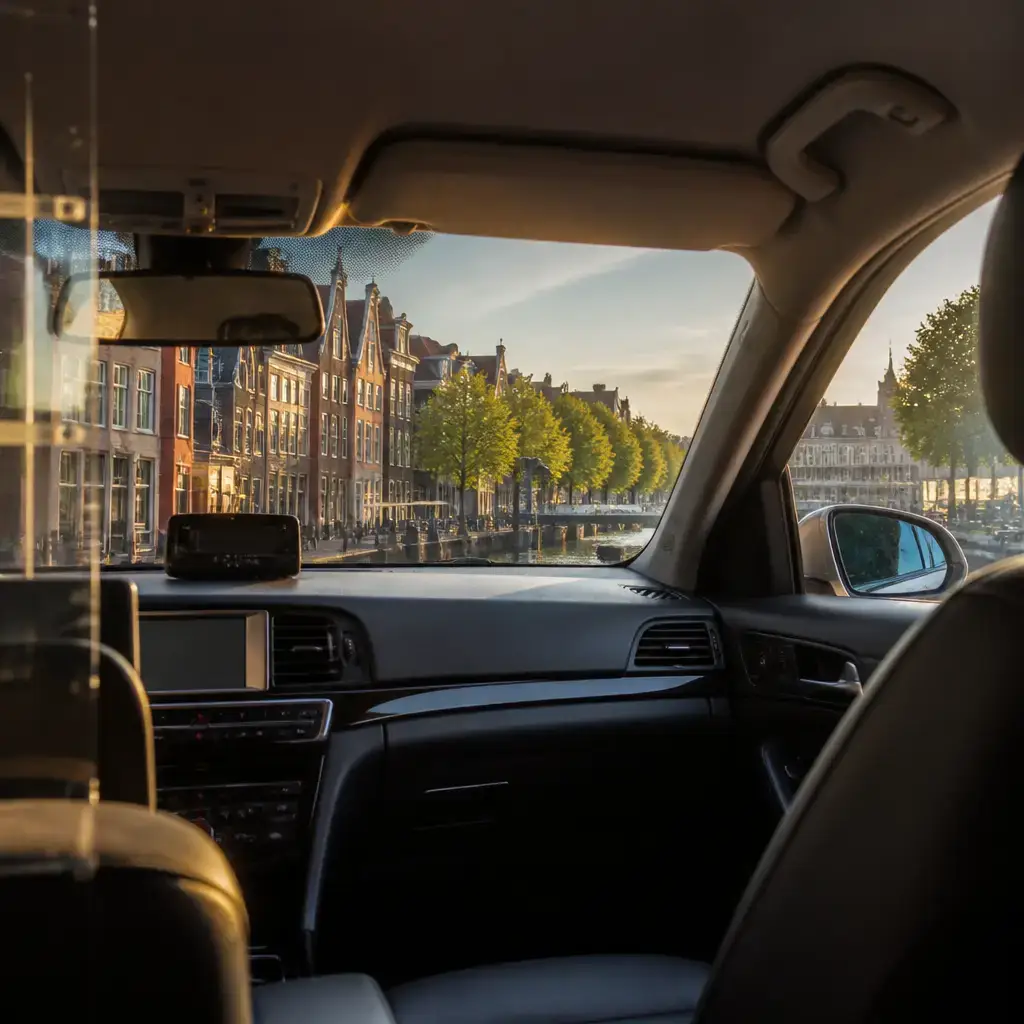
Entschuldigung
“Entschuldigung” means “excuse me” here and politely gets the taxi driver’s attention. Use it at the beginning of a polite question, as in “Entschuldigung, ...” when addressing someone you do not know.
fahren
In “fahren wir wegen des Verkehrs eine andere Strecke?”, “fahren” means travel or drive by vehicle. The reusable pattern is “Wir fahren ...”, with the route or destination added after the verb.
wir
“wir” means “we” and refers to the passenger and driver together in “fahren wir”. It is the subject of the question and commonly comes before or after the verb depending on sentence type.
wegen
“wegen” means “because of” and gives the reason in “wegen des Verkehrs”. Use it before the cause of a delay, change, or problem.
des
In “wegen des Verkehrs”, “des” is the form of “the” used with the following reason after “wegen”. The reusable phrase pattern is “wegen des ...” when giving a reason such as traffic.
Verkehrs
“Verkehrs” means traffic in “wegen des Verkehrs”. Its ending belongs to the form used after “wegen” in this expression; use “Verkehr” when referring to traffic as a cause of travel problems.
eine
“eine” means “a” in “eine andere Strecke”, referring to one route that is different from the expected route. Use it before a feminine noun in a phrase such as “eine Strecke”.
andere
“andere” means “different” or “other” in “eine andere Strecke”. It describes a route that is not the one expected, and it can be reused before a noun when choosing an alternative.
Strecke
“Strecke” means route or stretch of road in “eine andere Strecke”. Use it for the route being taken, as in “die Strecke erklären” when explaining a route.
Die
“Die” means “the” at the beginning of “Die Straße vor uns”. It introduces the specific road being discussed; the same written form appears as “die” before a feminine noun in other positions.
Straße
“Straße” means road or street in “Die Straße vor uns”. Use it for a road in a town or for the road ahead, often with a location phrase such as “vor uns”.
vor
In “vor uns”, “vor” means “in front of” or “ahead of”. Use the pattern “vor + person or group” to locate something ahead of them.
uns
“uns” means “us” in “vor uns”, referring to the passenger and driver together. It follows “vor” in this location expression and identifies the people in front of whom the road lies.
ist
“ist” means “is” in “Die Straße vor uns ist gesperrt”. It links the road with its current condition, and the pattern “etwas ist ...” describes a state or situation.
gesperrt
“gesperrt” means blocked or closed in “Die Straße vor uns ist gesperrt”. Use it for a road, entrance, or route that cannot currently be used.
deshalb
“deshalb” means “therefore” or “so” and connects the blocked road with the driver’s decision in “deshalb muss ich ...”. It commonly introduces a consequence of the previous statement.
muss
“muss” means “must” or “need to” in “muss ich einen Umweg fahren”. It expresses that the driver has no practical choice because the road is blocked; use it before an infinitive such as “fahren”.
ich
“ich” means “I” and identifies the speaker in “muss ich einen Umweg fahren” and “Ich habe gefragt”. It is used for the speaker as the subject of an action or statement.
einen
“einen” means “a” in “einen Umweg fahren”, referring to one detour. It is the form used before the masculine noun “Umweg” in this object expression.
Umweg
“Umweg” means detour in “einen Umweg fahren”. The reusable expression is “einen Umweg fahren” when a route must go around a blockage or other obstacle.
habe
In “Ich habe gefragt”, “habe” is the auxiliary form used to say that the speaker asked. It combines with “gefragt” to refer to a completed question, and the pattern is “Ich habe ...” followed by the completed action.
gefragt
“gefragt” means asked in “Ich habe gefragt”. Together with “habe”, it describes a completed act of asking; use it when explaining why you raised a question.
weil
“weil” means “because” and introduces the reason in “weil ich diese Gegend nicht kenne”. It introduces a reason clause, with the explanation following the main statement.
diese
“diese” means “this” in “diese Gegend” and points to the area currently around the speakers. It is used before the noun being identified, while the same form appears capitalized as “Diese” at the start of another sentence.
Gegend
“Gegend” means area or neighborhood in “diese Gegend”. Use it for a general part of a town or region, especially when saying whether you know the place.
nicht
“nicht” means “not” in “ich ... nicht kenne” and negates the speaker’s familiarity with the area. Place it with the verb or phrase that is being denied, as in “ich kenne ... nicht”.
kenne
“kenne” means know or recognize in “ich diese Gegend nicht kenne”. Here it refers to being familiar with the area; use it with a person or place that you know.
etwas
“etwas” means “a little” or “somewhat” in “etwas länger”. It softens the comparison and can be placed before an adjective to express a small degree.
länger
“länger” means longer in “Diese Strecke ist etwas länger”. It compares the duration or distance of this route with another route; use it after a subject with a comparison such as “etwas länger”.
aber
“aber” means “but” and introduces the positive consideration after the route is described as longer. Use it to connect two statements that qualify or balance each other.
so
In “aber so sollten wir weiterfahren können”, “so” means “this way” and refers to the route just described. Use it to point back to a way of doing something or a situation already mentioned.
sollten
“sollten” means “should” in “sollten wir weiterfahren können”, expressing an expected result rather than a firm guarantee. It is followed here by the infinitive construction “weiterfahren können”.
weiterfahren
“weiterfahren” means continue driving or continue traveling in “weiterfahren können”. It combines “weiter” with “fahren”; use it when a vehicle continues along its route.
können
“können” means “can” or “be able to” in “weiterfahren können”. It completes the modal construction and says that continuing to drive should be possible; use it after another verb when expressing ability or possibility.
Könnten
“Könnten” means “could” in the polite request “Könnten wir ... bleiben?”. It makes the passenger’s request less direct; use “Könnten wir ...?” when asking someone politely to do something.
wenn
“wenn” means “if” in “wenn möglich”. It introduces a condition, here allowing the request only when it can be done.
möglich
“möglich” means “possible” in “wenn möglich”. The expression “wenn möglich” is a practical way to add “if possible” to a polite request.
auf
In “auf größeren Straßen bleiben”, “auf” means “on” and indicates the roads on which the taxi should remain. The reusable pattern is “auf ... bleiben” for staying on a road, route, or other surface.
größeren
“größeren” means larger in “auf größeren Straßen”. It describes roads that are larger than the small side streets mentioned later; use it before the plural noun in this request.
Straßen
“Straßen” means roads or streets in “auf größeren Straßen”. The plural refers to several roads that the taxi may use, and the pattern “auf ... Straßen” describes traveling on roads.
bleiben
“bleiben” means stay or remain in “auf größeren Straßen bleiben”. Here it means continuing to use larger roads; use it after “auf” when saying where someone or something should remain.
Das
“Das” means “that” or “it” in “Das kann ich machen” and refers back to the passenger’s request. It can point back to an action or proposal that has just been mentioned.
kann
“kann” means “can” in “Das kann ich machen”. It says that the driver is able and willing to carry out the request; the reusable pattern is “Das kann ich machen” for accepting a proposed action.
machen
“machen” means “do” or “carry out” in “Das kann ich machen”. With “Das kann ich ...”, it refers to performing the action just requested rather than naming that action again.
ein
“ein” means “a” in “ein paar Minuten”. Together with “paar”, it introduces a small number of minutes; use the fixed pattern “ein paar” before a plural noun.
paar
In “ein paar Minuten”, “paar” means a few. The expression refers to a small, non-exact number and can be reused before a plural noun when the precise number is not important.
Minuten
“Minuten” means minutes in “ein paar Minuten länger dauern”. It measures the additional time, and the pattern “ein paar Minuten dauern” describes how long something takes.
dauern
“dauern” means take time or last in “ein paar Minuten länger dauern”. Here it describes the duration of the route; use it with a time expression such as “zehn Minuten dauern”.
dann
“dann” means “then” in “die Strecke ist dann leichter nachzuvollziehen”. It refers to the situation after choosing the larger roads and marks the resulting condition.
leichter
“leichter” means easier in “leichter nachzuvollziehen”. It describes a route that is easier to follow or understand; use it before an infinitive with “zu” when comparing how easy an action is.
nachzuvollziehen
“nachzuvollziehen” means to follow or understand in “die Strecke ist dann leichter nachzuvollziehen”. It is the “zu” form of “nachvollziehen”; the pattern “leichter nachzuvollziehen” describes something that is easier to understand.
passt
“passt” means “works” or “suits” in “Das passt”. The passenger uses it to accept the driver’s proposed arrangement; use “Das passt” when an option or plan is acceptable.
es
In “Ich habe es nicht eilig”, “es” is part of the fixed expression meaning “I am not in a hurry”. Keep it in the pattern “es eilig haben”, which describes urgency about leaving or arriving.
eilig
“eilig” means in a hurry in “Ich habe es nicht eilig”. With “nicht”, the expression says that the speaker is not pressed for time; use “es eilig haben” to talk about being in a hurry.
Ab
“Ab” means “from” or “starting at” in “Ab hier”. It marks the point from which the driver’s new route choice applies; use “ab” with a place or time to mark a starting point.
hier
“hier” means “here” in “Ab hier”. Together, “Ab hier” means from this point onward and can be used when a change begins at the speaker’s current location.
werde
In “werde ich ... vermeiden”, “werde” helps express the driver’s future plan to avoid the side streets. The pattern is “werde ... vermeiden”, with the infinitive at the end.
kleinen
“kleinen” means small in “die kleinen Nebenstraßen”. It describes the side streets the driver plans to avoid; use it before the plural noun in this phrase.
Nebenstraßen
“Nebenstraßen” means side streets in “die kleinen Nebenstraßen”. It refers to smaller streets away from the main roads, and the phrase can be used when discussing route choices in a town.
vermeiden
“vermeiden” means avoid in “werde ich die kleinen Nebenstraßen vermeiden”. It expresses deliberately not using something; use it with the thing being avoided, such as a road or problem.
weiß
In “Ich weiß es zu schätzen”, “weiß” contributes to the fixed expression meaning “I appreciate it”. Use the pattern “etwas zu schätzen wissen” when expressing gratitude or appreciation.
zu
In “zu schätzen”, “zu” marks the infinitive used inside the expression “etwas zu schätzen wissen”. It belongs with “schätzen” here and should be kept when reusing this appreciation pattern.
schätzen
In “Ich weiß es zu schätzen”, “schätzen” means appreciate or value rather than estimate. The complete pattern is “Ich weiß es zu schätzen, dass ...” when thanking someone for an action.
dass
“dass” means “that” and introduces the action appreciated in “dass Sie mir die Strecke erklären”. It connects the expression of appreciation with a full clause.
Sie
“Sie” means formal “you” in “dass Sie mir die Strecke erklären”. It addresses the taxi driver respectfully; use capitalized “Sie” when speaking formally to one or more people.
mir
“mir” means “to me” in “Sie mir die Strecke erklären”. It identifies the person receiving the explanation; use it with verbs such as “erklären” when saying who receives information.
erklären
“erklären” means explain in “Sie mir die Strecke erklären”. The reusable pattern is “jemandem etwas erklären”, with the person receiving the explanation before the thing explained.
sage
“sage” means say or tell in “Ich sage Ihnen Bescheid”. Here it is part of the expression for notifying someone; use “jemandem Bescheid sagen” when promising to provide an update.
Ihnen
“Ihnen” means “to you” in the formal expression “Ich sage Ihnen Bescheid”. It identifies the person who will receive the information and is capitalized for formal address.
Bescheid
In “Ich sage Ihnen Bescheid”, “Bescheid” refers to notice or an update. The fixed expression “jemandem Bescheid sagen” means to let someone know about something.
noch
In “noch einmal”, “noch” contributes the meaning “again” or “once more”. The fixed combination “noch einmal” is used when an action happens one more time.
einmal
In “noch einmal”, “einmal” means “once”, and the whole expression means again. Use “noch einmal” when asking for or describing a repeated action.
ändern
“ändern” means change in “sie noch einmal ändern”. It describes changing the route again; use it with the thing being changed, such as “die Strecke ändern”.