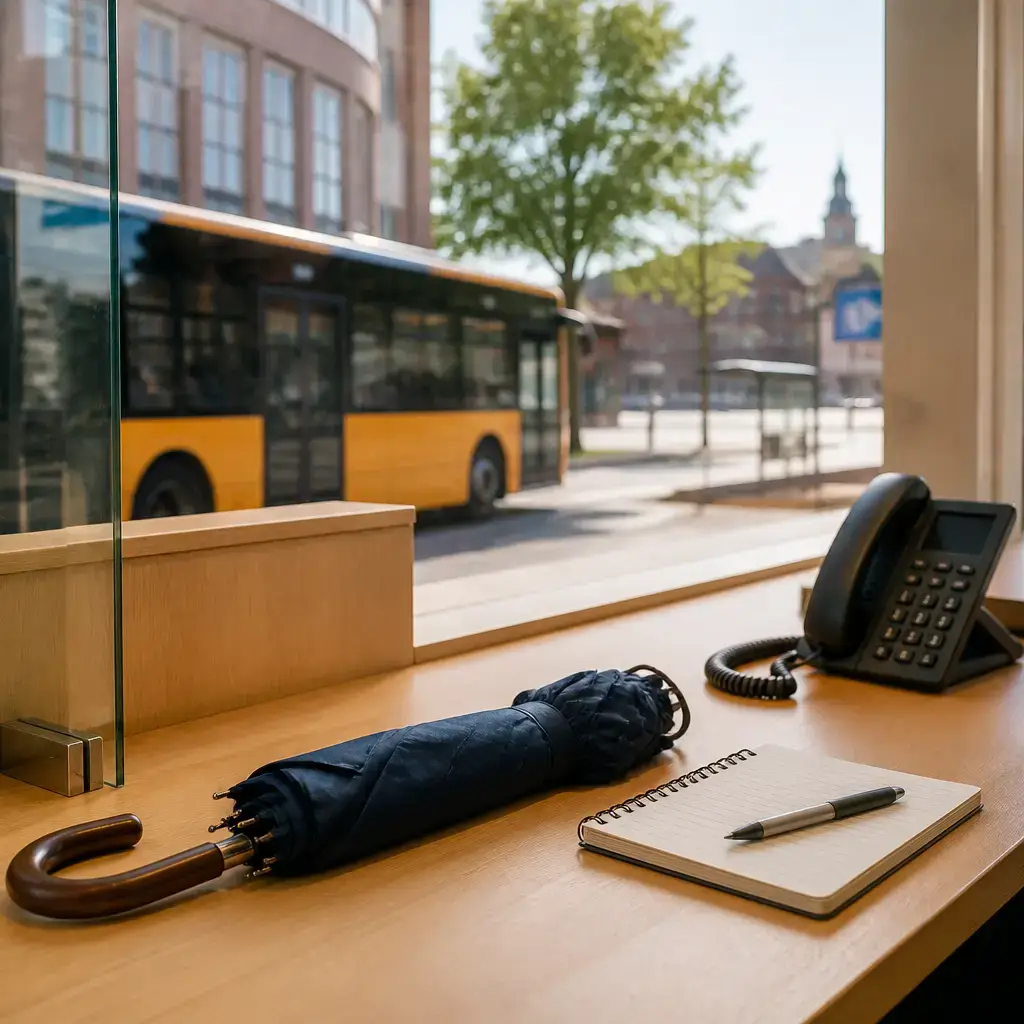
Ich
“Ich” is the speaker’s “I” in “Ich habe meinen Regenschirm ... liegen lassen.” It identifies the person who left the umbrella and is also used as the subject in “Ich reiche das Formular ... ein.”
habe
In “Ich habe ... liegen lassen”, “habe” is the auxiliary that helps describe a completed action. A useful pattern is “Ich habe ... gemacht” for something you have done.
meinen
“Meinen” means “my” before the umbrella in “meinen Regenschirm.” Its form agrees with the masculine object in this phrase; a useful pattern is “meinen” plus a masculine noun.
Regenschirm
“Regenschirm” is the umbrella being reported as left on the bus. It is the main object in “meinen Regenschirm” and is referred to later by “Er” and “ihn.”
heute
“Heute” means “today” in “heute Morgen”, locating the event on the current day. The common time expression is “heute” plus a time of day.
Morgen
Capitalized “Morgen” means “morning” in “heute Morgen.” The same written sequence appears as lowercase “morgen” in “morgen noch einmal”, where it means “tomorrow”; capitalization distinguishes the noun from the time adverb.
im
“Im” means “in the” in “im Bus”, describing where the umbrella was left. It is the contracted form of “in dem”; the reusable pattern is “im” plus a place.
Bus
“Bus” names the vehicle where the umbrella was left and where it had been during the morning rush. It appears with “im” in “im Bus” and with “dem” in “in dem Bus.”
liegen
In “liegen lassen”, “liegen” contributes the idea that the umbrella was lying or remained in place. Together with “lassen”, the phrase describes leaving something behind; a useful pattern is “etwas liegen lassen.”
lassen
In “liegen lassen”, “lassen” contributes the meaning of leaving something behind while it remains lying there. The complete reusable construction is “etwas liegen lassen”, rather than “lassen” alone for this meaning.
Du
“Du” addresses one person directly in “Du solltest ...”. It is the informal singular form of “you” used when giving the passenger advice.
solltest
“Solltest” gives advice in “Du solltest ... eine Verlustmeldung aufgeben”: you should file a report. A useful pattern is “Du solltest” followed by an infinitive, such as “Du solltest ... aufgeben.”
mit
“Mit” means “with” in “mit den Angaben zur Fahrt”, showing what information should accompany the report. It is commonly followed by a noun phrase, as in “mit den Angaben.”
den
In “mit den Angaben”, “den” is the article used with the plural information details after “mit.” The useful pattern is the preposition “mit” followed by “den” and a plural noun.
Angaben
“Angaben” means the details or information supplied for the trip in “den Angaben zur Fahrt.” It is useful for describing information provided for a form, report, or request.
zur
“Zur” means “to the” in “zur Fahrt”, linking the details to the trip. It is the contracted form of “zu der”; the reusable pattern is “Angaben zur” followed by the topic of the details.
Fahrt
“Fahrt” refers to the passenger’s bus trip in “Angaben zur Fahrt.” It is used here to identify which journey the report concerns.
eine
In “eine Verlustmeldung”, “eine” marks one report that should be filed. The same form begins “Eine genaue Beschreibung”, where it introduces one specific description; it is used before these feminine nouns.
Verlustmeldung
“Verlustmeldung” is the lost-item report the passenger should file. The practical expression in this scene is “eine Verlustmeldung aufgeben.”
aufgeben
“Aufgeben” means file or submit in “eine Verlustmeldung aufgeben.” It is used after “solltest” as an infinitive, and the same verb can be reused with a form or report that someone submits.
Er
“Er” refers back to the masculine noun “Regenschirm” in “Er war in dem Bus.” It means “it” here because the umbrella is grammatically masculine in German.
war
“War” says that the umbrella was in the bus in “Er war in dem Bus.” It describes the umbrella’s past location; a useful pattern is “war in” followed by a place.
in
“In” means “in” in “in dem Bus”, locating the umbrella inside the bus. With a fixed location, the reusable pattern is “in” plus a place.
dem
“Dem” means “the” in “in dem Bus.” Here it follows “in” for a fixed location and is the form used with the masculine noun “Bus.”
der
“Der” introduces the bus in the relative clause “der während des morgendlichen Berufsverkehrs hier gehalten hat.” It refers back to “dem Bus” and makes that bus the one that stopped here.
während
“Während” means “during” in “während des morgendlichen Berufsverkehrs”, locating the bus’s stop within the morning rush. A useful pattern is “während” plus the time or event that is in progress.
des
“Des” means “of the” in “des morgendlichen Berufsverkehrs.” It links the time phrase to “Berufsverkehrs” in the expression for the morning rush.
morgendlichen
“Morgendlichen” describes the Berufsverkehr as taking place in the morning in “morgendlichen Berufsverkehrs.” It is an adjective placed before the noun it describes.
Berufsverkehrs
“Berufsverkehrs” refers to rush-hour traffic associated with people commuting to work. In “während des morgendlichen Berufsverkehrs”, it gives the time context for the bus’s stop.
hier
“Hier” means “here” in “der ... hier gehalten hat”, referring to the transport service point where the speaker and staff are. It is a useful adverb for identifying the current location.
gehalten
“Gehalten” means “stopped” in “hier gehalten hat”, describing what the bus did at this place. It appears with “hat” in the completed-action expression “gehalten hat.”
hat
In “der ... gehalten hat”, “hat” is the auxiliary used with “gehalten” to describe the bus’s completed stop. A useful pattern is “hat” plus a past participle at the end of a subordinate clause.
Kannst
“Kannst” asks whether the passenger is able to do something in “Kannst du den Regenschirm genau beschreiben?” It is used with “du” and an infinitive, here “beschreiben.”
genau
“Genau” means clearly or precisely in “den Regenschirm genau beschreiben”, asking for an exact description. It can be placed before the infinitive phrase to specify how an action should be done.
beschreiben
“Beschreiben” means describe in “den Regenschirm genau beschreiben.” It is used with the thing being described as its object; the reusable pattern is “etwas genau beschreiben.”
ist
“Ist” describes the umbrella’s characteristics in “Er ist dunkelblau, zusammengeklappt ...”. It links “Er” to the color and condition being reported.
dunkelblau
“Dunkelblau” describes the umbrella as dark or navy blue in “Er ist dunkelblau.” It is a practical color description when identifying a lost item.
zusammengeklappt
“Zusammengeklappt” describes the umbrella as folded in “Er ist ... zusammengeklappt.” It gives the item’s physical condition and can be used as a concise identifying detail.
und
“Und” connects details in “dunkelblau, zusammengeklappt und hat einen Holzgriff.” It joins the umbrella’s color, condition, and handle information in one description.
einen
In “einen Holzgriff”, “einen” introduces the handle as one masculine object. Its form is used before the masculine noun “Holzgriff” in this object phrase.
Holzgriff
“Holzgriff” means a wooden handle in “hat einen Holzgriff.” It provides a specific physical detail that can help staff identify the umbrella.
Füge
“Füge” tells one person to add something in “Füge eine Telefonnummer hinzu.” It is the direct instruction used when completing the lost-item report.
Telefonnummer
“Telefonnummer” is the phone number the passenger should provide so staff can make contact. The useful construction is “eine Telefonnummer hinzufügen.”
hinzu
In “Füge ... hinzu”, “hinzu” completes the separable verb “hinzufügen” and contributes the idea of adding something to what is already there. The reusable pattern is “etwas hinzufügen.”
damit
“Damit” introduces the purpose of adding the phone number: “damit das Personal dich kontaktieren kann.” It is followed by a clause whose verb appears at the end.
das
In “damit das Personal ...”, “das” is the article before “Personal.” In “Das hängt davon ab”, the capitalized “Das” means “that” or “it” as the subject of the statement; the dialogue uses both functions.
Personal
“Personal” refers to the staff who handle the lost-item report in “das Personal dich kontaktieren kann.” It is the group expected to contact the passenger if the umbrella is found.
dich
“Dich” means “you” as the person staff can contact in “dich kontaktieren.” It is the object of “kontaktieren”; a useful pattern is “jemanden kontaktieren.”
kontaktieren
“Kontaktieren” means contact in “das Personal dich kontaktieren kann.” It is used with the person being contacted as its object, here “dich.”
kann
“Kann” expresses the staff’s ability or possibility to contact the passenger in “kontaktieren kann.” In a subordinate clause with “damit”, it appears after the infinitive “kontaktieren.”
falls
“Falls” introduces the condition “falls er gefunden wird”: if the umbrella is found. It is useful for stating a possible condition and places the clause’s finite verb at the end.
gefunden
“Gefunden” means found in “falls er gefunden wird.” Together with “wird”, it describes the umbrella as the item that may be found rather than the person who finds it.
wird
In “er gefunden wird”, “wird” helps form the passive expression meaning “is found.” The person or thing affected comes before this verb, here “er” for the umbrella.
Wie
“Wie” begins the question “Wie lange dauert es normalerweise ...?”, asking about the extent of time. The reusable question pattern is “Wie lange” plus a verb.
lange
“Lange” completes “Wie lange” and asks how much time something takes. It is used with “dauert” in the question about receiving a response.
dauert
“Dauert” asks how much time the process takes in “Wie lange dauert es ...?” It is commonly used with “es” and a duration question beginning with “Wie lange.”
es
In “Wie lange dauert es ...?”, “es” is the subject used for the process or waiting time. The pattern “Wie lange dauert es, bis ...?” asks how long it takes until something happens.
normalerweise
“Normalerweise” means usually or normally in “dauert es normalerweise.” It qualifies the expected time rather than describing one guaranteed result.
bis
“Bis” introduces the point up to which the waiting continues in “bis ich eine Rückmeldung bekomme.” The useful pattern is “bis” followed by the event that ends the waiting.
Rückmeldung
“Rückmeldung” means a response or follow-up from the transport service in “eine Rückmeldung bekomme.” The practical expression is “eine Rückmeldung bekommen” when waiting for an answer.
bekomme
“Bekomme” means receive or get in “bis ich eine Rückmeldung bekomme.” It is used with the thing received as the object, here “eine Rückmeldung.”
hängt
In “Das hängt davon ab”, “hängt” contributes the idea that the answer is dependent on something. The full reusable construction is “Das hängt davon ab”, meaning that it depends on that.
davon
In “Das hängt davon ab”, “davon” refers to the factor on which the result depends. It works together with “hängt ... ab” as the construction “von etwas abhängen.”
ab
In “Das hängt davon ab”, “ab” is the separable part that completes “abhängen.” It cannot be shortened away in this construction; the reusable pattern is “Das hängt davon ab.”
aber
“Aber” means “but” in “Das hängt davon ab, aber ...”, connecting the uncertainty about timing with the following general information. It marks a contrast between the two statements.
gefundene
“Gefundene” describes the items as items that have been found in “gefundene Gegenstände.” It comes before the plural noun and identifies which objects are being discussed.
Gegenstände
“Gegenstände” means items or objects in “gefundene Gegenstände.” Here it refers generally to objects handed in as lost property.
werden
In “gefundene Gegenstände werden ... abgeholt”, “werden” helps form the passive expression meaning that the items are collected. It is used with the plural subject “Gegenstände” and the participle “abgeholt.”
oft
“Oft” means often in “werden oft ... abgeholt”, describing what commonly happens rather than promising that it always happens. It is placed before the passive verb phrase here.
zum
“Zum” means “by the” or “until the” in “bis zum Abend”, giving the time limit for collection. It is the contracted form of “zu dem” and is used here before “Abend.”
Abend
“Abend” means evening in “bis zum Abend.” The expression sets the expected collection time up to the evening.
abgeholt
“Abgeholt” means collected or picked up in “werden ... bis zum Abend abgeholt.” Together with “werden”, it describes what happens to found items.
reiche
“Reiche” means submit or hand in in “Ich reiche das Formular ... ein.” It is the first part of the separable verb “einreichen”, used when submitting a form.
Formular
“Formular” is the form the passenger submits in “das Formular ... ein.” A useful pattern is “ein Formular einreichen” for formally submitting a completed form.
jetzt
“Jetzt” means now in “Ich reiche das Formular jetzt ein.” It shows that the submission will happen at the present time.
ein
In “reiche ... ein”, “ein” is the separable part of “einreichen” and contributes the meaning of submitting or handing in. The complete reusable expression is “ein Formular einreichen.”
erkundige
In “Ich erkundige mich morgen noch einmal”, “erkundige” begins the reflexive expression meaning ask for information or inquire. It is used together with “mich”, not alone, in this meaning.
mich
“Mich” is the reflexive pronoun required in “Ich erkundige mich ...”, where the speaker says they will inquire. The reusable pattern is “sich erkundigen” followed by the information one wants to ask about.
noch
In “noch einmal”, “noch” contributes the idea of doing something again. It forms the common expression “noch einmal” for repeating an action.
einmal
In “noch einmal”, “einmal” helps express “again” rather than counting one occasion. The complete reusable expression is “noch einmal”, used when checking or doing something another time.
Beschreibung
“Beschreibung” means description in “Eine genaue Beschreibung.” It refers to the identifying information about the umbrella and can be used with an adjective such as “genaue.”
macht
“Macht” means makes in “Eine genaue Beschreibung macht es dem Personal leichter.” It connects the description with the result that the task becomes easier.
leichter
“Leichter” means easier in “macht es dem Personal leichter.” The construction “jemandem etwas leichter machen” describes making a task easier for someone.
ihn
“Ihn” refers to the masculine noun “Regenschirm” in “ihn zuzuordnen.” It is the object that staff must match or assign to the correct report.
zuzuordnen
“Zuzuordnen” means to match or assign in “ihn zuzuordnen”, referring to matching the umbrella with its report or owner. It is used after “leichter” in the pattern “es jemandem leichter machen, etwas zuzuordnen.”