Der
In “Der Online-Eintrag”, “Der” is the definite article introducing the online listing. In “der zuverlässig wirkt”, the same form refers back to the item being chosen; use “der …” to add information about a masculine noun or item.
Online-Eintrag
“Online-Eintrag” means the online listing that provides information about the backpack. It is a compound used for a product entry or listing on a website.
ist
In “Der Online-Eintrag ist hilfreich”, “ist” connects the listing with its description and means “is”. Use it with a singular subject when stating what something is like.
hilfreich
“Hilfreich” describes the online listing as useful for the decision. It can be used after “ist” to describe whether information or assistance helps someone.
Aber
“Aber” introduces a contrast: the listing is helpful, but the speaker still wants to try the backpack in person. Use it to connect two contrasting statements.
ich
“Ich” identifies the speaker as the person who wants to try the backpack. It is used when the speaker is the subject of the statement.
möchte
In “ich möchte den Rucksack persönlich ausprobieren”, “möchte” expresses the speaker’s wish to try the backpack. A useful pattern is “ich möchte” followed by an object and an action.
den
In “den Rucksack”, “den” introduces the specific backpack as the object of the action. In “Wähle den”, it stands for the item to choose; use the surrounding noun or context to identify what it refers to.
Rucksack
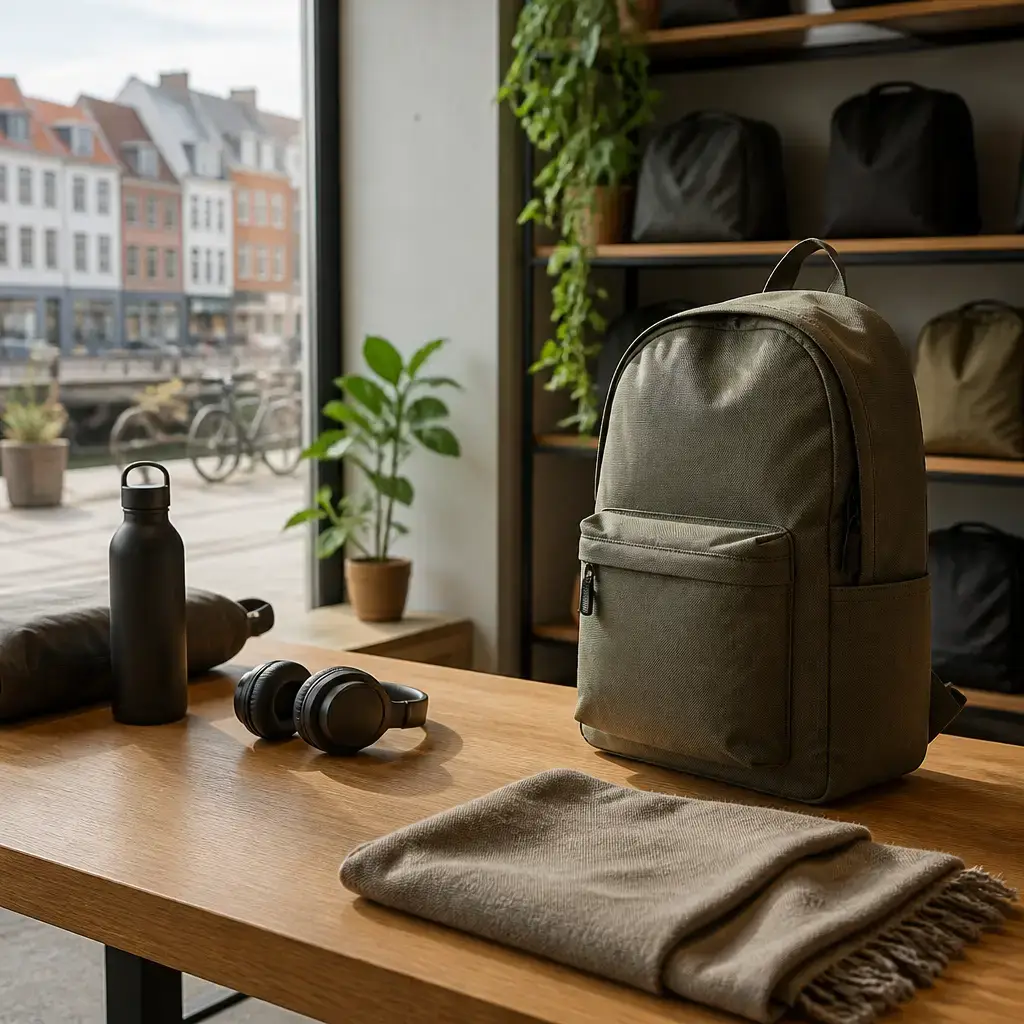
“Rucksack” means backpack, the item being inspected and compared in the shop. It can be used with product actions such as trying, opening, or comparing the backpack.
persönlich
“Persönlich” means in person here: the speaker wants to try the backpack directly rather than rely only on the listing. Use it when emphasizing direct personal contact or experience.
ausprobieren
“Ausprobieren” means to try out the backpack in “den Rucksack persönlich ausprobieren”. It is useful for testing whether a product works or feels suitable before deciding.
Im
“Im Geschäft” means in the shop. “Im” is the contracted form used in this location expression, and the pattern is useful for saying where an activity takes place.
Geschäft
“Geschäft” means shop or store in “Im Geschäft”. It refers to the physical place where the backpack can be checked directly.
kannst
In “kannst du die Träger … prüfen”, “kannst” says that the person has the possibility or ability to check the parts. Use it with “du” when telling someone what they can do.
du
“Du” addresses the other person directly in the shop conversation. It is used as the subject of advice about checking, asking, or choosing.
die
In “die Träger” and “die Farbauswahl”, “die” introduces the specific things being discussed. The same form also appears in “die Website”; the noun after it shows what it refers to.
Träger
“Träger” means the backpack straps in “die Träger … prüfen”. It is useful when discussing the parts of a bag that can be inspected for comfort or strength.
Reißverschluss
“Reißverschluss” means zipper in “den Reißverschluss … prüfen”. It names the single zipper part that the shopper wants to check closely.
und
“Und” joins items in the inspection list: the straps, zipper, and material. Use it to connect words or phrases that belong together.
das
In “das Material”, “das” introduces the material being checked. It is used here directly before the noun in a product description.
Material
“Material” means the material of the backpack in “das Material genau prüfen”. It is useful when evaluating what a product is made of.
genau
“Genau” means closely or precisely in “genau prüfen”. It shows that the inspection should be detailed rather than superficial.
prüfen
“Prüfen” means to check or inspect the backpack parts. Use it for examining whether an object, feature, or piece of information meets expectations.
In
In “In mehreren Bewertungen”, “In” places the information inside several reviews. It is useful for saying where a statement or piece of information appears.
mehreren
“Mehreren” means several in “In mehreren Bewertungen”. It indicates more than one review and is used before the plural noun in this expression.
Bewertungen
“Bewertungen” means reviews in which customers mention weak zippers. It is useful for referring to written customer opinions about a product.
werden
In “werden schwache Reißverschlüsse erwähnt”, “werden” helps present the zippers as the things mentioned in the reviews. Use it with “erwähnt” when reporting what is mentioned without focusing on who mentions it.
schwache
“Schwache” describes the zippers as weak in “schwache Reißverschlüsse”. It is placed directly before the plural noun to identify the reported problem.
Reißverschlüsse
“Reißverschlüsse” means zippers in the plural, referring to the zippers mentioned by several reviews. It is useful when discussing the same type of feature on multiple products or items.
erwähnt
“Erwähnt” means mentioned in “werden schwache Reißverschlüsse erwähnt”. It reports that the reviews refer to or speak about a particular issue.
deshalb
“Deshalb” means therefore or so and connects the reviews about weak zippers with the decision to test that part carefully. Use it to introduce a result or consequence.
diesen
In “diesen Teil”, “diesen” points to the particular part already discussed, namely the zipper area. It is useful when referring back to one specific item or part.
Teil
“Teil” means part in “diesen Teil sorgfältig testen”. It identifies one section or component of the backpack rather than the whole product.
sorgfältig
“Sorgfältig” means carefully and describes how the part should be tested. Use it when an action needs attention and should not be done casually.
testen
“Testen” means to test the zipper part in “diesen Teil sorgfältig testen”. It is useful for checking how a product feature works in practice.
Dann
“Dann” means then and introduces the next suggested action after discussing the weak zippers. Use it to show the next step in a sequence.
versuche
In “versuche, ihn ein paar Mal zu öffnen”, “versuche” tells the person to try an action. It is useful for giving informal advice about making an attempt.
ihn
“Ihn” refers back to the masculine noun “Rucksack” and means it in “ihn … zu öffnen”. Use it to avoid repeating the backpack when it is already clear from the context.
ein
In “ein paar Mal”, “ein” is part of the quantity expression meaning a few times. This expression is used before an action to specify a small number of repetitions.
paar
In “ein paar Mal”, “paar” contributes the meaning a few. The complete expression refers to a small, unspecified number of repetitions.
Mal
“Mal” means times in “ein paar Mal zu öffnen”. It counts how often the backpack should be opened.
zu
In “zu öffnen”, “zu” marks the infinitive that completes “versuche”. The pattern “versuche, … zu” introduces an action someone is told or encouraged to try.
öffnen
“Öffnen” means to open the backpack or its zipper in “ihn ein paar Mal zu öffnen”. It is useful for describing the action of making something no longer closed.
Frag
“Frag” tells the person to ask about the exchange policy before deciding. It is an informal direct instruction used when giving practical advice.
vor
In “vor deiner Entscheidung”, “vor” means before and places the question earlier than the decision. Use it with an event or action that must happen first.
deiner
“Deiner” means your in “deiner Entscheidung” and identifies the decision as belonging to the person being addressed. It is useful for referring to something connected with “du”.
Entscheidung
“Entscheidung” means decision in “vor deiner Entscheidung”. It refers to the moment when the shopper chooses whether to buy the item.
nach
In “nach der Umtauschregelung” with “Frag”, “nach” is part of the expression for asking about something. Use this pattern when requesting information about a rule, condition, or policy.
Umtauschregelung
“Umtauschregelung” means exchange policy, the shop’s rule about exchanging an item. It is useful to ask about this before committing to a purchase.
hier
“Hier” means here and identifies the backpack that is physically present in the shop. Use it to point to something at the current location.
fühlt
In “fühlt sich stabiler an”, “fühlt” contributes to the meaning that the backpack gives a certain physical impression. The complete expression is useful for describing how an object feels when handled.
sich
In “fühlt sich stabiler an”, “sich” is part of the expression describing how the backpack feels. It belongs with “fühlt … an” rather than expressing a separate meaning on its own.
stabiler
“Stabiler” means more stable or stronger in “fühlt sich stabiler an”. It compares the backpack here with another option being considered.
an
In “fühlt sich stabiler an”, “an” completes the verb expression that means feels or seems when handled. Keep it with “fühlt sich” when using this expression.
obwohl
“Obwohl” means although and introduces a contrast between the backpack feeling stronger and the website showing color options more clearly. Use it to connect a main statement with a contrasting fact.
Website
“Website” means website in the comparison between online information and the shop visit. It refers to the online source that displays the available color options.
Farbauswahl
“Farbauswahl” means the available color options or color selection. It names the range of colors shown on the website.
klarer
“Klarer” means more clearly in “die Farbauswahl klarer zeigt”. It indicates that the website presents the color options more clearly than the other source in the comparison.
zeigt
“Zeigt” means shows in “die Website die Farbauswahl klarer zeigt”. It describes what information the website presents to the shopper.
Nutze
“Nutze” tells the person to use the website for the available options. It is an informal instruction about how to make use of a source.
für
In “für die Auswahl”, “für” links the website with the purpose of selecting among the options. Use it to state what something is intended or useful for.
Auswahl
“Auswahl” means selection or options in “für die Auswahl”. It refers to choosing among the colors or other possibilities shown online.
Besuch
“Besuch” means visit in “den Besuch im Geschäft”. It refers to going to the shop in order to inspect the backpack directly.
um
In “um die Qualität zu beurteilen”, “um” introduces the purpose of the shop visit. The pattern “um … zu” explains what an action is intended to achieve.
Qualität
“Qualität” means quality in “die Qualität zu beurteilen”. It refers to the standard or reliability of the backpack as judged through direct inspection.
beurteilen
“Beurteilen” means to assess or judge in “die Qualität zu beurteilen”. It is useful when forming an opinion after examining information or an object.
So
“So” means in this way and refers to using the website for options and the shop visit for quality. It introduces the result of that combined method.
kann
In “So kann ich sie besser vergleichen”, “kann” expresses that the speaker is able to compare the items more effectively. Use it with an infinitive to describe what someone can do.
sie
“Sie” means them here and refers to the items being compared. It allows the speaker to refer to those items without repeating their names.
besser
“Besser” means better in “besser vergleichen”. It shows that the comparison becomes more effective or useful through the two sources of information.
vergleichen
“Vergleichen” means to compare the items in “sie besser vergleichen”. Use it when examining two or more options to decide which is more suitable.
Wähle
“Wähle” tells the person to choose the item that seems reliable and has the desired style. It is an informal instruction used when giving final selection advice.
zuverlässig
“Zuverlässig” means reliable in “zuverlässig wirkt”. It describes an item that seems dependable based on the inspection.
wirkt
“Wirkt” means seems or appears in “der zuverlässig wirkt”. It presents reliability as an impression formed from observing or testing the item.
trotzdem
“Trotzdem” means still or nevertheless and keeps the desired style as a requirement even after reliability is considered. Use it to add a point that remains true despite the preceding information.
Stil
“Stil” means style in “den Stil hat, den du möchtest”. It refers to the visual or personal design the shopper wants.
hat
In “den Stil hat”, “hat” means has and states that the chosen item possesses the desired style. Use it to describe what an item includes or possesses.
möchtest
In “den du möchtest”, “möchtest” expresses what the person wants in the item’s style. It is useful in a relative clause that identifies the desired object or feature.