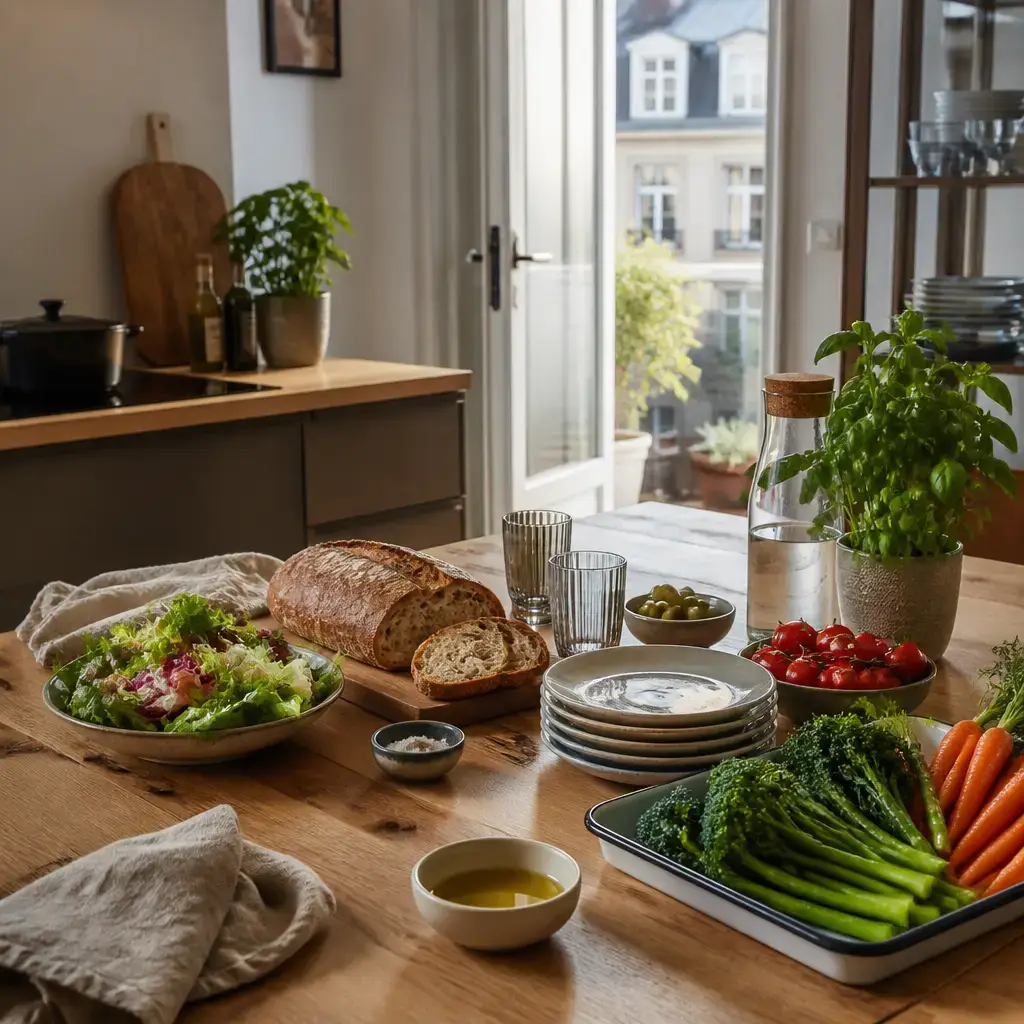
Die
In Die Gäste, this means “the” and refers to the guests. It is used before the plural noun Gäste; a reusable pattern is die + plural noun.
Gäste
Gäste means “guests,” the people who may arrive for dinner here. You can reuse it for people visiting your home, as in Gäste kommen.
kommen
kommen means “come” or “arrive” in Die Gäste kommen vielleicht an. With the particle an, it forms the arrival expression ankommen; a useful pattern is jemand kommt an.
vielleicht
vielleicht means “maybe” or “perhaps,” showing that the guests’ arrival is possible but not certain. It can usually be placed before the rest of the verb phrase, as in Sie kommen vielleicht später.
an
Here an is the separable particle that completes kommen in the meaning “arrive.” In a main clause, the particle comes at the end, as in Die Gäste kommen vielleicht an.
während
während means “while” and introduces the time when the guests may arrive. It links two simultaneous events, as in während das Essen kocht.
das
In das Hauptgericht, das means “the” before the neuter noun Hauptgericht. The capitalized form Das in Das gibt dem Hauptgericht... means “that,” referring to the previous suggestion; the meaning depends on its sentence context.
Hauptgericht
Hauptgericht means “main course,” the main dish of the dinner. A useful food-related pattern is das Hauptgericht servieren.
noch
noch means “still” in das Hauptgericht noch kocht, showing that the cooking is continuing at that time. A reusable pattern is noch + verb or noch nicht + verb for an ongoing or unfinished action.
kocht
kocht says that the main course is cooking in this dialogue. The form is used with the subject das Hauptgericht; a new example is Die Suppe kocht noch.
Dann
Dann means “then” and presents the next action after the possible late arrival. The same word appears in und dann das Hauptgericht, where it marks the next item in the serving order.
serviere
serviere means “serve” as a direct instruction to one person. It is used with the object eine einfache Vorspeise; a reusable pattern is Serviere + food or dish.
eine
eine means “a” in eine einfache Vorspeise. It introduces the singular feminine noun Vorspeise; a common pattern is eine + adjective + feminine noun.
einfache
einfache describes the starter as simple or uncomplicated. It appears directly before Vorspeise, as in eine einfache Vorspeise; a new example is eine einfache Mahlzeit.
Vorspeise
Vorspeise means “starter” or “appetizer,” the small dish served before the main course. A useful pattern is eine Vorspeise servieren.
damit
damit means “so that” and introduces the purpose of serving a starter: people can first settle in. It introduces a clause whose verb comes at the end, as in damit alle ankommen können.
alle
alle means “everyone” in damit alle erst einmal ankommen können and in sobald alle angekommen sind. It refers to all the people in the group; a reusable pattern is alle + verb.
erst
In erst einmal ankommen, erst means “first,” directing attention to the initial step before the main meal. The common expression erst einmal means “first of all” or “for now.”
einmal
In erst einmal, einmal helps make the expression mean “first of all” or “for now,” rather than referring to one single occasion. Erst einmal is useful when suggesting an initial or temporary step.
ankommen
ankommen means “arrive” and, in this context, also includes the idea of settling in after arrival. It appears after können in ankommen können; a reusable pattern is bei jemandem ankommen.
können
können means “can” or “be able to” in damit alle erst einmal ankommen können. It is followed by the infinitive ankommen; a useful pattern is jemand kann + infinitive.
Ich
Ich means “I,” referring to the speaker who can prepare the salad and bread. It commonly comes before a finite verb, as in Ich kann... or Ich habe...
kann
kann means “can” in Ich kann Salat und Brot fertig haben, expressing the speaker’s ability or possibility. It is followed by the infinitive phrase fertig haben; a reusable pattern is Ich kann + infinitive.
Salat
Salat means “salad,” one of the foods the speaker can have ready. It is coordinated with Brot by und; a useful pattern is Salat und Brot vorbereiten.
und
und means “and” and joins Salat with Brot in the prepared food list. It also joins Vorspeise with the next item in the serving order; use it to connect equivalent items or actions.
Brot
Brot means “bread,” the second food that can be ready before the guests arrive. A common pattern is Brot und Salat vorbereiten.
fertig
fertig means “ready” in fertig haben, describing food that has been prepared in advance. The reusable construction etwas fertig haben means to have something ready.
haben
haben means “have” in fertig haben, expressing possession of a prepared or ready state. After kann, it remains in the infinitive; a useful pattern is etwas fertig haben.
bevor
bevor means “before” and introduces the time before the guests come. It connects an earlier action with a later one, as in etwas vorbereiten, bevor die Gäste kommen.
sie
The lowercase sie in bevor sie kommen means “they,” referring to the guests. The capitalized Sie in Sie schmecken... appears at the start of a sentence and means “they,” referring there to the vegetables.
gibt
gibt means “gives” in Das gibt dem Hauptgericht etwas mehr Zeit. The reusable pattern is jemandem etwas Zeit geben, meaning to give someone or something some time.
dem
dem means “to the” in dem Hauptgericht and identifies the main course as the thing receiving extra time. It appears in the pattern jemandem etwas geben, where the recipient follows geben.
etwas
In etwas mehr Zeit, etwas means “a little” or “some,” not a specific object. The expression etwas mehr is a useful way to request or describe a small additional amount.
mehr
mehr means “more” or “extra” in etwas mehr Zeit. It describes an amount greater than the current amount; a reusable pattern is mehr Zeit haben.
Zeit
Zeit means “time,” here the extra time available for the main course. A common pattern is jemandem Zeit geben or mehr Zeit haben.
ohne
ohne means “without” in ohne dass das Abendessen verspätet wirkt, describing something that does not happen as a result. The construction ohne dass introduces a complete clause.
dass
dass means “that” and introduces the clause das Abendessen verspätet wirkt. It is used to connect a main statement with the result or situation being described.
Abendessen
Abendessen means “dinner,” the meal that should not appear delayed. A useful pattern is das Abendessen servieren or das Abendessen vorbereiten.
verspätet
verspätet means “late” or “delayed” in verspätet wirkt, describing how the dinner appears. It combines with wirkt to express an impression rather than directly stating that the dinner is delayed.
wirkt
wirkt means “seems” or “appears” in das Abendessen verspätet wirkt. A reusable pattern is etwas wirkt + adjective, such as Der Plan wirkt einfach.
Soll
Soll means “should” in Soll ich das Gemüse kochen?, forming a question about what the speaker ought to do. The pattern Soll ich + infinitive? is useful when asking for advice or permission.
Gemüse
Gemüse means “vegetables,” the food the speaker is considering cooking after everyone arrives. A common pattern is Gemüse kochen or frisches Gemüse.
kochen
kochen means “cook” in Soll ich das Gemüse kochen? It follows Soll as an infinitive; a reusable pattern is etwas kochen.
sobald
sobald means “as soon as” and introduces the point when everyone has arrived. It is useful for linking an action to an immediately following condition, as in Sobald du fertig bist, können wir anfangen.
angekommen
angekommen means “arrived” in angekommen sind, describing the completed arrival of everyone. It appears with sind in this clause; a useful pattern is Sobald alle angekommen sind, ...
sind
sind completes angekommen sind and shows that everyone has arrived before the vegetables are cooked. It is used with the plural subject alle; a reusable pattern is alle sind angekommen.
schmecken
schmecken means “taste” in Sie schmecken frisch gekocht besser, referring to the vegetables. A useful pattern is etwas schmeckt besser, meaning that something tastes better.
frisch
In frisch gekocht, frisch means “freshly,” describing food cooked shortly before it is eaten. The expression frisch gekocht is useful when talking about the quality of newly cooked food.
gekocht
gekocht means “cooked” in frisch gekocht, referring to vegetables that have just been prepared. It combines with frisch to describe their condition when they are served.
besser
besser means “better” in Sie schmecken frisch gekocht besser, comparing the taste of freshly cooked vegetables with another preparation time. A reusable pattern is etwas schmeckt besser + with a condition or comparison.
also
also means “so” or “therefore” and introduces the practical conclusion: wait before serving. It is useful for connecting a reason with the action that follows.
warte
warte means “wait” as a direct instruction to one person. It is followed by bis and the time condition; a reusable pattern is Warte, bis + clause.
bis
bis means “until” in bis du kurz davor bist, sie zu servieren. It introduces the point up to which someone should wait; a common pattern is warten, bis etwas passiert.
du
du means “you” when addressing one person informally. It is the subject of bist in bis du kurz davor bist; a reusable pattern is du bist + adjective or phrase.
kurz
In kurz davor, kurz means “shortly” or “close in time,” not physically short. The expression kurz davor sein means to be just before something or close to doing it.
davor
davor means “before it” or “before that,” referring here to the act of serving the vegetables. Together with kurz, kurz davor means “close to that point”; a reusable pattern is kurz davor sein, etwas zu tun.
bist
bist means “are” in du kurz davor bist, describing the person’s position close to serving. It is used with du; the pattern du bist kurz davor, etwas zu tun is reusable.
zu
zu marks the infinitive in zu servieren, meaning “to serve.” The construction kurz davor sein, etwas zu tun is a useful pattern for being close to doing something.
servieren
The lowercase servieren means “to serve” in sie zu servieren, referring to serving the vegetables. The capitalized form Servieren in fürs Servieren means “serving” as an activity; both forms keep the same serving idea.
bewirten
bewirten means “host” or “entertain guests” in Gäste zu bewirten. It refers to providing food and care for people in your home; a useful pattern is Gäste bewirten.
ist
ist means “is” in Gäste zu bewirten ist stressig and in schwieriger ist, alles zeitlich zu planen. It links the subject or situation with a description, such as etwas ist stressig.
stressig
stressig means “stressful,” describing the experience of hosting guests. A reusable pattern is etwas ist stressig, especially when discussing a demanding task or situation.
weil
weil means “because” and introduces the reason hosting feels stressful. It connects a statement with its explanation, as in Es ist schwierig, weil viel zu tun ist.
es
es means “it” in weil es schwieriger ist, alles zeitlich zu planen, referring to the activity of planning everything in time. It is used here as the subject of the general statement es ist schwieriger.
schwieriger
schwieriger means “more difficult,” comparing timing everything with cooking. It appears in the pattern etwas ist schwieriger als etwas anderes.
alles
alles means “everything,” referring to all the dinner tasks that need to be coordinated in time. A useful pattern is alles planen or alles vorbereiten.
zeitlich
zeitlich means “in terms of timing” or “with regard to time,” explaining how everything is being planned. It commonly combines with planen when the order or timing of events matters.
planen
planen means “plan,” here describing the task of arranging the timing of everything. It follows zeitlich zu; a useful pattern is etwas zeitlich planen.
als
als means “than” in the comparison schwieriger ..., als zu kochen. It introduces the activity used as the comparison point; a reusable pattern is schwieriger als + activity.
Mach
Mach means “make” as a direct instruction to one person. It is used with einen einfachen Plan; a reusable pattern is Mach einen Plan für + activity.
einen
einen means “a” in einen einfachen Plan, introducing the masculine noun Plan. It appears before the descriptive adjective and noun in the object of Mach.
einfachen
einfachen describes the plan as simple or uncomplicated. It appears in einen einfachen Plan; a new example is einen einfachen Ablauf planen.
Plan
Plan means “plan,” here a sequence for serving drinks, the starter, and the main course. A useful pattern is einen Plan fürs Servieren machen.
fürs
fürs is the shortened form of für das in Plan fürs Servieren, meaning “for the.” It introduces the activity the plan is intended for; a reusable pattern is ein Plan fürs + activity.
Getränke
Getränke means “drinks” or “beverages,” the first item in the serving plan. It is listed with Vorspeise and Hauptgericht; a common pattern is Getränke servieren.
diese
diese means “this” in diese Checkliste, referring to the particular checklist just being discussed. It comes directly before the feminine noun Checkliste; a reusable pattern is diese + noun.
Checkliste
Checkliste means “checklist,” a written list to help organize the dinner steps. A useful pattern is eine Checkliste neben etwas aufbewahren.
neben
neben means “next to” or “beside” in neben dem Herd, describing the checklist’s location. A common location pattern is etwas neben + place or object aufbewahren.
Herd
Herd means “stove,” the place near which the checklist can be kept. It appears after neben in neben dem Herd; a useful pattern is am Herd stehen or neben dem Herd.
aufbewahren
aufbewahren means “keep” or “store,” here referring to keeping the checklist near the stove. A reusable pattern is etwas an einem bestimmten Ort aufbewahren.
sollte
sollte means “should” in Das sollte dir helfen, expressing an expected helpful result. A useful pattern is Das sollte + infinitive when suggesting what is likely to help.
dir
dir means “to you” in Das sollte dir helfen, referring to the person receiving the help. Helfen commonly takes this form for the person helped; a reusable pattern is etwas hilft dir bei + task.
helfen
helfen means “help” in Das sollte dir helfen, konzentriert zu bleiben. It is followed by the person helped and an activity or result; a useful pattern is jemandem helfen, etwas zu tun.
konzentriert
konzentriert means “focused” in konzentriert zu bleiben, describing the state the checklist should help maintain. A reusable pattern is konzentriert bleiben bei + activity or task.
bleiben
bleiben means “stay” or “remain” in konzentriert zu bleiben, meaning to continue being focused. It follows zu in this infinitive construction; a useful pattern is ruhig or konzentriert bleiben.
Leute
Leute means “people,” referring to the guests as they arrive. It appears in während die Leute ankommen; a common pattern is Leute kommen an or viele Leute.