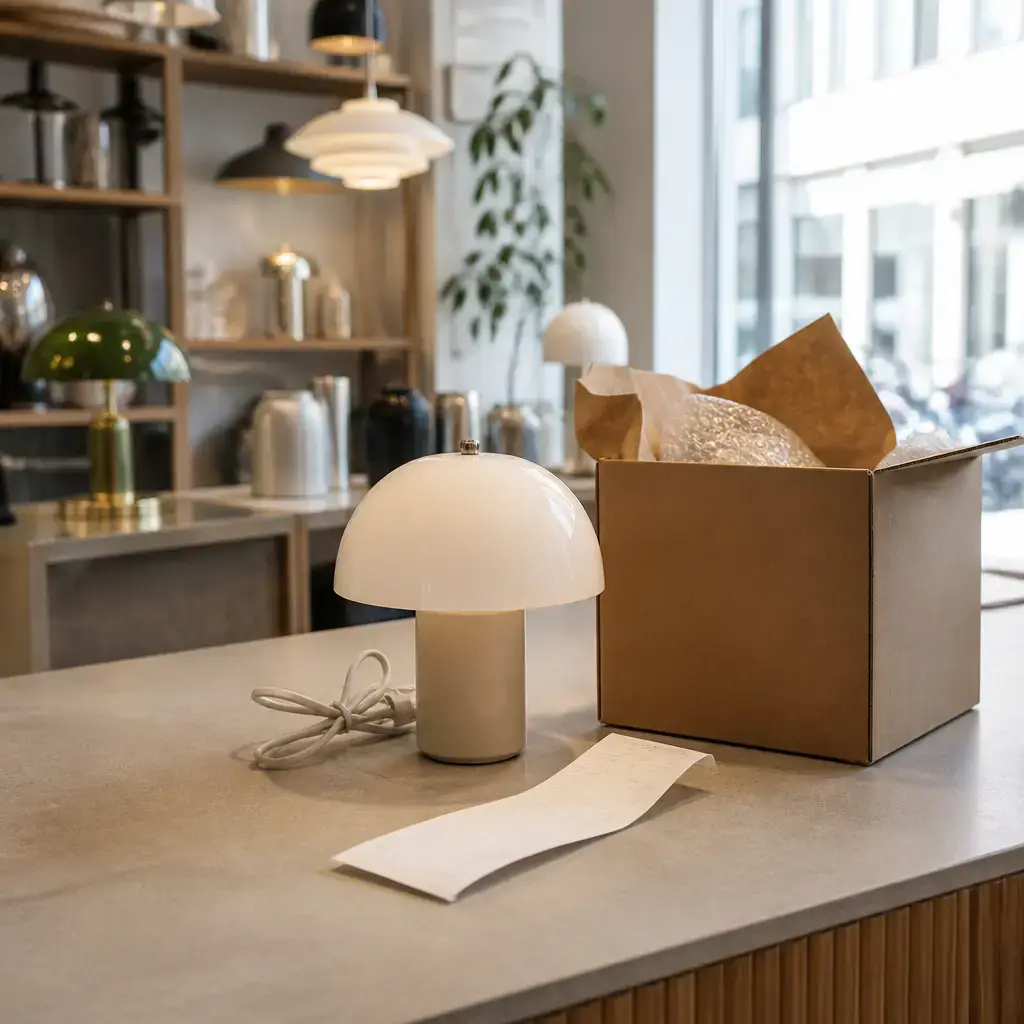
Diese
“Diese” points to the particular lamp being discussed in “Diese Lampe”. It is used before the noun to identify this specific item.
Lampe
“Lampe” means lamp, the faulty product in the dialogue. The word names the item whose replacement is being discussed.
hat
“Hat” is the helping verb in “hat nach kurzer Zeit nicht mehr funktioniert”, forming the past statement that the lamp stopped working. The same form of “haben” is also used in “Ich habe” to say what someone has.
nach
“Nach” means after in “nach kurzer Zeit”. It introduces the time that passed before the lamp stopped working.
kurzer
“Kurzer” describes the time as short in the expression “nach kurzer Zeit”. The adjective form belongs to this phrase and agrees with “Zeit”.
Zeit
“Zeit” means time in “nach kurzer Zeit”, referring to the brief period before the problem appeared. “Nach kurzer Zeit” is a reusable way to say after a short time.
nicht
“Nicht” is the negative part of “nicht mehr funktioniert”. Together with “mehr”, it says that the lamp no longer worked.
mehr
In “nicht mehr funktioniert”, “mehr” contributes the meaning any longer. The complete pattern “nicht mehr” is used to say that something has stopped happening or working.
funktioniert
“Funktioniert” means works or functions here, in “nicht mehr funktioniert”. Together with “hat”, it describes the lamp’s earlier failure in the conversation.
Haben
“Haben” means have at the beginning of the question “Haben Sie einen Kaufbeleg dabei?”. Putting it first forms a question about whether the customer has the proof of purchase with them.
Sie
“Sie” means you in the formal question “Haben Sie einen Kaufbeleg dabei?”. It is used when addressing the customer politely in a shop.
einen
“Einen” introduces one specific item in “einen Kaufbeleg”. It shows that the shop assistant is asking whether the customer has a proof of purchase.
Kaufbeleg
“Kaufbeleg” means proof of purchase in “einen Kaufbeleg dabei”. It refers to a document that can support the customer’s request about the faulty lamp.
dabei
“Dabei” means with you or on hand in “einen Kaufbeleg dabei”. With “haben”, it asks whether someone has an item with them at the current place.
Ich
“Ich” means I in “Ich habe den Kassenbon und die Originalverpackung dabei”. It identifies the customer as the person who has brought the items.
habe
“Habe” means have in “Ich habe ... dabei”. The pattern “Ich habe ... dabei” is useful for saying that you have something with you.
den
“Den” identifies “Kassenbon” as the specific receipt the customer has brought. It appears directly before that noun in “den Kassenbon”.
Kassenbon
“Kassenbon” means receipt in “den Kassenbon”. In this shop situation, it is the purchase document the customer presents.
und
“Und” means and and links “den Kassenbon” with “die Originalverpackung”. It adds the second item the customer has brought.
die
“Die” introduces the specific packaging in “die Originalverpackung”. It connects that item to the customer’s statement about what they have with them.
Originalverpackung
“Originalverpackung” means original packaging. In “die Originalverpackung dabei”, it is the packaging that came with the lamp and may help the shop check the product.
Dann
“Dann” means then in “Dann können wir prüfen”. It marks the next step after the customer confirms having the purchase documents.
können
“Können” means can in “können wir prüfen”, expressing that the shop is able to check the replacement possibility. With a second verb, it is followed by the infinitive “prüfen”.
wir
“Wir” means we in “können wir prüfen”. It refers to the shop staff together with the speaker as the people who will carry out the check.
prüfen
“Prüfen” means check or examine in “können wir prüfen”. It is used after “können” to describe checking whether a replacement is possible.
ob
“Ob” means whether in “ob ein Ersatz möglich ist”. It introduces a question about a possibility, with the verb at the end of this clause.
ein
“Ein” introduces one possible replacement in “ein Ersatz”. It presents the replacement as something whose availability or possibility is being checked.
Ersatz
“Ersatz” means replacement in “ob ein Ersatz möglich ist” and “einen Ersatz”. It names the new item the customer wants instead of the faulty lamp.
möglich
“Möglich” means possible in “ein Ersatz möglich ist”. It describes whether providing a replacement can be done.
ist
“Ist” means is in “ein Ersatz möglich ist”. It links “ein Ersatz” with the description “möglich” inside the clause introduced by “ob”.
hätte
“Hätte” expresses a polite or less direct preference in “Ich hätte lieber einen Ersatz”. The sentence presents having a replacement as the customer’s preferred solution.
lieber
“Lieber” means rather or preferably in “Ich hätte lieber einen Ersatz”. The pattern “Ich hätte lieber ...” is a useful way to state a preference politely.
brauche
“Brauche” means need in “Ich brauche weiterhin denselben Lampentyp”. It states that the customer still requires this kind of lamp.
weiterhin
“Weiterhin” means still or continuing to in “weiterhin denselben Lampentyp”. It shows that the need for the same type remains despite the faulty product.
denselben
“Denselben” means the same in “denselben Lampentyp”. It specifies that the customer wants the replacement to be the same type as the original lamp.
Lampentyp
“Lampentyp” means type of lamp. In “denselben Lampentyp”, it identifies the particular kind of lamp the customer still needs.
Das
“Das” means that in “Das klingt vernünftig” and refers back to the customer’s preference or request. It lets the speaker comment on the previous idea without repeating it.
klingt
“Klingt” means sounds in “Das klingt vernünftig”. The expression is used to give an evaluation of an idea or proposal.
vernünftig
“Vernünftig” means reasonable in “Das klingt vernünftig”. The shop assistant uses it to show that the customer’s request seems sensible.
sollten
“Sollten” expresses should in “Wir sollten den Artikel zuerst testen”. It gives a recommendation about the next step before arranging the exchange.
Artikel
“Artikel” means item or product in “den Artikel zuerst testen”. In this shop context, it refers to the lamp being examined.
zuerst
“Zuerst” means first in “den Artikel zuerst testen”. It places testing before the later handling of the exchange.
testen
“Testen” means test in “den Artikel zuerst testen”. The pattern “etwas testen” is used when checking whether a product works.
auch
“Auch” means also or as well in “Ich habe auch das Kabel mitgebracht”. It adds the cable to the other items the customer has brought.
Kabel
“Kabel” means cable in “das Kabel mitgebracht”. It is an additional part the shop may need when checking the lamp.
mitgebracht
“Mitgebracht” means brought along in “Ich habe auch das Kabel mitgebracht”. Together with “habe”, it describes bringing an item to the current place; the citation form is “mitbringen”.
falls
“Falls” means in case or if in “falls das hilft”. It introduces a possible condition under which bringing the cable may be useful.
hilft
“Hilft” means helps in “falls das hilft”. The word describes whether the cable will be useful for checking or confirming the problem.
Damit
“Damit” means with that or with those things in “Damit haben wir alles”. It refers to the items the customer has provided and connects them with the shop’s next action.
alles
“Alles” means everything in “alles, was wir brauchen”. It refers to the complete set of materials needed for the check and exchange.
was
“Was” means what in “alles, was wir brauchen”. It introduces the clause explaining which things are included in “alles”.
brauchen
“Brauchen” means need in “alles, was wir brauchen”. The pattern “alles, was wir brauchen” means everything that we need for a task.
um
“Um” starts the purpose construction “um das Problem zu bestätigen und den Umtausch abzuwickeln”. It shows why the shop needs the materials: to confirm the problem and handle the exchange.
Problem
“Problem” means problem in “das Problem zu bestätigen”. Here it refers to the lamp’s failure to work.
zu
The “zu” before “bestätigen” marks the infinitive in the purpose construction “um das Problem zu bestätigen”. It links the purpose to the action of confirming the problem.
bestätigen
“Bestätigen” means confirm in “das Problem zu bestätigen”. The shop wants to establish that the reported fault is really present.
Umtausch
“Umtausch” means exchange in “den Umtausch abzuwickeln”. It refers to the shop process of replacing the faulty product with another one.
abzuwickeln
“Abzuwickeln” means to handle or process in “den Umtausch abzuwickeln”. It describes completing the exchange procedure; the citation form is “abwickeln”, and the object here is “den Umtausch”.