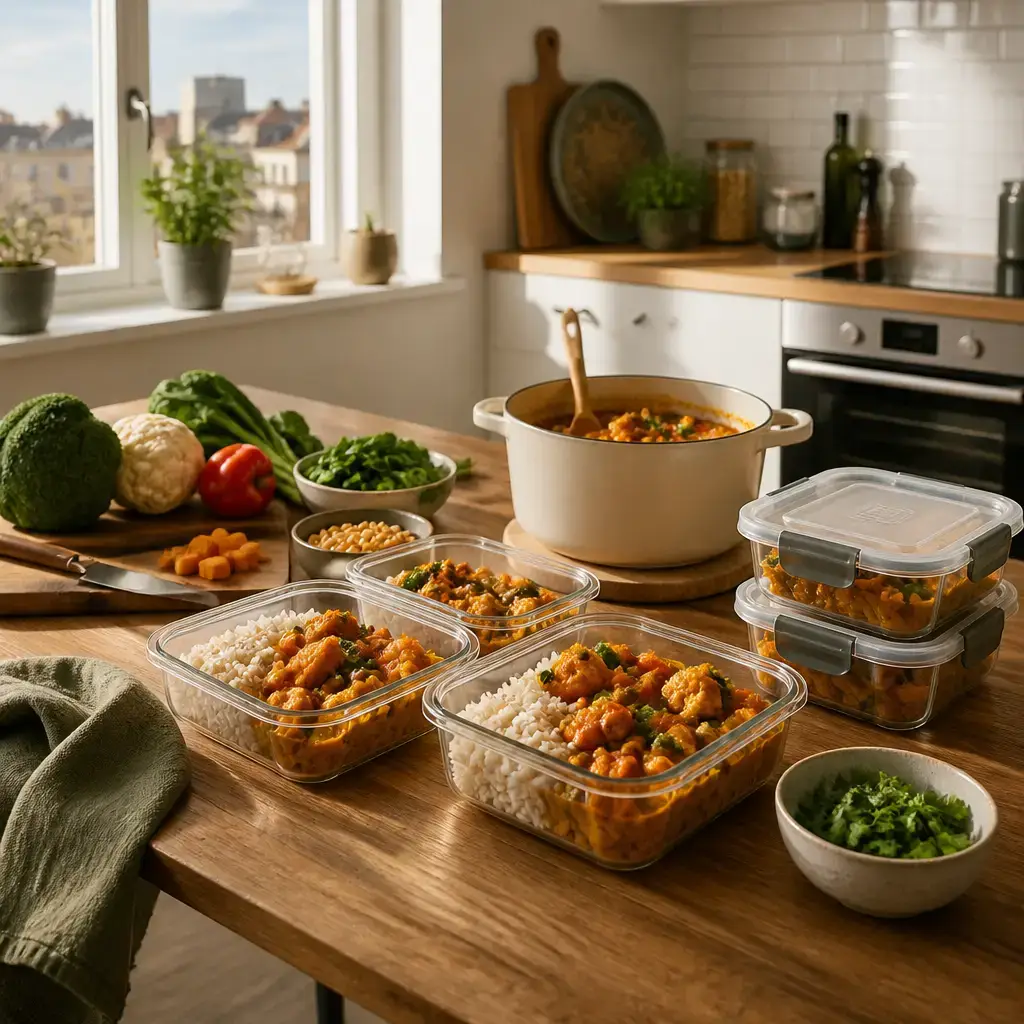
Nächste
Nächste means next here and describes Woche. It identifies the week immediately after the current one.
Woche
Woche means week, the period being described as busy. It is the singular form used with Nächste in this sentence.
sieht
sieht means looks or appears here, describing how the coming week seems. It is used with the separable particle aus to describe an impression.
voll
voll means busy or full here, referring to a week with many demands. It describes the week’s schedule rather than its physical contents.
aus
aus is the separable particle that completes the meaning of sieht ... aus as looks or appears. The particle comes at the end of this main clause.
deshalb
deshalb means therefore or so and connects the busy week with the suggestion that meal preparation would help. It introduces the consequence of the situation just mentioned.
wäre
wäre means would be here, presenting meal preparation as a helpful possibility or suggestion. It is used with hilfreich to evaluate the proposed action.
es
es functions as a placeholder subject in this sentence, while the action of preparing meals follows later. It appears in the pattern es wäre hilfreich, ... zu ... for saying that an action would be helpful.
hilfreich
hilfreich means helpful here and describes preparing some meals in advance as useful. It can be used after wäre to evaluate a proposed action.
einige
einige means some or several here and specifies an unspecified number of Mahlzeiten. It is placed directly before the noun it describes.
Mahlzeiten
Mahlzeiten means meals, the food portions to be prepared ahead of time. It is the plural form of Mahlzeit.
im Voraus
im Voraus means in advance, before the meals are needed. The expression combines im, meaning in the, with Voraus, meaning advance, and it commonly appears with an action planned beforehand.
zuzubereiten
zuzubereiten means to prepare here, referring to preparing the meals. It is the zu-infinitive form used after hilfreich to name the action being evaluated.
vorzubereiten
vorzubereiten means to prepare meals ahead of time in this dialogue. The element vor adds the idea that the preparation happens before the meals are needed; it is used with Mahlzeiten.
wird
wird means will here and presents meal preparation as something that will help. It appears before helfen in the future-like expression wird helfen.
helfen
helfen means help here, referring to the benefit of preparing meals. It follows wird in the reusable pattern wird ... helfen.
aber
aber means but and introduces a limitation to the helpful meal-preparation plan. It connects the positive suggestion with the advice to avoid repetition.
vermeide
vermeide means avoid here and gives direct advice not to eat the same thing every day. It is used before the action expressed by zu essen.
jeden
jeden means every here and applies to each individual Tag. It appears directly before the time word Tag in the repeated routine jeden Tag.
Tag
Tag means day here, forming the time expression jeden Tag for every day. It is the singular form used after jeden in this expression.
dasselbe
dasselbe means the same thing here, referring to repeating identical food. It is used as the object of essen in the advice about daily meals.
zu
zu marks the infinitive in zu essen, meaning to eat. Here it follows vermeide and introduces the action that should be avoided.
essen
essen means eat here, referring to eating the same food every day. It appears as the infinitive after zu.
Ich
Ich means I and identifies the speaker who had the meal idea. It is capitalized because it begins the sentence.
hatte
hatte means had here in the expression had thought about doing something. It combines with gedacht to describe the speaker’s earlier thought.
daran
daran points to the idea that follows, namely making a large amount of vegetable curry. It is used in the pattern daran denken, etwas zu machen for thinking about an action.
gedacht
gedacht means thought here and combines with hatte to express that the speaker had considered the plan. It is a form of denken used with hatte.
eine
eine means a here and introduces one unspecified Menge. It stands before the noun it determines.
große
große means large or big here and describes the amount of curry being planned. It appears directly before Menge.
Menge
Menge means amount here and refers to a large quantity of food prepared at once. With große and Gemüsecurry, it describes a batch suitable for several meals.
Gemüsecurry
Gemüsecurry means vegetable curry, the dish the speaker plans to prepare. It is the food connected with the amount described by eine große Menge.
machen
machen means make here, referring to preparing the vegetable curry. It appears after zu in the infinitive phrase zu machen.
Das
Das means that or it here and refers back to the proposed curry plan. It is the subject of the response Das klappt.
klappt
klappt means works or will work here, assessing whether the proposed plan is practical. It is used with Das to say that an idea or arrangement succeeds.
wenn
wenn means if and introduces the condition for the plan working. The condition consists of portioning the food correctly and storing it safely.
du
du means you here, addressing one person directly in the informal singular. It is the subject of the actions in the condition.
richtig
richtig means properly or correctly here and describes how the food should be portioned. It can be placed before a verb to explain that an action is done correctly.
portionierst
portionierst means divide into portions here, referring to dividing the curry into separate servings. It takes the object es and is used alongside aufbewahrst after wenn.
und
und means and and links the two required actions: portioning the food and storing it. It joins parallel actions in the conditional clause.
sicher
sicher means safely here and describes the way the food should be stored. It gives practical guidance about keeping prepared food.
aufbewahrst
aufbewahrst means you store or keep here, referring to keeping the prepared food safely. It is the form of aufbewahren used with du in the conditional clause.
Soll
Soll means should here and asks whether the speaker ought to freeze part of the food. It begins a direct question about what action to take.
einen
einen means a or one here and specifies one part of the prepared food. It appears before Teil in the object phrase einen Teil.
Teil
Teil means part here, referring to part of the curry that may be frozen. It is used with einen to form one part or a portion of the whole.
einfrieren
einfrieren means freeze here, referring to storing part of the food at freezing temperature. It follows Soll as an infinitive.
den
den means the here and introduces the specific Rest that remains after one part is frozen. It appears directly before Rest.
Rest
Rest means the remainder or the rest here, referring to the food not put in the freezer. It is kept in the Kühlschrank according to the question.
Kühlschrank
Kühlschrank means fridge or refrigerator here, the place where the remaining food will be stored. It appears after im in the phrase im Kühlschrank.
aufbewahren
aufbewahren means store or keep here, referring to keeping the remaining food in the fridge. It follows Soll as a second infinitive coordinated with einfrieren.
Friere
Friere means freeze here and gives a direct instruction to one person. The separable particle ein appears later in the same command.
ein
ein is the separable particle that completes einfrieren in the command Friere ... ein. It carries the added meaning into the verb expression for freezing something.
paar
paar means a few here and gives an approximate small number of portions. It appears in the quantity expression ein paar Portionen.
Portionen
Portionen means portions, the separate servings to be frozen. It is the plural form of Portion.
Beschrifte
Beschrifte means label here and instructs the listener to mark each container. It is used with Behälter as its object.
Behälter
Behälter means container here, referring to the containers holding the prepared food. It follows jeden in the instruction to label each one.
damit
damit means so that and introduces the purpose of labeling the containers. The purpose is expressed by making selection easier.
die
die means the here and introduces Auswahl, the specific selection being discussed. It is the article before the noun in die Auswahl.
Auswahl
Auswahl means choice or selection here, referring to choosing a meal container. It is the thing that becomes easier with clear labels.
leichter
leichter means easier here and describes the act of choosing among the containers. It is used with fällt in the expression for selection becoming easier.
fällt
fällt contributes to the expression die Auswahl fällt leichter, meaning the selection becomes easier. Here it does not describe a physical fall; it describes how easy the choice feels.
brauche
brauche means need here, expressing the speaker’s need for a balanced lunch option. It is used with Ich and takes etwas as its object.
zum
zum means for the or at the here in zum Mittagessen. It is the contracted form of zu dem and links the need to lunchtime or the lunch meal.
Mittagessen
Mittagessen means lunch here, specifying when or for which meal the balanced food is needed. It follows zum in the phrase zum Mittagessen.
auch
auch means also here and adds the balanced lunch to the other meal-preparation needs already mentioned. It usually comes near the element being added.
etwas
etwas means something here and refers to an unspecified food item or meal component. It is followed by Ausgewogenes, which describes what kind of thing is needed.
Ausgewogenes
Ausgewogenes means something balanced here, especially a balanced food option for lunch. It is a capitalized adjective used as a noun-like expression after etwas.
nicht
nicht means not here and rejects the idea that rice alone is sufficient for lunch. It works together with nur to limit the meaning of the meal.
nur
nur means only or just here and limits the lunch to rice as the single component being rejected. The pattern nicht nur ... indicates that additional ingredients are wanted.
Reis
Reis means rice here, the food that should not be the only part of lunch. It is used after nicht nur to identify the limited option.
Füge
Füge means add here and gives a direct instruction to include more food in the lunch. The separable particle hinzu appears later in the command.
Eier
Eier means eggs here, one possible addition to the lunch. It is the plural form of Ei and is one item in the list after Füge hinzu.
Bohnen
Bohnen means beans here, another possible addition to the lunch. It is the plural form of Bohne and is linked to the other options by oder.
oder
oder means or and presents alternatives among eggs, beans, and chicken. It links the listed foods as possible choices.
Hähnchen
Hähnchen means chicken here, one possible ingredient to add to the rice. It is the final food option in the list introduced by Füge hinzu.
hinzu
hinzu is the separable particle that completes Füge ... hinzu, meaning add. It appears at the end of the command and contributes the idea of adding something to what is already there.
je nachdem
je nachdem means depending on here and makes the choice of ingredient conditional on the person’s preference. Je contributes the dependency relation, while nachdem completes the fixed expression; it is commonly followed by information about the condition.
worauf
worauf means what ... on here in the question about what the person feels like eating. It refers to the desired food or option and introduces the phrase worauf du Lust hast.
Lust
Lust means desire or inclination here, as part of the expression for feeling like eating something. It is used with haben and worauf to ask about a person’s preference.
hast
hast means have here in the expression for having a desire or feeling like something. It is the form of haben used with du.
Reste
Reste means leftovers here, referring to the food remaining from the prepared meals. It is the plural form of Rest.
langweilig
langweilig means boring here and describes how the leftovers may seem after being eaten repeatedly. It is used after Reste and before wirken as a description.
wirken
wirken means seem or appear here, expressing an impression that the leftovers are boring. It commonly combines with an adjective such as langweilig to describe how something appears.
kann
kann means can here and expresses the speaker’s ability or option to change the side dish. It is followed by the infinitive ändern.
Beilage
Beilage means side dish here, the part of the meal that can be changed to make leftovers less repetitive. It is the object of ändern.
ändern
ändern means change here, referring specifically to changing the side dish. It follows kann as an infinitive.
Kleine
Kleine means small here and describes Änderungen. It appears at the beginning of the sentence because the phrase Kleine Änderungen is the subject.
Änderungen
Änderungen means changes here, referring to small variations in prepared meals. It is the plural form of Änderung.
vorbereitete
vorbereitete means prepared here and describes the meals that have already been made in advance. It appears directly before Mahlzeiten.
angenehmer
angenehmer means more enjoyable or more pleasant here, describing the result of making small changes to prepared meals. It is used after machen in the pattern etwas angenehmer machen.