In
In In der Nacht means during the night and introduces the time period when the snow fell. A useful reuse pattern is in plus a time expression.
der
In In der Nacht, der means the and accompanies Nacht. It is the article used with this time expression after In.
Nacht
Nacht means night in In der Nacht, referring to the previous nighttime period. It is useful in time expressions describing when something happened.
hat
Hat helps form the completed past event hat ... geschneit. In this sentence, it works together with es and geschneit to say that snow fell during the night.
es
Es is the impersonal it used with weather in hat es viel geschneit. Here it does not refer to a particular object; it is part of the German weather expression.
viel
Viel means a lot in viel geschneit and describes the large amount of snow. It can be reused before an expression to indicate a large amount.
geschneit
Geschneit means snowed in hat es viel geschneit. It is the form used with hat to describe the completed snowfall.
Die
Die means the in Die Gehwege and introduces the plural subject sidewalks. The capital letter is also required because it begins the sentence.
Gehwege
Gehwege means sidewalks, the surfaces that may be slippery this morning. It is the subject of Die Gehwege können ... sein.
können
Können means may or can here, expressing the possibility that the sidewalks are slippery. A useful pattern is können plus an infinitive, as in können ... glatt sein.
heute
Heute means today in heute Morgen. Together with Morgen, it identifies the morning of the current day.
Morgen
Morgen means morning in heute Morgen, not tomorrow. The expression heute Morgen is a common way to refer to this morning.
glatt
Glatt means slippery or icy here, describing the possible condition of the sidewalks. It is used with sein in glatt sein to describe a surface.
sein
Sein means be and completes können ... glatt sein. With a modal verb such as können, the infinitive sein appears at the end of the clause.
Dann
Dann means then and connects the snowy, slippery conditions to the speaker’s next decision. It is useful for introducing a consequence or next action.
sollte
Sollte means should in sollte ich ... tragen and expresses the speaker’s own sensible recommendation. A reusable pattern is sollte plus an infinitive for advice.
ich
Ich means I and identifies the person who should wear the boots. In sollte ich ..., it is the subject of the recommendation.
Stiefel
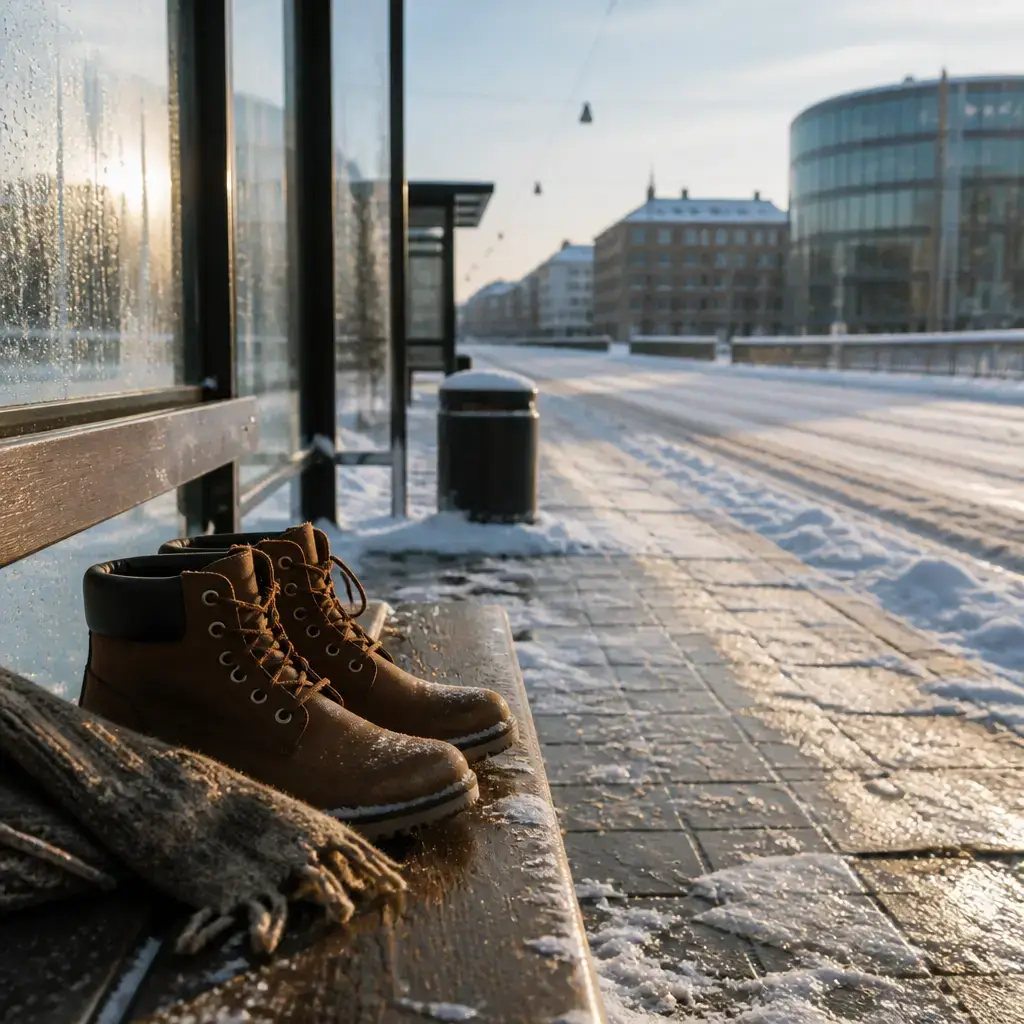
Stiefel means boots, the footwear the speaker plans to wear. The word is used here as the object of tragen.
mit
Mit means with in mit besserem Halt and introduces the feature of the boots. A useful pattern is mit plus a characteristic or feature.
besserem
Besserem means better in mit besserem Halt and describes improved grip. Its form fits the phrase introduced by mit and agrees with Halt there.
Halt
Halt means grip or traction in mit besserem Halt, referring to how securely the boots hold on the slippery ground. The phrase mit besserem Halt describes boots with improved traction.
tragen
Tragen means wear here, referring to putting on and using the boots. It completes sollte ich ... tragen and appears as the infinitive after sollte.
Du
Du means you and addresses one person directly in the advice. Du solltest is a common pattern for giving someone a recommendation.
solltest
Solltest means should when giving advice to du. In Du solltest auch vorsichtiger ... gehen, it introduces the action that is recommended.
auch
Auch means also and adds walking carefully to the earlier advice about wearing suitable boots. It can be placed before another recommended action to add it to the list.
vorsichtiger
Vorsichtiger means more carefully in vorsichtiger als sonst gehen. It shows that the walking should be more careful than the person’s usual way of walking.
als
Als means than and introduces the comparison in vorsichtiger als sonst. It connects the increased care to the usual situation.
sonst
Sonst means usually or normally in als sonst, referring to how the person walks under ordinary conditions. The pattern als sonst is useful for comparing something with the normal situation.
gehen
Gehen means walk here, describing movement on the slippery sidewalks. It is the infinitive completing Du solltest ... gehen.
Glaubst
Glaubst means do you think or do you believe in Glaubst du, dass ... and asks for the other person’s opinion. Glaubst du, dass ... is a reusable way to ask whether someone thinks a statement is true.
dass
Dass means that and introduces the content of the speaker’s question. It connects Glaubst du with the statement about the buses.
Busse
Busse means buses, the vehicles whose arrival may be affected by the snow. It is the subject of die Busse ... haben werden.
Verspätung
Verspätung means delay in Verspätung haben. The complete expression Verspätung haben means to be delayed, so the noun alone does not express the whole idea.
haben
Haben means have as part of Verspätung haben, the expression used for buses being delayed. A useful reuse pattern is a transport subject plus Verspätung haben.
werden
Werden marks the future in ... Verspätung haben werden, meaning that the buses will be delayed. In a future construction, werden is combined with an infinitive phrase.
Wahrscheinlich
Wahrscheinlich means probably and gives a likely answer about the bus delays. It can stand at the beginning of a reply to express an uncertain but likely conclusion.
weil
Weil means because and introduces the reason for expecting delays. It is useful for connecting a conclusion with its reason.
sich
Sich is part of the movement expression in sich ... bewegt; together with the verb, it describes the traffic moving. It should be learned with the movement verb rather than translated as themselves in this sentence.
Verkehr
Verkehr means traffic, the moving vehicles on the roads. Here it is the thing that moves slowly in the snow.
im
Im means in the in im Schnee. It is the shortened form used in this phrase and introduces the snowy conditions in which the traffic moves.
Schnee
Schnee means snow in im Schnee, identifying the weather condition affecting traffic. Im Schnee is a useful expression for something happening in snowy conditions.
langsam
Langsam means slowly here and describes the speed of the traffic’s movement. It can be used to say that an action happens at a low speed.
bewegt
Bewegt means moves in sich ... langsam bewegt and describes what the traffic does. Because it follows weil, this finite verb appears at the end of the subordinate clause.
Lass
Lass means let in Lass mich ... and introduces a request for permission to do something. Lass mich plus an infinitive is a common way to say let me do something.
mich
Mich means me in Lass mich ... and identifies the person who is asking to act. Together with Lass, it forms the request Lass mich ... prüfen.
vor
Vor means before in vor dem Losgehen and places the app check earlier than setting off. It is useful for introducing an action that happens before another event.
dem
Dem is the article in vor dem Losgehen, accompanying the named action Losgehen. Together, vor dem Losgehen means before setting off.
Losgehen
Losgehen means setting off or leaving in vor dem Losgehen. Its capitalized form names the action, and the expression refers to the time before the speakers leave.
Verkehrs-App
Verkehrs-App means transport app, the app the speaker wants to check for travel information. It is the object in die Verkehrs-App prüfen.
prüfen
Prüfen means check here, referring to checking the transport app before leaving. A useful reuse pattern is prüfen plus an object, as in die Verkehrs-App prüfen.
Das
Das means that in Das kann dir Zeit sparen and refers to checking the transport app as an action. It is the subject of the statement about saving time.
kann
Kann means can or may here, expressing the possible benefit of checking the app. A useful pattern is kann plus an infinitive, as in kann ... sparen.
dir
Dir means to you or for you in kann dir Zeit sparen and identifies the person who benefits. It is part of the expression kann dir Zeit sparen.
Zeit
Zeit means time in Zeit sparen. The full expression Zeit sparen means save time, so Zeit names what is saved.
sparen
Sparen means save in Zeit sparen, referring to avoiding wasted travel time. Zeit sparen is a common reusable expression for making an activity take less time.