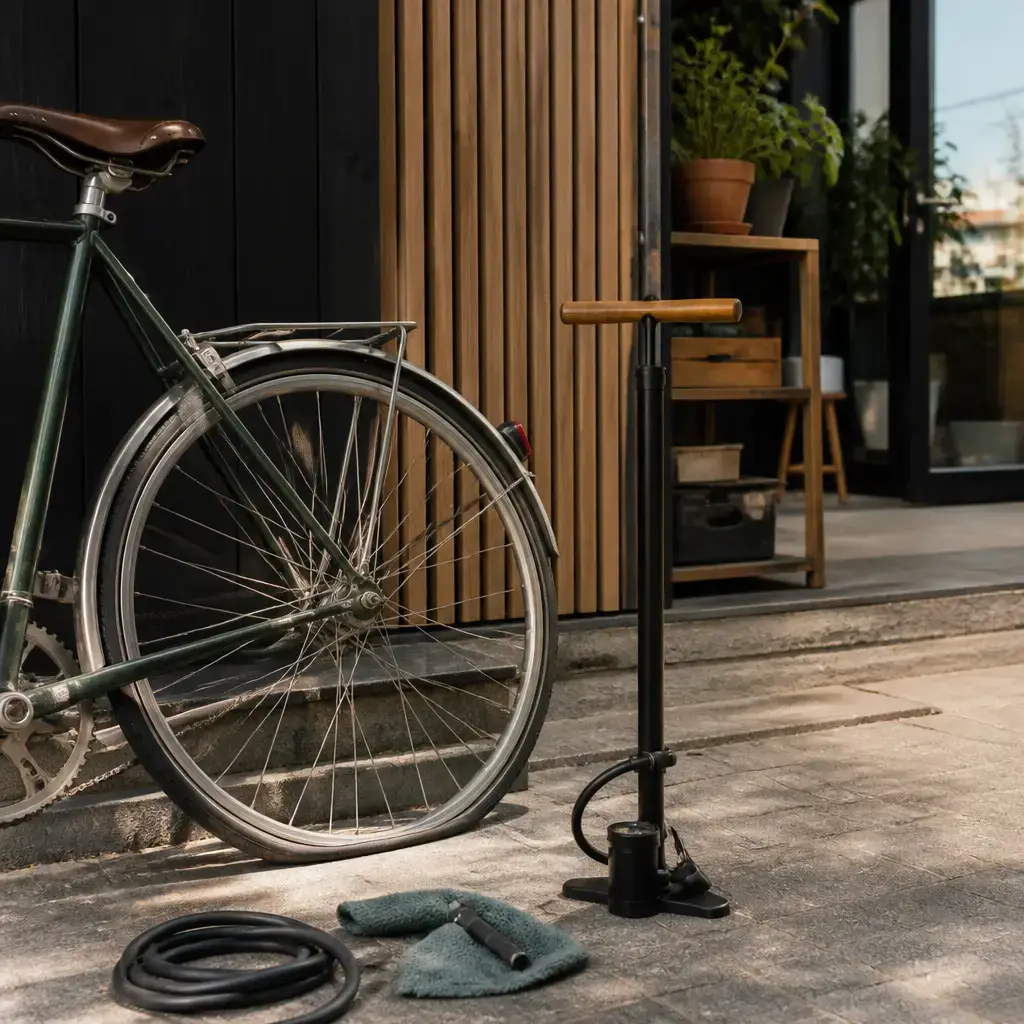
Mein
“Mein” means “my” in “Mein Hinterreifen” and identifies the tire as belonging to the speaker. It comes directly before the noun it describes. A reusable pattern is “Mein … ist …”.
Hinterreifen
“Hinterreifen” means “rear tire” here, referring to the tire at the back of the bicycle. It is the subject in “Mein Hinterreifen ist fast platt.” You can reuse it when describing the condition of a rear tire.
ist
“Ist” means “is” and links “Mein Hinterreifen” with its condition in “Mein Hinterreifen ist fast platt.” It is used in the pattern “X ist …” to describe a person or thing.
fast
“Fast” means “almost” and shows that the tire is close to being flat but not completely flat in “fast platt.” It comes before the word that describes the degree or condition. A reusable pattern is “fast …”.
platt
“Platt” means “flat” here and describes the condition of the tire. In “Mein Hinterreifen ist fast platt,” it refers to a tire that has lost much of its air. You can reuse “Der Reifen ist platt” as a new example.
Ich
“Ich” means “I” and is the speaker of “Ich habe eine Pumpe.” It is used as the subject when the speaker talks about having or doing something. A reusable pattern is “Ich habe …”.
habe
“Habe” means “have” in “Ich habe eine Pumpe,” stating that the speaker has a pump available. It is followed here by the thing the speaker has. A reusable pattern is “Ich habe …”.
eine
“Eine” means “a” and introduces one pump in “eine Pumpe.” It comes directly before the noun. The pattern “eine Pumpe” can be reused when mentioning an available pump.
Pumpe
“Pumpe” means “pump,” the tool that can be borrowed and used to add air. In “eine Pumpe, die du dir leihen kannst,” it is the item being offered. A reusable pattern is “eine Pumpe leihen.”
die
“Die” connects “Pumpe” with the information “die du dir leihen kannst” and refers back to the pump. The whole construction identifies which pump is meant: “eine Pumpe, die du dir leihen kannst.”
du
“Du” means “you” and is the person who can borrow the pump in “die du dir leihen kannst.” It addresses one person informally. A reusable pattern is “du kannst …”.
dir
“Dir” means “to you” or “for yourself” in “dir leihen,” showing that the person addressed can borrow the pump for personal use. It appears with the borrowing construction “sich etwas leihen.” A reusable pattern is “du kannst dir … leihen.”
leihen
“Leihen” means “borrow” in “die du dir leihen kannst.” It is the action that the person can perform, while “kannst” expresses ability. A reusable pattern is “sich etwas leihen,” with the borrowed object in the slot after “sich”.
kannst
“Kannst” means “can” or “are able to” in “die du dir leihen kannst.” It works with the infinitive “leihen,” which appears at the end of the clause. A reusable pattern is “du kannst dir … leihen.”
Soll
“Soll” means “should” in “Soll ich zuerst nach einem Loch suchen?” and asks whether the speaker ought to do something. It begins a question asking for advice or instruction. A reusable pattern is “Soll ich …?”.
zuerst
“Zuerst” means “first” and asks whether checking for a hole should happen before the other steps. It marks the first action in a sequence. A reusable pattern is “zuerst … suchen.”
nach
“Nach” means “for” in “nach einem Loch suchen,” as part of the expression for looking for something. Here it is followed by “einem Loch.” A reusable pattern is “nach etwas suchen.”
einem
“Einem” means “a” in “nach einem Loch.” After “nach” in this expression, it introduces the thing being searched for. A reusable pattern is “nach einem … suchen.”
Loch
“Loch” means “hole,” referring here to a possible hole in the tire. It appears in the phrase “nach einem Loch suchen.” You can reuse the complete pattern when searching for a hole.
suchen
“Suchen” means “look for” or “search for” in “nach einem Loch suchen.” It is used together with “nach” and the thing being sought. A reusable pattern is “nach etwas suchen.”
Schau
“Schau” means “look” and gives one person an informal instruction in “Schau vor dem Aufpumpen …”. It directs the listener’s attention to the sidewall. A reusable pattern is “Schau … entlang.”
vor
“Vor” means “before” in “vor dem Aufpumpen,” marking the action that must happen earlier. It introduces the activity that should come later. A reusable pattern is “vor dem …”.
dem
“Dem” means “the” in “vor dem Aufpumpen,” introducing the activity that follows “vor.” It belongs to the phrase “vor dem Aufpumpen.” This pattern can be reused before a named activity.
Aufpumpen
“Aufpumpen” means “pumping up” or “inflating” here, referring to adding air to the tire. In “vor dem Aufpumpen,” it is presented as the activity that comes after the inspection. A reusable pattern is “vor dem Aufpumpen.”
an
“An” means “at” or “on” in “an der Seitenwand entlang,” locating the path along the tire’s sidewall. It works together with “der Seitenwand.” A reusable pattern is “an … entlang.”
der
“Der” means “the” in “an der Seitenwand,” identifying the sidewall being examined. The same spelling appears capitalized at the start of “Der Reifen.” In this dialogue, it helps form the location phrase “an der Seitenwand entlang.”
Seitenwand
“Seitenwand” means “sidewall,” the side surface of the tire. In “an der Seitenwand entlang,” it names the area to inspect. A reusable pattern is “an der Seitenwand entlang.”
entlang
“Entlang” means “along” in “an der Seitenwand entlang,” describing movement or attention following the sidewall. It completes the location expression after “an der Seitenwand.” A reusable pattern is “an … entlang.”
mir
“Mir” means “to me” in “mir zeigen,” identifying the person who should receive the demonstration. It is used with “zeigen” when asking someone to show something to you. A reusable pattern is “Kannst du mir zeigen, wie …?”.
zeigen
“Zeigen” means “show” in “Kannst du mir zeigen, wie man sie befestigt?” and refers to demonstrating a method. It is used with a person introduced by “mir” and an explanation introduced by “wie.” A reusable pattern is “jemandem zeigen, wie man …”.
wie
“Wie” means “how” and introduces the method in “wie man sie befestigt.” It connects “zeigen” with an explanation of the action. A reusable pattern is “zeigen, wie man …”.
man
“Man” means “one” or “you in general” in “wie man sie befestigt.” It describes the method without naming a particular person. A reusable pattern is “wie man …”.
sie
“Sie” means “it” here and refers back to the pump in “wie man sie befestigt.” It is the thing being attached. A reusable pattern is “wie man sie befestigt.”
befestigt
“Befestigt” means “attaches” or “fastens” in “wie man sie befestigt,” describing how the pump part is secured. It is used with “sie” as the thing being attached. A reusable pattern is “wie man etwas befestigt.”
Drück
“Drück” means “press” and gives an informal instruction in “Drück dieses Teil auf das Ventil.” It tells the listener to apply the part to the valve. A reusable pattern is “Drück … auf …”.
dieses
“Dieses” means “this” and points to the specific part being held in “dieses Teil.” It comes directly before the noun it identifies. A reusable pattern is “dieses Teil.”
Teil
“Teil” means “part,” referring to a component of the pump. In “Drück dieses Teil auf das Ventil,” it is the object that should be pressed onto the valve. A reusable pattern is “dieses Teil auf das Ventil.”
auf
“Auf” means “onto” in “auf das Ventil,” showing the direction in which the part is pressed. It works with “Drück” to describe placing one thing onto another. A reusable pattern is “etwas auf das Ventil drücken.”
das
“Das” means “the” in “auf das Ventil,” identifying the specific valve receiving the pump part. It comes directly before “Ventil.” A reusable pattern is “auf das Ventil.”
Ventil
“Ventil” means “valve,” the part of the tire where the pump is attached. It appears in “auf das Ventil.” A reusable pattern is “etwas auf das Ventil drücken.”
und
“Und” means “and” and joins the two instructions in “Drück dieses Teil auf das Ventil und pumpe langsam.” It shows that pressing and pumping are consecutive parts of the same instruction. A reusable pattern is “A und B.”
langsam
“Langsam” means “slowly” and describes how the listener should pump in “pumpe langsam.” It comes after the action here. A reusable pattern is “Verb + langsam,” such as “pumpe langsam.”
Reifen
“Reifen” means “tire” in “Der Reifen fühlt sich jetzt fest genug an.” It is the thing whose condition is being assessed after pumping. A reusable pattern is “Der Reifen fühlt sich … an.”
fühlt
“Fühlt” is part of the construction “fühlt sich … an,” which means “feels …” here. In the dialogue, this construction describes how the tire seems when touched. A reusable pattern is “etwas fühlt sich … an.”
sich
“Sich” is the reflexive part of “fühlt sich … an,” making the tire the thing whose condition is being felt or assessed. It works together with “fühlt” and the final “an.” A reusable pattern is “etwas fühlt sich … an.”
jetzt
“Jetzt” means “now” and marks the current state of the tire after pumping. It appears in “fühlt sich jetzt fest genug an.” A reusable pattern is “jetzt …” when describing a changed or present condition.
fest
“Fest” means “firm” in “fühlt sich jetzt fest genug an,” describing the tire’s feel after air has been added. It appears before “genug” to show the degree of firmness. A reusable pattern is “sich fest anfühlen.”
genug
“Genug” means “enough” and shows that the tire has reached a sufficient level of firmness in “fest genug.” It follows the describing word here. A reusable pattern is “Adjective + genug,” as in “fest genug.”
zurück
“Zurück” means “back” in “Bring die Pumpe zurück,” telling the listener to return the pump to its previous place or owner. It completes the instruction with “Bring …”. A reusable pattern is “Bring etwas zurück.”
wenn
“Wenn” means “when” in “wenn du fertig bist,” introducing the time at which the pump should be returned. It connects the return instruction with the condition of being finished. A reusable pattern is “wenn …”.
fertig
“Fertig” means “finished” or “done” in “wenn du fertig bist,” describing the person’s state after completing the task. It is used with “sein” to say that someone is done. A reusable pattern is “du bist fertig.”
bist
“Bist” means “are” in “wenn du fertig bist,” completing the expression “you are finished.” It appears at the end of the clause introduced by “wenn.” A reusable pattern is “du bist fertig.”