Kann
Kann asks for permission in Kann ich etwas Putzspray benutzen? It is used at the beginning of this yes-or-no question. A reusable pattern is to put Kann before ich when asking whether you may do something.
ich
ich means I and refers to the person asking or acting in the dialogue. It is the subject in Kann ich etwas Putzspray benutzen? and Ich bringe beide zurück, wenn ich fertig bin. Use ich when describing your own action or state.
etwas
etwas means some in the request for an unspecified amount of cleaning spray, and something in Ist etwas verschüttet worden? Its meaning depends on whether it accompanies a substance or stands for an unspecified thing. It commonly appears before an unspecified noun or as the subject of a question.
Putzspray
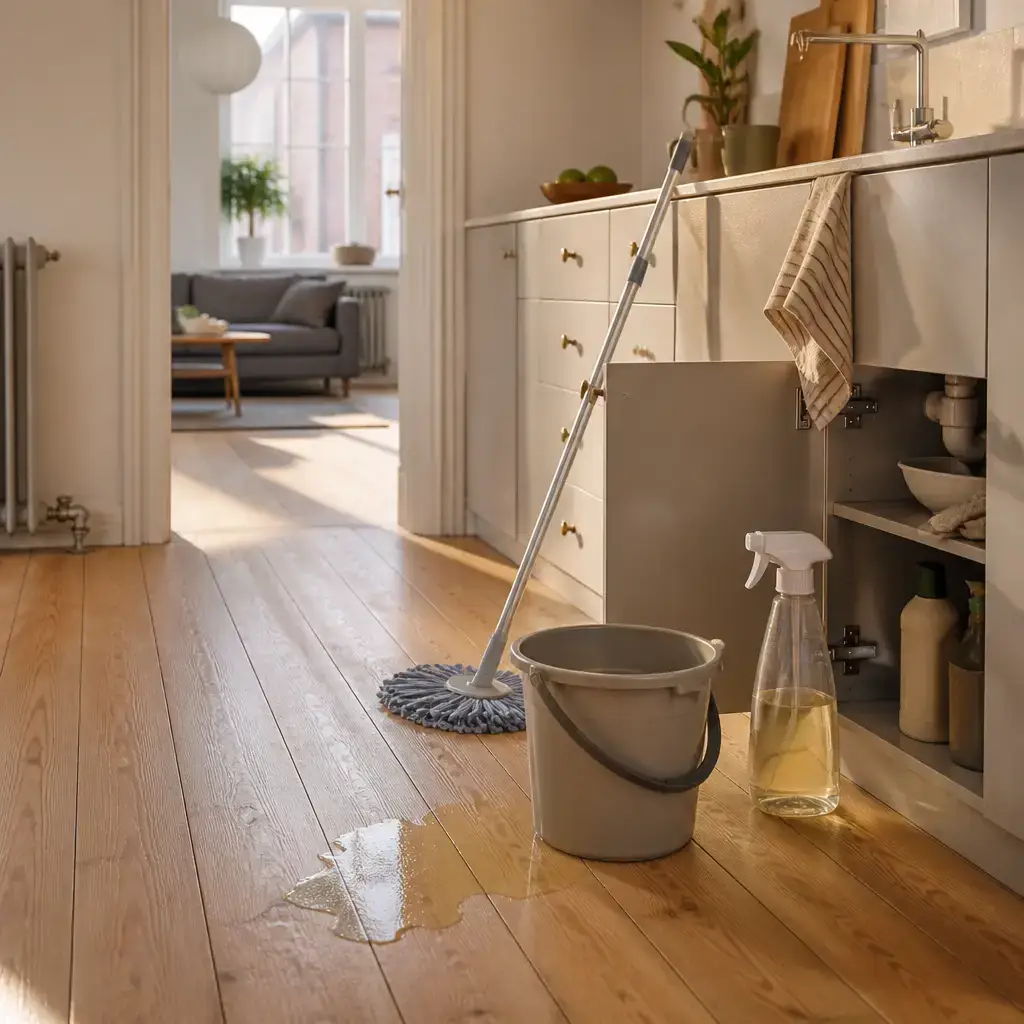
Putzspray means cleaning spray, the product the speaker wants to use. It is the object of benutzen in Kann ich etwas Putzspray benutzen? The compound names a spray used for cleaning.
benutzen
benutzen means to use in Kann ich etwas Putzspray benutzen? It is the action the speaker asks permission to perform. It can be reused with an object naming a tool, product, or other thing being used.
Es
Es means it in Es steht unter der Spüle, referring to the cleaning spray. It is the subject of the statement about where the spray is located. Es can refer back to a previously mentioned thing.
steht
steht says that the cleaning spray is located under the sink in Es steht unter der Spüle. Here it describes the position of an object rather than an action of standing. The dialogue reuses it with a location phrase introduced by unter.
unter
unter means under and gives the location of the spray in unter der Spüle. It places one thing below another. Use it with a following place or object when describing a lower position.
der
der means the in der Spüle, identifying the specific sink under which the spray is located. It belongs to the noun phrase naming that location. The exact form der appears before Spüle here.
Spüle
Spüle means sink, specifically the sink under which the cleaning spray is located. It completes the location phrase unter der Spüle. It is useful when identifying where a kitchen item can be found.
Ist
Ist is the form used for is in Ist etwas verschüttet worden? and Saft ist auf den Küchenboden verschüttet worden. At the start of the first sentence it forms a question; in the second it links Saft to the report about spilling. The dialogue shows it with etwas and with a named subject such as Saft.
verschüttet
verschüttet describes liquid that has been spilled in verschüttet worden. It appears in the question about whether something was spilled and in the statement that juice was spilled. Use it with a liquid and the location affected when reporting a spill.
worden
worden completes the report of a completed spilling event in Ist etwas verschüttet worden? and Saft ist auf den Küchenboden verschüttet worden. Its contribution is part of the expression verschüttet worden, which reports that the spilling happened to something. It follows verschüttet in both dialogue lines.
Saft
Saft means juice and is the liquid that was spilled in Saft ist auf den Küchenboden verschüttet worden. It is the named subject of this report. Use it when identifying what substance caused the mess.
auf
auf means onto or on in auf den Küchenboden, identifying the surface affected by the spilled juice. Here it connects the spilling event with the kitchen floor. It is reusable before a phrase naming the surface or place involved.
den
den means the in den Küchenboden, identifying the specific kitchen floor affected by the spill. It belongs to the phrase auf den Küchenboden. The exact form den appears before Küchenboden in this location phrase.
Küchenboden
Küchenboden means kitchen floor, the surface where the juice spilled. It completes auf den Küchenboden and identifies the area that needs cleaning. The compound combines kitchen with floor to name this specific place.
Nimm
Nimm means take in the direct instruction Nimm auch den kleinen Eimer. It tells the other person to take the bucket along with the spray. It is useful for giving an informal instruction about taking an object.
auch
auch means too in Nimm auch den kleinen Eimer, adding the bucket to the things already being taken. It marks an additional item or action. It commonly appears when another person should include one more thing.
kleinen
kleinen means small in den kleinen Eimer and describes the bucket being offered. It appears directly before Eimer inside the object phrase. It can be reused before a noun when identifying a small item.
Eimer
Eimer means bucket, the additional cleaning item to take. It is the object of Nimm in Nimm auch den kleinen Eimer. It is used here for a container needed to rinse the mop.
damit
damit means so that and introduces the purpose of taking the bucket in damit du den Mopp ausspülen kannst. It connects the action in the main clause with the intended result. A damit clause explains what an action is meant to make possible.
du
du means you and refers to the person who will rinse the mop in damit du den Mopp ausspülen kannst. It is the subject of this purpose clause. It is used when addressing one person informally.
Mopp
Mopp means mop, the cleaning tool to be rinsed. It is the object in den Mopp ausspülen. Use it when naming the tool involved in cleaning the floor.
ausspülen
ausspülen means rinse out in den Mopp ausspülen. It names the cleaning action made possible by taking the bucket. In the dialogue it remains together as an infinitive after kannst.
kannst
kannst means can in damit du den Mopp ausspülen kannst, expressing that the other person will be able to rinse the mop. It is used with the subject du and the infinitive ausspülen. This pattern places the action at the end of the damit clause.
Das
Das means that or it in Das hilft, referring to the help provided by the suggested cleaning supplies. It is the subject of hilft and points back to the preceding situation. Das can refer to an entire preceding action or offer.
hilft
hilft means helps in Das hilft, expressing that the offered solution is useful. The subject Das refers to the preceding help with the spill. It can be used to respond positively when an action or suggestion makes a situation easier.
bringe
bringe means bring in Ich bringe beide zurück, stating what the speaker will do with the borrowed items. It is used with the subject Ich and the object beide. The dialogue places zurück after the object to express bringing something back.
beide
beide means both and refers to the two borrowed items in Ich bringe beide zurück. It functions as the object of bringe and avoids repeating the item names. Use it when referring to two known things together.
zurück
zurück means back in Ich bringe beide zurück, showing that the items will be returned to their owner or place. Together with bringe, it expresses returning the borrowed things. It is useful after an action verb when something moves back to an earlier place or person.
wenn
wenn means when or once in wenn ich fertig bin and wenn alles trocken ist. It introduces the condition or time for the action in the main clause. A wenn clause gives the point at which the promised or requested action should happen.
fertig
fertig means finished or done in wenn ich fertig bin, referring to finishing the cleaning task. It describes the speaker's completed state. It is commonly used with bin to say that a person is done with an activity.
bin
bin means am in wenn ich fertig bin, describing the speaker's state as being done. It appears with ich and completes the expression fertig bin. Use bin with a word or phrase describing your current state.
Stell
Stell means put or place in the instruction Stell sie vor meine Tür. It tells the other person where to leave the borrowed items after cleaning. It is used here with an object and a location phrase.
sie
sie means them in Stell sie vor meine Tür and refers to the cleaning supplies that should be returned. It is the object of Stell. Use sie this way when referring back to known plural items.
vor
vor means in front of or by in vor meine Tür, giving the place where the items should be left. It identifies a position directly in front of the speaker's door. It is reusable with a noun phrase naming the place of placement.
meine
meine means my in meine Tür and identifies the door belonging to the person speaking. It modifies Tür inside the location phrase. It is used with a singular feminine noun in this exact expression.
Tür
Tür means door, specifically the speaker's door in vor meine Tür. It completes the location where the supplies should be left. Use it when directing someone to a doorway or identifying a place by a door.
alles
alles means everything in wenn alles trocken ist, referring to the cleaned area and items as a whole. It is the subject of trocken ist. It is useful when a condition applies to all relevant things without naming each one.
trocken
trocken means dry in wenn alles trocken ist, describing the condition required before the items are left by the door. It follows alles and is completed by ist. It can be reused to describe a surface or object after liquid has been removed.
Danke
Danke means thanks in Danke für deine Hilfe bei diesem Chaos. It expresses appreciation for the other person's help. It is commonly followed by für and the thing being appreciated.
für
für means for in für deine Hilfe, introducing what the speaker is thanking the other person for. It connects Danke with the appreciated help. The dialogue uses it before a noun phrase naming the reason for thanks.
deine
deine means your in deine Hilfe and refers to the help provided by the person addressed as du. It identifies the help as belonging to that person. It is used here before Hilfe in the expression Danke für deine Hilfe.
Hilfe
Hilfe means help in Danke für deine Hilfe, naming the assistance the speaker appreciates. It is the object of für after Danke. It is useful when thanking someone for assistance in a situation.
bei
bei means with or in connection with in bei diesem Chaos, describing the situation in which the help was given. It connects Hilfe with the mess being handled. Use it here before a noun phrase naming the situation or task involved.
diesem
diesem means this in bei diesem Chaos, pointing to the particular mess in the shared space. It modifies Chaos inside the phrase describing the situation. The exact form diesem appears directly before Chaos.
Chaos
Chaos means mess or chaos in bei diesem Chaos, referring to the disorder caused by the spilled juice. It names the situation for which help was needed. It can describe a disorganized or messy state.
Achte
Achte means make sure or pay attention in Achte nur darauf, dass der Boden danach nicht rutschig ist. It gives an informal instruction to check a safety condition. The dialogue uses it with darauf, dass to introduce what must be checked.
nur
nur means just in Achte nur darauf, dass der Boden danach nicht rutschig ist. It softens the instruction by presenting this as the one thing to make sure of. It is placed directly before darauf in this expression.
darauf
darauf is part of Achte nur darauf, dass der Boden danach nicht rutschig ist and points to the condition that must be checked. With Achte and dass, the whole construction means make sure that. It is reusable before a dass clause stating the thing to verify.
dass
dass means that and introduces the content of the check in dass der Boden danach nicht rutschig ist. It connects Achte darauf with the required condition. The clause after dass states what should be true.
Boden
Boden means floor in der Boden danach nicht rutschig ist, referring to the kitchen floor being cleaned. It is the subject of the condition introduced by dass. Use it when discussing the floor or ground surface.
danach
danach means afterward in der Boden danach nicht rutschig ist. It specifies that the floor must be checked after the cleaning process. It is useful for locating a condition after an already mentioned action or event.
nicht
nicht means not in nicht rutschig, denying the condition that the floor is slippery. It makes the required result a safe, non-slippery floor. It appears directly before rutschig in this description.
rutschig
rutschig means slippery in der Boden danach nicht rutschig ist. It describes the unsafe condition that should not remain after cleaning. It can be used to describe a surface that may cause someone to slip.