Kann
In ‘Kann ich mir heute deine große Pfanne ausleihen?’ Kann asks whether the speaker may borrow something. It commonly begins a request followed by an infinitive.
ich
ich means ‘I’ and identifies the speaker. In ‘Ich werde sie direkt nach dem Abendessen abwaschen’, it is the subject; in a question such as ‘Kann ich ...?’, it follows the verb.
mir
mir means ‘to me’ here and shows that the speaker borrows the pan for themself. It appears in ‘mir heute deine große Pfanne ausleihen’ as part of the borrowing construction.
heute
heute means ‘today’ and gives the time of the borrowing. It can be placed near the beginning of a sentence to specify when something happens.
deine
deine means ‘your’ and shows that the pan belongs to the person being addressed. It appears directly before ‘große Pfanne’.
große
große means ‘large’ and describes the pan in ‘große Pfanne’. An adjective like this appears before the noun it describes.
Pfanne
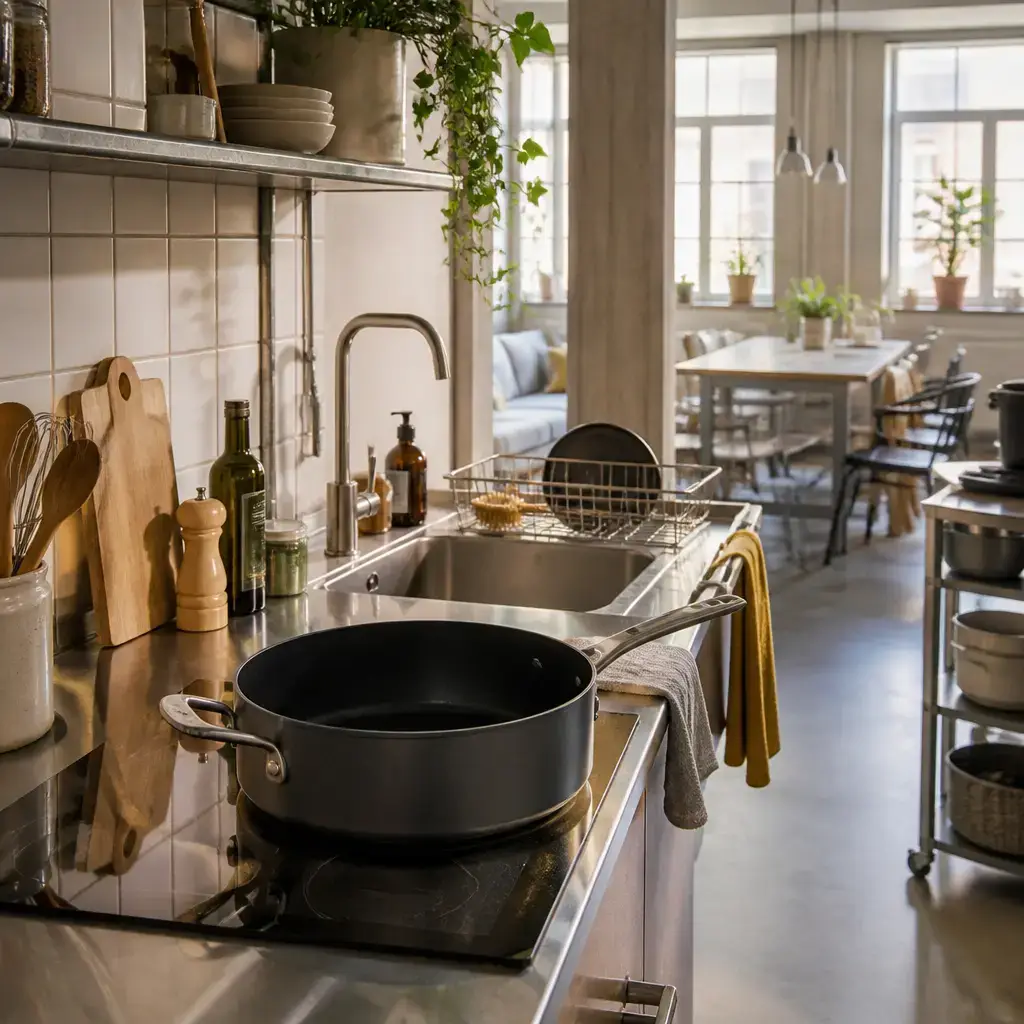
Pfanne means ‘pan’ and names the item being borrowed. In ‘deine große Pfanne’, it is the noun after the possessive and adjective.
ausleihen
ausleihen means ‘to borrow’ in this dialogue. It appears at the end of ‘Kann ich mir heute deine große Pfanne ausleihen?’ after Kann.
Ja
Ja means ‘yes’ and confirms the request. It can stand alone as an answer before an additional condition or warning.
aber
aber means ‘but’ and introduces a qualification to the positive answer. ‘Ja, aber’ is a common way to agree while adding a warning or condition.
pass
pass means ‘watch out’ or ‘take care’ in this direct command. In ‘pass auf den Griff auf’, the warning concerns the handle.
auf
Here auf is the separable part that completes the warning verb in ‘pass auf den Griff auf’. The object den Griff comes between pass auf and the final auf.
den
den is the definite article used before Griff in ‘den Griff’. It helps identify the specific handle that needs attention.
Griff
Griff means ‘handle’ and names the part of the pan being discussed. In ‘pass auf den Griff auf’, it is the object of the warning.
denn
denn means ‘because’ and introduces the reason for the warning. It links the warning to ‘denn er wird heiß’.
er
er means ‘it’ here and refers back to Griff, the handle. It is the subject in ‘er wird heiß’, avoiding repetition of the noun.
wird
wird means ‘gets’ or ‘becomes’ in ‘er wird heiß’. It describes a change into the state expressed by heiß and is used with that adjective here.
heiß
heiß means ‘hot’ and describes the handle’s resulting temperature. The reusable pattern ‘wird heiß’ expresses that something becomes hot.
Ist
Ist means ‘is’ at the beginning of the question ‘Ist sie auf diesem Herd in Ordnung?’. Its position first marks this as a yes-or-no question.
sie
sie means ‘it’ here and refers to the pan, Pfanne. It is the subject in ‘Ist sie ...?’ and ‘Sie sollte ...’, and the object in ‘werde sie ... abwaschen’.
diesem
diesem means ‘this’ and identifies the particular stove being discussed. It appears directly before Herd in ‘diesem Herd’.
Herd
Herd means ‘stove’ and names where the pan will be used. The phrase ‘auf diesem Herd’ specifies the stove in question.
in Ordnung
The whole expression ‘in Ordnung’ means ‘all right’ or ‘fine’ here. In contributes the preposition and Ordnung contributes the idea of order; together they express that something is acceptable, as in ‘Ist sie auf diesem Herd in Ordnung?’.
sollte
sollte means ‘should’ and gives a qualified expectation that the pan will be fine. It is followed by sein in ‘Sie sollte in Ordnung sein’.
sein
sein means ‘be’ and completes the expression after sollte in ‘Sie sollte in Ordnung sein’. It is the infinitive used to describe the expected condition.
wenn
wenn means ‘if’ and introduces the condition ‘wenn du die Hitze niedrig hältst’. In this subordinate clause, hältst comes at the end.
du
du means ‘you’ and addresses one person directly. It is the subject of hältst in ‘wenn du die Hitze niedrig hältst’.
die
die is the definite article in ‘die Hitze’. It identifies the particular heat level being discussed.
Hitze
Hitze means ‘heat’ and names what should be kept low. In ‘die Hitze niedrig hältst’, it is the thing whose level is controlled.
niedrig
niedrig means ‘low’ and describes the desired heat level. It appears with ‘die Hitze ... hältst’ to say that the heat should remain low.
hältst
hältst means ‘keep’ in ‘du die Hitze niedrig hältst’. This is the form used with du, and it appears at the end of the wenn-clause.
werde
werde means ‘will’ in ‘Ich werde sie direkt nach dem Abendessen abwaschen’. It is used with the infinitive abwaschen to state a future action.
direkt
direkt means ‘directly’ or ‘right’ and emphasizes that the washing will happen immediately after dinner. It appears before the time phrase ‘nach dem Abendessen’.
nach
nach means ‘after’ and places the action in time relative to dinner. It is used in the time phrase ‘nach dem Abendessen’.
dem
dem is the definite article in ‘dem Abendessen’. It belongs to the time phrase introduced by nach and comes directly before Abendessen.
Abendessen
Abendessen means ‘dinner’ and provides the time reference for washing the pan. ‘Nach dem Abendessen’ means after dinner.
abwaschen
abwaschen means ‘wash’ or ‘wash up’ in this dialogue. It appears at the end of ‘Ich werde sie direkt nach dem Abendessen abwaschen’ as the action planned for the pan.
Bitte
Bitte means ‘please’ and makes the request polite. It appears at the beginning of ‘Bitte trockne sie gut ab’.
trockne
trockne means ‘dry’ in this direct request to one person. In ‘trockne sie gut ab’, it tells the listener to dry the pan thoroughly.
gut
gut means ‘well’ here and describes how thoroughly the pan should be dried. It appears between sie and the separable particle ab in ‘trockne sie gut ab’.
ab
Here ab is the separable part that completes the drying verb in ‘trockne sie gut ab’. The object sie and the adverb gut come before this final particle.
bevor
bevor means ‘before’ and introduces the action that must happen first. In ‘bevor du sie zurückbringst’, it introduces the return of the pan.
zurückbringst
zurückbringst means ‘bring back’ or ‘return’ in ‘bevor du sie zurückbringst’. It is the form used with du and stands at the end of the subordinate clause.
Brauchst
Brauchst means ‘need’ in the question ‘Brauchst du sie morgen wieder?’. It asks whether the other person needs the pan again.
morgen
morgen means ‘tomorrow’ and specifies when the pan might be needed. It appears in ‘Brauchst du sie morgen wieder?’ after the object sie.
wieder
wieder means ‘again’ and shows that the need would happen another time. The phrase ‘morgen wieder’ means again tomorrow.
es
es is the pronoun used in ‘Nach dem Abendessen ist es in Ordnung’ for the situation or arrangement being judged acceptable. It completes the sentence with ist in Ordnung.
brauche
brauche means ‘need’ in ‘Ich brauche sie erst später in dieser Woche’. It is the form of brauchen used with ich and takes sie as its object.
erst
erst means ‘only’ or ‘not until’ in ‘erst später in dieser Woche’. It postpones the need until the later time mentioned.
später
später means ‘later’ and identifies a time after the present point. Together with erst, ‘erst später’ means not until later.
in
in means ‘in’ or ‘within’ in the time phrase ‘in dieser Woche’. Here it places the later time within the current week.
dieser
dieser means ‘this’ and identifies the week being discussed. It appears directly before Woche in ‘dieser Woche’.
Woche
Woche means ‘week’ and names the time period in ‘in dieser Woche’. The phrase specifies when the pan will next be needed.