Ich
Ich means “I” in this dialogue, as in “Ich möchte einen Lernraum reservieren.” It is used as the subject when the speaker describes their own request or action. A common pattern is “Ich möchte ...” for expressing what you would like to do.
möchte
möchte expresses “would like” in “Ich möchte einen Lernraum reservieren.” It makes the request polite and is followed here by the infinitive “reservieren.” A reusable pattern is “Ich möchte ...” when politely stating a wish.
einen
einen means “a” or “one” before “Lernraum” in “einen Lernraum.” It marks the specific object being reserved in this sentence. Reuse “einen” before a masculine noun when it is the object of an action, for example “Ich buche einen Raum.”
Lernraum
Lernraum means “study room” in “einen Lernraum reservieren.” It names the room intended for studying. A useful pattern is “einen Lernraum reservieren” when asking to reserve such a room.
reservieren
reservieren means “to reserve” in “einen Lernraum reservieren.” It appears in the infinitive after “möchte.” Reuse it with the thing being reserved, as in “Ich möchte einen Raum reservieren.”
schaue
schaue means “check” or “look” in “Ich schaue nach.” Together with “nach,” it describes checking information. A common pattern is “Ich schaue nach, welche ...” when checking which options are available.
nach
nach is the particle in “Ich schaue nach,” meaning that the speaker checks or looks something up. Its meaning here comes from the expression “nachschauen,” not from “nach” alone. Reuse the separated pattern “Ich schaue nach, welche ...” when checking information.
welche
welche means “which” in “welche Räume heute frei sind.” It introduces the question of which rooms meet the condition. A reusable pattern is “welche Räume ...” when selecting among several rooms.
Räume
Räume means “rooms” in “welche Räume heute frei sind.” It refers to multiple rooms that may be available. Reuse it with a description or condition, such as “Räume reservieren” or “Räume sind frei.”
heute
heute means “today” in “welche Räume heute frei sind” and “Heute Nachmittag.” It places the availability or time in the current day. A common pattern is “heute frei” for something available today.
frei
frei means “available” in “welche Räume heute frei sind” and “ein kleiner Raum ist frei.” Here it describes a room that can be used or booked. Reuse “Der Raum ist frei” to say that a room is available.
sind
sind means “are” in “welche Räume heute frei sind.” It links the plural subject “Räume” with the description “frei.” A reusable pattern is “Die Räume sind frei” when describing several available rooms.
brauche
brauche means “need” in “Ich brauche einen ruhigen Ort.” It expresses that the speaker requires a particular place. Reuse “Ich brauche ...” before the thing or place that is needed.
ruhigen
ruhigen means “quiet” in “einen ruhigen Ort.” It describes the place needed for studying. The ending in “ruhigen” fits the phrase “einen ... Ort”; reuse the whole pattern “einen ruhigen Ort” when asking for a quiet place.
Ort
Ort means “place” in “einen ruhigen Ort.” It refers here to a suitable place for studying. A useful pattern is “Ich brauche einen ... Ort” when explaining what kind of place you need.
um
um begins the purpose expression “um mit einem Klassenkameraden zu lernen,” meaning “in order to study with a classmate.” It introduces the purpose of needing a quiet place and works together with “zu” and the infinitive. Reuse “um ... zu ...” to explain why an action or place is needed.
mit
mit means “with” in “mit einem Klassenkameraden.” It shows who will study together with the speaker. It is commonly followed by the person or group accompanying someone, as in “mit einem Freund.”
einem
einem means “a” or “one” before “Klassenkameraden” in “mit einem Klassenkameraden.” The form is used after “mit” in this phrase. Reuse “mit einem ...” before a masculine or neuter person or thing accompanying an action.
Klassenkameraden
Klassenkameraden means “classmate” in “mit einem Klassenkameraden.” It identifies the person who will study with the speaker. A useful pattern is “mit einem Klassenkameraden lernen” when describing studying together.
zu
zu is part of the infinitive expression “zu lernen” in “um mit einem Klassenkameraden zu lernen.” Together with “um,” it helps express purpose. Reuse the complete pattern “um ... zu lernen” when saying that something is done in order to study.
lernen
lernen means “to study” or “to learn” in “mit einem Klassenkameraden zu lernen.” It is the infinitive used to state the purpose of needing the place. Reuse it with the subject or activity being learned, for example “Deutsch lernen.”
Nachmittag
Nachmittag means “afternoon” in “Heute Nachmittag.” It identifies the part of the day when the room is available. A common time expression is “am Nachmittag,” while this dialogue uses “Heute Nachmittag.”
ist
ist means “is” in “ein kleiner Raum ist frei.” It links the singular subject “Raum” with its availability. Reuse “Der Raum ist frei” to state that one room is available.
ein
ein means “a” before “kleiner Raum” in “ein kleiner Raum.” It introduces one unspecified room that is available. Reuse “ein” before a masculine noun when introducing it as the subject of a sentence.
kleiner
kleiner means “small” in “ein kleiner Raum.” It describes the available room. The ending in “kleiner” fits this phrase with “ein” and the masculine noun “Raum”; reuse “ein kleiner Raum” as a complete description.
Raum
Raum means “room” in “ein kleiner Raum.” It refers to the study room that is available this afternoon. A useful pattern is “Ein Raum ist frei” when announcing that a room is available.
Kann
Kann means “can” in “Kann ich ihn am Serviceschalter buchen?” It asks whether the speaker is allowed or able to book the room there. A reusable question pattern is “Kann ich ... buchen?” for asking permission to make a booking.
ihn
ihn means “it” in “Kann ich ihn am Serviceschalter buchen?” and refers back to the masculine noun “Raum.” It is the object of “buchen” in this sentence. Reuse “Ich buche ihn” when referring back to a masculine item already mentioned.
am
am means “at the” in “am Serviceschalter.” It is the contracted form used in this location expression. Reuse “am Serviceschalter” when saying that an action takes place at the service desk.
Serviceschalter
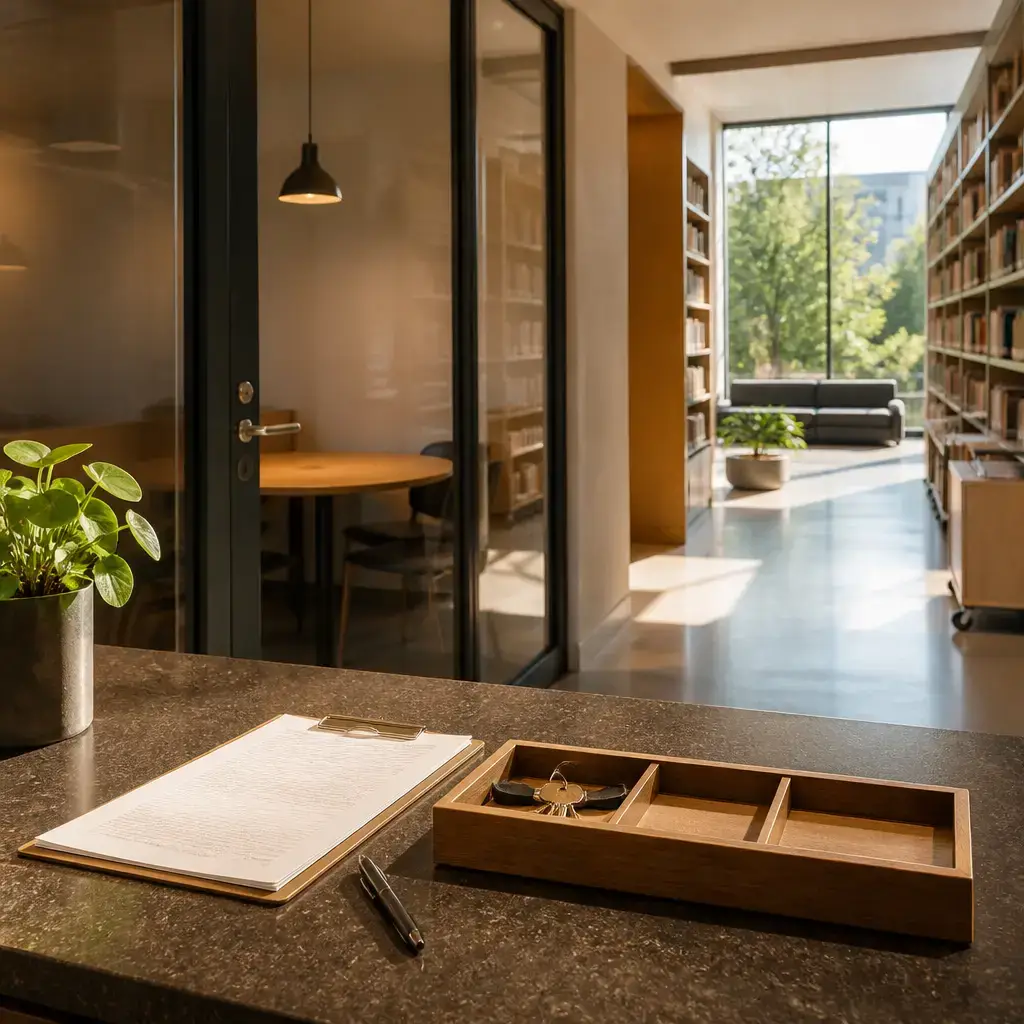
Serviceschalter means “service desk” in “am Serviceschalter.” It identifies the place where the room can be booked and where the form is handled. A useful pattern is “etwas am Serviceschalter buchen” for booking something at the service desk.
buchen
buchen means “to book” in “ihn am Serviceschalter buchen.” It describes making the reservation for the room. Reuse it with the item being booked, as in “einen Raum buchen.”
Bitte
Bitte means “please” in “Bitte füllen Sie hier das Anfrageformular aus.” It makes the instruction polite. Reuse “Bitte” at the beginning of a polite request or instruction.
füllen
füllen means “fill” in “füllen Sie ... aus.” Together with “aus,” it means “fill in” the form. Reuse the complete pattern “Bitte füllen Sie ... aus” when politely telling someone to complete a form.
Sie
Sie means formal “you” in “füllen Sie hier das Anfrageformular aus” and “Bringen Sie ihn ... zurück.” It addresses the other person respectfully. Reuse “Sie” with the formal verb form when giving a polite instruction or asking a service worker a question.
hier
hier means “here” in “füllen Sie hier das Anfrageformular aus.” It indicates the place where the form should be completed. Reuse “hier” to point out the location for an action.
das
das means “the” in “das Anfrageformular.” It refers to the particular request form that is present or understood at the desk. Reuse “das” before the neuter noun “Anfrageformular” when referring to this form.
Anfrageformular
Anfrageformular means “request form” in “das Anfrageformular.” It is the form the person must complete to make the request. A useful pattern is “das Anfrageformular ausfüllen” when completing a request form.
aus
aus is the particle in “füllen Sie ... aus,” which means “fill in” when used with “füllen.” Its meaning here comes from the complete verb “ausfüllen.” Reuse the separated pattern “Sie füllen das Formular aus.”
Gebe
Gebe means “give” in the question “Gebe ich den Schlüssel ... zurück?” Together with “zurück,” it expresses returning the key. Reuse the question pattern “Gebe ich ... zurück?” when checking whether you should return something.
den
den means “the” before “Schlüssel” in “den Schlüssel ... zurück.” It refers to the particular key that must be returned. The form fits the key as the object of “zurückgeben”; reuse “den Schlüssel zurückgeben” for returning the key.
Schlüssel
Schlüssel means “key” in “den Schlüssel ... zurück.” It identifies the object that the learner must return after using the room. A useful pattern is “den Schlüssel zurückgeben” when returning a key.
an
an means “to” or “at” in “an diesem Serviceschalter.” Here it identifies the service desk as the destination for returning the key. Reuse the phrase “etwas an einem Serviceschalter zurückgeben” when returning something at a service desk.
diesem
diesem means “this” in “an diesem Serviceschalter.” It points to the particular service desk being discussed. The form fits the phrase after “an” for this location; reuse “an diesem ...” when indicating a specific place.
zurück
zurück means “back” in “den Schlüssel ... zurück” and “Bringen Sie ihn ... zurück.” It shows that the key or item is being returned. Reuse it with a suitable verb, such as “den Schlüssel zurückgeben” or “ihn zurückbringen.”
Bringen
Bringen means “bring” in “Bringen Sie ihn vor der Schließzeit zurück.” With “zurück,” it tells the person to bring the key back. Reuse the formal instruction pattern “Bringen Sie ... zurück” when asking someone to return an item.
vor
vor means “before” in “vor der Schließzeit.” It sets the deadline for returning the key. Reuse “vor der ...” before a time or event that must not be passed.
der
der means “the” in “der Schließzeit.” It refers to the closing time as the deadline for returning the key. Reuse “vor der Schließzeit” when stating that something must happen before the place closes.
Schließzeit
Schließzeit means “closing time” in “vor der Schließzeit.” It identifies the time by which the key must be returned. A useful pattern is “vor der Schließzeit zurückbringen” for returning something before closing.