Könnten
„Könnten“ expresses “could” in the polite request „Könnten Sie ... empfehlen?“. Use this form when making a courteous request to someone formally.
Sie
„Sie“ means “you” when addressing one or more people formally. In „Könnten Sie ...?“ and „Suchen Sie ...?“, it marks respectful communication with the librarian.
Sprachlernenden
„Sprachlernenden“ means “language learners” here, the people for whom the recommended book is suitable. It follows „ein Buch empfehlen“ as the people receiving the recommendation; a new example is „Ich helfe Sprachlernenden.“
ein
„ein“ means “a” in „ein Buch“, introducing one unspecified book. Use it before a singular noun when referring to one item without identifying it further.
Buch
„Buch“ means “book”, the item being recommended and borrowed in this dialogue. A common pattern is „ein Buch empfehlen“ for recommending a book.
empfehlen
„empfehlen“ means “recommend” in „Sprachlernenden ein Buch empfehlen“. The pattern places the people receiving the recommendation before the thing recommended; a new example is „Können Sie mir ein Buch empfehlen?“
Suchen
„Suchen“ means “are looking for” in the question „Suchen Sie einfache Geschichten oder kurze Artikel?“. Use „Suchen Sie ...?“ to ask formally what someone wants to find.
einfache
„einfache“ describes the „Geschichten“ as easy or simple. It is useful before a noun when describing material that is not difficult; a new example is „einfache Texte“.
Geschichten
„Geschichten“ means “stories”, specifically the easy stories being considered and requested. A common pattern is „kurze Geschichten“ when describing stories by their length.
oder
„oder“ means “or” and presents two alternatives in „einfache Geschichten oder kurze Artikel“. Use it to connect options in a question or statement.
kurze
„kurze“ describes the „Artikel“ as short. It can be placed directly before a noun to describe its limited length; a new example is „eine kurze Nachricht“.
Artikel
„Artikel“ means “articles”, offered as the alternative to stories in the librarian’s question. A common pattern is „kurze Artikel“ for short written pieces.
Ich
„Ich“ means “I”, the person asking for a book and deciding what kind of material is wanted. Use it at the start of a sentence when speaking about yourself, as in „Ich möchte ...“.
möchte
„möchte“ expresses “would like” or “want” in „Ich möchte kurze Geschichten ...“. It is a polite way to state a preference or request; a new example is „Ich möchte ein Buch.“
mit
„mit“ means “with” and introduces what the stories should contain in „mit einfachen Wörtern“. Use „mit“ before an accompanying thing or feature; a new example is „Kaffee mit Milch“.
einfachen
„einfachen“ means “simple” or “easy” and describes the „Wörtern“ in „mit einfachen Wörtern“. The phrase is useful when describing language that is easy for a learner to understand.
Wörtern
„Wörtern“ means “words” in „mit einfachen Wörtern“, referring to the vocabulary used in the stories. A common pattern is „mit ... Wörtern“ when describing something by the words it uses.
Dieses
„Dieses“ means “this” and points to the particular book being recommended in „Dieses Buch“. Use it before a noun when identifying a nearby or already-mentioned item.
hat
„hat“ means “has” in „Dieses Buch hat ...“, introducing the contents or features of the book. It is commonly used to say that a book, object, or place contains something.
leicht
„leicht“ contributes the meaning “easy” in „leicht verständliche Geschichten“. Together with „verständliche“, it describes stories that learners can understand without much difficulty.
verständliche
„verständliche“ means “understandable” in „leicht verständliche Geschichten“. Together with „leicht“, it describes the stories as easy to understand; a new example is „verständliche Erklärungen“.
und
„und“ means “and” and connects „leicht verständliche Geschichten“ with „hilfreiche Bilder“. Use it to join two related items or descriptions.
hilfreiche
„hilfreiche“ means “helpful” and describes the „Bilder“ in the book. It is useful before a noun when explaining that something supports the learner; a new example is „hilfreiche Hinweise“.
Bilder
„Bilder“ means “pictures”, one of the helpful features of the book. A common pattern is „Bilder haben“ when saying that a book or other material contains pictures.
Kann
„Kann“ means “can” in the permission question „Kann ich es heute mit nach Hause nehmen?“. Use „Kann ich ...?“ to ask whether you may do something.
es
„es“ means “it” and refers back to the book in „Kann ich es ... nehmen?“. Use it to avoid repeating a previously mentioned neuter item such as „das Buch“.
heute
„heute“ means “today” and specifies when the speaker wants to take the book home. It can be placed in a sentence to identify the current day; a new example is „Ich komme heute.“
nach Hause
„nach Hause“ means “home” or “to home” in „mit nach Hause nehmen“. Here „nach“ marks movement toward a destination, and „Hause“ is the form used in this fixed expression. Use „nach Hause“ when describing going or taking something home.
nehmen
„nehmen“ means “take” in „es ... mit nach Hause nehmen“. The reusable pattern is „etwas mit nach Hause nehmen“, with the thing being taken before the destination phrase.
Bitte
„Bitte“ means “please” at the beginning of the instruction „Bitte zeigen Sie ...“. Use it to make a request or instruction more polite.
zeigen
„zeigen“ means “show” in „Bitte zeigen Sie Ihre Bibliothekskarte“. A common pattern is „jemandem etwas zeigen“, meaning to show something to someone; a new example is „Ich zeige Ihnen das Buch.“
Ihre
„Ihre“ means “your” when addressing someone formally and refers to the library card in „Ihre Bibliothekskarte“. Use it before a noun when speaking respectfully about something belonging to the listener.
Bibliothekskarte
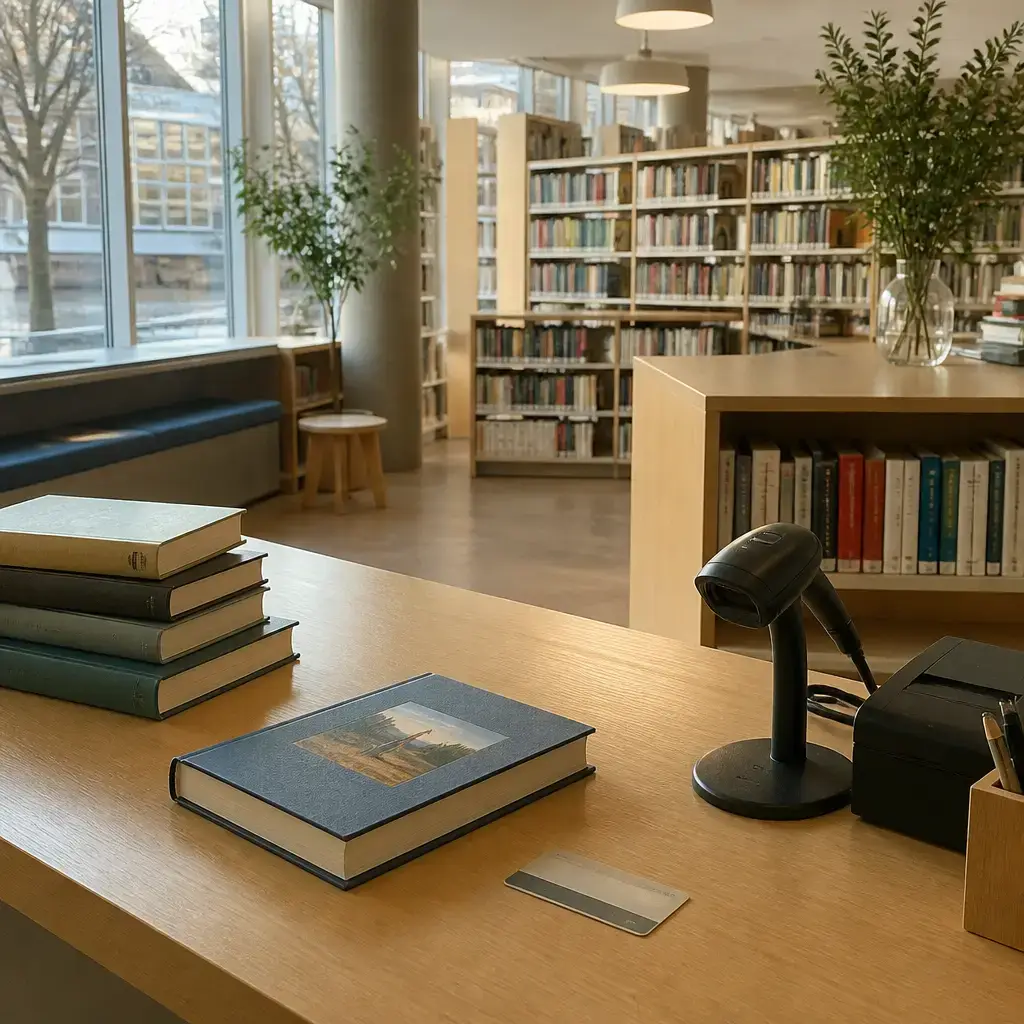
„Bibliothekskarte“ means “library card”, the card the visitor must show at the desk. A practical pattern is „seine Bibliothekskarte zeigen“ when presenting a library card.
am
„am“ means “at the” in „am Schalter“. It is used here to locate the action at the library counter; a common pattern is „am Schalter fragen“.
Schalter
„Schalter“ means “desk” or “counter” here, specifically the place where the library card is shown. Use „am Schalter“ when referring to an action at a service counter.
leihe
„leihe“ means “borrow” in „Ich leihe es jetzt aus“, referring to borrowing the book now. The reusable pattern is „etwas ausleihen“, with the borrowed item as the object.
jetzt
„jetzt“ means “now” and says that the borrowing is happening at this moment. It can identify an action taking place immediately; a new example is „Ich mache das jetzt.“
aus
„aus“ is the separable part of „ausleihen“ in „Ich leihe es jetzt aus“. Together, „leihe ... aus“ means “borrow” or “check out”; in a main clause, this part appears at the end.
Kommen
„Kommen“ means “come” in the formal request „Kommen Sie wieder“. Use this form with „Sie“ to invite or direct someone formally to come.
wieder
„wieder“ means “back” or “again” in „Kommen Sie wieder“, inviting the visitor to return to the library. A common pattern is „wiederkommen“ for coming back again.
wenn
„wenn“ means “when” in „wenn Sie das Buch gelesen haben“, identifying the time at which the visitor should return. Use it to introduce a condition or time clause; a new example is „Kommen Sie, wenn Sie Zeit haben.“
das
„das“ means “the” in „das Buch“, referring to the specific book already discussed. Use it before a noun when the listener knows which item is meant.
gelesen
„gelesen“ means “read” in „das Buch gelesen haben“, referring to finishing the book. It is used with „haben“ here to describe the completed reading before the visitor returns.
haben
„haben“ means “have” in „gelesen haben“ and works with „gelesen“ to express that the book has been read. The reusable pattern is „etwas gelesen haben“, with the thing read in the object position.
um
„um“ introduces the purpose in „um eine weitere Empfehlung zu bekommen“, meaning “in order to get another recommendation”. Use „um ... zu ...“ to explain the purpose of an action.
eine
„eine“ means “a” in „eine weitere Empfehlung“, introducing one additional recommendation. Use it before a singular noun when referring to one unspecified item.
weitere
„weitere“ means “another” or “additional” in „eine weitere Empfehlung“. It shows that this recommendation would come after the first one; a new example is „eine weitere Frage“.
Empfehlung
„Empfehlung“ means “recommendation”, specifically another book recommendation the librarian can give later. A common pattern is „eine Empfehlung bekommen“ for receiving a recommendation.
zu
„zu“ is part of the purpose construction „um eine weitere Empfehlung zu bekommen“, meaning “in order to get”. Use „zu“ before the infinitive in an „um ... zu ...“ purpose phrase.
bekommen
„bekommen“ means “get” or “receive” in „eine weitere Empfehlung zu bekommen“. The reusable pattern is „etwas bekommen“, with the thing received as the object; a new example is „eine Antwort bekommen.“