Wie
In "Wie benutze ich den Drucker in der Bibliothek?", Wie means “how” and asks about the manner of using something. It commonly comes at the beginning of a question followed by the verb and subject, as in this question. Use it when asking how to operate or do something.
benutze
In "Wie benutze ich den Drucker in der Bibliothek?", benutze means “use” and refers to operating the printer. It is the first-person form of benutzen used with ich. A reusable pattern is Wie benutze ich + object? when asking how to use something.
ich
In "Wie benutze ich den Drucker in der Bibliothek?", ich means “I” and identifies the person asking the question. The same pronoun appears as capitalized Ich at the start of "Ich muss nur ein kurzes Dokument drucken." Use ich for yourself when it is not at the beginning of a sentence.
den
In "den Drucker", den marks the definite noun “the printer” as the direct object of benutze. This form is used before the masculine noun Drucker in this object phrase. Reuse den before a masculine object when the specific item is already clear.
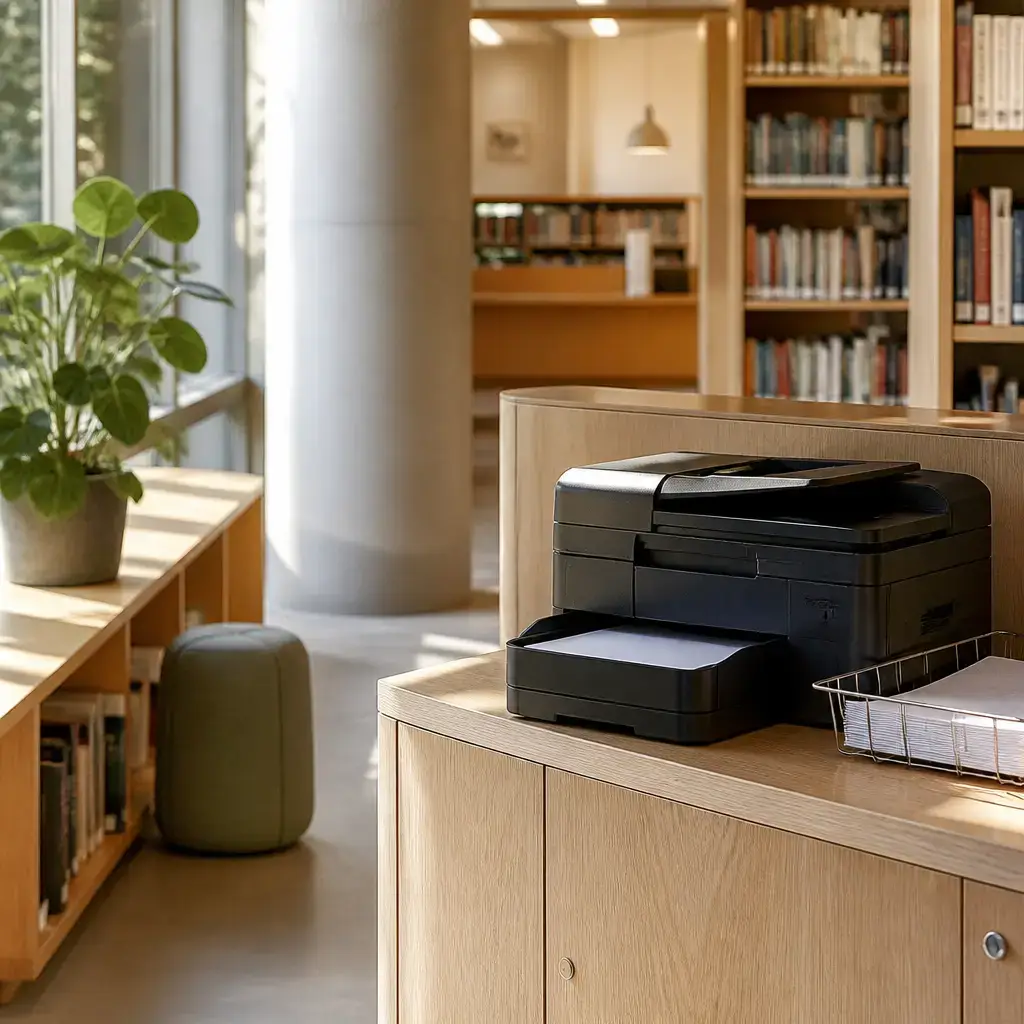
Drucker
In "den Drucker", Drucker means “printer,” the machine being used in the library. It is the object of benutzen and auswählen in the dialogue. Use it when referring to a printer as a device.
in
In "in der Bibliothek", in means “in” and gives the location of the printer use. Here it introduces a stationary place, followed by der Bibliothek. Use in with a place when saying where something is or happens.
der
In "der Bibliothek", der means “the” and accompanies the feminine noun Bibliothek after in for this location. Together, the phrase identifies the specific library. Reuse der before a feminine noun in a similar location phrase.
Bibliothek
In "in der Bibliothek", Bibliothek means “library,” the place where the printer is located. The phrase in der Bibliothek describes where the action takes place. Use it when talking about a library as a place for reading, studying, or using its equipment.
Wählen
At the start of "Wählen Sie zuerst den Drucker auf diesem Bildschirm aus.", Wählen is the verb part meaning “choose.” The ending aus completes the separable verb auswählen in this formal instruction. A reusable instruction pattern is Wählen Sie + object + aus.
Sie
In "Wählen Sie zuerst den Drucker auf diesem Bildschirm aus.", Sie means formal “you” and addresses one person politely. It is used with the formal instruction Wählen Sie ... aus. Use capitalized Sie when giving or receiving polite instructions.
zuerst
In "Wählen Sie zuerst den Drucker auf diesem Bildschirm aus.", zuerst means “first” and marks the first step in the procedure. It can be placed near the verb to show the order of an action. Use it when explaining a sequence of instructions.
auf
In "auf diesem Bildschirm", auf means “on” and locates the printer option on the screen. It is followed here by diesem Bildschirm for a fixed location. Use auf with a surface or interface when identifying where an option appears.
diesem
In "auf diesem Bildschirm", diesem means “this” and points to the screen being shown. Its form fits the location phrase with Bildschirm after auf. Use it to identify a nearby or currently relevant item.
Bildschirm
In "auf diesem Bildschirm", Bildschirm means “screen,” specifically the display where the printer is selected. The phrase tells the learner where to find the option. Use it for a computer, phone, or machine display.
aus
In "Wählen Sie zuerst den Drucker auf diesem Bildschirm aus.", aus completes the separable verb auswählen and contributes the sense of selecting something. It is placed at the end of this formal instruction, while auswählen appears together in "doppelseitiges Drucken auswählen". Keep the object between Wählen Sie and aus in this instruction pattern.
Kann
In "Kann ich doppelseitiges Drucken auswählen?", Kann means “can” or “may” and asks whether the speaker is allowed or able to select the option. It is the form of können used with ich in this question. A reusable pattern is Kann ich + action? for asking permission or possibility.
doppelseitiges
In "doppelseitiges Drucken", doppelseitiges means “double-sided” and describes printing on both sides of a sheet. It specifies the printing option that the speaker wants to select. Use it with Drucken when referring to this type of print setting.
Drucken
In "doppelseitiges Drucken", Drucken means “printing” and names the action as a selectable option. This capitalized form is a noun-like use of the verb drucken, which appears later in "bevor Sie drucken". Use it after an adjective when naming a printing option.
auswählen
In "Kann ich doppelseitiges Drucken auswählen?", auswählen means “select” and describes choosing a printer setting. It follows Kann and remains in its base form at the end of the question. Reuse auswählen with an object for selecting an option or item.
Ändern
At the start of "Ändern Sie die Einstellung, bevor Sie drucken.", Ändern means “change” and gives a formal instruction to modify the setting. It is followed by Sie and the object die Einstellung. A reusable pattern is Ändern Sie + object for polite instructions.
die
In "die Einstellung", die means “the” and introduces the specific setting that should be changed. It accompanies the feminine noun Einstellung in this object phrase. Reuse die before a known feminine noun in a similar instruction.
Einstellung
In "Ändern Sie die Einstellung", Einstellung means “setting,” such as the printer choice or print configuration. It is the item that the listener is told to change before printing. Use it when referring to an adjustable option in a device or program.
bevor
In "bevor Sie drucken", bevor means “before” and introduces the action that must happen first. It connects the instruction about changing the setting with the later printing action. Use bevor with a clause when ordering two actions in time.
muss
In "Ich muss nur ein kurzes Dokument drucken", muss means “must” or “need to” and expresses the speaker’s necessity to print. It is the form of müssen used with ich, followed by the action drucken. Reuse Ich muss + action when explaining what you need to do.
nur
In "Ich muss nur ein kurzes Dokument drucken", nur means “only” and limits the need to printing one short document. It shows that the speaker’s requirement is modest or restricted. Use nur before the part of the sentence that you want to limit.
ein
In "ein kurzes Dokument", ein means “a” and introduces one unspecified document. It appears with the adjective kurzes and the noun Dokument as one noun phrase. Reuse ein with a singular countable item when introducing it for the first time.
kurzes
In "ein kurzes Dokument", kurzes means “short” and describes the document as brief. Its form matches the noun phrase with Dokument after ein. Use it when describing a document that is not long.
Dokument
In "ein kurzes Dokument", Dokument means “document,” the file or text that the speaker needs to print. It is the object of drucken. Use it for a document being printed, viewed, or handled.
Dann
In "Dann prüfen Sie die Vorschau, bevor Sie starten.", Dann means “then” and introduces the next step after changing the setting. It helps organize the printer instructions in sequence. Use it when telling someone what to do next.
prüfen
In "Dann prüfen Sie die Vorschau", prüfen means “check” or “examine” and gives a formal instruction to look at the preview. It is followed by the object die Vorschau. Reuse prüfen with an object when asking someone to verify information or a display.
Vorschau
In "die Vorschau", Vorschau means “preview,” the on-screen view of the document before printing. The instruction is to check it before starting. Use it when referring to a preliminary display of a document or print result.
starten
In "bevor Sie starten", starten means “start” and refers to beginning the printing process. It appears with formal Sie inside the clause introduced by bevor. Use it when telling someone to begin an operation or process.
Wo
In "Wo kommen die gedruckten Seiten heraus?", Wo means “where” and asks for the location from which the pages emerge. It begins a question about a place. Use it when asking where an object or result can be found or comes out.
kommen
In "Wo kommen die gedruckten Seiten heraus?", kommen means “come” and describes the pages emerging from the printer. It agrees with the plural subject die gedruckten Seiten. Reuse Wo kommen ... heraus? when asking where items emerge from a machine.
gedruckten
In "die gedruckten Seiten", gedruckten means “printed” and describes the pages after the printing process. It modifies Seiten inside the full noun phrase. Use it when referring to pages that have been printed.
Seiten
In "die gedruckten Seiten", Seiten means “pages,” the printed sheets that come out of the printer. It is the plural subject of kommen. Use Seiten when referring to multiple pages of a document.
heraus
In "kommen die gedruckten Seiten heraus", heraus completes the separable verb herauskommen and indicates movement out from the printer. It is placed after the subject in this question. Keep the subject between kommen and heraus when using this word order pattern.
unten
In "Sie kommen unten aus dem Fach", unten means “below” or “down below” and identifies the lower location of the tray. It works together with aus dem Fach to explain where the pages emerge. Use it when pointing out a lower position.
dem
In "aus dem Fach", dem means “the” and introduces the specific tray from which the pages come. It is the article form used after aus in this phrase. Reuse aus dem + noun when describing movement or origin from a specific item.
Fach
In "aus dem Fach", Fach means “tray” or “compartment,” the part of the printer where the pages appear. The phrase identifies the pages’ point of exit. Use it for a tray or compartment that holds or releases something.