Ich
“Ich” means “I” here: the customer is talking about their own thoughts. It is used as the subject when the speaker describes what they are considering or doing.
überlege
“überlege” means “am considering” in “Ich überlege, diesen kleinen Lautsprecher zu kaufen.” It introduces a possible action that the speaker has not decided on yet; a useful pattern is “Ich überlege, … zu …”.
diesen
“diesen” identifies the specific speaker the customer is considering buying. It is used before “kleinen Lautsprecher” in the object phrase “diesen kleinen Lautsprecher”.
kleinen
“kleinen” means “small” and describes the speaker in “diesen kleinen Lautsprecher.” It is placed directly before the noun it describes.
Lautsprecher
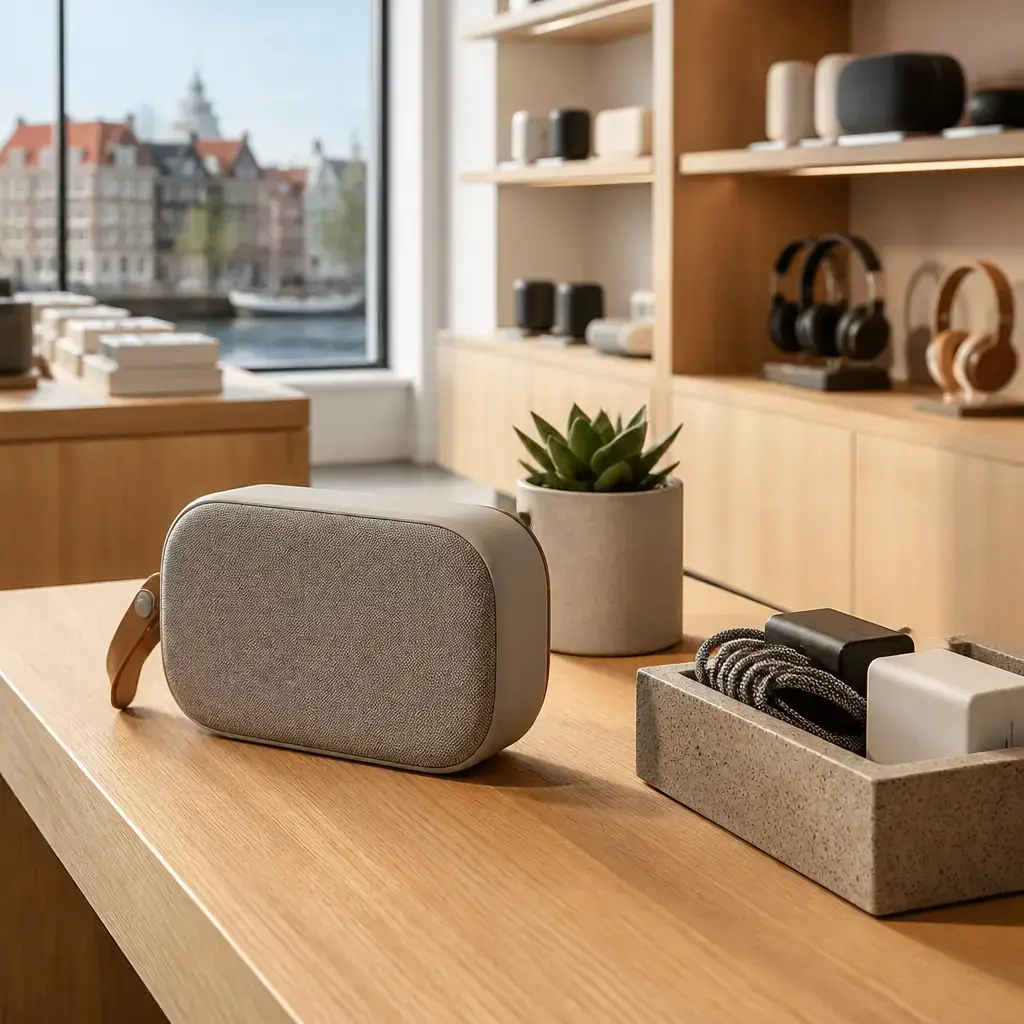
“Lautsprecher” means “speaker,” specifically the small product the customer may buy. It can be used for the audio device being discussed or checked.
zu
“zu” helps form the action “zu kaufen” after “Ich überlege.” In the pattern “überlegen, … zu kaufen,” it connects the thought to the possible action.
kaufen
“kaufen” means “buy” in “diesen kleinen Lautsprecher zu kaufen.” It names the possible purchase, and a reusable pattern is “etwas kaufen” for buying something.
kann
“kann” means “can” in “Ich kann Ihnen die Garantie erklären.” It expresses that the staff member is able or willing to explain something; a common pattern is “Ich kann Ihnen … erklären.”
Ihnen
“Ihnen” means “to you” when the staff member addresses the customer formally. It marks the person receiving the explanation in “Ihnen die Garantie erklären,” and it is used with formal customer service.
die
“die” means “the” before “Garantie” in “die Garantie.” Here it points to the specific warranty for the product being discussed.
Garantie
“Garantie” means “warranty” in this shop conversation. It is the coverage that the staff member explains and the customer asks about; a useful pattern is “die Garantie erklären.”
erklären
“erklären” means “explain” in “die Garantie erklären.” It takes the thing being explained as its object, here “die Garantie”.
bevor
“bevor” means “before” and places one event earlier than another in “bevor Sie sich entscheiden.” It introduces the point before the customer makes a decision.
Sie
“Sie” means formal “you” in “bevor Sie sich entscheiden.” It addresses the customer respectfully; the same formal form also appears in the request “Bringen Sie …”.
sich
“sich” is part of the expression “sich entscheiden,” meaning “to decide.” It refers back to the person who makes the decision, so the complete expression is needed for this meaning.
entscheiden
“entscheiden” means “decide” in the expression “sich entscheiden.” In this dialogue, it describes the customer’s decision about whether to buy the speaker.
Was
“Was” means “what” in the questions “Was deckt die Garantie ab?” and “Was ist mit Schäden durch Unfälle?” It starts a question asking for information about coverage or another possible issue.
deckt
“deckt” means “covers” as part of “deckt … ab.” The verb is split around the covered item in “Was deckt die Garantie ab?”; a reusable pattern is “Die Garantie deckt … ab.”
ab
“ab” completes the meaning of “deckt … ab,” which means “covers.” It appears at the end of the question “Was deckt die Garantie ab?” and belongs with “deckt,” rather than meaning “off” by itself here.
Produktfehler
“Produktfehler” means faults or defects in a product. Here it names the problems covered by the warranty, and it can be used after “deckt … ab” to specify what coverage includes.
bei
“bei” means “during” or “under the circumstances of” in “bei normaler Nutzung.” It links the product faults to the condition of normal use.
normaler
“normaler” describes the use as normal in “bei normaler Nutzung.” It is placed directly before “Nutzung” and helps define the conditions under which the warranty applies.
Nutzung
“Nutzung” means “use” in “bei normaler Nutzung.” Together with “bei,” it describes ordinary use of the product, as opposed to damage from an accident.
ist
“ist” means “is” in the question “Was ist mit Schäden durch Unfälle?” It introduces the question of how accidental damage should be treated.
mit
“mit” means “with” in the expression “Was ist mit …?” Here the expression asks what about or how to treat a particular matter, namely “Schäden durch Unfälle.”
Schäden
“Schäden” refers to damage in “Schäden durch Unfälle.” It names the possible harm caused by accidents that the customer asks about.
durch
“durch” means “through” or “caused by” in “durch Unfälle.” It identifies accidents as the cause of the damage.
Unfälle
“Unfälle” means “accidents” in “Schäden durch Unfälle.” It specifies the cause of the damage being discussed; a useful pattern is “Schäden durch …” for damage caused by something.
Das
“Das” means “that” in “Das wäre nicht abgedeckt.” It refers back to the accidental damage the customer has just mentioned.
wäre
“wäre” means “would be” in “Das wäre nicht abgedeckt.” It presents the staff member’s assessment of whether that type of damage falls under the warranty.
nicht
“nicht” means “not” and negates “abgedeckt” in “nicht abgedeckt.” It shows that the accidental damage is excluded from the stated coverage.
abgedeckt
“abgedeckt” means “covered” in “Das wäre nicht abgedeckt.” It describes whether something is included by the warranty; the negative phrase “nicht abgedeckt” means it is not included.
Wohin
“Wohin” means “where to” in “Wohin soll ich gehen?” It asks for a destination or service point, not just a location.
soll
“soll” means “should” in “Wohin soll ich gehen?” The customer uses it to ask for advice about the appropriate next step.
gehen
“gehen” means “go” in “Wohin soll ich gehen?” It names the movement to the place where the faulty product should be handled; a useful pattern is “Wohin soll ich gehen?”
wenn
“wenn” means “if” or “when” in “wenn es nicht mehr funktioniert.” It introduces the condition under which the customer needs help with the speaker.
es
“es” means “it” in “wenn es nicht mehr funktioniert.” Here it refers to the small speaker, which is the product that may stop working.
mehr
“mehr” contributes the meaning “any longer” in “nicht mehr funktioniert.” Together, “nicht mehr” says that the speaker no longer works.
funktioniert
“funktioniert” means “works” or “functions” in “es nicht mehr funktioniert.” It describes whether the speaker operates properly; a useful pattern is “etwas funktioniert.”
Bringen
“Bringen” means “bring” in the formal request “Bringen Sie den Kassenbon und die Schachtel …” It tells the customer to take the listed items to customer service.
Kassenbon
“Kassenbon” means “receipt” in “den Kassenbon.” It is the proof of purchase that the customer should bring for customer service.
und
“und” means “and” in “den Kassenbon und die Schachtel.” It joins the two items the customer is asked to bring.
Schachtel
“Schachtel” means “box” in “die Schachtel.” Here it refers to the product’s box, which should be brought together with the receipt.
zum
“zum” means “to the” in “zum Kundenservice.” It is the combined form used before “Kundenservice” to show the destination of the requested action.
Kundenservice
“Kundenservice” means “customer service” in “zum Kundenservice.” It is the place or department where the product, receipt, and box can be taken for assistance.
können
“können” means “can” in “Sie können ihn überprüfen.” It expresses that the customer service staff are able to check the item; a common pattern is “Sie können … überprüfen.”
ihn
“ihn” means “it” here and refers to the speaker that customer service can check. It is used as the object of “überprüfen” in “ihn überprüfen.”
überprüfen
“überprüfen” means “check” or “inspect” in “ihn überprüfen.” It describes examining the speaker to find out whether there is a product fault; a reusable pattern is “etwas überprüfen.”