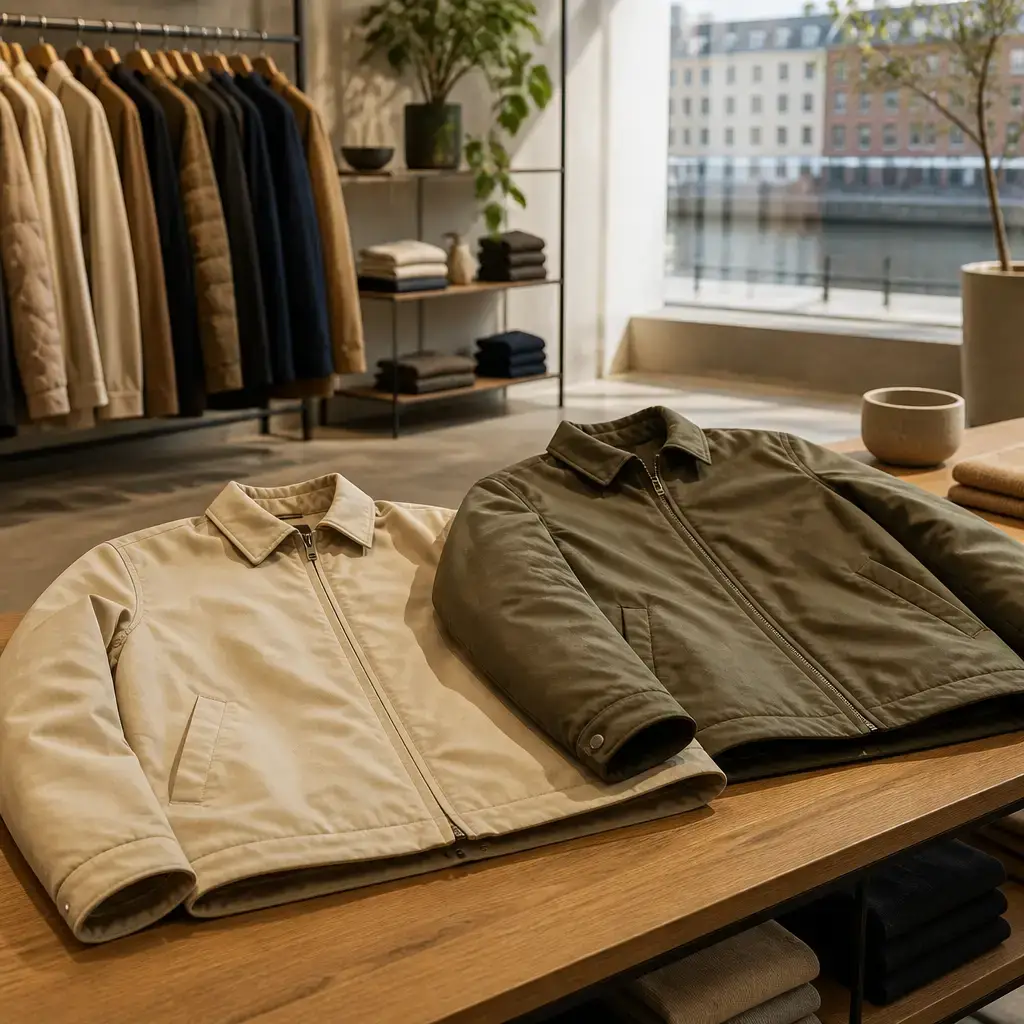
Diese
In „Diese beiden Jacken“ means “these” and points to the two jackets being discussed. It comes directly before the noun phrase „Diese beiden Jacken“. You would use it when indicating specific nearby or already-mentioned items.
beiden
In „Diese beiden Jacken“ means “both” and specifies that there are two jackets. It is used together with the plural noun „Jacken“. A reusable pattern is „beide + plural noun“ for two items together.
Jacken
„Jacken“ means “jackets” and refers to the two garments in the shop. It is the plural form related to the singular citation form „Jacke“. You can use it for comparing or describing several jackets.
sehen
In „Diese beiden Jacken sehen sehr ähnlich aus“ means “look” or “appear”. Together with „aus“, it describes how the jackets appear. A reusable pattern is „etwas sieht + adjective + aus“.
sehr
In „sehr ähnlich“ intensifies the adjective and means “very”. It shows that the similarity is strong, not merely slight. You can place „sehr“ before many adjectives, such as in „sehr warm“.
ähnlich
„ähnlich“ means “similar” and describes the appearance of the two jackets. In „sehen sehr ähnlich aus“, it is the adjective after the verb of appearance. You can use it to compare two things that resemble each other.
aus
In „sehen sehr ähnlich aus“, „aus“ completes the separable verb „aussehen“ and contributes the meaning “look” or “appear”. It stands at the end of this main clause. The same pattern is used to describe how something appears.
Vergleichen
At the start of „Vergleichen wir Stoff und Passform“, „Vergleichen“ means “let’s compare”. It is an invitation or suggestion addressed to a group including the speaker. A reusable pattern is „Vergleichen wir + two things“.
wir
„wir“ means “we” and identifies the speaker together with the other person as the people who will compare the jackets. In „Vergleichen wir“ it follows the verb in the suggestion. You use it when the speaker includes themself and others.
Stoff
„Stoff“ means “fabric” and is one of the two features being compared. In „Stoff und Passform“, it is an object of „Vergleichen“. You can use it when discussing the material of clothing.
und
„und“ means “and” and connects „Stoff“ with „Passform“. It joins two equally relevant items in the comparison. Use it to link words or phrases without contrasting them.
Passform
„Passform“ means “fit” and refers to how well a jacket fits the body. In „Stoff und Passform“, it is compared alongside the fabric. You can use it when discussing whether clothing fits comfortably or appropriately.
hier
In „Diese hier“ means “this one here” and helps identify one jacket among the available choices. It follows the demonstrative „Diese“. You can use „hier“ after a demonstrative when pointing out a particular item.
fühlt
In „fühlt sich leicht an“, „fühlt“ describes the jacket’s tactile impression and means “feels”. Its meaning here depends on the complete expression „fühlt sich ... an“. You can use this construction to describe how something feels to the touch or while wearing it.
sich
In „fühlt sich leicht an“, „sich“ is the reflexive pronoun used with the verb expression „sich anfühlen“. It links the feeling to the jacket itself. A reusable pattern is „etwas fühlt sich + adjective + an“.
leicht
In „fühlt sich leicht an“, „leicht“ means “light” in weight. It describes the jacket’s physical feeling when handled. You can use it after „fühlt sich“ to describe the weight or sensation of an object.
an
In „fühlt sich leicht an“, „an“ completes „sich anfühlen“ and helps express how something feels. In „Probier sie zuerst an“, it completes „anprobieren“ and contributes the meaning “on” in “try on”. Its meaning comes from the complete verb expression in each context.
Der
In „Der Stoff“ means “the” and introduces the specific fabric being discussed. It appears directly before „Stoff“. You use this form with the masculine noun „Stoff“ in this phrase.
wirkt
„wirkt“ means “seems” or “appears” and presents the fabric as an impression rather than a confirmed fact. In „Der Stoff wirkt dünn“, it is followed by the adjective „dünn“. You can use „wirkt + adjective“ when describing how something appears.
dünn
„dünn“ means “thin” and describes the apparent thickness of the fabric. In „Der Stoff wirkt dünn“, it follows „wirkt“. You can use it for fabric or other objects that have little thickness.
Die
In „Die andere“ means “the other one” and refers to the other jacket. In „Die könnte für den Alltag besser sein“, it refers back to that jacket as “that one”. The form can identify a feminine noun that is stated or understood from context.
andere
In „Die andere“ means “the other” and distinguishes this jacket from the first one. The noun „Jacke“ is understood after the adjective in this phrase. You can use „der/die/das andere“ to identify the remaining item in a choice.
robuster
„robuster“ means “sturdier” and compares the second jacket with the first one. It describes greater resistance or solidity in „robuster und wärmer“. You can use the pattern „robuster als ...“ when making the same kind of comparison.
wärmer
„wärmer“ means “warmer” and says that the other jacket provides more warmth than the first one. It appears alongside the comparison „robuster“. You can use it to compare the warmth of clothing or other things.
könnte
„könnte“ means “might” or “could” and expresses a tentative possibility about the jacket. In „Die könnte für den Alltag besser sein“, the speaker makes a cautious assessment rather than a firm claim. A reusable pattern is „Das könnte ... sein“.
für
In „für den Alltag“ means “for” and marks the intended use of the jacket. It introduces the phrase „den Alltag“. You can use „für“ before a purpose or intended situation, such as clothing for everyday use.
den
In „für den Alltag“, „den“ means “the” and belongs to the noun phrase „den Alltag“. It appears after the preposition „für“ in this expression. The phrase can be reused when talking about suitability „für den Alltag“.
Alltag
„Alltag“ means “everyday life” or “daily use”. In „für den Alltag“, it describes ordinary daily situations rather than a special occasion. You can use this phrase when discussing clothing or objects for regular use.
besser
„besser“ means “better” and evaluates the jacket as more suitable for everyday use. In „für den Alltag besser sein“, it compares this jacket with the other one. You can use „besser für ... sein“ to compare suitability.
sein
In „könnte für den Alltag besser sein“, „sein“ means “be” and completes the expression about the jacket’s suitability. It appears at the end after „könnte“. A reusable pattern is „könnte + adjective + sein“.
Probier
At the start of „Probier sie zuerst an“, „Probier“ means “try” and gives an informal singular command. The jacket is the object of the complete expression „Probier sie ... an“. You can use „Probier ... an“ when telling one person to try on clothing.
sie
In „Probier sie zuerst an“, „sie“ refers to the jacket and means “it”. In „wie sie sich anfühlt“, it again refers to the jacket. The pronoun replaces the feminine noun „Jacke“ so it does not need to be repeated.
zuerst
„zuerst“ means “first” and places trying on the jacket before checking how it feels. In „Probier sie zuerst an“, it comes before the separable verb particle „an“. You can use it to order the first step in a series of actions.
schau
„schau“ means “look” or “see” and is an informal singular command asking someone to pay attention to the result. In „schau, wie sie sich anfühlt“, it introduces what the person should observe. A reusable pattern is „Schau, wie ...“.
wie
In „wie sie sich anfühlt“, „wie“ means “how” and introduces a clause describing the jacket’s feel. It connects „schau“ with the observation that follows. You can use „wie“ to ask or describe the manner in which something happens.
Ich
„Ich“ means “I” and identifies the speaker who will try on the jackets. It begins „Ich probiere beide an“. You use it as the subject when talking about your own action or intention.
probiere
In „Ich probiere beide an“, „probiere“ means “try” and states the speaker’s intention to try on both jackets. Together with „an“, it forms the expression „beide anprobieren“. You can use „Ich probiere ... an“ when saying that you will try on clothing.
beide
„beide“ means “both” and refers to the two jackets that the speaker will try on. In „Ich probiere beide an“, it is the object of the complete expression „anprobieren“. You can use it before or instead of a plural noun when referring to two known items.
bevor
„bevor“ means “before” and introduces the action that must happen before the speaker decides. In „bevor ich mich entscheide“, it begins a subordinate clause. You can use „bevor“ to order two actions in time.
mich
In „bevor ich mich entscheide“, „mich“ is the reflexive pronoun used with „sich entscheiden“. Together, „ich mich entscheide“ means that the speaker decides. A reusable pattern is „sich entscheiden“ when choosing between options.
entscheide
In „bevor ich mich entscheide“, „entscheide“ means “decide”. It describes the speaker’s choice after trying both jackets. You can use it with „sich“ in the pattern „ich entscheide mich“.
Das
„Das“ means “that” and refers to the preceding action of trying on both jackets. In „Das sollte die Wahl leichter machen“, it is the subject of the sentence. You can use it to refer back to an action or situation just mentioned.
sollte
„sollte“ means “should” and expresses the expectation that the previous action will help. In „Das sollte die Wahl leichter machen“, it presents the result as likely but not guaranteed. A reusable pattern is „Das sollte ... machen“ for an expected effect.
Wahl
„Wahl“ means “choice” and refers to the decision between the two jackets. In „die Wahl leichter machen“, it is the thing whose difficulty is changed. You can use „die Wahl zwischen ...“ when naming the options.
leichter
In „die Wahl leichter machen“, „leichter“ means “easier”, not physically lighter. It describes the choice as requiring less effort after comparing and trying the jackets. You can use the pattern „etwas leichter machen“ for making a task or decision easier.
machen
In „die Wahl leichter machen“, „machen“ means “make” and connects the choice with the result „leichter“. The construction says that trying both jackets will make the choice easier. A reusable pattern is „etwas + adjective + machen“.