In
In “In letzter Zeit”, “In” means during or in a period of time. The whole expression refers to the recent period. A useful pattern is “In ... Zeit” for talking about a time period.
letzter
In “In letzter Zeit”, “letzter” means recent or last and describes the time being mentioned. Together with “Zeit”, it forms the expression “In letzter Zeit” for recently. Use it as part of this time expression rather than on its own here.
Zeit
“Zeit” means time in “In letzter Zeit”. The phrase refers to the recent period when it has been getting dark earlier. A useful pattern is “Zeit” after a time expression such as “In letzter Zeit”.
wird
In “wird es früher dunkel”, “wird” means becomes or is getting and describes a change into darkness. It is the form used with “es” here. A reusable pattern is “es wird + description” for a changing general condition.
es
In “wird es früher dunkel”, “es” is the general subject used when describing the conditions becoming dark. It does not refer to a particular object. This pattern is useful for talking about general changes in the weather, light, or surroundings.
früher
“Früher” means earlier in “früher dunkel”. It shows that darkness begins earlier than before. A useful pattern is “früher + description” when comparing the timing of a condition.
dunkel
“Dunkel” means dark in “wird es früher dunkel”. It describes the condition that is beginning earlier. A reusable pattern is “es wird dunkel” for saying that it is getting dark.
Ich
“Ich” means I and identifies the speaker in “Ich werde vor dem Abendessen die Vorhänge schließen”. It is used when the speaker describes their own action or intention. A common pattern is “Ich + verb” for a statement about oneself.
werde
“Werde” means will in “Ich werde ... schließen”. It helps form a future statement about closing the curtains. A useful pattern is “Ich werde + infinitive” for saying what you will do.
vor
In “vor dem Abendessen”, “vor” means before and places the action earlier than dinner. It introduces the time of the planned action. A useful pattern is “vor dem + event” for before an event.
dem
In “vor dem Abendessen”, “dem” means the and belongs to the time phrase before dinner. This is the article form used with “Abendessen” after “vor” here. Reuse the complete pattern “vor dem Abendessen” for before dinner.
Abendessen
“Abendessen” means dinner in “vor dem Abendessen”. It names the meal that comes after the curtain-closing action. A useful pattern is “vor dem Abendessen” for before dinner.
die
In “die Vorhänge”, “die” means the and identifies the curtains as the object being closed. It belongs directly with “Vorhänge”. A useful pattern is “die Vorhänge schließen” for close the curtains.
Vorhänge
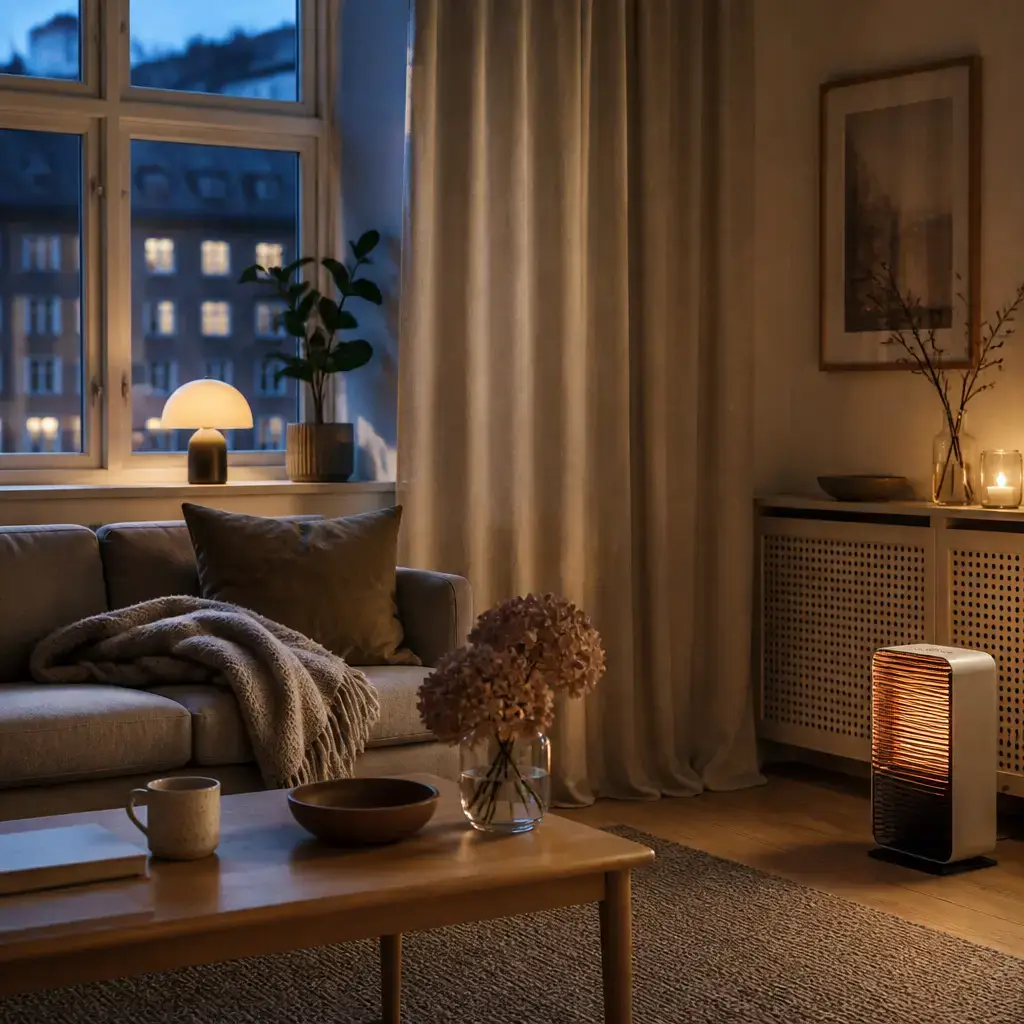
“Vorhänge” means curtains in “die Vorhänge schließen”. These are the things the speaker plans to close before dinner. A useful pattern is “die Vorhänge schließen” when talking about closing curtains.
schließen
“Schließen” means close in “die Vorhänge schließen”. It is the action planned by the speaker. A useful pattern is “etwas schließen”, with the object placed before the verb in this infinitive phrase.
Könntest
“Könntest” expresses could in a polite request: “Könntest du auch ...?” The speaker is asking another person to perform an action. A useful pattern is “Könntest du + infinitive?” for a polite request.
du
“Du” means you and refers to one person addressed informally. In “Könntest du auch die kleine Heizung einschalten?”, it identifies the person being asked. Use it when addressing one familiar person in this way.
auch
“Auch” means also or too in “auch die kleine Heizung”. It adds the heater to the action being requested. A useful pattern is placing “auch” before the additional item or action.
kleine
“Kleine” means small in “die kleine Heizung”. It describes the heater being switched on. A useful pattern is an adjective directly before a noun, as in “die kleine Heizung”.
Heizung
“Heizung” means heater or heating in this dialogue, where it is something that can be switched on and adjusted. The sentence refers specifically to the small heater. A useful pattern is “eine Heizung einschalten” for switch on a heater.
einschalten
“Einschalten” means switch on in “die kleine Heizung einschalten”. It names the requested action. A useful pattern is “etwas einschalten” when turning a device or appliance on.
kann
“Kann” means can in “Ich kann sie auf eine niedrige Stufe stellen”. It expresses the speaker’s ability or willingness to adjust the heater. A useful pattern is “Ich kann + infinitive” for saying what you can do.
sie
“Sie” means it here and refers back to “die Heizung”. In “Ich kann sie ... stellen”, it replaces the noun so it does not have to be repeated. A useful pattern is using a pronoun for an object already mentioned.
auf
In “auf eine niedrige Stufe stellen”, “auf” introduces the setting selected for the heater. Here it means to a particular level rather than on a physical surface. Reuse the pattern “auf eine niedrige Stufe stellen” for setting something to a low level.
eine
“Eine” means a or one before “Stufe” in “eine niedrige Stufe”. The same word unit appears as “Eine” at the beginning of “Eine weichere Lampe” because it starts a sentence there. Use it before a singular noun in these expressions.
niedrige
“Niedrige” means low in “eine niedrige Stufe”. It describes the heater setting the speaker chooses. A useful pattern is “eine niedrige Stufe” for a low setting.
Stufe
“Stufe” means level or setting in “auf eine niedrige Stufe”. It refers to the heater’s selected intensity. A useful pattern is “auf eine ... Stufe stellen” for setting something to a particular level.
stellen
“Stellen” means set here, as in setting the heater to a low level. In “auf eine niedrige Stufe stellen”, it describes adjusting a setting rather than simply placing an object. A useful pattern is “etwas auf eine Stufe stellen” for setting something to a level.
Aber
“Aber” means but and introduces a contrast with the request to switch on the heater. The speaker says the room is already comfortable. Use it at the beginning of a sentence when adding a contrasting point.
der
In “der Raum”, “der” means the and identifies the room being discussed. It belongs directly with “Raum” as the subject of the sentence. A useful pattern is “der Raum” when referring to the room.
Raum
“Raum” means room in “der Raum fühlt sich schon angenehm an”. It is the place whose atmosphere already feels comfortable. The dialogue also uses the same form in “der Raum gemütlich machen” as the room affected by the lamp.
fühlt
In “fühlt sich schon angenehm an”, “fühlt” contributes the meaning feels. It works together with “sich” and the final “an” to describe how the room feels. A useful pattern is this complete verb expression for describing a room or thing.
sich
In “fühlt sich schon angenehm an”, “sich” is the reflexive part of the expression describing how the room feels. It connects the room with its own perceived condition. The dialogue uses a corresponding form in “sich der Raum heute Abend gemütlich anfühlt”.
schon
“Schon” means already in “fühlt sich schon angenehm an”. It shows that the room is comfortable at this point, before any further adjustment. A useful pattern is “schon + description” when saying a condition is already true.
angenehm
“Angenehm” means comfortable or pleasant in “fühlt sich schon angenehm an”. It describes the room’s current feel. A useful pattern is using it in a construction that describes how something feels.
an
In “fühlt sich schon angenehm an”, the final “an” completes the verb expression meaning feels a certain way. It does not have the separate meaning on here. Use the complete expression when describing how something feels.
möchte
“Möchte” expresses a wish or preference, meaning would like or want. In “Ich möchte, dass sich der Raum heute Abend gemütlich anfühlt”, it introduces the desired condition of the room. A useful pattern is “Ich möchte, dass ...” for stating what you want to happen.
dass
“Dass” means that and introduces the clause describing the speaker’s wish. In “Ich möchte, dass sich der Raum heute Abend gemütlich anfühlt”, it links the wish to its desired result. A useful pattern is “möchte, dass + clause”.
heute
“Heute” means today in “heute Abend”. It places the desired cozy feeling on the current day. A useful pattern is “heute Abend” for this evening.
Abend
“Abend” means evening in “heute Abend”. Together with “heute”, it identifies the time when the room should feel cozy. Reuse the expression “heute Abend” for this evening.
gemütlich
“Gemütlich” means cozy or comfortable in “gemütlich anfühlt”. It describes the pleasant, relaxed atmosphere the speaker wants in the room. Use it for a cozy atmosphere or feeling.
anfühlt
In “dass sich der Raum heute Abend gemütlich anfühlt”, “anfühlt” means feels and appears at the end of the clause. It is the clause form of the same verb expression seen in “fühlt sich schon angenehm an”. A useful pattern is using it after “dass” to describe how something feels.
weichere
“Weichere” means softer in “Eine weichere Lampe”. It compares the lamp’s light or quality with a less soft option in the discussion. A useful pattern is “weichere + noun” when describing a softer choice.
Lampe
“Lampe” means lamp in “Eine weichere Lampe könnte den Raum gemütlich machen”. It is suggested as a way to create a cozy atmosphere. A useful pattern is “eine ... Lampe” when describing a lamp.
könnte
“Könnte” means might or could and presents the softer lamp as a possible solution. In “Eine weichere Lampe könnte den Raum gemütlich machen”, it makes a suggestion rather than a firm statement. A useful pattern is “könnte + infinitive” for a possible action or result.
den
In “den Raum gemütlich machen”, “den” means the and identifies the room as the thing affected by the lamp. It belongs directly with “Raum” in this object phrase. A useful pattern is “den Raum + description machen” for making the room a certain way.
machen
“Machen” means make in “den Raum gemütlich machen”. It describes causing the room to have a cozy quality. A useful pattern is “etwas + adjective machen” for making something a certain way.
ohne
“Ohne” means without and introduces an action that should not happen. In “ohne ihn zu warm zu machen”, the lamp should create coziness without making the room too warm. A useful pattern is “ohne + infinitive” for describing an action avoided.
ihn
“Ihn” means it here and refers back to “den Raum”. In “ihn zu warm zu machen”, it identifies the room as the object that should not become too warm. A useful pattern is replacing a previously mentioned masculine noun with “ihn”.
zu
This line uses “zu” in two ways: “zu warm” means too warm, while “zu machen” marks the infinitive in the expression after “ohne”. The two exact phrases are “zu warm” and “zu machen”. Learn each meaning from its surrounding words.
warm
“Warm” means warm in “zu warm”. It describes the temperature the room should not reach. In “ihn zu warm zu machen”, it is part of the result being avoided.
Das
In “Das weichere Licht”, “Das” means the and identifies the softer light being discussed. It belongs directly with “weichere Licht”. A useful pattern is “Das + noun” when introducing a specific thing.
Licht
“Licht” means light in “Das weichere Licht”. The softer light is described as making the room calmer. A useful pattern is “das Licht” when talking about the light in a room.
viel
“Viel” means much or a lot in “viel ruhiger”. It strengthens the comparison and means much calmer or much quieter. A useful pattern is “viel + comparative” to make a comparison stronger.
ruhiger
“Ruhiger” means calmer or quieter in “viel ruhiger”. It describes the atmosphere created by the softer light. A useful pattern is “viel ruhiger” when comparing how calm or quiet something feels.
Dann
“Dann” means then and presents relaxing as the result of making the room comfortable. It connects the earlier changes with the next activity. A useful pattern is beginning a result or next-step sentence with “Dann”.
können
“Können” means can in “Dann können wir uns ... entspannen”. It expresses the possibility of relaxing after the room is prepared. A useful pattern is “können + infinitive” for what someone can do.
wir
“Wir” means we and refers to both speakers together. In “wir uns ... entspannen”, both people are included in the plan to relax. A useful pattern is “wir können ...” for a shared possibility or plan.
uns
“Uns” means ourselves in “wir können uns ... entspannen”. It shows that the speakers themselves will relax. A useful pattern is “wir können uns entspannen” for saying that we can relax.
nach
In “nach dem Essen”, “nach” means after and places relaxing later than the meal. It introduces a time that follows an event. A useful pattern is “nach dem + event” for after an event.
Essen
“Essen” means the meal or eating in “nach dem Essen”. Here it refers to the meal after which the speakers will relax. Reuse “nach dem Essen” for after the meal or after eating.
entspannen
“Entspannen” means relax in “uns entspannen”. It is the activity the speakers can do after eating. A useful pattern is using it with a reflexive pronoun, as in “uns entspannen”.