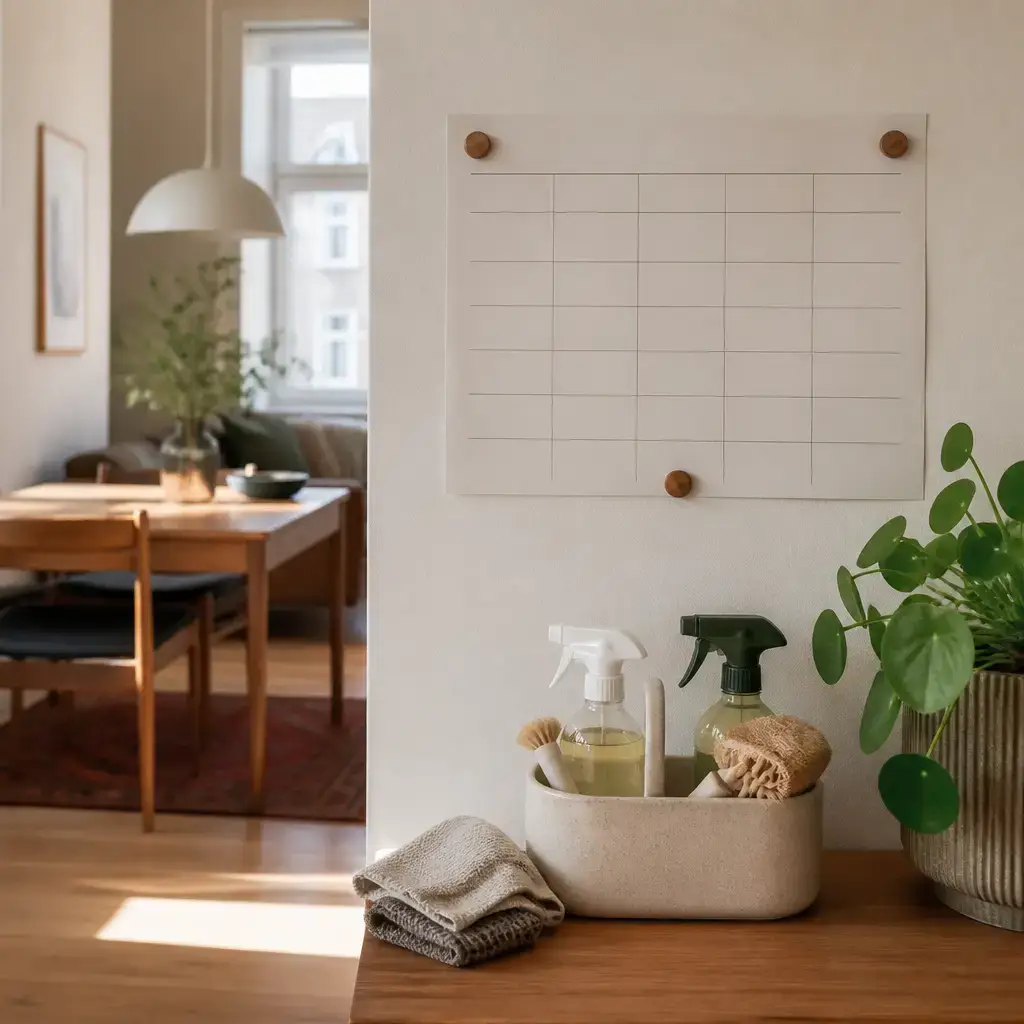
Wir
“Wir” means “we” here and refers to both adults. It is the subject used for a shared need, plan, or action.
brauchen
“brauchen” means “need” in this sentence. It is followed directly by the thing needed, here “einen besseren Putzplan”.
einen
“einen” means “a” in “einen besseren Putzplan.” It is the indefinite article used before this masculine object form.
besseren
“besseren” means “better” and describes the proposed cleaning schedule. Its ending fits the phrase “einen besseren Putzplan”.
Putzplan
“Putzplan” means “cleaning schedule,” a plan that organizes cleaning tasks. It is used here as the thing the speakers need.
für
“für” means “for” and connects the schedule with the apartment it is intended for. A common pattern is “für” followed by the person, place, or thing concerned.
die
“die” means “the” before “Wohnung” in this sentence. It is the definite article identifying a specific apartment.
Wohnung
“Wohnung” means “apartment” here. In “für die Wohnung,” it names the place for which the cleaning schedule is needed.
teilen
“teilen” contributes the idea of dividing the chores between the two people. In “teilen ... auf,” “auf” completes the verb meaning “divide up”.
Aufgaben
“Aufgaben” means “tasks” or “chores” here, referring to the cleaning duties. It is the plural form used for several duties that can be divided.
bisher
“bisher” means “so far” or “up to now.” It places the statement in the period before the new schedule is introduced.
nicht
“nicht” makes the statement negative: so far, the speakers have not divided the chores evenly. It normally comes before the part of the sentence being negated.
gleichmäßig
“gleichmäßig” means “evenly,” describing how the chores are divided. It is useful when talking about distributing work or another responsibility fairly.
auf
“auf” completes the separable verb in “teilen ... auf,” giving the meaning “divide up.” In the sentence, it appears at the end because the verb is used in a main clause.
Ich
“Ich” means “I” and identifies the speaker as the person taking responsibility for the task. It is the subject of the proposed cleaning action.
kann
“kann” means “can” and expresses that the speaker is able or willing to do the task. With a modal verb such as “kann,” the main action appears as an infinitive at the end, here “abstauben”.
am
“am” means “on” in the time expression “am Samstagmorgen.” It is commonly used before a particular day or time period.
Samstagmorgen
“Samstagmorgen” means “Saturday morning.” It specifies when the speaker can carry out the dusting.
Regale
“Regale” means “shelves” here, the surfaces that will be dusted. It is the plural form naming more than one shelf.
abstauben
“abstauben” means “dust” in this sentence. It is the infinitive placed at the end after “kann,” and it takes the thing being dusted, here “die Regale”.
Dann
“Dann” means “then” and links the second speaker’s task to the preceding plan. It introduces what will happen next or what the speaker will do in response.
wische
“wische” means “mop” or “wipe” here, referring to cleaning the kitchen floor. The speaker uses this form to state their own cleaning action.
nach
“nach” means “after” in “nach dem Mittagessen.” It introduces the event that must happen first, commonly followed by a meal, appointment, or other time reference.
dem
“dem” means “the” in “nach dem Mittagessen.” It identifies the specific lunch that serves as the time reference after “nach”.
Mittagessen
“Mittagessen” means “lunch.” In this sentence, it marks when the mopping will take place.
den
“den” means “the” before “Küchenboden” in this sentence. It identifies the specific kitchen floor that is being mopped.
Küchenboden
“Küchenboden” means “kitchen floor.” It is the surface affected by the action “wische”.
Sollen
“Sollen” means “should” in this question and asks whether cleaning the bathroom every Sunday is the proposed plan. It is placed at the beginning because the sentence is a yes-or-no question.
jeden
“jeden” means “every” in “jeden Sonntag.” It marks a repeated weekly time rather than one particular Sunday.
Sonntag
“Sonntag” means “Sunday.” Together with “jeden,” it specifies the recurring day for cleaning the bathroom.
das
“das” means “the” in “das Bad.” It identifies the specific bathroom that the speakers are discussing.
Bad
“Bad” means “bathroom” in this dialogue. It is the room they propose cleaning every Sunday.
putzen
“putzen” means “clean.” It is the infinitive used after “Sollen” to describe the proposed activity.
Der
“Der” means “the” in “Der Sonntag.” It identifies Sunday as the day being evaluated.
passt
“passt” means “works” or “suits” here, so Sunday is a suitable choice. This verb is useful when agreeing that a proposed time or arrangement is convenient.
weil
“weil” means “because” and introduces the reason Sunday works. It begins the explanation “weil das Bad schnell schmutzig wird,” with the conjugated verb at the end.
schnell
“schnell” means “quickly” and describes how fast the bathroom becomes dirty. It can describe the speed of a change or action.
schmutzig
“schmutzig” means “dirty” in “schmutzig wird.” It describes the condition the bathroom reaches.
wird
“wird” means “becomes” or “gets” here, not “will.” With “schmutzig,” it describes the bathroom becoming dirty.
hänge
“hänge” means “hang” or “put up” here, referring to placing the cleaning schedule on the fridge. It is the speaker’s own action in “Ich hänge den Putzplan an den Kühlschrank.”
an
“an” means “on” or “onto” in “an den Kühlschrank.” It introduces the surface where something is attached or placed.
Kühlschrank
“Kühlschrank” means “fridge.” In this sentence, it is the surface where the cleaning schedule will be put up.
sollte
“sollte” means “should” here and expresses an expected result: the schedule is expected to help them. It is used with “helfen” to describe what the schedule is likely to do.
uns
“uns” means “us,” referring to both speakers. It identifies the people who are expected to receive the help.
helfen
“helfen” means “help” in this sentence. A common pattern is to say that something helps a person, as in “uns helfen.”
jede
“jede” means “each” or “every” in “jede Aufgabe.” It presents the tasks individually, one by one.
Aufgabe
“Aufgabe” means “task” here, referring to one cleaning duty on the schedule. It is the singular form used after “jede”.
zu
“zu” marks the infinitive in “zu denken.” After “helfen,” it introduces the action that the schedule should help the speakers perform.
denken
“denken” means “think of” or “remember” here, as in remembering each task. It commonly appears with an item introduced by “an,” as in “an jede Aufgabe zu denken.”