Wo
“Wo” asks where the speakers should sit in “Wo sollen wir sitzen?”. It is useful at the beginning of a question about a place or position. Use it when asking someone to choose or identify a location.
sollen
“sollen” expresses what the speakers should do in “Wo sollen wir sitzen?”. Together with “wir sitzen”, it asks for a suggestion about their next action. A reusable pattern is “Sollen wir ...?” when proposing or considering something together.
wir
“wir” means “we” in “Wo sollen wir sitzen?”. It identifies the speaker and at least one other person as the people who will sit. Use it when talking about a shared action.
sitzen
“sitzen” means “sit” in “Wo sollen wir sitzen?”. It follows “sollen” in the expression “sollen wir sitzen” and names the action being considered. Use it when discussing where people will remain seated.
Der
“Der” means “the” before “Tisch” in “Der Tisch in der Ecke”. It introduces the particular table being discussed. Use it before a masculine singular noun in a phrase such as “Der Tisch ...”.
Tisch
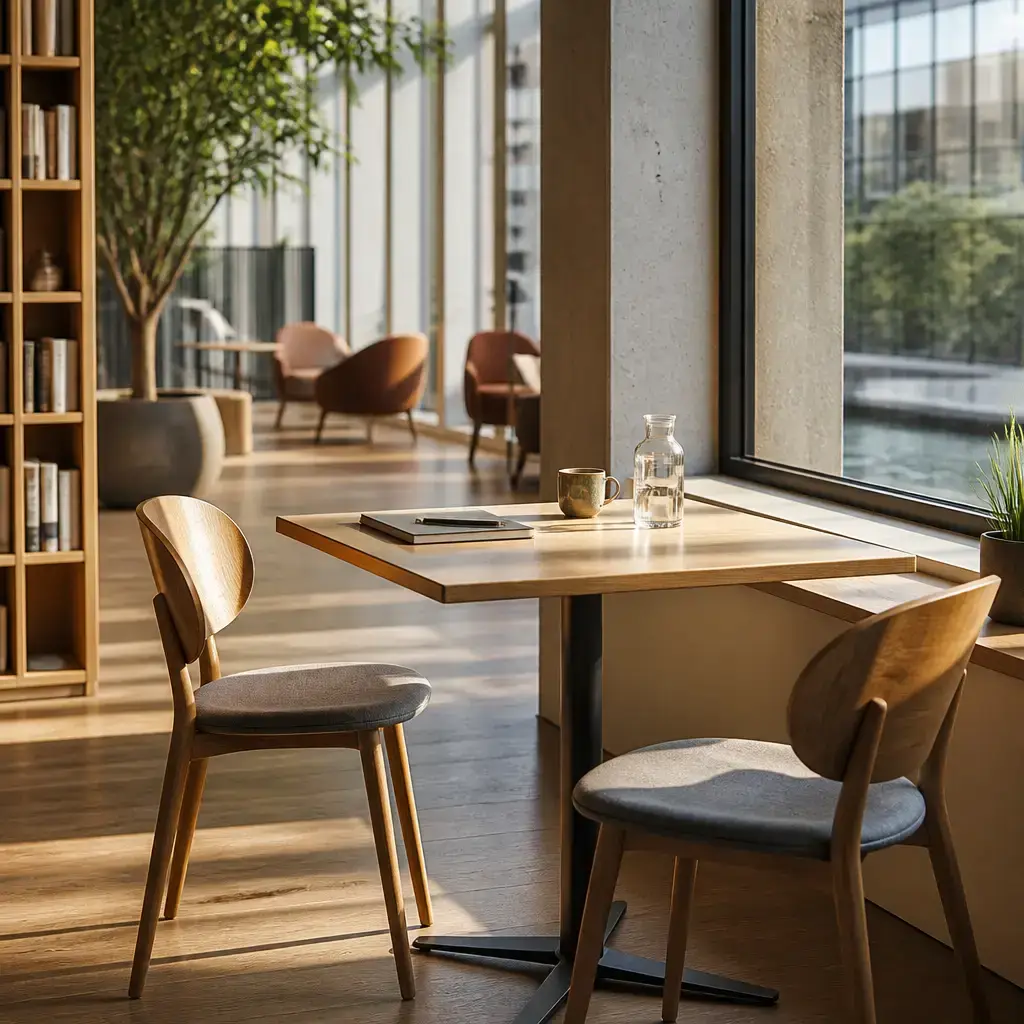
“Tisch” means “table” in “Der Tisch in der Ecke”. Here it is the piece of furniture the speakers are comparing and choosing. Use it for a table together with a location or description when needed.
in
“in” means “in” in “in der Ecke” and shows the table’s location inside the corner area. It comes before the location phrase “der Ecke”. Use it to describe where something is located.
Ecke
“Ecke” means “corner” in “in der Ecke”. Together with “in der”, it identifies the place where the table is located. Use it for a corner of a room or other space.
steht
“steht” says that the table is standing or located in “Der Tisch in der Ecke steht an einem ruhigen Ort.” It describes the table’s position rather than an action of placing it. Use it to state where an object is located.
an
“an” means “at” in “an einem ruhigen Ort” and “An diesem Tisch”. It links the table or light to a particular place or table. Use it with a location such as “an einem ruhigen Ort” or with a table such as “An diesem Tisch”.
einem
“einem” means “a” in “an einem ruhigen Ort”. It introduces one unspecified place within the location phrase. Its form belongs to the phrase “an einem ruhigen Ort”.
ruhigen
“ruhigen” describes the place as quiet in “an einem ruhigen Ort”. It appears directly before “Ort” and gives the location its quality. Use an adjective before the noun it describes, as in “an einem ruhigen Ort”.
Ort
“Ort” means “place” or “spot” in “an einem ruhigen Ort”. It names the location where the table is situated. Use it when referring to a place, especially in a phrase describing where something is.
diesem
“diesem” means “this” in “An diesem Tisch”. It points to the specific table the speaker is referring to. Use it before “Tisch” when referring to this table at a location.
ist
“ist” means “is” in “An diesem Tisch ist auch gutes Licht.” It states that good light is present at the table. Use it to describe what is or exists in a particular place.
auch
“auch” means “also” or “too” in “ist auch gutes Licht”. It adds good light as another positive feature of the table. Use it to add one more fact or quality to what has already been mentioned.
gutes
“gutes” means “good” or “nice” in “gutes Licht”. It describes the quality of the light at the table. Use it directly before “Licht” when describing the light as good.
Licht
“Licht” means “light” in “An diesem Tisch ist auch gutes Licht.” It names the light available at the table, which matters for reading. Use it when talking about the amount or quality of light in a place.
Dieser
“Dieser” means “this” in “Dieser Tisch wäre besser zum Lesen.” It points to the table that the speaker recommends. Use it before “Tisch” to identify this particular table.
wäre
“wäre” expresses “would be” in “Dieser Tisch wäre besser zum Lesen.” It presents the speaker’s judgment that this table would be the better choice. Use it when giving a considered or less direct opinion about what would be suitable.
besser
“besser” means “better” in “wäre besser zum Lesen”. It compares this table with another possible table for reading. Use it when one option is more suitable than another.
zum
“zum” is part of “zum Lesen”, meaning “for reading” as a purpose. It connects the table’s suitability with the activity “Lesen”; the whole expression carries the purpose meaning. Use “zum” in a purpose phrase before a noun such as “Lesen”.
Lesen
“Lesen” means “reading” in “zum Lesen”. It names the activity for which the table would be better and is written with a capital letter here. Use it after “zum” when referring to reading as an activity.
Sind
“Sind” means “are” in the question “Sind diese Stühle bequem?”. It asks about the chairs’ condition or comfort. Use it at the beginning of a yes-or-no question with a plural subject.
diese
“diese” means “these” in “diese Stühle”. It points to the particular chairs near the speakers. Use it before a plural noun when referring to specific things nearby or under discussion.
Stühle
“Stühle” means “chairs” in “Sind diese Stühle bequem?”. It names the seats whose comfort the speaker is checking. Use it when talking about more than one chair.
bequem
“bequem” means “comfortable” in “Sind diese Stühle bequem?”. It describes whether the chairs feel suitable for sitting. Use it after “sein”, as in “Die Stühle sind bequem”, to describe comfort.
Für
“Für” means “for” in “Für mich sind sie bequem.” It introduces the person whose opinion or experience is being given. Use it before a person when stating what is comfortable or suitable for that person.
mich
“mich” means “me” in “Für mich”. It identifies the speaker as the person giving the judgment about the chairs. Use it after “Für” in the expression “Für mich ...” to give a personal opinion.
sie
“sie” means “they” in “Für mich sind sie bequem.” It refers back to the chairs. Use it to refer to the plural objects already being discussed.
Setzen
“Setzen” begins the suggestion “Setzen wir uns an diesen Tisch.” It invites both speakers to sit down at the chosen table. Use it with “wir uns” when suggesting that you and another person sit down together.
uns
“uns” means “us” or “ourselves” in “Setzen wir uns”. Together with “Setzen wir”, it makes the suggestion “let’s sit down”. Use it in this expression when the speakers themselves are the ones sitting down.
diesen
“diesen” means “this” in “an diesen Tisch”. It identifies the table toward which the speakers will sit. The phrase “an diesen Tisch” marks the selected table as the destination of the movement.
Ich
“Ich” means “I” in “Ich stelle unsere Taschen unter den Tisch.” It identifies the speaker as the person who will put the bags there. Use it at the start of a statement about your own action.
stelle
“stelle” means “put” or “place” in “Ich stelle unsere Taschen unter den Tisch.” It describes the speaker’s action of placing the bags under the table. A reusable pattern is “Ich stelle [something] unter den Tisch.”
unsere
“unsere” means “our” in “unsere Taschen”. It shows that the bags belong to the speakers together. Use it before a plural noun when referring to something shared by the speakers.
Taschen
“Taschen” means “bags” in “unsere Taschen”. It names the objects that will be placed under the table. Use it when referring to more than one bag.
unter
“unter” means “under” in “unter den Tisch”. It describes the position where the bags will be placed. Use it before the object that is below or toward a position beneath something.
den
“den” means “the” in “unter den Tisch”. It introduces the specific table beneath which the bags will be placed. Here it belongs to the complete location phrase “unter den Tisch”.