Haben
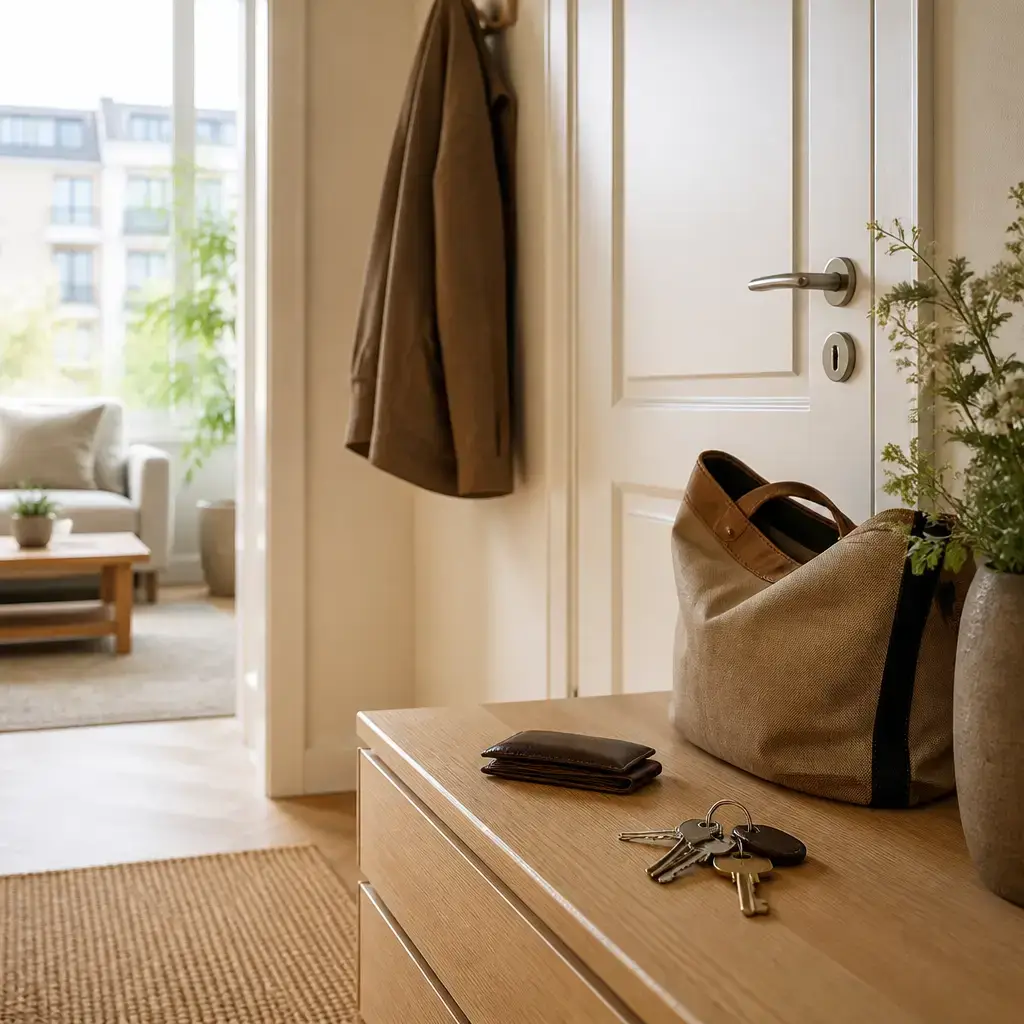
In "Haben wir alles" means “have” and asks whether everything is available before leaving. "Haben" comes first because this is a yes-or-no question; a reusable pattern is "Haben wir ...?" for asking whether we have something.
wir
"wir" means “we” in the question about leaving with everything. It refers to the two people speaking, and it commonly appears as the subject in patterns such as "Wir haben ..." or "Haben wir ...?".
alles
"alles" means “everything” in "Haben wir alles". It refers broadly to all the things needed before leaving, and it can be used after "haben" to ask whether everything is present.
bevor
"bevor" means “before” and introduces the time condition in "bevor wir gehen". It connects an action with a later point in time, and the verb remains at the end of this clause.
gehen
"gehen" means “go” or, here, “leave” in "bevor wir gehen". It is the infinitive used after "wir" in the subordinate clause; a reusable pattern is "bevor wir gehen" for “before we leave.”
Lass
In "Lass uns jetzt nachsehen", "Lass" helps make the suggestion “let’s check now.” It addresses one person and is used with "uns" plus an infinitive to suggest doing something together.
uns
"uns" means “us” in the suggestion "Lass uns jetzt nachsehen". Together with "Lass" and the infinitive, it identifies the people who should do the action; the reusable pattern is "Lass uns ...".
jetzt
"jetzt" means “now” and places the checking at the present moment in "Lass uns jetzt nachsehen". It can be placed before an action to say when it should happen.
nachsehen
"nachsehen" means “check” or “look to see” in "jetzt nachsehen". It is used here as the infinitive after "Lass uns", and the pattern "Lass uns ... nachsehen" suggests checking something together.
Hast
In "Hast du deine Schlüssel?", "Hast" means “have” when asking one person whether something is with them. It comes first in this yes-or-no question; a reusable pattern is "Hast du ...?".
du
"du" means “you” when one person is asked about their keys. It is the person addressed in "Hast du deine Schlüssel?" and commonly follows "Hast" in this question pattern.
deine
"deine" means “your” in "deine Schlüssel" and identifies the keys as belonging to the person addressed. It is used directly before the plural noun "Schlüssel"; a reusable pattern is "deine" plus a personal item.
Schlüssel
"Schlüssel" means “keys” in "deine Schlüssel". Here it refers to the keys the person needs before leaving, and it can be used after a possessive such as "deine Schlüssel".
Sie
"Sie" means “they” in "Sie sind in meiner Tasche" and refers back to the keys. It is the subject of the statement about their location, and it can refer to plural objects already mentioned.
sind
"sind" means “are” in "Sie sind in meiner Tasche" and states where the keys are. It links the plural subject "Sie" with their location, as in "Sie sind in ...".
in
"in" means “in” and shows the location in "in meiner Tasche". It is used before the place containing the keys, such as "in meiner Tasche" for “in my pocket.”
meiner
"meiner" means “my” in "meiner Tasche" and identifies the pocket as belonging to the speaker. In this location phrase it comes directly before "Tasche"; a reusable pattern is "in meiner" plus a place or container.
Tasche
"Tasche" means “pocket” in "meiner Tasche" and “bag” in "deiner Tasche". The surrounding words show which container is meant, and the word is commonly used after "in" to name a location.
Ist
In "Ist dein Portemonnaie in deiner Tasche?", "Ist" means “is” and asks about the wallet’s location. It comes first in this yes-or-no question; a reusable pattern is "Ist ... in ...?".
dein
"dein" means “your” in "dein Portemonnaie" and identifies the wallet as belonging to the person addressed. It comes directly before "Portemonnaie", as in the reusable pattern "dein" plus a personal item.
Portemonnaie
"Portemonnaie" means “wallet” in "dein Portemonnaie". It is the item whose location is being checked, and it can be used after a possessive such as "dein Portemonnaie".
deiner
"deiner" means “your” in "deiner Tasche" and identifies the bag as belonging to the person addressed. It comes before "Tasche" in the location phrase, forming the reusable pattern "in deiner Tasche".
Ich
"Ich" means “I” in "Ich habe es dort hineingelegt" and identifies the speaker as the person who put the wallet there. It is the subject of the statement and commonly begins a sentence about the speaker’s action.
habe
"habe" means “have” in "Ich habe es dort hineingelegt" and helps state that the speaker put the wallet there. With "hineingelegt", it forms a past statement; a reusable pattern is "Ich habe ..." followed by what the speaker did.
es
"es" means “it” in "Ich habe es dort hineingelegt" and refers to the wallet mentioned in the previous question. It is the item affected by the action, and a reusable pattern is "Ich habe es ..." when referring back to a known thing.
dort
"dort" means “there” and points to the place where the speaker put the wallet in "dort hineingelegt". It can be used with a verb of placing to identify a location without naming it again.
hineingelegt
"hineingelegt" means “put in there” in "Ich habe es dort hineingelegt". It describes placing the wallet inside the bag and appears with "habe" in this past statement; the reusable pattern is "Ich habe es ... hineingelegt".
die
"die" means “the” in "die Tür" and introduces the specific door being checked. It comes directly before "Tür"; a reusable pattern is "die" plus a known feminine noun such as "die Tür".
Tür
"Tür" means “door” in "Ist die Tür abgeschlossen?". It is the object whose locked state is being checked, and it commonly appears with the definite article as "die Tür".
abgeschlossen
"abgeschlossen" means “locked” in "Ist die Tür abgeschlossen?" and describes the door’s state. It follows "ist" to ask whether the door is locked, and the reusable pattern is "Ist ... abgeschlossen?".
gerade
"gerade" means “just now” in "Ich habe gerade nachgesehen" and shows that the checking happened very recently. It commonly appears with "habe" and the completed action to say something was done moments ago.
nachgesehen
"nachgesehen" means “checked” in "Ich habe gerade nachgesehen". It describes looking to verify the door and appears with "habe" in this past statement; a reusable pattern is "Ich habe gerade nachgesehen".