About This Lesson
Use Checking a Room Before Use to practice German conversation, pronunciation, vocabulary, grammar, and quizzes.
Dialogue
A
Ist der Raum bereit?
ist dair rowm beh-RITE Is the room ready?
B
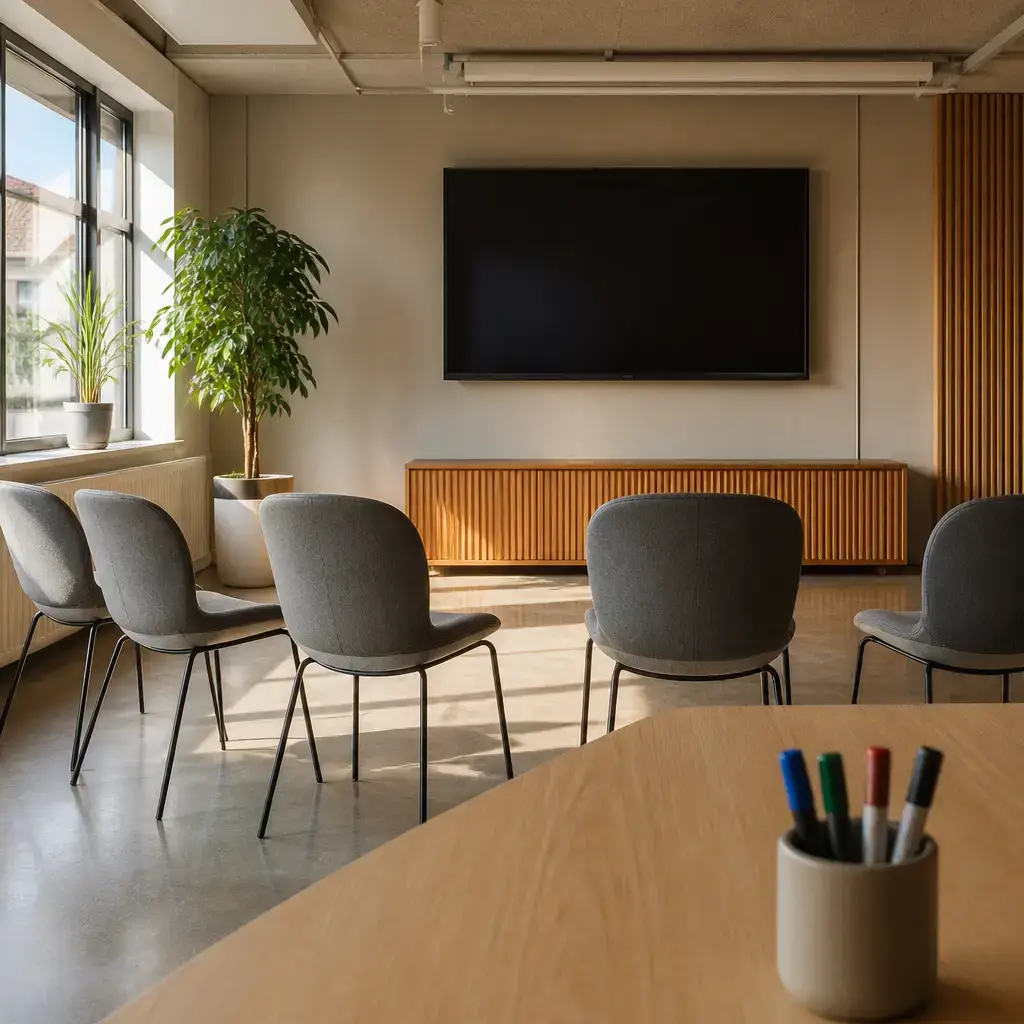
Die Stühle stehen an ihrem Platz.
dee SHTYOO-leh SHTAY-en an EYE-rem PLAHTS The chairs are in place.
A
Funktioniert der Bildschirm?
foongk-tsee-oh-NEERT dair BILT-shirm Is the screen working?
B
Das Bild ist klar.
dahs bilt ist klahr The picture looks clear.
A
Haben wir Marker?
HAH-ben veer MAR-ker Do we have markers?
B
Sie liegen auf dem Tisch.
zee LEE-gen owf daim tish They're on the table.
A
Ist genug Platz zum Bewegen da?
ist guh-NOOK plahts tsoom beh-VAY-gen dah Is there space to move around?
B
Es gibt genug Platz zum Herumgehen.
ess geept guh-NOOK plahts tsoom heh-ROOM-gay-en There's enough room to walk around.Word by Word
Ist
“Ist” means “is” here and asks about the room’s state in “Ist der Raum bereit?”. It appears at the beginning because this is a yes-or-no question. Use it when checking whether a room or item is ready or available.
der
“der” means “the” in “der Raum” and introduces the room being asked about. It is the masculine singular nominative article used with “Raum” here. Use it when referring to the room being checked.
Raum
“Raum” means “room” in “der Raum”; here it refers to the shared room being checked. It appears after “der” as the main noun in the question. Use it when referring to the room where an activity will take place.
bereit
“bereit” means “ready” in “Ist der Raum bereit?”. It describes the room’s state after “ist”, so the question checks whether the room can be used. Use it when checking a room or item before use.
Die
“Die” means “the” in “Die Stühle stehen an ihrem Platz” and introduces the chairs as a group. It appears directly before “Stühle”. Use it when referring to the chairs in the room.
Stühle
“Stühle” means “chairs” in “Die Stühle stehen an ihrem Platz”. It is the plural form referring to the chairs being checked. Use it when talking about the chairs that should be arranged in a room.
stehen
“stehen” means “are standing” or “are positioned” in “Die Stühle stehen an ihrem Platz”. Here it describes the chairs’ position. Use it when reporting that chairs or other items are positioned somewhere.
an
“an” means “at” in “an ihrem Platz”. It contributes to the location phrase “an ihrem Platz”, showing where the chairs are positioned. Use it when stating that something is at its designated place.
ihrem
“ihrem” indicates possession in “ihrem Platz”, referring to the place associated with the chairs. It is the inflected possessive form used directly before “Platz”. Use it when identifying a place as belonging or being assigned to something already mentioned.
Platz
“Platz” means “place” or “spot” in “ihrem Platz”; here it is the chairs’ designated position. It completes the location phrase after “an”. Use it when checking whether something is in its intended place.
Funktioniert
“Funktioniert” means “works” or “functions” in “Funktioniert der Bildschirm?”. The speaker asks whether the screen operates correctly. It appears first because this is a yes-or-no question, so use it when checking a device before using it.
Bildschirm
“Bildschirm” means “screen” in “der Bildschirm”; here it is the device being checked. It follows “der” as the subject of “Funktioniert der Bildschirm?”. Use it when asking whether a screen is operating.
Das
“Das” means “the” in “Das Bild ist klar”. It is the article placed before “Bild” in this statement. Use it when referring to the picture or image being checked.
Bild
“Bild” means “picture” or “image” in “Das Bild ist klar”. Here it is the visible picture on the screen, described as clear. Use it when reporting the quality of an image on a screen.
klar
“klar” means “clear” in “Das Bild ist klar”. It describes the picture after “ist”, reporting that the image is clear. Use it when confirming that an image is easy to see.
Haben
“Haben” means “have” in “Haben wir Marker?”. Here it asks whether the group has markers available. It appears at the beginning because this is a yes-or-no question. Use it when checking whether needed items are available.
wir
“wir” means “we” in “Haben wir Marker?”. It refers to the people checking the room together and is the subject of the question. Use it when asking about something available to a group that includes the speaker.
Marker
“Marker” means “markers” in “Haben wir Marker?”. It names the writing tools being checked. Use it when asking whether markers are available for an activity in the room.
Sie
“Sie” refers to the markers in “Sie liegen auf dem Tisch”. It is the subject of the statement about where the markers are located. Use it to refer back to the markers after they have been mentioned.
liegen
“liegen” means “are lying” or “are located” in “Sie liegen auf dem Tisch”. Here it reports the markers’ location. Use it when stating that items are located on a surface or in a place.
auf
“auf” means “on” in “auf dem Tisch”, identifying the table as the surface where the markers are located. It combines with “dem Tisch” to give their location. Use it when saying that something is on a table or another surface.
dem
“dem” means “the” in “dem Tisch”. It is the article used after “auf” in this location phrase. Use the complete phrase when stating where the markers are.
Tisch
“Tisch” means “table” in “dem Tisch”; here it is the surface where the markers are located. It follows “dem” in the phrase “auf dem Tisch”. Use it when identifying a table as the place where an item is.
genug
“genug” means “enough” in “genug Platz”. Here it says that the available room is sufficient for moving around. It comes before “Platz” to express a sufficient amount. Use it when confirming that there is sufficient space for an activity.
zum
“zum” means “for” in “zum Bewegen”. It is the contraction of “zu dem” before the capitalized form “Bewegen”. Here it introduces the activity for which space is needed. Use it in phrases describing space needed for an activity.
Bewegen
“Bewegen” refers to “moving” in “zum Bewegen”; here it names the activity that the space should allow. Its capitalized form is used after “zum” in this phrase. Use it when discussing room needed for movement.
da
“da” means “there” or “present” in “Ist genug Platz zum Bewegen da?”. Here it asks whether sufficient space is available. It appears at the end of the question as part of the availability statement. Use it when checking whether something is present or available.
Es
“Es” introduces the statement “Es gibt genug Platz zum Herumgehen”. Together with “gibt”, it states that enough space exists. Use this opening when saying that something or a certain amount is available.
gibt
“gibt” means “there is” or “there are” in “Es gibt genug Platz zum Herumgehen”. Together with “Es”, it states that enough space exists. Use “Es gibt” when saying that something is available or present.
Herumgehen
“Herumgehen” means “walking around” in “zum Herumgehen”; here it names the activity that the available space permits. Its capitalized form follows “zum” as the activity in the phrase. Use it when discussing space needed to walk around.
Grammar Points
zum + Infinitiv
zum Bewegen
tsoom beh-VAY-gento move around
German uses zum (zu dem) before a nominalized infinitive to express purpose or an activity.
German Vocabulary
an ihrem Platz
phrase
an EYE-rem PLAHTS
in their place
bereit
adj
beh-RITE
ready
das Bild
noun
dahs bilt
the picture; the image
der Bildschirm
noun
dair BILT-shirm
the screen
der Raum
noun
dair rowm
the room
die Stühle
noun
dee SHTYOO-leh
the chairs
funktioniert
verb
foongk-tsee-oh-NEERT
works; is working
haben
verb
HAH-ben
to have
klar
adj
klahr
clear
Marker
noun
MAR-ker
markers
sie
pron
zee
they
stehen
verb
SHTAY-en
to stand; are standing
Quiz
Word Order
Arrange the words in the correct order.
Is the room ready?
Show Answer
Ist der Raum bereit?The chairs are in place.
Show Answer
Die Stühle stehen an ihrem Platz.Is the screen working?
Show Answer
Funktioniert der Bildschirm?Spelling
Tap the letters to spell the word.
ready
Show Answer
bereitworks; is working
Show Answer
funktioniertto stand; are standing
Show Answer
stehenclear