Schauen
In Schauen wir auf die Liste, Schauen begins the suggestion “let’s look.” It is the form of schauen used at the start of this suggestion. A reusable pattern is Schauen wir auf + an object when suggesting that you look at something together.
wir
wir means “we,” referring to the speaker and another person together. In Schauen wir auf die Liste, it identifies who should look. It is also the subject in Wir brauchen noch einen Löffel.
auf
In Schauen wir auf die Liste, auf connects schauen with the thing receiving attention: the list. The reusable pattern is schauen auf + an object, as in Schauen wir auf die Liste.
die
die is the definite article for the specific list mentioned here. It belongs with Liste in die Liste. This article is used before a known noun in the expression Schauen wir auf die Liste.
Liste
Liste means “list,” specifically the list the two people are checking. It is the noun in die Liste. A common reuse pattern is eine Liste or die Liste for an unspecified or known list.
Ich
Ich means “I,” referring to the person speaking. It is the subject in Ich habe sie hier and Ich kann noch einen holen. German writes this pronoun with a capital letter even when it is not at the beginning of a sentence.
habe
habe means “have” in Ich habe sie hier: the speaker has the list with them. It is the form of haben used with Ich. A reusable pattern is Ich habe + an object, as in Ich habe sie hier.
sie
sie refers to the list in Ich habe sie hier and means “it” there; in Ich habe sie alle gewaschen, it refers to the cups and means “them.” Its exact meaning comes from the noun being referred to in each line. It can function as the object after habe or gewaschen.
hier
hier means “here,” indicating the speaker’s current location or position. In Ich habe sie hier, it says that the list is here with the speaker. It commonly appears at the end of a short statement about where something is.
Sind
Sind means “are” in the question Sind die Tassen bereit? It is the plural form of sein used with die Tassen. At the start of a yes-or-no question, it comes before the subject: Sind + subject + description.
Tassen
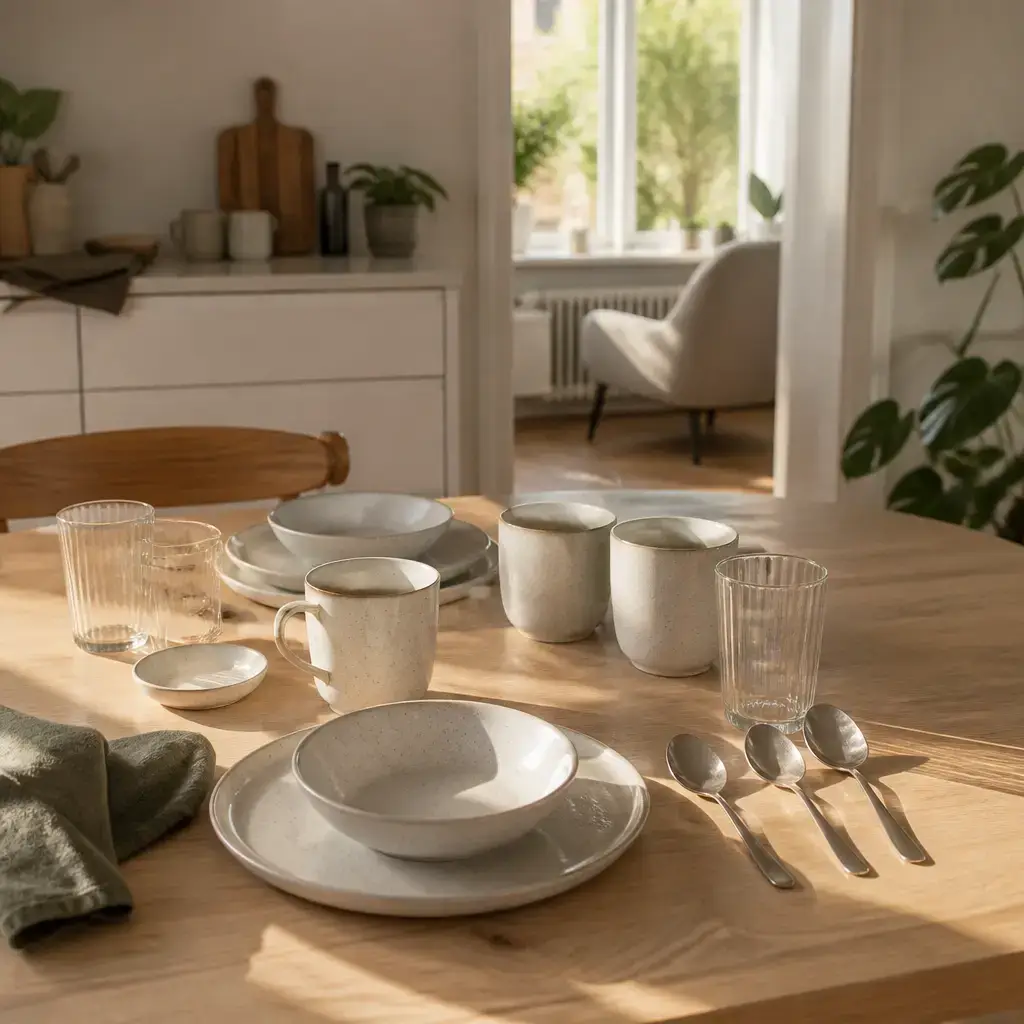
Tassen means “cups,” referring to the cups being checked. It is the plural form of Tasse in die Tassen. The noun appears as the subject in Sind die Tassen bereit?
bereit
bereit means “ready,” describing the condition of the cups in Sind die Tassen bereit? It follows the form of sein in this question. It is commonly used after sein to ask or state whether something is ready.
alle
alle means “all,” showing that every cup is included in Ich habe sie alle gewaschen. It comes after sie and emphasizes the complete group. A reusable pattern is sie alle for “all of them.”
gewaschen
gewaschen means “washed,” saying that the cups have been washed in Ich habe sie alle gewaschen. It is the form of waschen used with habe to report the completed washing. A reusable pattern is Ich habe + object + gewaschen.
Fehlt
Fehlt means “is missing” in Fehlt etwas? The question asks whether anything is absent from the items being checked. It is the form of fehlen used with the singular subject etwas. The pattern Fehlt etwas? is a concise way to ask whether something is missing.
etwas
etwas means “anything” in Fehlt etwas?, leaving the missing item unspecified. It refers to an unspecified thing after the verb. It commonly appears in questions when the speaker does not know whether an item is present.
brauchen
brauchen means “need” in Wir brauchen noch einen Löffel. It takes the needed item as its object, here einen Löffel. A reusable pattern is Wir brauchen + an object.
noch
In Wir brauchen noch einen Löffel, noch means that one spoon is still additionally needed. In Ich kann noch einen holen, it supports the meaning “another one.” It commonly appears before the item or action that remains or is added.
einen
einen means “a” or “one” before Löffel in Wir brauchen noch einen Löffel. It is the form of ein used with this noun here. In Ich kann noch einen holen, the noun is left unstated because the earlier spoon supplies the meaning.
Löffel
Löffel means “spoon,” the item that is still needed for the table. It appears in the phrase einen Löffel. This noun can be reused when naming a spoon as an item that is needed or missing.
kann
kann means “can” in Ich kann noch einen holen, expressing the speaker’s ability or possibility to fetch another one. It is the form of können used with Ich. After kann, the following action appears as an infinitive: kann ... holen.
holen
holen means “get” or “fetch” in Ich kann noch einen holen, referring to getting another spoon. It is the infinitive used after kann. A reusable pattern is Ich kann + an infinitive for saying what you can do.
Dann
Dann means “then,” linking the needed action with its result. In Dann ist der Tisch gedeckt, it introduces the conclusion that follows. It commonly appears at the beginning of a sentence describing the next step or result.
ist
ist means “is” in Dann ist der Tisch gedeckt, connecting the table with its resulting state. It is the form of sein used with der Tisch. It commonly comes before a description of a person or thing’s state.
Tisch
Tisch means “table,” specifically the table that is being prepared. In Dann ist der Tisch gedeckt, it is the thing described as ready for the meal. The noun can be reused when talking about a table in the home.
gedeckt
gedeckt means “set” or “laid,” describing the table as prepared in Dann ist der Tisch gedeckt. It is the form of decken used with ist to describe the resulting state. The pattern ist ... gedeckt states that a table has been set.