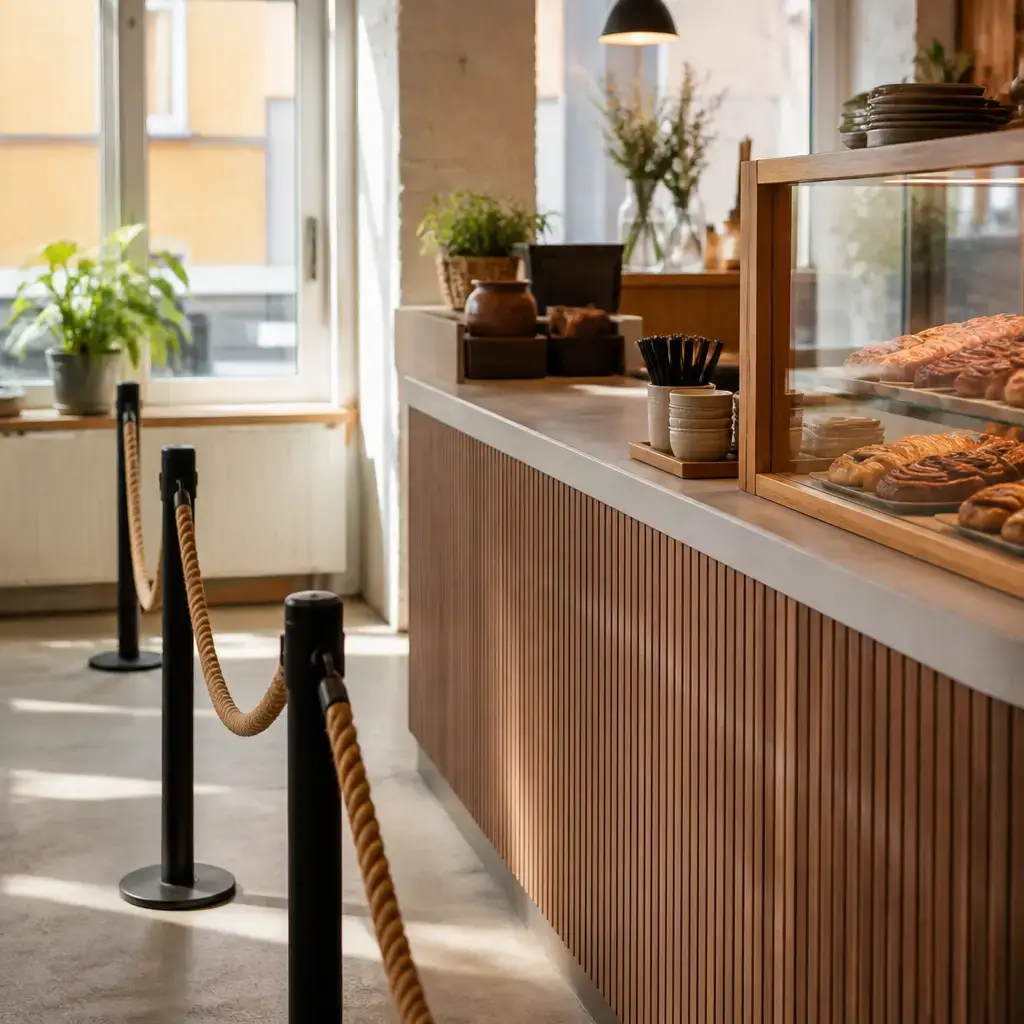
Die
“Die” means “the” in “Die Schlange” and introduces the line or queue being discussed. It is the form used before “Schlange” here; a reusable pattern is “die” plus a noun.
Schlange
“Schlange” means “line” or “queue” in “Die Schlange geht weiter.” In this situation, it refers to the people waiting at the counter; a common reuse is “in der Schlange” for being in line.
geht
In “Die Schlange geht weiter”, “geht” says that the line moves or continues. It is the form of “gehen” used with “Die Schlange”; with “weiter”, the expression describes forward movement.
weiter
“Weiter” contributes the meaning “onward” or “forward” in “Die Schlange geht weiter.” Together with “geht”, it shows that the line is continuing to move; a reusable pattern is “weitergehen” for continuing to go.
Wir
“Wir” means “we” as the subject of “Wir sollten jetzt weiter nach vorne gehen.” It refers to the speaker and the other person together; a common reuse is “Wir” followed by a verb to describe a shared action.
sollten
“Sollten” expresses a suggestion or what the two people should do in “Wir sollten jetzt weiter nach vorne gehen.” With “gehen” at the end, it forms a modal-verb construction; a reusable pattern is “Wir sollten” plus an action.
jetzt
“Jetzt” means “now” and shows that the suggested movement should happen at this moment. In “Wir sollten jetzt weiter nach vorne gehen”, it places the action in the present situation; it can be reused to make the timing of an action clear.
nach
In “nach vorne”, “nach” helps express movement toward the front. It works with “vorne” in “weiter nach vorne gehen”; a reusable pattern is “nach vorne gehen” when telling someone to move toward the front.
vorne
“Vorne” means “at the front” or “forward” in “weiter nach vorne gehen.” Together with “nach”, it identifies the direction of movement; a common reuse is “nach vorne” for moving toward the front.
gehen
“Gehen” means “go” or “walk” in “Wir sollten jetzt weiter nach vorne gehen.” It appears at the end because it follows “sollten”; a reusable pattern is a modal verb followed by “gehen” for saying that someone should or can go.
Sind
“Sind” means “are” in the question “Sind wir als Nächstes dran?” It is the form of “sein” used with “wir” here; starting the question with “Sind” places the verb before the subject.
als
In “als Nächstes”, “als” helps express the idea of being next. The whole phrase “als Nächstes dran” asks whether it is the speakers’ turn next; a reusable pattern is “als Nächstes” for identifying the next action or turn.
Nächstes
“Nächstes” means “next” in “Sind wir als Nächstes dran?” Together with “als”, it identifies the next turn in the line; a common reuse is “als Nächstes” when saying what happens next.
dran
“Dran” means that someone is due to act or is next in turn in “Sind wir als Nächstes dran?” The expression “als Nächstes dran sein” is used to ask or say who comes next; it is especially useful when discussing turns in a line or activity.
Fast
“Fast” means “almost” in “Fast, eine Person ist vor uns.” It shows that the speakers are nearly next but not quite; it can be used on its own as a brief answer when something is nearly true.
eine
“Eine” means “a” or “one” before “Person” in “eine Person ist vor uns.” It introduces one person in the situation; a reusable pattern is “eine” plus a singular noun.
Person
“Person” means “person” in “eine Person ist vor uns.” Here it identifies the single person still ahead of the speakers; it can be reused when referring neutrally to an individual.
ist
“Ist” means “is” in “eine Person ist vor uns.” It links the person with her position ahead of the speakers; it is the form of “sein” used with “eine Person” here.
vor
In “vor uns”, “vor” means “in front of” or “ahead of.” The phrase describes the position of the person relative to the speakers; a reusable pattern is “vor” plus a person or object to describe what is ahead.
uns
“Uns” means “us” in “vor uns” and refers to the two speakers. It completes the position phrase showing that the person is ahead of them; a common reuse is “vor uns” for something located or waiting ahead.
Ich
“Ich” means “I” as the subject of “Ich habe meine Karte schon parat.” It identifies the speaker who has the card ready; a reusable pattern is “Ich” followed by a verb to describe the speaker’s situation.
habe
“Habe” means “have” in “Ich habe meine Karte schon parat.” It presents the speaker as having the card available and ready; it is the form of “haben” used with “Ich” here.
meine
“Meine” means “my” before “Karte” in “meine Karte.” It marks the card as belonging to or being associated with the speaker; a reusable pattern is “meine” plus a noun.
Karte
“Karte” means “card” in “Ich habe meine Karte schon parat.” It refers to the card the speaker will use at the counter; a common reuse is “eine Karte haben” when referring to possessing a card.
schon
“Schon” means “already” in “meine Karte schon parat” and emphasizes that the card is ready at this point. It is useful for showing that something has been prepared before it is needed; a reusable pattern is “schon” with a state or action that is already true.
parat
“Parat” means “ready” or “on hand” in “Ich habe meine Karte schon parat.” It describes the card as immediately available for use; a reusable pattern is “etwas parat haben” for having something ready.
Halte
“Halte” is a direct instruction to hold or keep something in “Halte sie in der Hand.” It tells one person what to do with the card; a reusable pattern is “Halte” followed by an object and its position.
sie
“Sie” means “it” in “Halte sie in der Hand” and refers back to “meine Karte.” It is the object being held, not the people who can take the order; a common reuse is a pronoun such as “sie” replacing a previously mentioned noun.
in
In “in der Hand”, “in” expresses the location where the card should be held. It combines with “der Hand” to mean “in the hand”; a reusable pattern is “etwas in der Hand halten.”
der
“Der” means “the” in the phrase “in der Hand.” It is the article used before “Hand” in this location phrase; the complete reusable expression is “in der Hand.”
Hand
“Hand” means “hand” in “in der Hand.” It identifies where the card should be kept; a common reuse is “etwas in der Hand halten” for holding something in one’s hand.
bin
“Bin” means “am” in “Ich bin bereit zu bestellen.” It states the speaker’s current state of readiness; it is the form of “sein” used with “Ich” here.
bereit
“Bereit” means “ready” in “Ich bin bereit zu bestellen.” It describes the speaker as prepared to place an order; a reusable pattern is “bereit zu” followed by an action.
zu
In “zu bestellen”, “zu” marks the action that the speaker is ready to perform. It connects “bereit” with the infinitive “bestellen”; a reusable pattern is “bereit zu” plus an infinitive.
bestellen
“Bestellen” means “order” in “Ich bin bereit zu bestellen.” It names the action the speaker is prepared to carry out at the counter; a common reuse is “etwas bestellen” when naming what someone orders.
können
“Können” means “can” or “are able to” in “Sie können als Nächstes unsere Bestellung aufnehmen.” It says that the staff can take the order next; it is used with the infinitive “aufnehmen” at the end.
unsere
“Unsere” means “our” before “Bestellung” in “unsere Bestellung.” It shows that the order belongs to or is being made by the speakers together; a reusable pattern is “unsere” plus a noun.
Bestellung
“Bestellung” means “order” in “unsere Bestellung aufnehmen.” It refers to the order that the staff can take from the speakers; a common reuse is “eine Bestellung aufnehmen” for taking a customer’s order.
aufnehmen
In “unsere Bestellung aufnehmen”, “aufnehmen” means “take” or “record” an order. It is the action the staff can perform, and it appears at the end after “können”; a reusable pattern is “eine Bestellung aufnehmen.”