Dieser
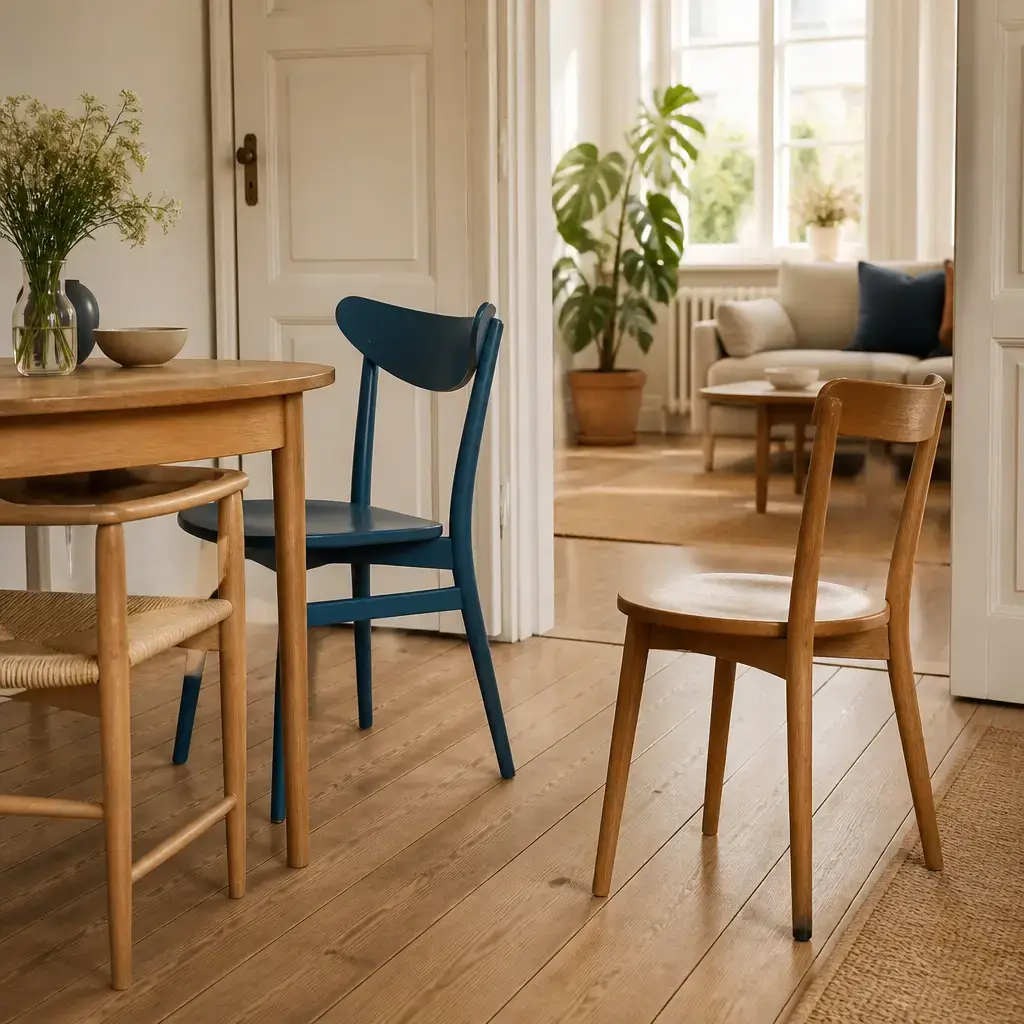
“Dieser” means “this” in “Dieser Stuhl” and points to the specific chair being discussed. Use it before a noun when identifying one particular thing nearby or already known.
Stuhl
“Stuhl” means “chair” in this dialogue. In “Dieser Stuhl” it names the piece of furniture that feels loose; the same noun can be reused when choosing or moving a seat.
fühlt
“fühlt” means “feels” in “Dieser Stuhl fühlt sich locker an.” Here it describes how the chair seems when touched or used, as part of “fühlt sich ... an”; this pattern is useful for describing how something feels.
sich
“sich” is the reflexive pronoun used with “fühlt ... an” in “fühlt sich locker an.” It links the feeling back to the chair, and the same kind of reflexive construction is used when something is described as feeling a certain way.
locker
“locker” means “loose” here and describes the chair’s unsafe condition. In “fühlt sich locker an,” it tells the listener that the chair does not feel firmly fixed; use it when reporting a loose part or object.
an
In “fühlt sich locker an,” “an” is the separable part that completes the expression meaning “feels.” In “an die Wand,” it is a preposition showing the chair’s destination against the wall, so its function depends on the surrounding words.
Welcher
“Welcher” means “which” in “Welcher Teil” and asks the listener to identify one part from several possible parts. Use “Welcher” before a noun when asking which particular item is involved.
Teil
“Teil” means “part” in “Welcher Teil ist bewegt sich?” Actually, in the dialogue it appears in “Welcher Teil bewegt sich?” and refers to one component of the chair. Use it to ask or talk about one component of a larger thing.
bewegt
“bewegt” means “moves” in “Welcher Teil bewegt sich?” Together with “sich,” it describes the part that is moving. This form is useful when asking which object or component is in motion.
Das
“Das” means “the” in “Das hintere Stuhlbein” and identifies the specific chair leg being discussed. Use it before a noun when referring to a particular thing.
hintere
“hintere” means “back” or “rear” in “Das hintere Stuhlbein.” It specifies which chair leg is meant, so it is useful when locating a part by its position.
Stuhlbein
“Stuhlbein” means “chair leg” and names the part that wobbles. It is used here to identify a specific component of the chair when reporting a problem.
wackelt
“wackelt” means “wobbles” in “Das hintere Stuhlbein wackelt ein bisschen.” It describes unsteady movement of the chair leg; use it when a part moves from side to side rather than staying firm.
ein
“ein” appears in the expression “ein bisschen,” which means “a little” here. Together with “bisschen,” it makes the description less than a large amount, useful when reporting a small degree of movement.
bisschen
“bisschen” means “bit” or “little” in “ein bisschen.” The whole expression “ein bisschen” says that the chair leg wobbles only slightly, so it is useful for describing a small amount.
Wir
“Wir” means “we” in “Wir sollten ihn reparieren” and includes the speaker and the listener. Use it when suggesting that both people should take part in an action.
sollten
“sollten” means “should” in “Wir sollten ihn reparieren” and expresses what the speakers consider advisable. The reusable pattern “Wir sollten” introduces a shared recommendation or plan.
ihn
“ihn” means “it” here and refers back to the chair in “Wir sollten ihn reparieren.” It is used again in “bevor jemand ihn benutzt,” keeping the chair as the object of the actions being discussed.
reparieren
“reparieren” means “repair” or “fix” in “Wir sollten ihn reparieren.” It names the action needed for the loose chair, and it follows “sollten” in this recommendation.
bevor
“bevor” means “before” and introduces “bevor jemand ihn benutzt.” It places repairing the chair earlier than someone’s use of it; use it when one action must happen before another.
jemand
“jemand” means “someone” or “anyone” in “bevor jemand ihn benutzt.” It refers to an unspecified person who might use the chair, which is useful when the particular person is not known.
benutzt
“benutzt” means “uses” in “jemand ihn benutzt,” referring to using the chair. It describes the action that should wait until the chair has been repaired; use it when someone makes use of an object.
Soll
“Soll” means “should” in the question “Soll ich mich woanders hinsetzen?” Here it asks whether the speaker ought to sit somewhere else. The pattern “Soll ich” is useful for asking whether one should take an action.
ich
“ich” means “I” in “Soll ich mich woanders hinsetzen?” and refers to the person speaking. The same pronoun appears as “Ich” at the start of “Ich stelle diesen Stuhl weg”; the capital letter is required because it begins the sentence.
mich
“mich” marks the speaker as the person sitting down in “mich woanders hinsetzen.” Together with “hinsetzen,” it describes changing one’s sitting place; use this construction when talking about where you will sit.
woanders
“woanders” means “somewhere else” in “mich woanders hinsetzen.” It indicates a different place from the current one, useful when moving to another seat or location.
hinsetzen
“hinsetzen” means “sit down” in “mich woanders hinsetzen.” With “mich” and “woanders,” it describes sitting down in another place, and it follows “Soll” in the question.
Nimm
“Nimm” means “take” or, in this context, “use” as an instruction in “Nimm erst einmal einen anderen Stuhl.” It is useful when telling one person to choose or take a particular object.
erst
“erst” contributes to the temporary meaning of “erst einmal” in “Nimm erst einmal einen anderen Stuhl.” The expression tells the listener to use the other chair for the present situation, while the loose chair is not ready.
einmal
“einmal” is part of “erst einmal,” which means “for now” in this dialogue rather than referring to a single count. Use the whole expression when giving a temporary instruction or solution.
einen
“einen” is the article used before “anderen Stuhl” in “Nimm erst einmal einen anderen Stuhl.” It introduces the chair that the listener should use, and the same article-plus-noun pattern can identify an object after an instruction.
anderen
“anderen” means “another” or “different” in “einen anderen Stuhl.” It identifies a chair different from the loose one, which is useful when directing someone to an alternative object.
stelle
“stelle” means “place” or “put” in “Ich stelle diesen Stuhl weg.” Here it describes moving the chair to a different position, while “weg” completes the meaning of putting it away.
diesen
“diesen” means “this” or “this one” in “diesen Stuhl.” It points to the specific chair that has just been discussed, useful when selecting one object from the situation.
weg
“weg” means “away” in “stelle diesen Stuhl weg.” Together with “stelle,” it says that the chair is being put away from its current place; use this separable-particle pattern when removing an object.
Stell
“Stell” means “put” or “place” as an instruction in “Stell ihn an die Wand.” It tells one person where to position the chair, and “an die Wand” supplies the destination.
die
“die” means “the” in “die Wand” and identifies the particular wall as the destination. Use it before a known or specific noun such as the wall in the room.
Wand
“Wand” means “wall” in “an die Wand.” It names the surface against which the chair should be placed, useful when giving a location for an object.
damit
“damit” means “so that” in “damit der Durchgang frei bleibt.” It introduces the desired result of moving the chair, and it is useful when explaining the purpose of an action.
der
“der” means “the” in “der Durchgang” and identifies the specific passage that should remain clear. Use it before a noun when referring to a particular part of the room.
Durchgang
“Durchgang” means “walkway” or “passage” in “der Durchgang frei bleibt.” It refers to the route people use to walk through the room, so it is useful when discussing space that must not be blocked.
frei
“frei” means “clear” in “der Durchgang frei bleibt.” It describes the walkway as unobstructed, which is the practical reason for moving the chair away.
bleibt
“bleibt” means “stays” or “remains” in “der Durchgang frei bleibt.” With “frei,” it says that the walkway continues to be clear after the chair is moved; use it to describe a condition that continues.