Ich
“Ich” means “I” and identifies the speaker in “Ich habe eine kleine Schraube verloren.” It is used as the subject when talking about yourself, often before the verb.
habe
“habe” means “have” in “Ich habe eine kleine Schraube verloren.” Here it helps form a statement about something that has been lost. It commonly follows “Ich” when describing what you have done.
eine
“eine” means “a” and introduces one screw in “eine kleine Schraube.” It is used before this feminine noun when referring to an unspecified screw.
kleine
“kleine” means “small” and describes the screw in “eine kleine Schraube.” It comes before the noun it describes and shows that the object is not large.
Schraube
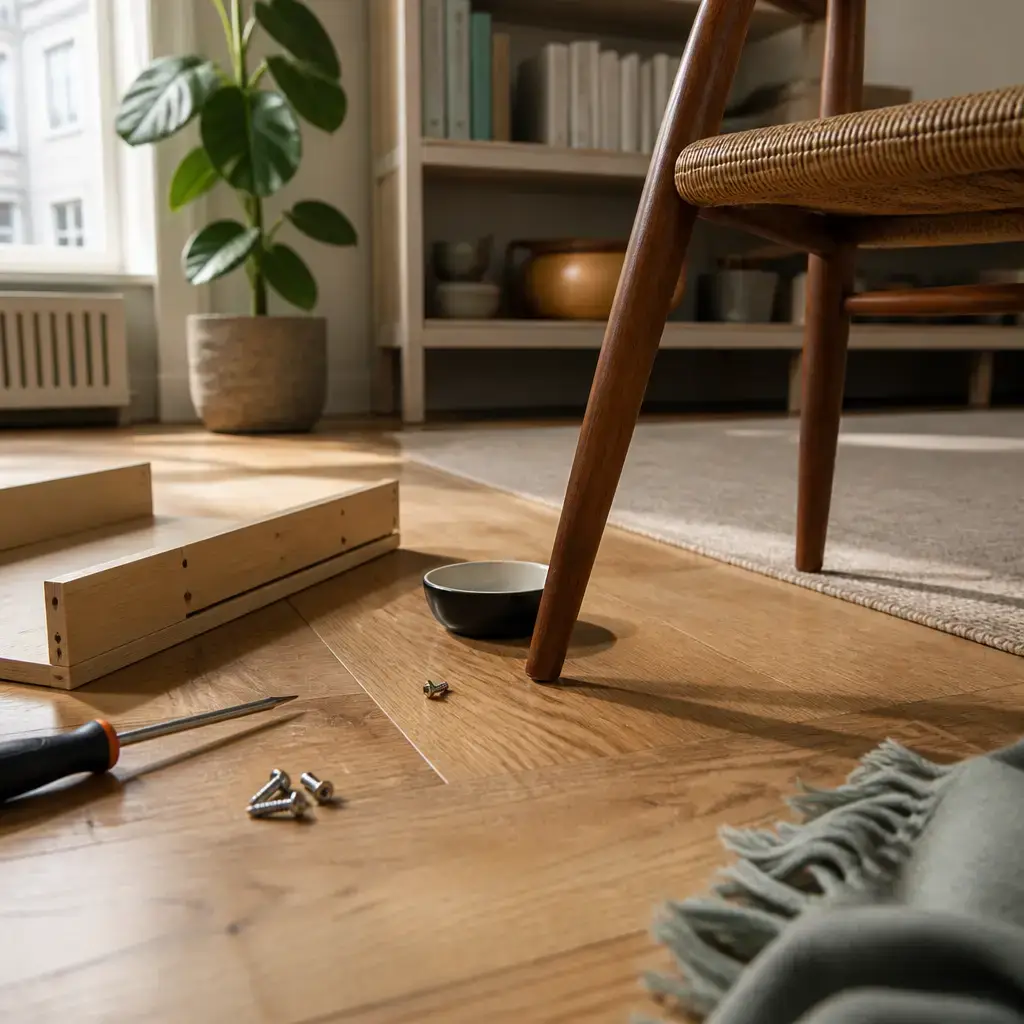
“Schraube” means “screw,” the small object that was lost and found. In “eine kleine Schraube,” it names the object being discussed. You can use it when talking about a screw needed for repair work.
verloren
“verloren” means “lost” in “Ich habe eine kleine Schraube verloren.” It is the form used with “habe” to describe the completed loss of the screw. It can follow “haben” when saying that something has been lost.
Schau
“Schau” means “check” or “look” in the informal command “Schau unter dem Stuhl nach.” It tells one person to inspect a place. The reusable pattern “Schau ... nach” can be used when asking someone to check a location or item.
unter
“unter” means “under” in “unter dem Stuhl.” It shows that the checking should happen beneath the chair. Use it before a place or object when describing something located underneath it.
dem
“dem” means “the” in “dem Stuhl.” It is the article used here before the masculine noun “Stuhl” after “unter” in this location phrase. It identifies the specific chair being checked.
Stuhl
“Stuhl” means “chair” in “unter dem Stuhl.” It names the furniture beneath which the screw may be found. Use it when referring to a chair as a place or object.
nach
“nach” is the particle in “Schau unter dem Stuhl nach,” where “Schau ... nach” means “check” or “look for.” It completes the checking expression rather than meaning a separate upward movement. Keep it at the end of this command pattern.
Sie
“Sie” means “it” in “Sie lag am Stuhlbein” and refers to the feminine noun “Schraube.” The capital letter appears because it begins the sentence; here it does not mean formal “you.” A feminine noun can be referred to with this pronoun.
lag
“lag” means “was lying” in “Sie lag am Stuhlbein.” It describes the screw’s position beside the chair leg. The citation form is “liegen”; “lag” is the past form used for the earlier position.
am
“am” means “by” or “at the” in “am Stuhlbein.” It is the shortened form of “an dem” and introduces the location of the screw. Use it before a specific location in a phrase describing where something is or was.
Stuhlbein
“Stuhlbein” means “chair leg,” the part of the chair beside which the screw was lying. In “am Stuhlbein,” it identifies the precise location. It is useful when naming a chair’s leg rather than the whole chair.
Heb
“Heb” means “pick up” or “lift” in the command “Heb sie vorsichtig auf.” It tells one person to raise the screw from the floor or another surface. The citation form is “heben,” and the command takes an object such as the screw here.
vorsichtig
“vorsichtig” means “carefully” in “Heb sie vorsichtig auf.” It tells the listener to handle the tiny screw with care while picking it up. It can be used with instructions for handling a small or fragile object.
auf
“auf” is the particle in “Heb sie vorsichtig auf,” completing the expression for “pick up.” It belongs with “Heb” and moves to the end of this command. Keep it after the object in this separable-verb pattern.
ist
“ist” means “is” in “Sie ist winzig.” It connects the screw with the description “winzig.” It is used between a subject and a present description.
winzig
“winzig” means “tiny” in “Sie ist winzig.” It emphasizes that the screw is very small. Use it to describe a very small object after a form of “sein.”
Halte
“Halte” means “hold” in the informal command “Halte sie in deiner Handfläche.” It tells one person to keep the screw in the palm. The citation form is “halten,” and the pattern can be used with an object and the place where it should be held.
in
“in” means “in” in “in deiner Handfläche.” It introduces the place where the screw should be held. Use it before a container, body part, or other place that contains or supports something.
deiner
“deiner” means “your” in “deiner Handfläche.” It shows that the palm belongs to the person being addressed. It comes before the noun that names the person’s body part or possession.
Handfläche
“Handfläche” means “palm of the hand” in “in deiner Handfläche.” It identifies the inside surface where the screw should be kept. Use it when describing something held in the palm rather than generally in the hand.
damit
“damit” means “so that” in “damit sie nicht wieder wegrollt.” It introduces the purpose of holding the screw in the palm: preventing it from rolling away. It commonly begins a clause that explains the intended result of an action.
nicht
“nicht” means “not” in “sie nicht wieder wegrollt.” It makes the rolling away negative. Here it appears before the verb at the end of the subordinate clause.
wieder
“wieder” means “again” in “nicht wieder wegrollt.” It indicates that rolling away is something that could happen another time. Use it to mark a repeated action or event.
wegrollt
“wegrollt” means “rolls away” in “sie nicht wieder wegrollt.” The form describes the screw moving away by rolling. The citation form is “wegrollen,” and this form appears at the end of the subordinate clause after “damit.”
Wir
“Wir” means “we” in “Wir brauchen sie.” It refers to the speaker and the other person together. It is the sentence-initial subject here and can introduce what the group needs or does.
brauchen
“brauchen” means “need” in “Wir brauchen sie.” It expresses that the two people require the screw for the repair. It commonly takes the needed person or thing as its object.
um
“um” is part of the purpose construction “um das Regal zu reparieren,” meaning “in order to repair the shelf.” It introduces the goal of needing the screw. Use “um ... zu” when explaining the purpose of an action.
das
“das” means “the” in “das Regal.” It is the article used here with the neuter noun “Regal.” It identifies the specific shelf that needs repair.
Regal
“Regal” means “shelf” in “das Regal.” It names the piece of furniture the speakers are repairing. Use it when referring to a shelf as the object of a repair or other action.
zu
“zu” is the infinitive marker in “zu reparieren.” Together with “um,” it forms the purpose expression “um das Regal zu reparieren.” It comes before the infinitive when stating what the purpose is.
reparieren
“reparieren” means “repair” or “fix” in “um das Regal zu reparieren.” It names the action the screw is needed for. Here it follows “zu” in a purpose construction and takes “das Regal” as its object.
Dann
“Dann” means “then” in “Dann können wir es fertig reparieren.” It links the next step to finding and keeping the screw safe. It can be placed at the beginning of a sentence to introduce what happens afterward.
können
“können” means “can” or “be able to” in “Dann können wir es fertig reparieren.” It expresses that the speakers will be able to complete the repair. With this meaning, it is followed by the action that they are able to perform.
es
“es” means “it” in “wir es fertig reparieren” and refers back to “das Regal.” It is the thing that the speakers will finish repairing. Use it to refer back to this previously named neuter object.
fertig
“fertig” indicates completion in “es fertig reparieren,” meaning to finish repairing it. It shows that the repair should be brought to completion, not merely started. It can be used with an action to express that the action is completed.