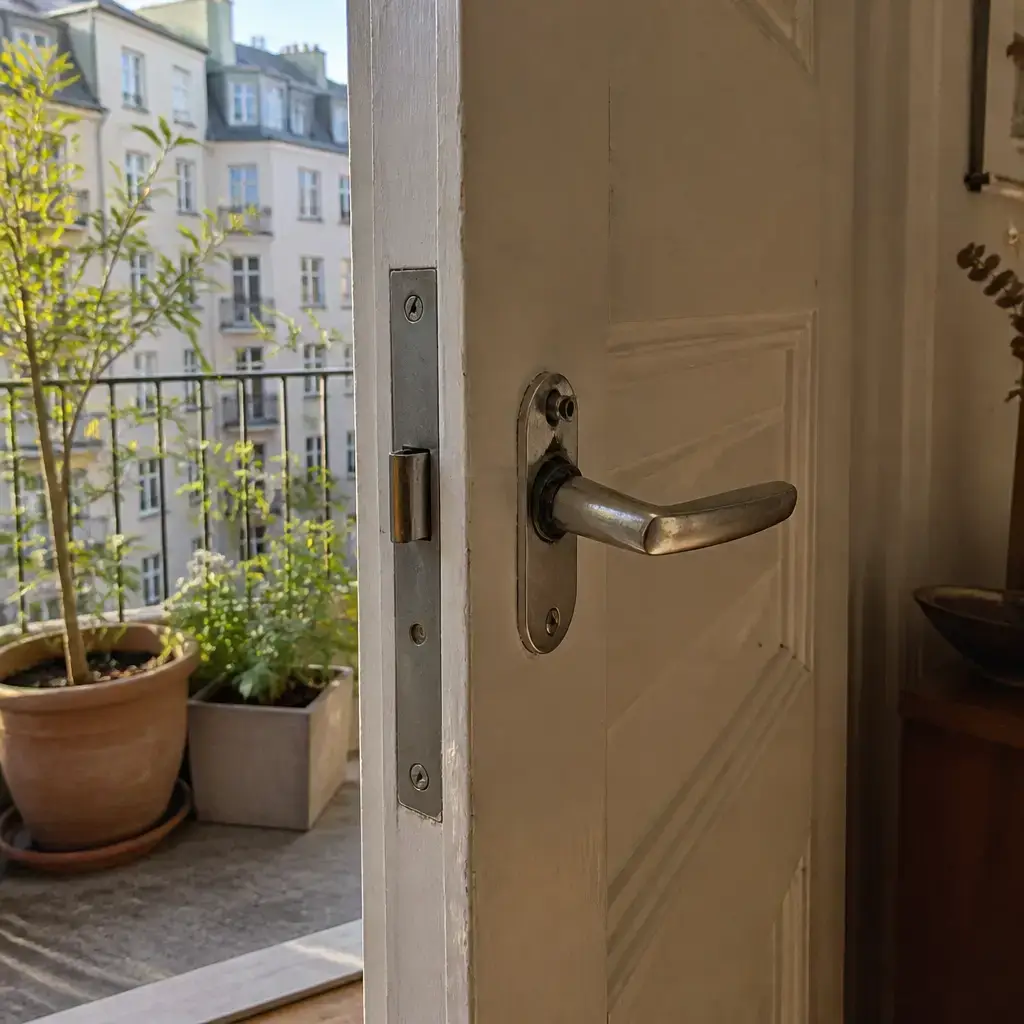
Die
“Die” means “the” here and introduces the feminine noun “Tür” in “Die Tür klemmt.” It is the definite article used with this noun. A reusable pattern is “die” plus a feminine noun when referring to a specific thing.
Tür
“Tür” means “door” in “Die Tür klemmt.” It names the door that is stuck in this situation. A useful pattern is “die Tür” for “the door.”
klemmt
“Klemmt” says that the door is stuck or jams in “Die Tür klemmt.” It is the exact form used to describe the door’s current problem. Use it when describing something that does not move freely because it is jammed.
Versuch
“Versuch” means “try” as a direct instruction in “Versuch, am Griff zu ziehen.” It addresses one person informally. A reusable pattern is “Versuch, … zu” followed by an action to try.
am
“Am” means “at the” in “am Griff” and refers to the place where the pulling happens. It is the contracted form of “an dem.” A useful pattern is “am” plus a masculine or neuter noun when referring to a specific place or point.
Griff
“Griff” means “handle” in “am Griff.” It identifies the part of the door that should be pulled. A reusable expression is “am Griff ziehen,” meaning to pull the handle.
zu
“Zu” marks the infinitive construction “zu ziehen” in “Versuch, am Griff zu ziehen.” Together, “Versuch, … zu ziehen” tells someone to try pulling. This pattern is useful after “Versuch” when naming an action to try.
ziehen
“Ziehen” means “pull” in “am Griff zu ziehen.” It describes the action suggested for opening the door. A useful pattern is “an etwas ziehen” or, in this dialogue, “am Griff ziehen.”
Ich
“Ich” means “I” in “Ich habe daran gezogen.” It identifies the person who pulled the handle. Use it at the start of a statement about your own action.
habe
“Habe” means “have” as the auxiliary in “Ich habe daran gezogen.” Together with “gezogen,” it reports that the pulling happened. A reusable pattern is “Ich habe …” followed by a completed action.
daran
“Daran” means “at it” or “on it” in “Ich habe daran gezogen,” referring to the handle mentioned just before. It avoids repeating the object after “gezogen.” A useful pattern is “an etwas ziehen” and, when referring back to it, “daran ziehen.”
gezogen
“Gezogen” means “pulled” in “Ich habe daran gezogen.” It is the form used with “habe” to report the completed pulling action. A reusable pattern is “Ich habe daran gezogen” when explaining that you pulled at something.
aber
“Aber” means “but” in “Ich habe daran gezogen, aber sie bleibt zu.” It connects the pulling action with the result that the door is still closed. Use it to introduce a contrasting result or fact.
sie
“Sie” means “it” here and refers back to the feminine noun “Tür” in “aber sie bleibt zu.” It keeps the door as the subject of the second part. A useful pattern is a pronoun such as “sie” referring back to a previously mentioned feminine noun.
bleibt
“Bleibt” means “stays” or “remains” in “sie bleibt zu.” It says that the door continues to be closed after the pulling. A reusable pattern is “etwas bleibt …” when a condition continues.
Drück
“Drück” means “push” as a direct instruction in “Drück langsam am Rand.” It tells one person informally what action to take. A reusable pattern is the command form followed by an adverb and the place of the action.
langsam
“Langsam” means “slowly” in “Drück langsam am Rand.” It tells the listener to push gently and without speed. Place it with an action verb when describing how the action should be done.
Rand
“Rand” means “edge” in “am Rand.” It identifies the area near which the listener should push. A useful pattern is “am Rand” when referring to the edge of an object.
ist
“Ist” means “is” in “Sie ist ein wenig aufgegangen.” Here it works with “aufgegangen” to describe the door’s change of state. A reusable pattern is “etwas ist …” when describing what something has become or how it is.
ein
“Ein” contributes “a” in the expression “ein wenig,” which means “a little.” In this dialogue it is not counting one object; it is part of the quantity expression. A useful pattern is “ein wenig” plus an adjective or description.
wenig
“Wenig” means “little” in “ein wenig aufgegangen,” indicating a small amount or degree of opening. Together, “ein wenig” means “a little.” Use “ein wenig” to describe a small degree or amount.
aufgegangen
“Aufgegangen” means “opened” in “Sie ist ein wenig aufgegangen.” It describes the door moving from closed toward open, and it appears with “ist.” A reusable pattern is “etwas ist aufgegangen” when something has opened.
Der
“Der” means “the” in “Der Griff fühlt sich locker an.” It introduces the masculine noun “Griff” as the specific handle being discussed. A reusable pattern is “der” plus a masculine noun when referring to a specific thing.
fühlt
“Fühlt” means “feels” in “Der Griff fühlt sich locker an.” It describes the impression the handle gives when touched or used. A useful pattern is “etwas fühlt sich … an” to describe how something feels.
sich
“Sich” is part of “fühlt sich locker an,” where it makes the expression describe how the handle feels. It refers back to the handle itself. A reusable pattern is “etwas fühlt sich … an” followed by a description.
locker
“Locker” means “loose” in “Der Griff fühlt sich locker an.” It describes the handle as not firmly attached. Use it after “fühlt sich” to describe a loose physical object.
an
“An” is the separable part of “fühlt sich … an” in “Der Griff fühlt sich locker an.” Together, the expression means “feels.” In a main clause, this particle appears at the end of the sentence.
Sollen
“Sollen” means “should” in the question “Sollen wir diese Tür nicht mehr benutzen?” It asks whether the speakers ought to stop using the door. A reusable question pattern is “Sollen wir …?” when suggesting or considering a shared action.
wir
“Wir” means “we” in “Sollen wir diese Tür nicht mehr benutzen?” It includes the speaker and the other person. Use it when proposing or discussing an action for both people.
diese
“Diese” means “this” in “diese Tür,” pointing to the particular door nearby. It appears directly before the noun it identifies. A useful pattern is “diese” plus a noun when indicating one specific thing.
nicht
“Nicht” supplies the negation in “diese Tür nicht mehr benutzen.” Together with “mehr,” it expresses stopping the use of the door. A reusable pattern is “nicht mehr” for something that should no longer happen.
mehr
“Mehr” means “any more” in “nicht mehr benutzen.” With “nicht,” it means that using this door should stop from now on. Use the pattern “nicht mehr” to say that an action will no longer continue.
benutzen
“Benutzen” means “use” in “diese Tür nicht mehr benutzen.” It is the action being considered in the question. A useful pattern is “etwas benutzen,” with the thing used directly after the verb.
können
“Können” means “can” in “Wir können den Griff reparieren.” It expresses that the speakers are able or have the option to repair the handle. A reusable pattern is “Wir können …” followed by an infinitive action.
den
“Den” means “the” in “den Griff reparieren.” It introduces the specific handle as the object of the repair action. A reusable pattern is “den” plus a masculine noun when that noun is the object of an action.
reparieren
“Reparieren” means “repair” or “fix” in “den Griff reparieren.” It names the action the speakers can take to solve the loose-handle problem. A useful pattern is “etwas reparieren,” with the item being fixed as the object.
bevor
“Bevor” means “before” in “bevor wieder jemand stecken bleibt.” It introduces the event that should be prevented before it happens again. A reusable pattern is “bevor” followed by a clause describing a later event.
wieder
“Wieder” means “again” in “wieder jemand stecken bleibt.” It shows that someone getting stuck has happened or is expected to happen another time. Use it with an action or event that repeats.
jemand
“Jemand” means “someone” or “anyone” in “jemand stecken bleibt.” It refers to an unspecified person who might get stuck. A useful pattern is “jemand” followed by a verb when the person is not identified.
stecken
“Stecken” contributes the meaning “be stuck” in the expression “stecken bleibt.” Together, “stecken bleibt” describes someone remaining unable to get free. A reusable pattern is “stecken bleiben” for a person or thing that becomes stuck.