Auf
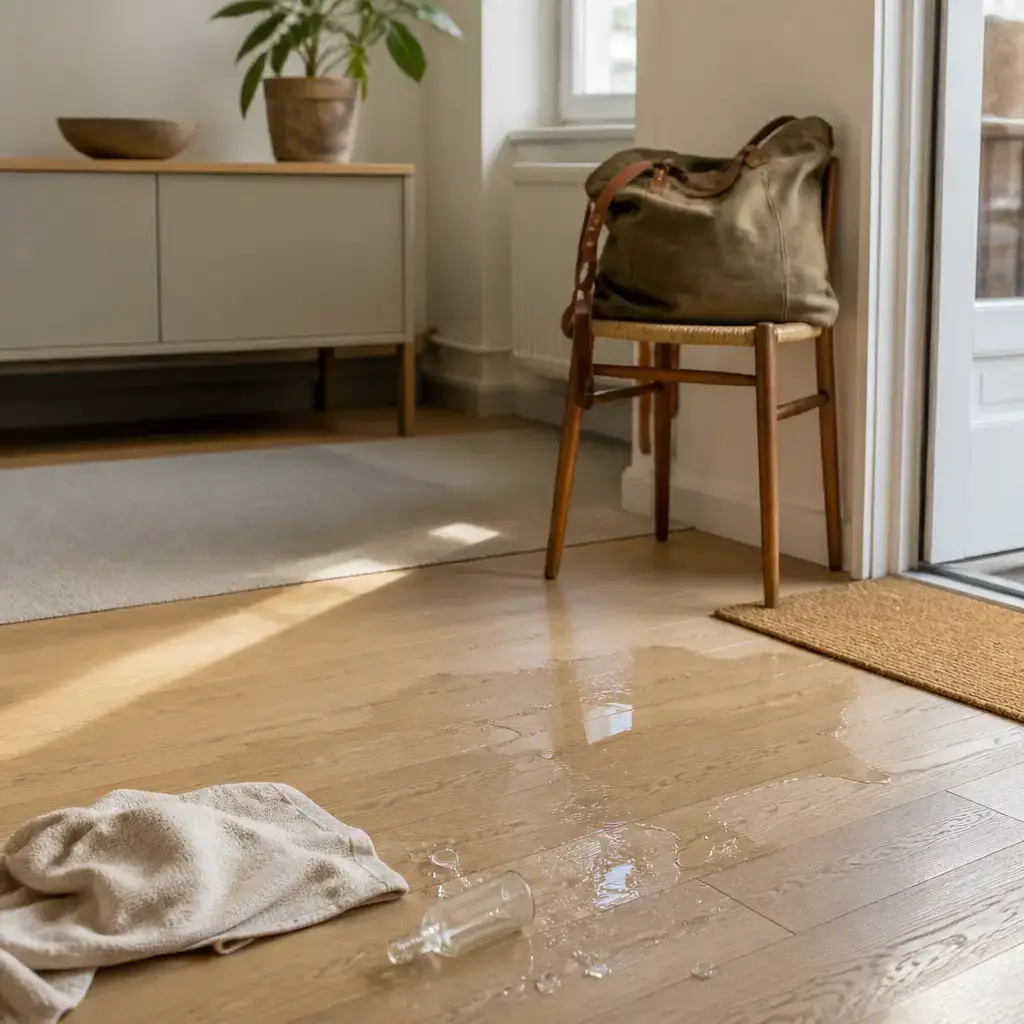
“Auf” means “on” in “Auf dem Boden ist Wasser.” Here it introduces the surface where the water is located. A common reuse pattern is “auf” plus a place, as in “auf dem Tisch” for “on the table.”
dem
“Dem” means “the” in “Auf dem Boden” and marks the location after “auf.” It belongs to the phrase “auf dem Boden,” not to “ist Wasser.” A common reuse pattern is “auf dem” plus a masculine or neuter place noun for a fixed location.
Boden
“Boden” means “floor” in “Auf dem Boden ist Wasser.” It names the surface where the water is. You can reuse it in “auf dem Boden” when describing something located on the floor.
ist
“Ist” means “is” in “Auf dem Boden ist Wasser.” It states that water is present at that location. A common reuse pattern is “[place] ist [thing]” when saying what is in a place.
Wasser
“Wasser” means “water” in “Auf dem Boden ist Wasser.” It is the substance found on the floor in this scene. You can reuse “Wasser” when talking about drinking, spilling, or cleaning water.
Das
“Das” means “the” in “Das Wasser läuft zur Tür” and refers back to the water already mentioned. It identifies the water as the thing moving toward the door. A common reuse pattern is “Das [noun]” when continuing to talk about a specific thing.
läuft
“Läuft” describes the water as running or flowing in “Das Wasser läuft zur Tür.” The form is used with “Das Wasser” here, and the direction follows in “zur Tür.” A common reuse pattern is “[thing] läuft zu[r] [place]” for something moving or flowing toward a place.
zur
“Zur” means “to” or “toward” in “zur Tür.” It is the contracted form of “zu der,” and it connects the movement with its destination. You can reuse “zur” before a feminine destination, as in “zur Schule.”
Tür
“Tür” means “door” in “Das Wasser läuft zur Tür.” It names the destination toward which the water is flowing. A common reuse pattern is “zur Tür” when describing movement toward the door.
Die
“Die” means “the” in “Die kleine Flasche ist kaputtgegangen.” It introduces the specific bottle that broke. A common reuse pattern is “die” before a feminine noun such as “die Flasche.”
kleine
“Kleine” means “small” in “Die kleine Flasche.” It describes the bottle’s size and appears directly before “Flasche.” You can reuse the pattern “die kleine [noun]” to describe a specific small thing.
Flasche
“Flasche” means “bottle” in “Die kleine Flasche ist kaputtgegangen.” It identifies the container that broke. You can reuse “Flasche” when talking about a bottle of water or another drink.
kaputtgegangen
“Kaputtgegangen” means “broken” or “has broken” in “Die kleine Flasche ist kaputtgegangen.” Together with “ist,” it presents the bottle as having become broken. Its citation form is “kaputtgehen”; the exact form “kaputtgegangen” is used here with “ist.”
Ich
“Ich” means “I” in “Ich hole ein trockenes Handtuch.” It identifies the speaker as the person who will get the towel. A common reuse pattern is “Ich” followed by an action, such as “Ich hole …” when announcing what you will get.
hole
“Hole” means “get” or “go get” in “Ich hole ein trockenes Handtuch.” In this exchange, it announces the speaker’s immediate action. Its citation form is “holen,” and “hole” is the exact form used with “Ich”; a common pattern is “Ich hole [object].”
ein
“Ein” means “a” in “ein trockenes Handtuch.” It introduces one non-specific towel that the speaker will get. A common reuse pattern is “ein” before a singular masculine or neuter object.
trockenes
“Trockenes” means “dry” in “ein trockenes Handtuch.” It describes the towel the speaker wants to get. You can reuse “trockenes” directly before a suitable singular neuter noun, as in “ein trockenes Handtuch.”
Handtuch
“Handtuch” means “towel” in “ein trockenes Handtuch.” It names the item needed for cleaning up the water. You can reuse it when asking for or fetching a towel.
Kannst
“Kannst” means “can” in “Kannst du zuerst die Tasche bewegen?” It asks whether the other person is able or willing to move the bag. Its citation form is “können”; “kannst” is the exact form used with “du,” and a common pattern is “Kannst du [action]?”
du
“Du” means “you” in “Kannst du zuerst die Tasche bewegen?” It addresses one person directly. A common reuse pattern is “Kannst du …?” when making a request to someone you address as “du.”
zuerst
“Zuerst” means “first” in “zuerst die Tasche bewegen.” It sets moving the bag as the action that should happen before cleaning the floor. A common reuse pattern is “zuerst [action]” when ordering two actions.
Tasche
“Tasche” means “bag” in “Kannst du zuerst die Tasche bewegen?” It names the item that needs to be moved away from the water. You can reuse “die Tasche” when asking someone to carry or move a bag.
bewegen
“Bewegen” means “move” in “die Tasche bewegen.” It is the action requested in the question. Its citation form is “bewegen,” and after “Kannst du” the reusable pattern is “Kannst du [object] bewegen?”
lege
“Lege” means “put” or “place” in “Ich lege sie auf den Stuhl.” It announces that the speaker will place the bag somewhere. Its citation form is “legen”; “lege” is the exact form used with “Ich,” and a common pattern is “Ich lege [object] auf [place].”
sie
“Sie” means “it” here in “Ich lege sie auf den Stuhl” and refers to “die Tasche.” Because it replaces the bag, it keeps the reference to that specific item while the speaker places it. A common reuse pattern is “Ich lege sie auf …” when placing a previously mentioned feminine noun.
den
“Den” means “the” in “auf den Stuhl.” Here “auf” describes movement to a destination, so the phrase identifies where the bag is being placed. A common reuse pattern is “auf den” plus a masculine destination noun for movement onto or toward it.
Stuhl
“Stuhl” means “chair” in “auf den Stuhl.” It is the destination where the speaker will put the bag. You can reuse “auf den Stuhl” when saying that something is placed on the chair.
Dann
“Dann” means “then” in “Dann können wir den Boden sauber machen.” It connects the next action to the earlier step of moving the bag. A common reuse pattern is “Dann [action]” when stating what happens next.
können
“Können” means “can” in “können wir den Boden sauber machen.” It expresses that the speakers will be able to clean the floor after moving the bag. Its citation form is “können,” and with “wir” it commonly introduces an infinitive action such as “können wir … machen.”
wir
“Wir” means “we” in “können wir den Boden sauber machen.” It refers to the two speakers acting together. A common reuse pattern is “Wir können [action]” when suggesting or describing a shared action.
sauber
“Sauber” means “clean” in “den Boden sauber machen.” It describes the result that the speakers want for the floor. The reusable construction is “[object] sauber machen,” where “sauber” gives the result and “machen” expresses making it that way.
machen
“Machen” contributes “make” in “den Boden sauber machen,” the construction meaning “clean the floor.” It combines with the result word “sauber” rather than meaning “clean” by itself here. A common reuse pattern is “[object] sauber machen” for cleaning something.
bleibt
“Bleibt” means “stays” or “remains” in “Die Tasche bleibt dort trocken.” It says that the bag will remain in that dry condition at that place. Its citation form is “bleiben”; “bleibt” is the exact form used with “Die Tasche,” and a common pattern is “[thing] bleibt [description].”
dort
“Dort” means “there” in “Die Tasche bleibt dort trocken.” It points to the place previously mentioned, the chair. A common reuse pattern is “[thing] bleibt dort” when saying that something remains in a particular place.
trocken
“Trocken” means “dry” in “Die Tasche bleibt dort trocken.” It describes the condition the bag will remain in at that place. A common reuse pattern is “bleibt trocken” when saying that something does not become wet.