Ich
“Ich” means “I” and is the subject of “Ich war noch nie in diesem Rathaus.” It is used before the verb when talking about yourself, as in “Ich war …”.
war
“war” means “was” in this dialogue and describes the speaker’s past experience. It is a past form of sein used with “Ich”; the pattern “Ich war …” can describe where you were or what something was like.
noch
In “noch nie” here, “noch” reinforces the meaning “ever before,” so “Ich war noch nie …” means “I have never been … before.” Reuse the pattern “noch nie” with a verb to describe an experience that has not happened before.
nie
“nie” means “never” in “Ich war noch nie in diesem Rathaus.” Together with “noch,” it expresses that the speaker has had no such experience before.
in
“in” means “inside” or “in” here: the speaker has been inside the city hall. With a location such as “in diesem Rathaus,” it describes where someone is or has been.
diesem
“diesem” means “this” in “in diesem Rathaus,” referring to the particular city hall the speakers are entering. Its form belongs with “Rathaus” in this location phrase; reuse “in diesem …” when identifying a specific place.
Rathaus
“Rathaus” means “city hall,” the public building in the dialogue. The phrase “in diesem Rathaus” identifies the building where the speakers are; “Rathaus” can be used after a place expression such as “in.”
Das
“Das” has two uses in the dialogue: in “Das Gebäude” it means “the” before “Gebäude,” while in “Das ergibt Sinn” it refers to the situation and means “that” or “it.” Its meaning therefore depends on whether it introduces a noun or refers back to an idea.
Gebäude
“Gebäude” means “building” in “Das Gebäude ist schöner …” and refers to the city hall as a physical structure. Reuse it with a description after “Das Gebäude ist …” when talking about a building.
ist
“ist” means “is” and links “Das Gebäude” with its description “schöner.” It is the present form of sein used with “Das Gebäude”; the pattern “X ist …” gives a description of something.
schöner
“schöner” means “nicer” or “more beautiful” in “Das Gebäude ist schöner, als ich erwartet habe.” It is the comparative form used to compare the building with the speaker’s expectation; “schöner als …” introduces what it is being compared with.
als
“als” means “than” in the comparison “schöner, als ich erwartet habe.” It introduces the reference point for a comparative description, as in “schöner als …”.
erwartet
“erwartet” means “expected” in “als ich erwartet habe.” It appears together with “habe” to express what the speaker had expected; the reusable pattern is “ich habe … erwartet” with the expected thing as the object.
habe
“habe” means “have” as the auxiliary in “ich erwartet habe.” It works with “erwartet,” and in this subordinate clause it comes at the end after that form; the same auxiliary is used in “ich habe … erwartet.”
Der
“Der” means “the” before “Eingang” at the start of “Der Eingang ist …”. The same article appears as lowercase “der” in “in der Nähe,” where it belongs to the fixed location phrase; capitalization changes because the first occurrence starts a sentence.
Eingang
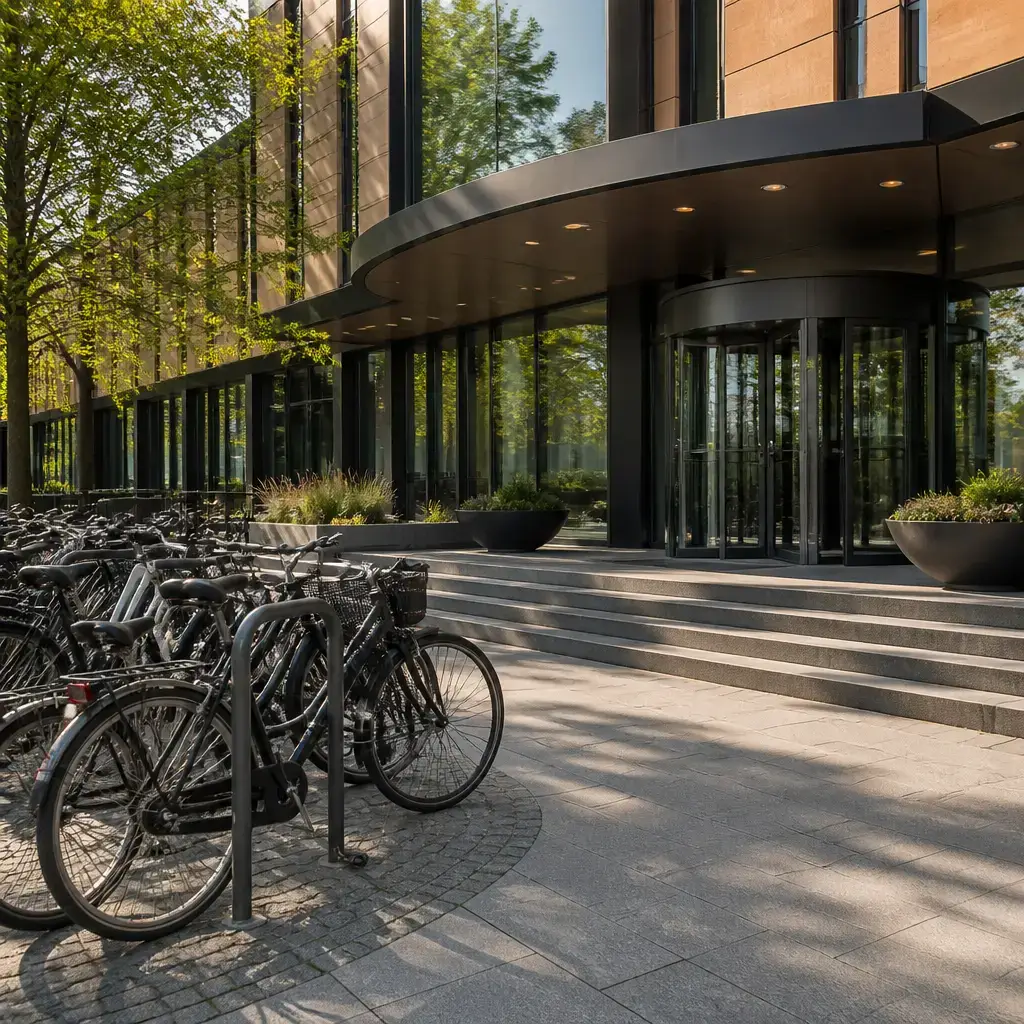
“Eingang” means “entrance” in “Der Eingang ist neben dem Fahrradparkplatz.” It names the way into the building; reuse it with a location phrase such as “Der Eingang ist …”.
neben
“neben” means “beside” or “next to” and places the entrance beside the bicycle parking area. In “neben dem Fahrradparkplatz,” it is followed by the place being used as the reference point.
dem
“dem” means “the” in “neben dem Fahrradparkplatz.” It is the article used with “Fahrradparkplatz” in this phrase after “neben”; keep the pattern “neben dem …” when locating something next to a masculine place or object.
Fahrradparkplatz
“Fahrradparkplatz” means “bicycle parking area” and identifies the place beside the entrance. It is used after “neben dem” in “neben dem Fahrradparkplatz,” a pattern for locating something next to a designated area.
Viele
“Viele” means “many” or “a lot of” in “Viele Leute sind … gekommen.” It describes a large number of people and comes directly before the plural noun “Leute” here; reuse “Viele” with a plural noun.
Leute
“Leute” means “people” in “Viele Leute sind mit dem Fahrrad gekommen.” It refers to the people who arrived by bicycle; the common pattern here is “Viele Leute sind … gekommen.”
sind
“sind” is the auxiliary “are” in “Viele Leute sind mit dem Fahrrad gekommen,” helping form the statement about people who came. It is used with “gekommen”; the pattern “sie sind … gekommen” describes their arrival.
mit
“mit” means “with” and, in “mit dem Fahrrad,” expresses the means of transport: by bicycle. Reuse “mit dem Fahrrad” to say that someone travels by bike.
Fahrrad
“Fahrrad” means “bicycle” or “bike” in “mit dem Fahrrad.” With “mit dem,” it names the means of transport; the complete reusable phrase is “mit dem Fahrrad.”
gekommen
“gekommen” means “come” or “came” in “sind mit dem Fahrrad gekommen,” describing arrival by bicycle. It is used with “sind” in this past-time construction; the pattern “sind … gekommen” describes people arriving.
ergibt
“ergibt” contributes the idea of “gives” or “results in” in “Das ergibt Sinn.” The whole expression “Das ergibt Sinn” means “That makes sense,” so the meaning comes from the complete expression rather than from “ergibt” alone.
Sinn
“Sinn” means “sense” in the expression “Das ergibt Sinn.” Use it in the complete pattern “Das ergibt Sinn” when agreeing that an explanation, decision, or situation is logical.
einfacher
“einfacher” means “easier” in “Das ist einfacher, als auf den Bus zu warten.” It compares the ease of cycling with waiting for the bus; the pattern “Das ist einfacher, als …” introduces the alternative being compared.
auf
“auf” is part of “auf den Bus warten,” meaning “wait for the bus.” The verb “warten” commonly uses “auf” before the person or thing being awaited; keep the object in the pattern “auf … warten.”
den
“den” means “the” in “auf den Bus warten.” It is the article used with “Bus” after “auf” in this waiting expression; reuse the exact pattern “auf den … warten” with an appropriate object.
Bus
“Bus” means “bus” in “auf den Bus zu warten.” It is the vehicle the speakers would wait for; the reusable expression is “auf den Bus warten.”
zu
“zu” marks the infinitive in “auf den Bus zu warten.” It appears before “warten” because this action is compared with the easier option; keep “zu warten” together in this construction.
warten
“warten” means “wait” in “auf den Bus zu warten.” It is used with “auf” and the thing being awaited, as in “auf den Bus warten”; this pattern is useful when discussing waiting for transport or another person.
Beim
“Beim” is the contraction of “bei dem” and, in “Beim nächsten Mal,” forms the time expression “next time.” Use the complete phrase “Beim nächsten Mal” when referring to a future occasion.
nächsten
“nächsten” means “next” in the time phrase “Beim nächsten Mal.” It describes the upcoming occasion named by “Mal”; reuse the complete pattern “Beim nächsten Mal …” to introduce a future plan.
Mal
“Mal” means “time” or “occasion” in “Beim nächsten Mal.” Together with “beim nächsten” it refers to a future occasion, so “Beim nächsten Mal” means “next time.”
könnten
“könnten” means “could” in “könnten wir … radeln” and presents a possible suggestion for next time. It is a modal form used with the infinitive “radeln”; the pattern “könnten wir …” can propose a possible activity.
wir
“wir” means “we” in “könnten wir auch hierher radeln.” It identifies the speaker and listener as the people who might cycle; use “wir” as the subject for a shared plan or suggestion.
auch
“auch” means “also” or “too” in “auch hierher radeln,” adding cycling here as another possibility. It can be placed before the destination or activity being added, as in this sentence.
hierher
“hierher” means “to here” and points toward the speakers’ current location, the city hall. It is used with a movement verb such as “radeln” when someone is coming or traveling to this place.
radeln
“radeln” means “cycle” or “ride a bike” in “hierher radeln.” It is the infinitive after “könnten”; the pattern “könnten wir … radeln” proposes cycling somewhere.
Dann
“Dann” means “then” and links the proposed cycling plan to the next action. It introduces a consequence or following step, as in “Dann können wir …”.
können
“können” means “can” in “können wir die Fahrräder … abstellen,” expressing what the speakers are able or allowed to do. It is followed by the infinitive “abstellen”; the pattern “können wir …” describes a possible action.
die
“die” means “the” before “Fahrräder” in “die Fahrräder … abstellen.” Here it introduces the plural noun referring to the bicycles; reuse “die” before a specific plural group.
Fahrräder
“Fahrräder” means “bikes” or “bicycles” and refers to the speakers’ bicycles. It is the object of “abstellen” in “die Fahrräder … abstellen”; use it when talking about more than one bicycle.
Nähe
“Nähe” means “vicinity” or “nearby area” in “in der Nähe des Eingangs.” The complete phrase locates the bicycles close to the entrance; reuse “in der Nähe von …” or the fuller pattern from the dialogue when identifying what is nearby.
des
“des” means “the” in “des Eingangs” and introduces the entrance as the reference point for the nearby area. Together with “Eingangs,” it forms the phrase “in der Nähe des Eingangs,” meaning “near the entrance.”
Eingangs
“Eingangs” means “of the entrance” in “in der Nähe des Eingangs.” It identifies which entrance the nearby area is close to; keep it with “des” in the reusable phrase “in der Nähe des Eingangs.”
abstellen
“abstellen” means “leave” or “park” in “die Fahrräder … abstellen,” specifically putting the bicycles in a place and leaving them there. It follows “können” as an infinitive; the pattern “die Fahrräder abstellen” describes parking the bikes.
Vorerst
“Vorerst” means “for now” and limits the speakers’ plan to the immediate situation. It introduces a temporary or current next step, as in “Vorerst gehen wir …”.
gehen
“gehen” means “go” in “gehen wir hinein” and describes the action of moving inside. It is paired with “hinein” to show inward movement; the pattern “gehen wir hinein” is a way to suggest entering.
hinein
“hinein” means “inside” or “in” with a direction toward the interior. In “gehen wir hinein,” it shows that the speakers are going into the building; use it with a movement verb when emphasizing movement inward.
und
“und” means “and” and joins the two planned actions “gehen wir hinein” and “suchen den richtigen Schalter.” It connects actions or ideas that belong together in the same statement.
suchen
“suchen” means “look for” in “suchen den richtigen Schalter.” It takes the thing being sought directly after it; the reusable pattern is “etwas suchen,” such as looking for a particular place or object.
richtigen
“richtigen” means “right” or “correct” in “den richtigen Schalter.” It specifies that the speakers are looking for the appropriate counter, not just any counter; reuse it before a noun when identifying the correct option.
Schalter
“Schalter” means “counter” or “service desk” in the city hall context. The phrase “den richtigen Schalter” refers to the desk where the speakers need to go; use it when looking for the appropriate service counter.