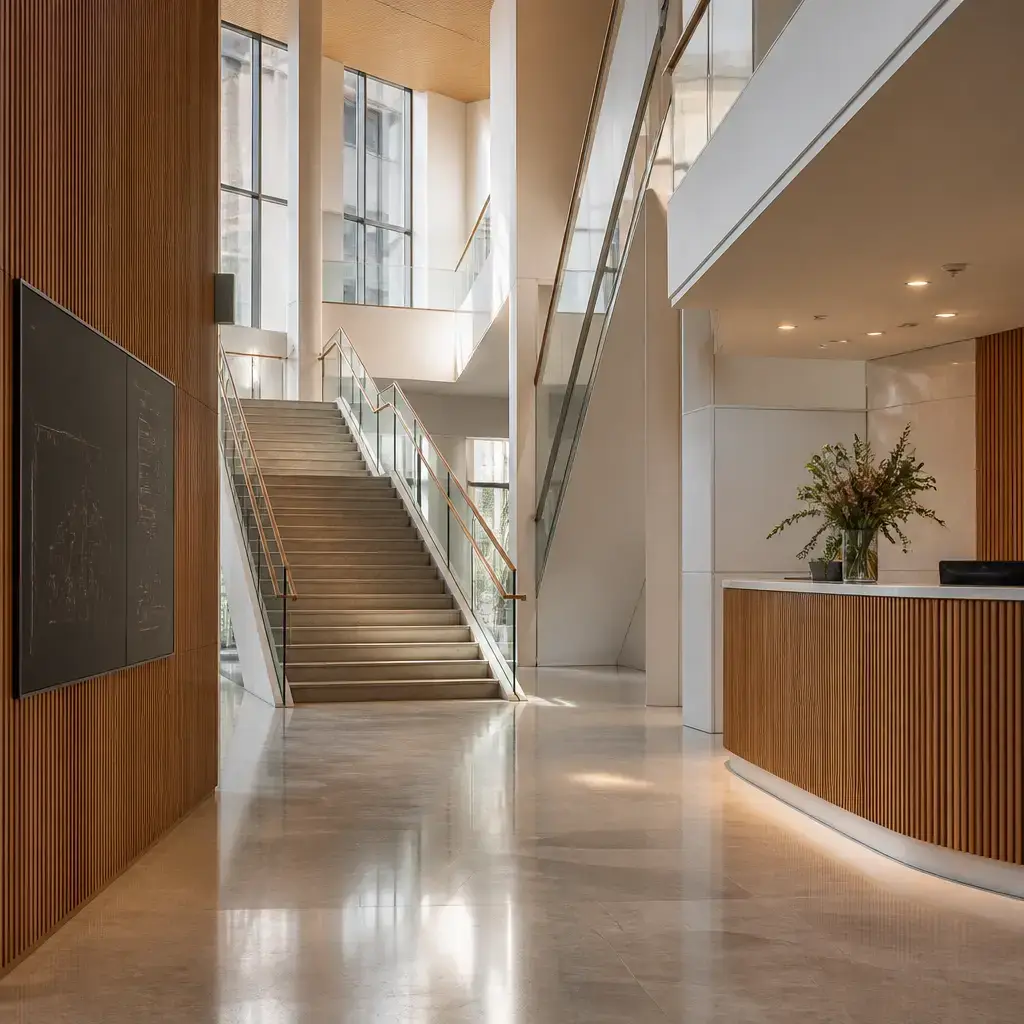
Dieses
“Dieses” means “this” in “Dieses Gebäude” and identifies the building being discussed. Its form appears before the noun “Gebäude”; use it before a noun when pointing out one specific thing.
Gebäude
“Gebäude” means “building” in “Dieses Gebäude”. It names the physical building, and you can use it with a determiner or an adjective when describing a building.
wirkt
“Wirkt” means “seems” or “comes across as” in “Dieses Gebäude wirkt innen sehr sauber” and “wirkt die Lobby offen”. It is the dialogue form of “wirken” and is used here with descriptions such as “sauber” and “offen”. Use it when describing how a place appears.
innen
“Innen” means “inside” in “wirkt innen sehr sauber”. It limits the description to the interior of the building. Use it when describing what a place is like on the inside.
sehr
“Sehr” means “very” in “sehr sauber”. It strengthens the adjective that follows it. Use it before an adjective when emphasizing its degree.
sauber
“Sauber” means “clean” in “sehr sauber”. Here it describes the building’s interior after “wirkt”. Use it when evaluating the cleanliness of a place.
Durch
“Durch” means “because of” or “as a result of” in “Durch die hohe Decke wirkt die Lobby offen”. It introduces the cause of an impression or result. Use “Durch + noun” when explaining what produces an effect.
die
“Die” is the definite article “the”. In this lesson it appears in “die hohe Decke”, “die Lobby”, “die Veranstaltung”, “die Rolltreppe”, and “die Treppe”; the same form is used with these feminine nouns in different sentence roles.
hohe
“Hohe” means “high” in “die hohe Decke”. It describes the ceiling and appears directly before “Decke”. Use it in an adjective-and-noun phrase when describing height.
Decke
“Decke” means “ceiling” in “die hohe Decke”. It names the overhead part of the room. Use it when describing the interior of a building.
Lobby
“Lobby” means “lobby” in “die Lobby”. It refers to the entrance or waiting area inside a building. Use it when talking about this open area near a building entrance.
offen
“Offen” means “open” in “wirkt die Lobby offen”. Here it describes the impression created by the high ceiling. Use it after “wirken” to describe how a space comes across.
Suchen
“Suchen” means “let’s look for” or “let’s find” in “Suchen wir den Anmeldeschalter”. Together with “wir”, it proposes a joint search. A reusable pattern is “Suchen wir + object” when suggesting that both speakers look for something.
wir
“Wir” means “we” in “Suchen wir”. It includes the speaker and the listener in the suggested action. Use it with a verb when proposing that a group do something together.
den
“Den” is the definite article “the” before a masculine noun used as an object here, as in “den Anmeldeschalter”, “den Gebäudeplan”, and “den Ort”. Use it before a masculine noun in this object role.
Anmeldeschalter
“Anmeldeschalter” means “registration desk” in “den Anmeldeschalter für die Veranstaltung”. It identifies the counter where people register. Use it when looking for a place to register for an event.
für
“Für” means “for” in “für die Veranstaltung”. It shows what the registration desk is connected with or intended for. Use “für + noun” to specify a purpose or the event concerned.
Veranstaltung
“Veranstaltung” means “event” in “für die Veranstaltung”. It identifies the event for which registration is needed. Use it after “für” to name the event or purpose concerned.
Ich
“Ich” means “I” in “Ich schaue in den Gebäudeplan”. It identifies the speaker as the person checking the directory. Use it as the subject when speaking about yourself.
schaue
“Schaue” means “look” or “check” in “Ich schaue in den Gebäudeplan”. It is the dialogue form of “schauen”; here the phrase means to consult the building directory. Use “Ich schaue in ...” when saying that you are checking something by looking at it.
in
“In” means “in” or “into” in “in den Gebäudeplan”. Here it introduces what the speaker looks into while checking the directory. Use “in + noun” with “schauen” when consulting something.
Gebäudeplan
“Gebäudeplan” means “building directory” or “floor plan” in “in den Gebäudeplan”. It is the guide used to find locations inside the building. Use it when checking a building’s layout or room locations.
an
“An” means “at” or “on” in “an der Wand”. It places the directory next to or on the wall. Use “an” for a fixed location at a wall or surface.
der
“Der” means “the” in “an der Wand” and “Der Anmeldeschalter”. In “an der Wand” it is used for the fixed location phrase, while in “Der Anmeldeschalter” it introduces the subject of the statement. Use the exact form shown with these nouns in these contexts.
Wand
“Wand” means “wall” in “an der Wand”. It identifies the surface where the building plan is located. Use it when describing the position of something on or beside a wall.
Auf
“Auf” means “on” in “Auf dem Plan steht”. It presents the plan as the place where the information is written. Use “Auf + location” when saying that information appears on a plan or sign.
dem
“Dem” means “the” in “Auf dem Plan”. It is the article used here after “Auf” for the fixed location of the plan. A reusable pattern is “Auf dem Plan steht ...” when reporting information shown on a plan.
Plan
“Plan” means “plan” or “directory” in “Auf dem Plan steht”. Here it refers to the building guide that contains the location information. Use it when referring to a plan that shows where places are.
steht
“Steht” means “says” or “is written” in “Auf dem Plan steht”. It is the dialogue form of “stehen”; with a plan, it refers to information appearing there. Use “Auf ... steht ...” when reporting written information.
ist
“Ist” means “is” in “Der Anmeldeschalter ist oben”. It connects the registration desk with its location. Use “X ist ...” to state where something is.
oben
“Oben” means “upstairs” or “above” in “ist oben”. It gives the registration desk’s higher location without naming a floor. Use it when directing someone to a higher level.
Nehmen
“Nehmen” means “let’s take” in “Nehmen wir die Rolltreppe oder die Treppe?” and “Nehmen wir die Treppe”. Together with “wir”, it proposes a route or option. Use “Nehmen wir + option” when deciding how to move through a building.
Rolltreppe
“Rolltreppe” means “escalator” in “die Rolltreppe”. It names one possible way to move between levels. Use it when choosing an escalator inside a building.
oder
“Oder” means “or” in “die Rolltreppe oder die Treppe”. It connects two alternatives. Use “X oder Y?” when offering a choice.
Treppe
“Treppe” means “stairs” or “staircase” in “die Treppe”. It names the stairway chosen as the route upstairs. Use it in the phrase “die Treppe nehmen” when choosing the stairs.
sie
“Sie” means “it” in “sie ist gleich hier” and refers back to “die Treppe”. It avoids repeating the noun when referring to that staircase. Use it after a previously mentioned singular feminine noun.
gleich
“Gleich” means “right” or “just” in “gleich hier”. It emphasizes that the stairs are immediately nearby. Use it before a place word when pointing out something very close.
hier
“Hier” means “here” in “gleich hier”. It locates the stairs at the speakers’ current position. Use it when pointing to the place where you are.
Holztreppe
“Holztreppe” means “wooden staircase” in “Die Holztreppe”. It identifies the staircase by its material. Use it when describing or distinguishing a staircase made of wood.
lässt
“Lässt” contributes “makes” or “causes” in “lässt den Ort warm wirken”. It is the dialogue form of “lassen” and works with “wirken” to say that the wooden staircase causes the place to seem warm. A reusable construction is “subject lässt + object + infinitive” when one thing creates an impression.
Ort
“Ort” means “place” in “den Ort warm wirken”. It refers to the location as a whole. Use it when describing what a place is like or how it appears.
warm
“Warm” means “warm” in “warm wirken”. Here it describes how the place seems. Use it before “wirken” when describing a warm impression.
wirken
“Wirken” means “seem” or “appear” in “warm wirken”. It is the infinitive that completes “lässt den Ort warm wirken”. Use it after an adjective when saying that something appears a certain way.