Die
In "Die Straße" this means "the" and refers to the specific road being discussed. It is used before this feminine noun when talking about a known road or street.
Straße
"Straße" means road or street; here it is the road that is busy today. The exact phrase "Die Straße" is useful when identifying a particular road in a travel situation.
ist
In "Die Straße ist heute wirklich voll", "ist" says what condition the road is in: it is busy or full. It is the form used with "Die Straße" to describe a current situation, such as traffic conditions.
heute
"heute" means today and places the road condition on the current day. It can be used with a statement about something happening or being true today, especially when reporting current travel conditions.
wirklich
Here "wirklich" means really and strengthens the description "voll". It is useful when emphasizing that a situation is genuinely busy or crowded.
voll
In "Die Straße ist heute wirklich voll", "voll" describes the road as very busy or crowded with traffic. The pattern "etwas ist voll" can describe a place or route that has little available space because many people or vehicles are there.
Hauptverkehrszeit
"Hauptverkehrszeit" means rush hour, the busy period when traffic is especially heavy. It is useful when explaining why roads or public transport are crowded.
hat
In "hat begonnen", "hat" contributes the meaning "has" and helps express that the start has already happened. This form is used with a completed event, such as saying that rush hour has started.
begonnen
In "Die Hauptverkehrszeit hat begonnen", "begonnen" means started or begun. It is the completed form related to "beginnen" and is used with "hat" to report that an event has started; new example: "Der Kurs hat begonnen."
Schaffen
In "Schaffen wir noch den nächsten Zug?", "Schaffen" asks whether they can still manage to catch the next train. The pattern "Schaffen wir noch ...?" is useful when checking whether there is still enough time for something.
wir
"wir" means we and refers to the two people acting together. It is used as the subject when asking about or describing a shared action, as in "Schaffen wir".
noch
Here "noch" means still and asks whether catching the next train remains possible. It is useful when checking if there is still time or opportunity to do something.
den
In "den nächsten Zug", "den" means "the" and marks the specific train they want to catch. It is used before this object in a phrase naming the particular train affected by the action.
nächsten
"nächsten" means next and identifies the train that follows the current one in the travel sequence. In "den nächsten Zug", it describes which train they are trying to catch.
Zug
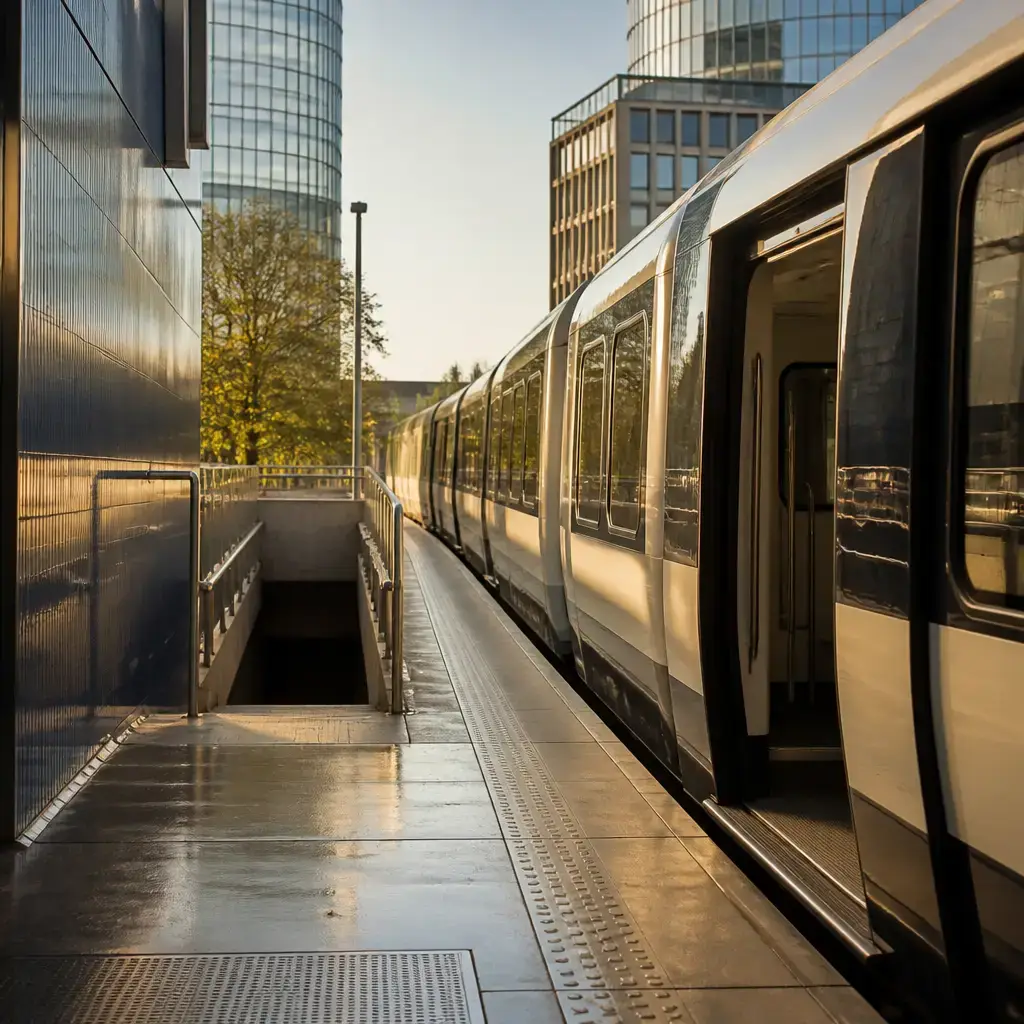
"Zug" means train; here it is the next train they may still catch. The exact phrase "den nächsten Zug" is useful when discussing which train to take.
Das
In "Das sollten wir", "Das" means "that" and refers to the idea of catching the next train from the previous question. It can be used to point back to a suggestion or action that has just been mentioned.
sollten
In "Das sollten wir", "sollten" says that they should do the action being discussed. It expresses advice or an expected course of action when agreeing that catching the train is appropriate.
Der
In "Der Bahnhof", "Der" means "the" and introduces the specific station they are approaching. It is used before this masculine noun when referring to a known station.
Bahnhof
"Bahnhof" means station, specifically the railway station in this scene. The phrase "Der Bahnhof" is useful when pointing out or discussing the station during a journey; new example: "Wir treffen uns am Bahnhof."
gleich
In "gleich da vorne", "gleich" means just or right, showing that the station is very near in the direction ahead. This expression is useful when giving quick directions to a nearby place.
da
In "da vorne", "da" means there and points to a location. Together with "vorne", it helps indicate a place visible ahead, such as a station entrance.
vorne
In "da vorne", "vorne" means ahead or up front. The phrase is useful when directing someone toward a place that is in front of the speakers.
Ich
"Ich" means I and is the speaker referring to themself. It is used as the subject in "Ich kann jetzt den Eingang sehen" when reporting a personal observation.
kann
In "Ich kann jetzt den Eingang sehen", "kann" means can and expresses the speaker's ability to see the entrance. The pattern "Ich kann ... sehen" is useful for reporting what is visible.
jetzt
"jetzt" means now and shows that the entrance has become visible at this moment. It is useful for marking an immediate change in what someone can see or do.
Eingang
"Eingang" means entrance; here it is the station entrance that the speaker can see. The phrase "den Eingang sehen" is useful when identifying or locating an entrance.
sehen
In "Ich kann jetzt den Eingang sehen", "sehen" means see and names the visual action. It follows "kann" in the pattern "kann ... sehen", which is useful for saying that something is visible.
Gehen
In "Gehen wir direkt zum Bahnsteig", "Gehen" forms a suggestion meaning "let's go". The pattern "Gehen wir ..." is useful when proposing that two or more people move somewhere together.
direkt
Here "direkt" means directly or straight and describes the route to the platform. The exact phrase "direkt zum Bahnsteig" is useful when telling someone to go straight to a destination.
zum
In "zum Bahnsteig", "zum" means "to the" and is the contracted form of "zu dem". It introduces the destination in a phrase such as "direkt zum Bahnsteig".
Bahnsteig
"Bahnsteig" means platform, the area beside the track where passengers board a train. The phrase "zum Bahnsteig" is useful when giving directions inside a station.
fährt
In "Der Zug fährt schon ein", "fährt" describes the train moving into the station or platform area. It is the form used to describe what the train is doing in the present situation.
schon
Here "schon" means already and shows that the train is pulling in sooner than the travelers may have expected. It is useful for emphasizing that an event has begun by the current moment.
ein
In this line, "ein" is the separable verb particle that completes the movement meaning of "fährt". Together, "fährt" and "ein" describe the train pulling in, with "ein" placed at the end of the sentence.
Bleib
"Bleib" means stay and gives a direct instruction to one person to remain nearby. It is the form related to "bleiben" used in the phrase "Bleib in meiner Nähe" when asking a companion not to move away.
in
In "in meiner Nähe", "in" introduces the location relationship, while the whole phrase means near me. This pattern is useful when telling someone where to remain or where someone is located.
meiner
In "meiner Nähe", "meiner" means my and identifies whose vicinity is meant. It combines with "Nähe" in the reusable phrase "in meiner Nähe" when asking someone to stay close to the speaker.
Nähe
"Nähe" means vicinity or closeness; in "in meiner Nähe" it refers to the area close to the speaker. This expression is useful in crowded places when asking a companion to remain close.
dann
In "dann steigen wir zusammen ein", "dann" means then and links staying close with the following result. It is useful for expressing what will happen after a condition or prior action.
steigen
In "steigen wir zusammen ein", "steigen" carries the action of getting onto the train, together with the particle "ein". The pattern "Wir steigen ... ein" is useful when saying that people are boarding a vehicle; new example: "Wir steigen am Bahnhof ein."
zusammen
Here "zusammen" means together and shows that the speakers will board as a group. It is useful when emphasizing that people perform an action jointly rather than separately.