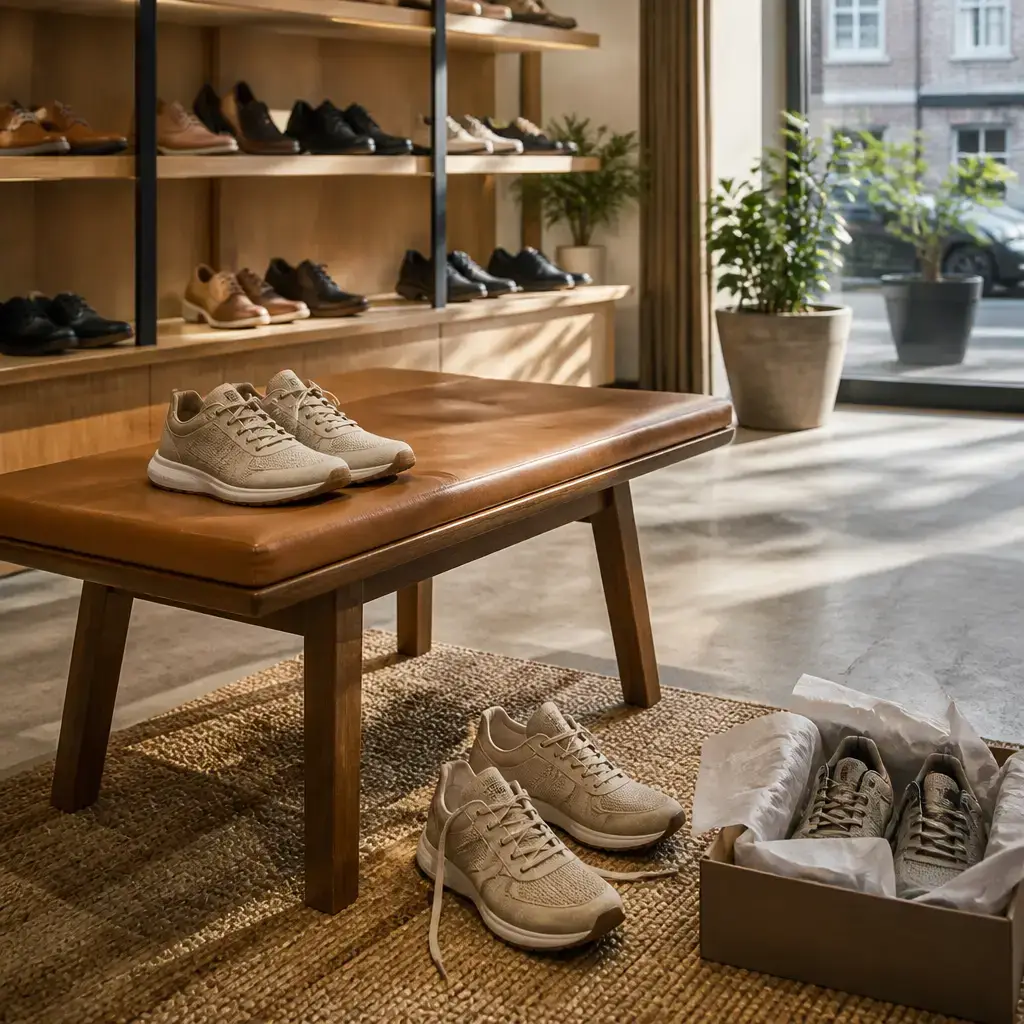
Diese
Diese means these or this specific one here. In Diese Schuhe it points to the shoes, and in Diese Größe it points to the size being discussed. It is useful when identifying a particular object or choice.
Schuhe
Schuhe means shoes in Diese Schuhe sehen bequem aus. It names the footwear being examined in the shop. A reusable pattern is Schuhe + a description of their appearance or fit.
sehen
In Diese Schuhe sehen bequem aus, sehen means look or appear. Together with the final particle aus, it describes how something seems visually or generally. A reusable pattern is a subject + sehen ... aus to say that something looks a certain way.
bequem
Bequem means comfortable in Diese Schuhe sehen bequem aus. It describes the shoes as appearing comfortable. Use it when describing comfortable footwear, clothing, furniture, or another item.
aus
In Diese Schuhe sehen bequem aus, aus completes the meaning of sehen as look or appear and is placed at the end of the sentence. It does not contribute the separate meaning of out here. A reusable pattern is sehen ... aus for describing an appearance.
Sie
Sie means they in Sie sind für lange Spaziergänge gemacht, but it means formal you in Ziehen Sie sie auf dieser Bank an and Probieren Sie dieses größere Paar an. The capital letter marks the formal you form in those instructions. Use Sie with a verb when addressing a customer formally.
sind
Sind means are in Sie sind für lange Spaziergänge gemacht. It links the shoes with their intended purpose in this sentence. A reusable pattern is Sie sind + a description or purpose.
für
Für means for in für lange Spaziergänge. It introduces the purpose for which the shoes are made. A reusable pattern is für + a noun phrase when stating a purpose.
lange
Lange means long in lange Spaziergänge. It describes the walks that the shoes are intended for. Use it before a noun when describing a long duration or distance.
Spaziergänge
Spaziergänge means walks in für lange Spaziergänge. It names the activity for which the shoes are made. The word is used here after für as part of the purpose phrase.
gemacht
Gemacht means made in Sie sind für lange Spaziergänge gemacht. It contributes the idea that the shoes were designed or prepared for that purpose. A reusable pattern is etwas ist für + a purpose + gemacht.
Kann
Kann begins the question Kann ich sie hier anprobieren? and asks whether the speaker may or can try the shoes on. It is the form of können used at the start of this question. A reusable pattern is Kann ich + an action to ask permission politely.
ich
Ich means I in Kann ich sie hier anprobieren? It identifies the person asking permission. Use it before the verb when speaking about yourself.
hier
Hier means here in Kann ich sie hier anprobieren? It specifies the place where the speaker wants to try the shoes on. Use it to point to the current location.
anprobieren
Anprobieren means try on in Kann ich sie hier anprobieren? It refers specifically to putting on clothing or shoes to check their fit. A reusable pattern is Kann ich + an object + anprobieren?
Ziehen
Ziehen means pull or put on in Ziehen Sie sie auf dieser Bank an. With Sie and the final an, it gives a formal instruction to put the shoes on. A reusable pattern is Ziehen Sie + an object + an for a formal instruction to put something on.
auf
Auf means on in auf dieser Bank. It locates the action at the bench where the customer should put on the shoes. A reusable pattern is auf + a place to indicate where something happens.
dieser
Dieser means this in auf dieser Bank. It points to the particular bench available in the shop. Use it with a noun when identifying a specific nearby object or place.
Bank
Bank means bench in auf dieser Bank. It names the seat the customer should use while putting on the shoes. The phrase auf dieser Bank identifies the place of the action.
an
In Ziehen Sie sie auf dieser Bank an, an completes the verb meaning put on. In Sie fühlen sich ein bisschen klein an and Dieses Paar fühlt sich besser an, it completes the expression describing how something feels. Its contribution depends on the verb construction, so it is not translated independently in these sentences.
fühlen
Fühlen means feel in Sie fühlen sich ein bisschen klein an. With sich and the final an, it describes how the shoes seem to the person wearing them. A reusable pattern is an object + fühlen sich + a description + an.
sich
Sich is the reflexive part of Sie fühlen sich ein bisschen klein an and Dieses Paar fühlt sich besser an. It connects fühlen with the thing whose feel or apparent fit is being described. A reusable pattern is an object + fühlen sich ... an.
ein
In ein bisschen, ein contributes to the small quantity phrase meaning a little. The complete phrase ein bisschen softens the description klein. A reusable pattern is ein bisschen + an adjective or description.
bisschen
Bisschen means bit or little in ein bisschen. Together, ein bisschen means a little and makes the statement about the shoes less strong. Use ein bisschen before a description when expressing a small degree.
klein
Klein means small in Sie fühlen sich ein bisschen klein an. It describes the shoes as feeling too limited in size for the wearer in this context. Use it to describe the size of an item or space.
Probieren
Probieren means try in Probieren Sie dieses größere Paar an. With Sie and the final an, it is a formal instruction to try the pair on. A reusable pattern is Probieren Sie + an object + an.
dieses
Dieses means this in dieses größere Paar. It points to the particular larger pair that the shop assistant is offering. Use it with a noun when selecting or identifying one specific item.
größere
Größere means larger in dieses größere Paar. It describes this pair as larger than the pair the customer tried before. Use it when offering a larger option in a comparison.
Paar
Paar means pair in dieses größere Paar and Dieses Paar fühlt sich besser an. It refers to the two shoes as one item for selection and comparison. A reusable pattern is dieses Paar when referring back to a selected pair.
fühlt
Fühlt means feels in Dieses Paar fühlt sich besser an. It describes the pair’s apparent comfort or fit for the wearer. A reusable pattern is ein item + fühlt sich + a description + an.
besser
Besser means better in Dieses Paar fühlt sich besser an. It shows that this pair feels more suitable than the earlier pair. Use it when comparing how two options feel or work.
Größe
Größe means size in Diese Größe passt Ihnen gut. It refers to the shoe size being evaluated. A reusable pattern is Diese Größe + a statement about whether it fits someone.
passt
Passt means fits or suits in Diese Größe passt Ihnen gut. Here it says that the size is suitable for the customer. A reusable pattern is a size + passt + a person + gut.
Ihnen
Ihnen means to you in Diese Größe passt Ihnen gut. It identifies the customer for whom the size fits, using the formal form of address. Use it with expressions such as passt Ihnen gut when speaking politely to a customer.
gut
Gut means well or suitably in Diese Größe passt Ihnen gut. With passt, it gives the positive evaluation that the size fits the customer well. The reusable expression passt Ihnen gut is useful when confirming that something suits a person.