Alle
“Alle” means “everyone” here and refers to all the people involved in choosing the group gift. It is used as the subject before “har” in “Alle har en forskellig mening”. This form is useful when talking about every person in a group.
har
“har” means “has” here and states what everyone has: an opinion. It is used with the subject “Alle” in “Alle har en forskellig mening”. A common reuse pattern is a person or group followed by “har” and something they possess or experience.
en
“en” is the indefinite article meaning “a” before “mening” in “en forskellig mening”. It introduces one non-specific opinion. Reuse it before a noun in the same type of indefinite noun phrase.
forskellig
“forskellig” means “different” and describes the opinion as not being the same as the others’ opinions. It comes before “mening” in “en forskellig mening”. This adjective can be reused before a noun when pointing out that something differs from another thing.
mening
“mening” means “opinion” in “en forskellig mening”. The phrase refers to what each person thinks about the gift. It commonly appears with “om” when introducing the subject of an opinion, as in “mening om den fælles gave”.
om
“om” means “about” here and introduces the subject of the opinion in “mening om den fælles gave”. It links “mening” to the gift being discussed. A reliable reuse pattern is “mening om” followed by the topic.
den
“den” points to the specific gift being discussed in “den fælles gave”, meaning “the”. It comes before the adjective and noun that identify the gift. Reuse this form when referring to a specific item described by a phrase such as “den fælles gave”.
fælles
“fælles” means “shared” or “common” and shows that the gift belongs to or is chosen by the group. In “den fælles gave”, it describes the gift. This word is useful for shared plans, activities, or things involving several people.
gave
“gave” means “gift” in “den fælles gave”. With “den”, it refers to the particular gift the group is discussing. The noun can be reused for a present given to someone.
Lad
“Lad” begins the suggestion “Lad os finde en praktisk måde”, meaning “Let’s”. Together with “os”, it invites the group to do something. Use this construction when proposing a shared action.
os
“os” means “us” in “Lad os finde en praktisk måde”. It identifies the people who are being invited to act together. The reliable pattern is “Lad os” followed by an action.
finde
“finde” means “find” in the suggestion “Lad os finde en praktisk måde”. Here, the group wants to identify a practical method for deciding. It follows “Lad os” in this shared-action construction.
praktisk
“praktisk” means “practical” and describes the proposed way of deciding as useful and workable. It comes before “måde” in “en praktisk måde”. Reuse it before a noun when evaluating a solution or method.
måde
“måde” means “way” or “method” in “en praktisk måde”. It refers to how the group can make the decision. A useful pattern is “en” plus an adjective plus “måde” for describing a particular method.
at
“at” marks the infinitive in “at beslutte det”, meaning “to decide it”. It connects “måde” with the action that the method is for. Reuse it before an infinitive when expressing an action, as in “at beslutte”.
beslutte
“beslutte” means “decide” in “at beslutte det”. The group is discussing how to reach a decision about the gift. It follows “at” here and takes “det” as the thing being decided.
det
“det” means “it” in “at beslutte det” and refers to the gift decision under discussion. It functions as the object of “beslutte”. The same form appears as “Det” at the start of the final sentence, where it refers back to the proposed gift plan.
på
“på” is part of the expression “beslutte det på”, which completes the idea of deciding how to do something. It is not the word that alone means the whole method; “måde ... på” expresses “the way ...”. This is a reusable pattern for describing the way an action is carried out.
Nogle
“Nogle” means “some” and introduces part of the group in “Nogle vil gerne have noget personligt”. It contrasts with “andre”, the other people in the group. Use it before a plural group or noun phrase when referring to an unspecified part of a larger group.
vil
“vil” expresses what some people want in “Nogle vil gerne have noget personligt”. With “gerne”, it forms the expression “vil gerne have”, meaning “would like to have”. This pattern is useful for stating a person’s preference or wish.
gerne
“gerne” adds the idea of willingness or desire in “vil gerne have”. Together, “vil gerne have” means “would like to have”, rather than simply describing possession. Reuse it after “vil” when expressing what someone would like.
have
“have” means “have” in “vil gerne have noget personligt”. It is the action desired by the people described in the sentence. It follows “vil gerne” and takes “noget personligt” as its object.
noget
“noget” means “something” in “noget personligt” and introduces an unspecified thing the people would like to have. The adjective “personligt” describes that thing. This form is useful before an adjective when referring generally to an unspecified item.
personligt
“personligt” means “personal” in “noget personligt”. It describes the kind of gift some people would prefer. It is used after “noget” in this phrase, so the two words work together as “something personal”.
mens
“mens” means “while” or “whereas” and introduces the contrasting preference in “mens andre foretrækker noget nyttigt”. It connects the view of some people with the view of others. Use it to place two simultaneous or contrasting situations next to each other.
andre
“andre” means “others” and refers to the remaining people in contrast with “Nogle”. In “mens andre foretrækker noget nyttigt”, it is the subject of the second preference. This form is useful when contrasting one group of people with the rest.
foretrækker
“foretrækker” means “prefer” and describes the choice made by the other people in “andre foretrækker noget nyttigt”. It is followed by the thing they prefer, “noget nyttigt”. Reuse it before a preferred object or option.
nyttigt
“nyttigt” means “useful” and describes the unspecified thing that others prefer in “noget nyttigt”. It follows “noget” and completes that noun phrase. This form is useful when describing something by its practical value.
Hvad
“Hvad” means “what” at the beginning of “Hvad ved vi om, hvad de faktisk kan lide?”. It asks for information about the people’s actual preferences. It is placed first in this direct question.
ved
“ved” means “know” in “Hvad ved vi om”. It asks what information the group possesses about the people’s preferences. A common pattern is a question word followed by “ved” and the subject, as in “Hvad ved vi”.
vi
“vi” means “we” and identifies the speakers’ group in “Hvad ved vi”. The speakers are asking about information they share or can establish. It is also used as “Vi” in “Vi kan lægge et fælles kort ved”, where the group proposes an action.
de
“de” means “they” in “hvad de faktisk kan lide” and refers to the people who will receive the group gift. It is the subject of the embedded clause about what they like. Use it when referring to a group already understood from the conversation.
faktisk
“faktisk” means “actually” and emphasizes the people’s real preferences in “hvad de faktisk kan lide”. It helps distinguish known likes from guesses about what they might want. It can be placed before the verb phrase it emphasizes.
kan
“kan” means “can” in “kan lide”, but this pair is the Danish expression for “like”. Here it contributes to describing what the recipients like. Reuse the complete pattern “kan lide” before the thing or activity someone likes.
lide
“lide” completes the expression “kan lide”, meaning “like” in “de faktisk kan lide”. It should be understood together with “kan”, not as a standalone translation of the whole expression. The reusable pattern is “kan lide” followed by the liked thing, such as “kan lide kaffe”.
kaffe
“kaffe” means “coffee” in “De kan lide kaffe”. It is the drink that the gift recipients like. This noun can be used after “kan lide” when talking about liking coffee.
og
“og” means “and” and joins the two facts in “De kan lide kaffe og arbejder ofte på caféer”. It connects their liking coffee with their work in cafés. Use it to link two related words, phrases, or clauses.
arbejder
“arbejder” means “work” in “arbejder ofte på caféer”. It describes what the recipients regularly do. It is followed here by “ofte” and the place phrase “på caféer”.
ofte
“ofte” means “often” and says that the recipients work in cafés frequently in “arbejder ofte på caféer”. It comes between the verb and the place phrase here. Reuse it near the verb when describing a repeated activity.
caféer
“caféer” means “cafés” and names the places where the recipients often work. In “på caféer”, it follows “på” to form a place phrase. This plural form is useful when referring to more than one café without specifying which ones.
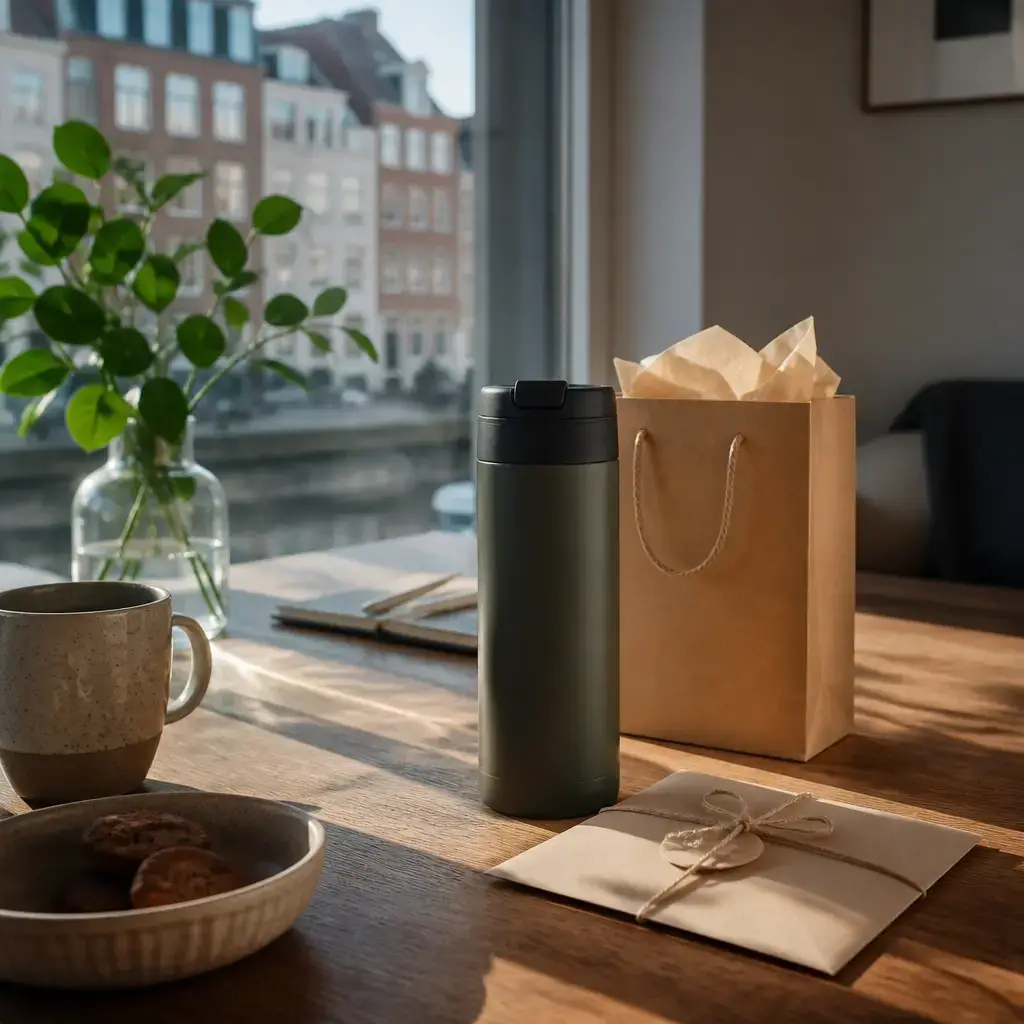
Et
“Et” means “a” in “Et termokrus” and introduces one travel mug as a possible gift. It appears at the beginning of the sentence because the noun phrase is the subject. Use it before an unspecified item in a similar noun phrase.
termokrus
“termokrus” means “travel mug” and is the proposed gift in “Et termokrus kunne føles både nyttigt og personligt”. The sentence presents it as an option that combines usefulness with a personal quality. It can be reused when naming this kind of insulated drinking container.
kunne
“kunne” expresses possibility in “kunne føles”, meaning that the travel mug could seem useful and personal. It presents the idea as a possible assessment rather than a certainty. Reuse it before an infinitive when discussing what something might do or be like.
føles
“føles” means “feel” or “seem” in “kunne føles både nyttigt og personligt”. It describes the impression the gift may give. It is used after “kunne” and before the qualities being attributed to the gift.
både
“både” means “both” and introduces the two qualities in “både nyttigt og personligt”. It signals that both qualities apply to the travel mug. The reusable pattern is “både” followed by one item or quality, “og” followed by the second.
lægge
“lægge” means “put” or “include” in “Vi kan lægge et fælles kort ved”. Here it describes adding a shared card alongside the gift. It follows “kan” and is part of the expression “lægge ... ved” for placing something with something else.
kort
“kort” means “card” in “et fælles kort”. The card is intended for messages from everyone in the group. This noun can be used for a card included with a gift.
så
“så” means “so” in “så alle kan skrive en besked”. It introduces the purpose or intended result of including the card. Use it before a clause that explains what an action makes possible.
skrive
“skrive” means “write” in “alle kan skrive en besked”. It names the action everyone can perform on the shared card. It follows “kan” and takes “en besked” as its object.
besked
“besked” means “message” in “skrive en besked”. It is the written contribution that each person can add to the card. A common reuse pattern is “skrive en besked” when composing a written message.
får
“får” means “makes” or “causes” in “Det får gaven til at virke gennemtænkt”. It expresses that the shared card causes the gift to give a thoughtful impression. The construction is “får” plus an object, “til at” plus an action or impression.
gaven
“gaven” means “the gift” in “Det får gaven til at virke gennemtænkt”. It refers back to the gift being planned, now as a specific item. This is the definite form related to “gave”, used when the gift is already identified.
til
“til” is part of the construction “får gaven til at virke”, which expresses causing the gift to appear thoughtful. It links the object “gaven” to the following action or impression. Reuse the pattern “få” plus an object plus “til at” and an infinitive.
virke
“virke” means “seem” or “appear” in “til at virke gennemtænkt”. It describes the impression the gift gives because of the shared card. It follows “til at” in the causative construction “får gaven til at virke”.
gennemtænkt
“gennemtænkt” means “thoughtful” or “well-considered” in “virke gennemtænkt”. It describes the gift as appearing carefully chosen. It follows “virke” and can describe a plan, choice, or gift that shows careful thought.
uden
“uden” means “without” in “uden at gøre valget kompliceret”. It introduces something that does not happen while the gift is made thoughtful. The reusable pattern here is “uden at” followed by an infinitive.
gøre
“gøre” means “make” in “uden at gøre valget kompliceret”. It describes making the choice complicated, which the speakers want to avoid. It follows “uden at” and takes “valget” as its object.
valget
“valget” means “the choice” in “gøre valget kompliceret”. It refers to the specific decision about which group gift to choose. This is the definite form related to “valg”, used because the choice is already understood in the conversation.
kompliceret
“kompliceret” means “complicated” and describes the choice in “gøre valget kompliceret”. The sentence says that the thoughtful gift does not make the decision difficult or complicated. It follows the object and completes the pattern “gøre ... kompliceret”.