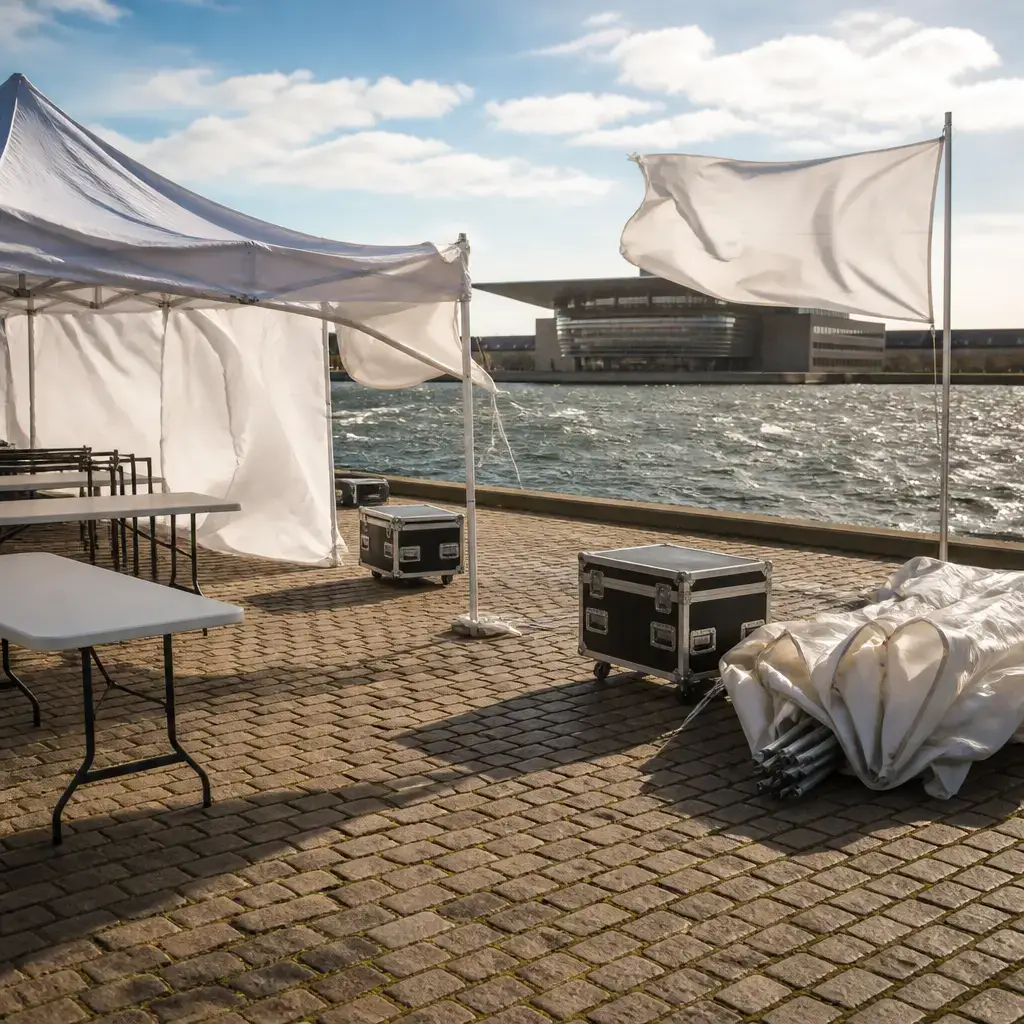
Vejrudsigten
‘Vejrudsigten’ means the forecast in this dialogue. It refers to the specific weather forecast being discussed. A useful pattern is ‘Vejrudsigten siger, at …’ when reporting what the forecast predicts.
siger
‘siger’ means says in ‘Vejrudsigten siger, at …’. It introduces information that follows in the clause after it. Reuse the pattern ‘siger, at’ before a complete statement.
at
‘at’ introduces the clause containing what the forecast says. Here it links ‘siger’ with ‘den kraftige vind vil fortsætte …’. Use ‘siger, at’ to report information or an opinion.
den
‘den’ means the and points to the specific wind mentioned in ‘den kraftige vind’. It appears directly before the description and noun. The reusable pattern here is ‘den’ plus an adjective and noun.
kraftige
‘kraftige’ means strong and describes the wind in ‘den kraftige vind’. It gives the wind the strength relevant to the safety concern. A useful phrase is ‘den kraftige vind’ when referring to strong wind.
vind
‘vind’ means wind and is the natural force expected to continue during the event. It is the subject of ‘vil fortsætte’. Use it with weather descriptions such as ‘kraftige vind’ when discussing windy conditions.
vil
‘vil’ expresses that the wind is expected to continue in ‘vil fortsætte’. It is followed here by the infinitive ‘fortsætte’. The pattern ‘vil’ plus an infinitive is useful for describing a future or expected action.
fortsætte
‘fortsætte’ means continue in ‘vil fortsætte’. It describes the wind continuing during the event rather than starting a new action. Use it after ‘vil’ when saying that an activity or condition is expected to continue.
under
‘under’ means during here and places the continuing wind within the time of ‘udendørsarrangementet’. It connects an activity or condition with a period or event. The dialogue uses ‘under udendørsarrangementet’ for during the outdoor event.
udendørsarrangementet
‘udendørsarrangementet’ means the outdoor event. It identifies the event during which the strong wind is expected to continue. A useful pattern is ‘under udendørsarrangementet’ when describing something happening during that event.
Det
‘Det’ means that or it and refers to the situation described in the previous sentence. In ‘Det kan blive et problem’, it is the sentence subject for the possible problem. Use ‘Det kan blive …’ to say that a situation may become something.
kan
‘kan’ expresses possibility in ‘Det kan blive et problem’. Here it is closer to could because the problem is possible rather than certain. The pattern ‘kan blive’ is useful for describing something that may develop into a result.
blive
‘blive’ means become in ‘kan blive et problem’. It describes a change into a possible problem. Use it after ‘kan’ with a result such as ‘et problem’.
et
‘et’ is the indefinite article meaning a or an before ‘problem’. It introduces one problem that may arise from the tents and equipment. The pattern ‘et problem med …’ names a problem involving something.
problem
‘problem’ means problem or difficulty in this situation. The problem concerns the tents and sound equipment in ‘et problem med telte og lydudstyr’. Use ‘et problem med’ to identify what causes or involves a difficulty.
med
‘med’ means with and links the problem to ‘telte og lydudstyr’. Here it introduces the things connected with the problem. The reusable pattern is ‘et problem med’ followed by a thing or situation.
telte
‘telte’ means tents, the outdoor structures that may be affected by the wind. It is one of the items listed after ‘med’. Use it in a list such as ‘telte og lydudstyr’ when discussing event equipment.
og
‘og’ means and and joins ‘telte’ with ‘lydudstyr’. It connects two items in the same list. Use ‘og’ between nouns or other elements that belong together.
lydudstyr
‘lydudstyr’ means sound equipment. It is the second type of event equipment that could be a problem in strong wind. It can be used after ‘med’ in ‘med telte og lydudstyr’.
Vi
‘Vi’ means we and refers to the people discussing how to manage the event. It is the subject of ‘kan sikre’. Use ‘Vi kan …’ to state what a group is able or willing to do.
sikre
‘sikre’ means secure or make safe in ‘Vi kan sikre bordene’. It describes fastening or stabilizing the tables so they are less affected by the wind. The pattern ‘sikre’ plus an object is useful when describing how to make equipment safer.
bordene
‘bordene’ means the tables and is the object of ‘sikre’. These are the tables that can be secured before the event. Use it after ‘sikre’ when referring to the specific tables.
men
‘men’ means but and introduces a contrast between securing the tables and the danger of putting up the banner. It connects two opposing points in the same sentence. Use ‘men’ to present a limitation or different concern.
være
‘være’ means be in ‘det kan være farligt’. It links the situation with the description ‘farligt’. After ‘kan’, use ‘være’ to describe what a situation may be like.
farligt
‘farligt’ means dangerous in ‘det kan være farligt’. Here it describes putting up the banner as an unsafe activity. The pattern ‘kan være farligt at’ is useful when warning about a possible danger.
sætte
‘sætte’ means put or set in ‘at sætte banneret op’. It is part of the expression for putting the banner into position. A useful pattern is ‘sætte’ plus an object and ‘op’, as in ‘sætte banneret op’.
banneret
‘banneret’ means the banner and is the object being put up. It refers to the specific banner planned for the outdoor event. Use it with ‘sætte … op’ when describing putting the banner in position.
op
‘op’ means up and completes the expression ‘sætte banneret op’. It shows that the banner is being put into an upright or displayed position. Use ‘sætte’ plus an object plus ‘op’ for putting something up.
Sikkerhed
‘Sikkerhed’ means safety and is presented as the priority in the decision. It is the subject of ‘er vigtigere’. A useful pattern is ‘Sikkerhed er vigtigere end …’ when comparing safety with another goal.
er
‘er’ means is and links ‘Sikkerhed’ with the comparison ‘vigtigere’. It states how safety ranks in the decision. Use ‘er’ to connect a subject with a description or comparison.
vigtigere
‘vigtigere’ means more important in the comparison about safety and the original setup. It shows that one consideration has higher priority than another. The pattern ‘vigtigere end’ introduces what has lower priority.
end
‘end’ means than and introduces the thing being compared with safety. Here it connects ‘vigtigere’ with ‘at beholde den oprindelige opsætning’. Use ‘vigtigere end’ to compare priorities.
beh rightolde
The dialogue form ‘beholde’ means keep or retain, referring to keeping the original setup. It follows ‘at’ in ‘at beholde den oprindelige opsætning’. Use ‘at beholde’ before the thing that someone wants to keep.
oprindelige
‘oprindelige’ means original and describes the setup that was planned first. It distinguishes that setup from a possible indoor arrangement. A useful phrase is ‘den oprindelige opsætning’ when referring to the initial arrangement.
opsætning
‘opsætning’ means setup or arrangement. It refers to how the event equipment was originally arranged. Use it after ‘den oprindelige’ when discussing the planned event arrangement.
Skal
‘Skal’ asks whether the speakers should take an action in ‘Skal vi aflyse eller flytte …?’. It turns the sentence into a question about a joint decision. The pattern ‘Skal vi …?’ is useful for suggesting or discussing what to do next.
aflyse
‘aflyse’ means cancel and is the first option in ‘Skal vi aflyse eller flytte …?’. It refers to ending the event rather than relocating it. Use it after ‘Skal vi’ when asking whether an event should be cancelled.
eller
‘eller’ means or and presents an alternative between cancelling and moving the event. It joins the two possible actions after ‘Skal vi’. Use ‘eller’ to offer a choice between actions or options.
flytte
‘flytte’ means move and is the second option in the question. Here it means relocating the event and its contents to another place. Use it after ‘Skal vi’ when asking whether something should be moved.
hele
‘hele’ means whole or everything in ‘det hele’. It makes clear that the complete set of event items should be moved. The reusable expression is ‘flytte det hele’ for moving everything.
til
‘til’ means to and introduces the destination of the move. Here it connects ‘flytte det hele’ with ‘forsamlingshuset’. Use ‘flytte … til’ before the new location.
forsamlingshuset
‘forsamlingshuset’ means the community hall and is the proposed destination for the event. It is the place to which everything may be moved. Use it after ‘til’ when naming this destination.
bedre
‘bedre’ means better and expresses a preferred option in ‘Det er bedre at flytte indenfor’. It compares moving indoors with leaving the event outside or cancelling it. Use ‘Det er bedre at’ to state that one action is preferable.
indenfor
‘indenfor’ means indoors and describes the new location for the event. In ‘flytte indenfor’, it indicates moving inside rather than remaining outdoors. Use it after ‘flytte’ when describing a move into an indoor place.
hvis
‘hvis’ means if and introduces the condition that the hall must be available. It connects the preferred action with the condition in ‘hvis forsamlingshuset er ledigt’. Use ‘hvis’ before a condition.
ledigt
‘ledigt’ means available or vacant in ‘forsamlingshuset er ledigt’. It says that the hall is free for the event. Use ‘er ledigt’ when checking whether a place is available.
Jeg
‘Jeg’ means I and identifies the person who will contact the organizer. It is the subject of ‘kan ringe’. Use ‘Jeg kan …’ to state what you can or are able to do.
ringe
‘ringe’ means call in ‘ringe til arrangøren’. It describes contacting the organizer by telephone. The reusable pattern is ‘ringe til’ followed by the person being called.
arrangøren
‘arrangøren’ means the organizer and is the person to be contacted about the indoor option. It follows ‘ringe til’. Use ‘ringe til arrangøren’ when saying that you will call the organizer.
spørge
‘spørge’ means ask and describes the second action after calling the organizer. It is followed by ‘om’ and the topic of the question. Use ‘spørge om’ to ask about a possibility or matter.
om
‘om’ means about in ‘spørge om muligheden’. It introduces the topic being asked about. The pattern ‘spørge om’ is useful when requesting information about something.
muligheden
‘muligheden’ means the possibility or option of moving the event indoors. It is the topic of the question to the organizer. Use ‘spørge om muligheden for’ when asking about an available option for an action.
for
‘for’ links ‘muligheden’ with the action described after it. In ‘muligheden for at flytte det indenfor’, it means the option of moving it indoors. Use ‘muligheden for at’ before an action that may be possible.
Fortæl
‘Fortæl’ means tell and gives a direct instruction to communicate the change. In ‘Fortæl også deltagerne det’, it asks someone to tell the participants the information. Use ‘Fortæl’ followed by the person and the information to be communicated.
også
‘også’ means also or too and adds this communication to the other actions that need to happen. It appears after ‘Fortæl’ in the instruction. Use it to add another person, action, or piece of information.
deltagerne
‘deltagerne’ means the participants and identifies the people who need to receive the information. It follows ‘Fortæl’ as the people being told. Use ‘Fortæl’ plus the people plus the information when giving this kind of instruction.
før
‘før’ means before and introduces the point in time when the participants start traveling. It connects the instruction with the time condition in ‘før de tager af sted’. Use ‘før’ before an action that should happen later.
de
‘de’ means they and refers back to the participants. It is the subject of the action in ‘de tager af sted’. Use it before a verb when referring to those participants.
tager af sted
‘tager af sted’ means leave or set out in the dialogue. The whole expression describes the participants beginning their journey; ‘tager’ supplies the verb element, while ‘af’ and ‘sted’ together complete the expression. A useful pattern is ‘før de tager af sted’ when giving information before people leave.
Ændringer
‘Ændringer’ means changes and refers to changes made late in the event planning. It is the subject of ‘er frustrerende’. Use it when discussing adjustments to a plan or arrangement.
i
‘i’ means in as part of the time expression ‘i sidste øjeblik’. It helps locate the changes at a very late point. Use ‘i’ with a time expression to say when something happens.
sidste
‘sidste’ means last in ‘i sidste øjeblik’. It describes the final possible moment before something happens. The full expression ‘i sidste øjeblik’ is useful for changes made very late.
øjeblik
‘øjeblik’ means moment in ‘i sidste øjeblik’. Together with ‘i sidste’ it identifies the final moment for making a change. Use it in the expression ‘i sidste øjeblik’ when referring to a last-minute event.
frustrerende
‘frustrerende’ means frustrating and describes the effect of late changes. It is the description linked to ‘Ændringer’ by ‘er’. Use it to describe an action or situation that causes frustration.
farlige
‘farlige’ means dangerous and describes the conditions in ‘farlige forhold’. It explains why the safety concern is more serious than the frustration caused by late changes. Use it before a noun when describing dangerous conditions.
forhold
‘forhold’ means conditions in this weather-related context. It refers to the dangerous circumstances affecting the event. The phrase ‘farlige forhold’ is useful when describing unsafe conditions.
værre
‘værre’ means worse and compares dangerous conditions with the frustration caused by late changes. It emphasizes that safety risks are the more serious problem. Use it to say that one situation is more negative than another.
Tydelig
‘Tydelig’ means clear and describes communication that people can understand. It is placed before ‘kommunikation’ in ‘Tydelig kommunikation’. Use this pattern when emphasizing that information should be easy to understand.
kommunikation
‘kommunikation’ means communication and is presented as important when the weather changes the plan. It refers to sharing the change clearly with the people involved. Use ‘tydelig kommunikation’ when discussing clear information between people.
vigtig
‘vigtig’ means important in ‘kommunikation er vigtig’. It states that clear communication matters in this situation. Use ‘er vigtig’ to say that something has importance.
når
‘når’ means when and introduces the situation in which the weather changes the plan. It connects the importance of communication with that situation. Use ‘når’ before a clause describing when something happens.
vejret
‘vejret’ means the weather and is the subject of the change described in the final clause. It refers to the weather conditions affecting the event plan. Use it with verbs such as ‘ændrer’ when describing weather-related changes.
ændrer
‘ændrer’ means changes and describes what the weather does to the plan. It takes ‘vejret’ as the subject and ‘planen’ as the object. Use the pattern ‘vejret ændrer planen’ when weather causes a plan to change.
planen
‘planen’ means the plan and is the object affected by the weather. It refers to the specific event plan already being discussed. Use it after ‘ændrer’ when saying that something changes the plan.