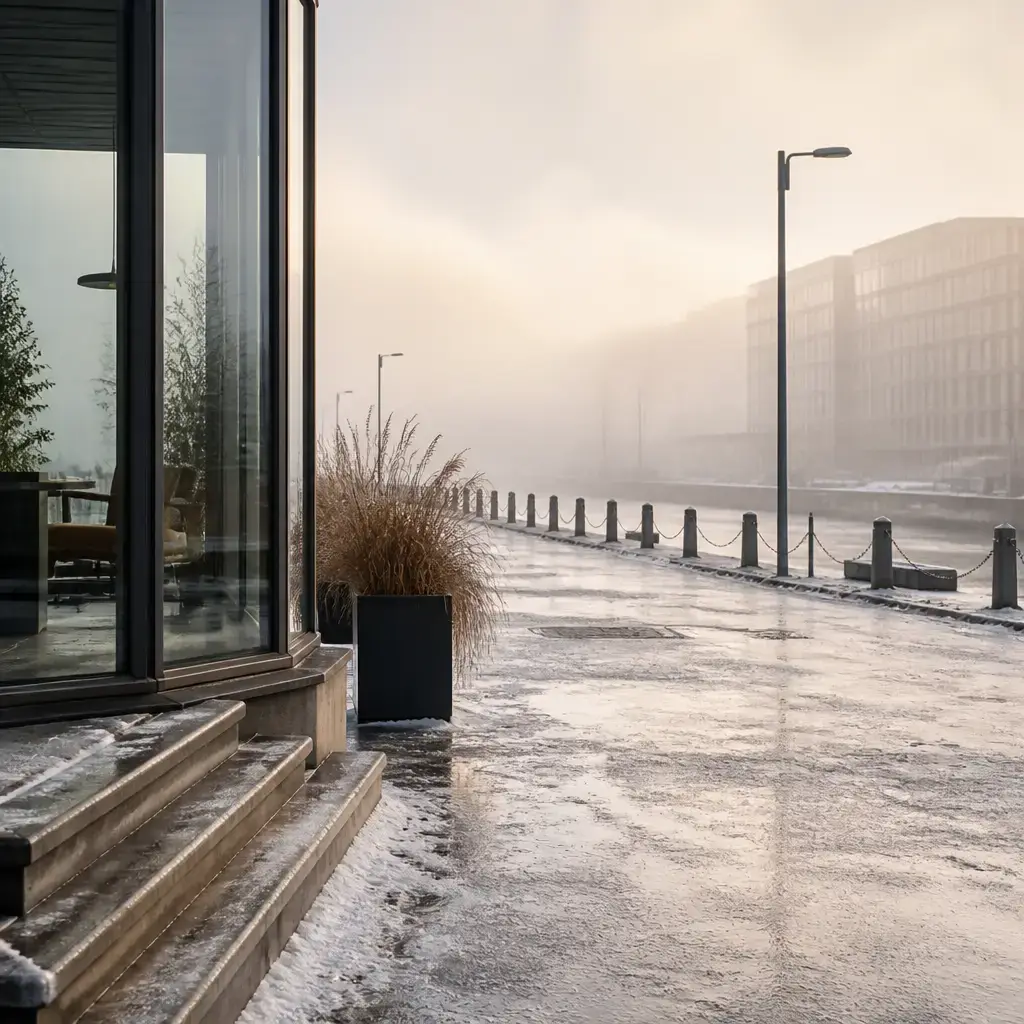
Vejene
“Vejene” means “the roads” in the sentence about icy roads. It is the definite form of “veje” and refers to the roads in the situation. A reusable pattern is “Vejene er …” when describing road conditions.
er
“er” means “is” or “are” and links the subject with information about it. Here, “Vejene er isglatte” says that the roads are icy, while “sigtbarheden er dårlig” says that visibility is poor. Use “er” to describe a current state or quality.
isglatte
“isglatte” means “icy” or “covered with ice” here and describes the roads. Its form matches the plural subject “Vejene”. A reusable pattern is “vejene er isglatte” when warning about dangerous road surfaces.
og
“og” means “and” and joins two related statements. Here it connects the condition of the roads with the poor visibility. Use “og” to link words, phrases, or complete clauses.
sigtbarheden
“sigtbarheden” means “the visibility” in the weather description. It is the definite form referring to the visibility at this time and place. A reusable pattern is “sigtbarheden er dårlig” when visibility is limited.
dårlig
“dårlig” means “poor” or “bad” and describes the visibility in “sigtbarheden er dårlig”. Here it expresses an unfavorable condition rather than a person’s quality. Use “dårlig” with a situation, condition, or result that is not good.
i
“i” means “in” in “i morges”, the time expression for this morning. Together with the following word, it locates the situation in the morning. Use “i” in time expressions such as “i morges” when referring to this morning.
morges
“morges” means “this morning” as part of the expression “i morges”. The expression places the poor visibility at the morning of the day being discussed. A reusable pattern is “i morges” when describing something that happened or was true this morning.
Det
“Det” means “it” or “that” and refers to the situation just mentioned: driving to the meeting. In “Det lyder risikabelt”, it introduces an evaluation of that situation. Use “Det lyder …” to say how something sounds or seems.
lyder
“lyder” means “sounds” in “Det lyder risikabelt”. It expresses an impression or evaluation of a situation, here driving on the roads. A reusable pattern is “Det lyder …” followed by an adjective such as “risikabelt”.
risikabelt
“risikabelt” means “risky” and evaluates driving to the meeting as unsafe. It appears after “Det lyder” to describe how the plan seems. Use “Det lyder risikabelt at …” before an action that seems dangerous.
at
“at” marks the infinitive in “at køre”, meaning “to drive”. It connects the infinitive action with the evaluation “Det lyder risikabelt”. Use “at” before an infinitive when an action is described or evaluated.
køre
“køre” means “drive” in “at køre til mødet”. The action is traveling by vehicle to the meeting. A reusable pattern is “at køre til” followed by a destination or event.
til
“til” means “to” and marks the destination in “til mødet”. It shows that the driving is directed toward the meeting. Use “til” before a destination, person, or event you are going to.
mødet
“mødet” means “the meeting” in “til mødet”. It is the specific meeting that the speakers are discussing. A reusable pattern is “flytte mødet” when rescheduling a meeting.
Jeg
“Jeg” means “I” and identifies the speaker as the person who hates rescheduling and is considering the options. It is capitalized because it begins the sentence. Use “Jeg” before an action or opinion about yourself.
hader
“hader” means “hate” in “Jeg hader at flytte mødet”. It expresses a strong negative feeling about rescheduling the meeting. Use “Jeg hader at” before an action you strongly dislike.
flytte
“flytte” means “move” here, specifically reschedule the meeting to another time or arrangement. It follows “hader at” in “at flytte mødet”. A reusable pattern is “flytte mødet” when changing the meeting time.
men
“men” means “but” and introduces a statement that contrasts with the speaker’s dislike of rescheduling. Here it presents safety as the more important consideration. Use “men” to connect two contrasting ideas.
sikkerheden
“sikkerheden” means “safety” in the statement that safety should come first. It is the definite form referring to safety as the relevant priority in this situation. A reusable pattern is “sikkerheden bør komme først” when emphasizing safety as the priority.
bør
“bør” means “should” or “ought to” and expresses what is advisable. Here it says that safety ought to have priority. Use “bør” before an infinitive to state a recommendation or duty.
komme
“komme” means “come” in the expression “komme først”. In this context, it contributes to the idea that safety should take first place. A reusable pattern is “komme først” when saying that something has the highest priority.
først
“først” means “first” in “sikkerheden bør komme først”. It describes priority rather than sequence in this sentence. Use “komme først” to say that something should be treated as the most important consideration.
Skriv
“Skriv” means “write” or “message” and is a direct instruction to contact the people concerned. Here it is followed by “til dem” to specify the recipients. A reusable pattern is “Skriv til …” when telling someone to write to a person or group.
dem
“dem” means “them” and refers to the people involved in the meeting. It follows “til” in “til dem”, identifying who should receive the message. Use “til dem” when writing or speaking to those people.
nu
“nu” means “now” and makes the instruction immediate. In “Skriv til dem nu”, it says that the message should be sent at this time. Use “nu” to indicate that an action should happen immediately or around the present time.
forklar
“forklar” means “explain” and gives a second instruction about the message. Here the road conditions should be made clear to the recipients. A reusable pattern is “forklar … tydeligt” when asking for a clear explanation.
tydeligt
“tydeligt” means “clearly” and describes how the road conditions should be explained. It modifies the action “forklar”. Use “forklar … tydeligt” when the listener needs an understandable and unambiguous explanation.
vejforholdene
“vejforholdene” means “the road conditions” in the explanation to the meeting participants. It refers to the state of the roads, including the icy conditions. A reusable pattern is “forklare vejforholdene” when giving a road-related reason for a change.
Skal
“Skal” introduces the question “Should I suggest …?” and asks whether the speaker ought to take an action. Here it is followed by “jeg” and the infinitive “foreslå”. Use “Skal jeg …?” to ask whether you should do something.
foreslå
“foreslå” means “suggest” in the question about an online meeting. It introduces the proposed alternative through “at vi mødes online”. A reusable pattern is “foreslå, at …” when suggesting that a person or group do something.
vi
“vi” means “we” and refers to the people who might meet online. It is the subject of “mødes” in the suggested arrangement. Use “vi” when including yourself and at least one other person in an action.
mødes
“mødes” means “meet” in “at vi mødes online”. It describes the participants meeting with each other rather than one person meeting someone else. A reusable pattern is “vi mødes …” followed by a place, time, or manner.
online
“online” means “online” and describes the proposed way of meeting. It contrasts with canceling the meeting completely by keeping the meeting in a remote format. Use “mødes online” for a meeting held through the internet.
i stedet for
“i stedet for” means “instead of” and introduces the alternative to canceling completely: meeting online. In this expression, “i” is part of the fixed prepositional phrase, “stedet” contributes the idea of the place or option being substituted, and “for” marks what it replaces. Use “i stedet for” before a noun or an infinitive, such as “i stedet for at aflyse”.
aflyse
“aflyse” means “cancel” in “at aflyse helt”. It refers to ending the meeting arrangement rather than moving it or holding it online. Use “at aflyse” before an event that will not take place.
helt
“helt” means “completely” and emphasizes that the meeting would be canceled in full. It modifies “aflyse” in “at aflyse helt”. Use “aflyse helt” when distinguishing full cancellation from changing the format or time.
ville
“ville” means “would” and presents a possible result of the online option. In “Det ville holde arbejdet i gang”, it describes what that option would achieve. Use “ville” before an infinitive to discuss a hypothetical or proposed result.
holde
“holde” means “keep” in “holde arbejdet i gang”. It describes maintaining the work rather than stopping it because of travel conditions. A reusable pattern is “holde noget i gang” when keeping an activity progressing.
arbejdet
“arbejdet” means “the work” and is the activity that would continue. It appears as the object of “holde” in “holde arbejdet i gang”. Use “holde arbejdet i gang” when work continues despite a difficulty or change.
i gang
“i gang” means “in progress” or “going” in “holde arbejdet i gang”. As a whole, the expression says that the work continues; “i” marks the state and “gang” contributes the idea of ongoing movement or activity. Use “holde … i gang” with an activity, process, or task that should continue.
uden
“uden” means “without” and introduces what is avoided by meeting online. Here no one needs to travel. Use “uden at” before an action that does not happen, as in “uden at nogen behøver at rejse”.
nogen
“nogen” means “anyone” in the negative-style context “uden at nogen …”. It refers to any person who might otherwise need to travel. A reusable pattern is “uden at nogen …” when saying that nobody has to perform an action.
behøver
“behøver” means “needs to” in “nogen behøver at rejse”. It expresses necessity, which is removed by the online arrangement. Use “behøver at” before an action that someone is required to do.
rejse
“rejse” means “travel” in the context of going to the meeting. It follows “behøver at” and names the action that no one needs to perform. Use “at rejse” when talking about traveling from one place to another.
kan
“kan” means “can” and expresses the speaker’s ability or possibility to ask a question. In “Jeg kan spørge”, it introduces an action the speaker is able or willing to take. Use “kan” before an infinitive to describe ability or a possible action.
spørge
“spørge” means “ask” in “Jeg kan spørge”. The speaker plans to ask whether joining by video would work for the others. A reusable pattern is “spørge, om …” when asking whether something is possible or suitable.
om
“om” means “whether” or “if” in “spørge, om det ville fungere”. It introduces the question being asked indirectly. Use “spørge, om …” before a clause that states what information you want to find out.
fungere
“fungere” means “work” or “function” in the question about joining by video. Here it asks whether that arrangement would be suitable for the other participants. A reusable pattern is “fungere for” followed by the person or group for whom something is suitable.
for
“for” means “for” in “fungere for dem”. It identifies the people whose needs or preferences determine whether the arrangement works. Use “fungere for nogen” to say that something works for someone.
deltage
“deltage” means “participate” or “join” in the video meeting. It follows “at” in “at deltage på video”. Use “deltage i” for taking part in an activity, and in this dialogue the manner is expressed by “på video”.
på
“på” means “by” or “on” in “på video”. It describes the medium used for participating in the meeting. Use “deltage på video” when joining a meeting through video.
video
“video” means “video” and names the medium for joining the meeting. Together with “på”, “på video” means by video rather than in person. Use “på video” for participation through a video connection.
Tilbyd
“Tilbyd” means “offer” and is a direct instruction to present another meeting option. Here the offer is to meet in person when the roads are safer. A reusable pattern is “Tilbyd at …” when telling someone to offer an action.
også
“også” means “also” or “too” and adds the in-person meeting as an additional option. It shows that the online option is not the only proposal. Use “også” to add another person, action, or possibility.
fysisk
“fysisk” means “in person” or “physically” in the phrase “mødes fysisk”. It contrasts with meeting online by describing a face-to-face meeting. Use “mødes fysisk” when participants meet at the same physical location.
når
“når” means “when” and introduces the time condition for the in-person meeting. Here the meeting can happen when the roads are safer. Use “når” before a clause describing the time or condition for an event.
mere
“mere” means “more” in “mere sikre”. It marks a comparison with the roads’ current level of safety. Use “mere” before an adjective when describing a greater degree of a quality.
sikre
“sikre” means “safe” in the comparative expression “mere sikre”, meaning safer. It describes the roads after conditions improve. Use “mere sikre” when comparing a future or alternative situation with the present one.
Hvis
“Hvis” means “if” and introduces a condition about the other people’s preference. The main possibility is that tomorrow will suit the speaker if they prefer to wait. Use “Hvis” before a condition that determines what happens next.
de
“de” means “they” and refers to the people being contacted about the meeting. It is the subject of “vil vente” in the conditional clause. Use “de” before an action performed by those people.
hellere
“hellere” means “rather” and expresses a preference for waiting over the other available options. In “hellere vil vente”, it modifies what they would prefer to do. Use “hellere vil” before an action someone prefers.
vil
“vil” means “want to” in “hellere vil vente”. It expresses the other people’s choice or preference in this sentence. Use “vil” before an infinitive when stating what someone wants to do.
vente
“vente” means “wait” in the condition “de hellere vil vente”. It describes postponing the meeting until a later time. Use “vente” after “vil” to say that someone wants to wait.
passer
“passer” means “suits” or “works” in “i morgen passer … for mig”. It says that tomorrow is a suitable time for the speaker. A reusable pattern is “[time] passer for mig” when saying that a time suits you.
i morgen
“i morgen” means “tomorrow” and names the alternative meeting day. In this time expression, “i” forms the expression with “morgen”, which identifies the next day. Use “i morgen” when arranging or discussing something for tomorrow.
fint
“fint” means “fine” or “well” in “passer … fint for mig”. It reinforces that tomorrow is completely acceptable to the speaker. Use “passer fint for mig” to say that a proposed time suits you well.
mig
“mig” means “me” and identifies the person for whom tomorrow is suitable. It follows “for” in “for mig”. Use “for mig” when stating whether an arrangement suits you.
Tydelige
“Tydelige” means “clear” and describes the options that are being offered. Its form agrees with the plural noun “muligheder”. A reusable pattern is “tydelige muligheder” for options that are easy to understand.
muligheder
“muligheder” means “options” or “possibilities” in the final statement. It refers to the different choices: meeting online, meeting later in person, or waiting. Use “muligheder” when presenting more than one possible course of action.
burde
“burde” means “should” or “ought to” and expresses an expectation about the result. Here clear options are expected to make the change easier to accept. Use “burde” before an infinitive when predicting or recommending a likely or appropriate result.
gøre
“gøre” means “make” in the construction “gøre ændringen lettere”. It describes causing a change in how easy something is. A reusable pattern is “gøre noget lettere” when saying that something makes an action or situation easier.
ændringen
“ændringen” means “the change” and refers to changing the meeting arrangement. It is the thing made easier to accept by presenting clear options. A reusable pattern is “acceptere ændringen” when discussing acceptance of a change.
lettere
“lettere” means “easier” in “gøre ændringen lettere at acceptere”. It describes a reduced level of difficulty in accepting the change. Use “gøre noget lettere at …” before an infinitive describing the action that becomes easier.
acceptere
“acceptere” means “accept” in “lettere at acceptere”. It names the action of agreeing to or being willing to accept the changed meeting arrangement. Use “acceptere” after “lettere at” when describing something that becomes easier to accept.