Jeg
“Jeg” means “I” and is the subject who dropped the phone and later says what they can do. It is used before the verb in statements such as “Jeg tabte min telefon” and “Jeg kan have den i et etui”.
tabte
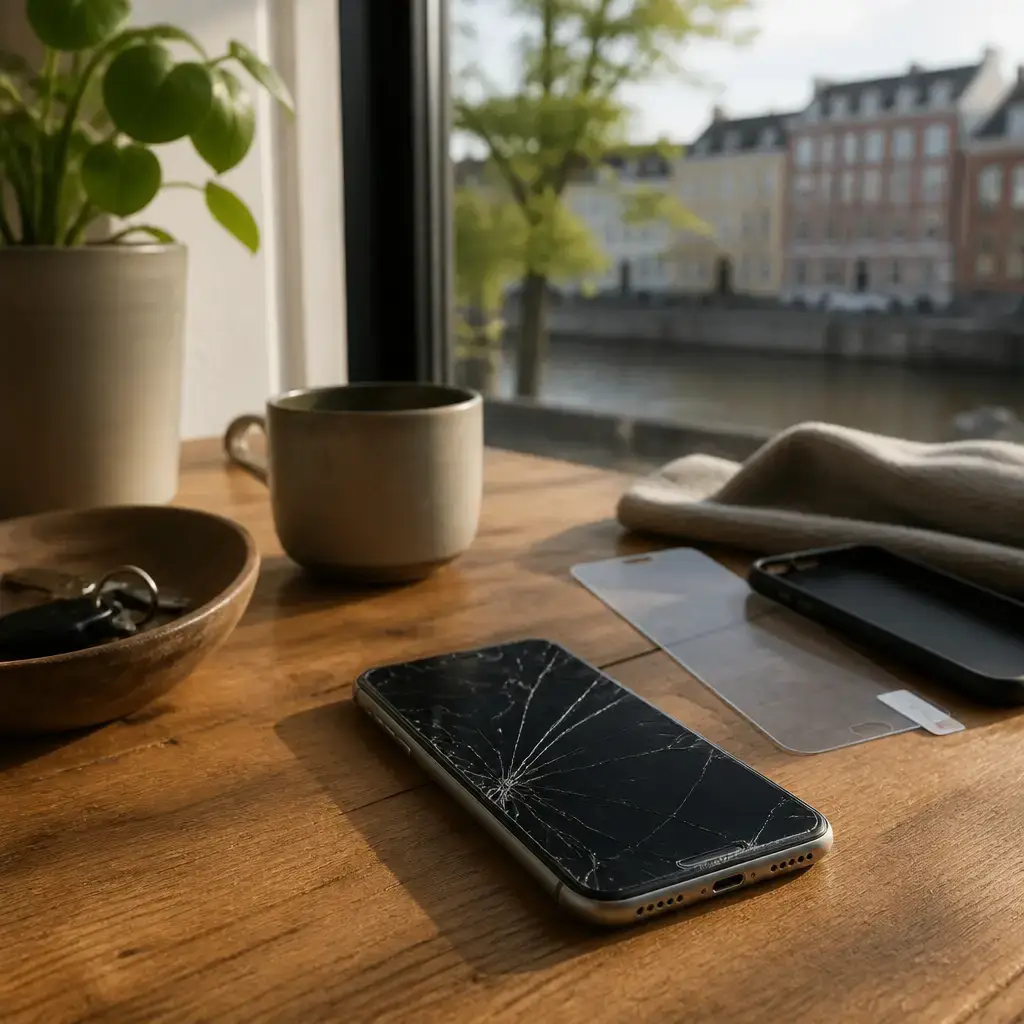
“Tabte” means “dropped” in “Jeg tabte min telefon”, describing the completed action that caused the damage. The citation form is “tabe”; use it with an object such as “tabe sin telefon” in a new example.
min
“Min” means “my” before “telefon” in “min telefon”. It identifies something belonging to the speaker, and it can be reused before another singular item in a pattern such as “min telefon”.
telefon
“Telefon” means “phone” in “min telefon”, the object that was dropped and needs repair. It is used after a possessive in this phrase; a new example could be “en telefon” for “a phone”.
og
“Og” means “and” and links “Jeg tabte min telefon” with the statement about the screen. It can join two related actions or descriptions, as in “Jeg læser og skriver” in a new example.
skærmen
“Skærmen” means “the screen” in “skærmen er revnet”. It is the damaged part of the phone; the citation form is “skærm”, and the exact form “skærmen” is used when referring to this specific screen.
er
“Er” means “is” in “skærmen er revnet” and links the screen with its current condition. It is used before a description or condition, such as “er klar” in a new example.
revnet
“Revnet” means “cracked” and describes the screen’s condition in “skærmen er revnet”. It is useful after “er” when stating that something has cracks, as in “Glasset er revnet” in a new example.
men
“Men” means “but” and introduces the fact that the cracked screen still works. It is used to connect two contrasting facts, as in “Den er gammel, men den virker” in a new example.
den
“Den” means “it” here and refers back to the damaged phone or screen in “den virker stadig”. It is used as the subject when continuing to talk about that specific item without repeating the noun.
virker
“Virker” means “works” or “functions” in “den virker stadig”, despite the cracked screen. The citation form is “virke”; use “virker” after a singular subject when saying that an item functions.
stadig
“Stadig” means “still” in “den virker stadig”, showing that the phone or screen continues to work. It commonly appears with a verb to show that a situation remains true.
Lav
“Lav” means “make” in the command “Lav en sikkerhedskopi af dine data”. It is a direct instruction, and the reusable pattern is “Lav en sikkerhedskopi af …” followed by the data or files to protect.
en
“En” introduces the singular common-gender noun “sikkerhedskopi” in “en sikkerhedskopi”. It is used before one item of this noun type, as in “en telefon” in a new example.
sikkerhedskopi
“Sikkerhedskopi” means “backup copy” in “Lav en sikkerhedskopi af dine data”. It names a copy made for protection, and it can be reused with “af” before the information being backed up.
af
“Af” means “of” in “en sikkerhedskopi af dine data”, identifying the data included in the backup copy. The reusable pattern is “en kopi af …” when naming what a copy contains.
dine
“Dine” means “your” before “data” in “dine data”. It links the data to the person being addressed, and it can be used before the person’s plural belongings or items.
data
“Data” means “data” in “dine data”, referring to the information stored on the phone. It is used after “sikkerhedskopi af” to specify what should be backed up.
før
“Før” means “before” and introduces the time condition “før skaden bliver værre”. It is used before an event or clause that should happen later than the main action.
skaden
“Skaden” means “the damage” in “før skaden bliver værre”. It refers to the existing damage to the phone; the citation form is “skade”, while “skaden” identifies this particular damage.
bliver
“Bliver” means “becomes” or “gets” in “skaden bliver værre”. The citation form is “blive”; it is used before a description when something changes into a new condition.
værre
“Værre” means “worse” in “skaden bliver værre”, describing a deterioration in the damage. It can follow “bliver” when warning that a condition may deteriorate.
Det
“Det” means “that” in “Det gør jeg nu”, referring back to the suggested backup rather than naming it again. The pattern “Det gør jeg” can be used to agree to do something just mentioned.
gør
“Gør” means “do” in “Det gør jeg nu”, where the speaker says they will carry out the earlier suggestion. The citation form is “gøre”; the pattern “Det gør jeg” is a practical way to confirm an action.
nu
“Nu” means “now” in “Det gør jeg nu”, showing that the speaker will act immediately. It can be placed after the verb or at the end of a short statement to specify the time.
knuste
“Knuste” describes the glass as broken or crushed in “det knuste glas”. It identifies the damaged glass that is making the speaker nervous, and it can be placed before a noun when describing damaged material.
glas
“Glas” means “glass” in “det knuste glas”. Here it refers to the broken glass from the phone screen, and it is used after a describing word such as “knuste”.
mig
“Mig” means “me” in “gør mig nervøs”, identifying the person who feels nervous. It is used after the verb when the action affects the speaker, as in “Det hjælper mig” in a new example.
nervøs
“Nervøs” means “nervous” in “gør mig nervøs”, describing the speaker’s reaction to the broken glass. It is used after “gør …” to name the resulting feeling in this construction.
Sæt
“Sæt” means “put” or “place” in the instruction “Sæt en midlertidig skærmbeskytter på”. It is used to tell someone to place something somewhere, with “på” showing that the protector goes onto the screen.
midlertidig
“Midlertidig” means “temporary” in “en midlertidig skærmbeskytter”, showing that the protection is only for the period before repair. It is placed before the noun it describes.
skærmbeskytter
“Skærmbeskytter” means “screen protector” in “en midlertidig skærmbeskytter”. It names the object placed on the screen to protect it, and it can be used after a describing word such as “midlertidig”.
på
“På” means “on” in “Sæt … på”, showing where the screen protector should be placed. The reusable construction is “sætte noget på” when putting something onto a surface.
undgå
“Undgå” means “avoid” in the instruction “undgå at trykke hårdt på den”. It is followed here by “at” and an action, giving the pattern “undgå at …” for something a person should not do.
at
“At” marks the following action in “undgå at trykke hårdt på den”. It connects “undgå” with the action to avoid, and the reusable pattern is “undgå at” plus an infinitive.
trykke
“Trykke” means “press” in “at trykke hårdt på den”, referring to pressing hard on the damaged screen protector or screen. It follows “at” after “undgå”, and “trykke på” is used for pressing on something.
hårdt
“Hårdt” means “hard” or “forcefully” in “trykke hårdt på den”. It describes the force of the pressing, and it can be placed after an action verb to explain how forcefully the action is done.
Skal
“Skal” asks about what the speaker should do in “Skal jeg blive ved med at bruge den?”. It begins a question about a proposed action, and the pattern “Skal jeg …?” can be used when asking for advice or permission.
blive
“Blive” contributes the idea of continuing or remaining in “blive ved med at bruge den”. Together with “ved med at” it forms the expression “blive ved med at” meaning to keep doing something.
ved
“Ved” is part of “blive ved med at bruge den”, the expression used for continuing an action. In this pattern, it belongs together with “blive” and “med at”, so the reusable form is “blive ved med at” plus an action.
med
“Med” is part of the continuation expression “blive ved med at bruge den”. The complete pattern means “keep using it” here and is followed by “at” and the action that continues.
bruge
“Bruge” means “use” in “at bruge den”, referring to continuing to use the phone. It follows “at” in the pattern “blive ved med at bruge …”, with the object placed after it.
indtil
“Indtil” means “until” and introduces the point when the repair service checks the phone. It is used before an event or clause that marks the end of the period.
et
“Et” introduces the singular noun “værksted” in “et værksted”. It is used before one item of this noun type, as in “et etui” in a new example.
værksted
“Værksted” means “repair shop” or “workshop” in “et værksted tjekker den”. Here it is the place or service that checks the phone, and it can follow “et” when referring to one repair shop.
tjekker
“Tjekker” means “checks” in “et værksted tjekker den”, describing the repair shop’s inspection of the phone. The citation form is “tjekke”; use it with an object when describing an inspection.
Brug
“Brug” means “use” in the instruction “Brug den kun til enkle opgaver”. It tells the listener how to use the damaged phone, and the pattern “Brug den til …” specifies a permitted purpose.
kun
“Kun” means “only” in “Brug den kun til enkle opgaver”, limiting the phone’s use to simple tasks. It is placed before the phrase that states the restriction.
til
“Til” means “for” in “til enkle opgaver”, showing what purpose the phone may be used for. The reusable pattern is “bruge noget til …” followed by an activity or purpose.
enkle
“Enkle” means “simple” in “enkle opgaver”, describing tasks that are not demanding. It is placed before “opgaver” and agrees with the form used for that noun phrase.
opgaver
“Opgaver” means “tasks” in “til enkle opgaver”. It refers to the limited activities suitable for the damaged phone, and it can follow “til” when naming a purpose.
fordi
“Fordi” means “because” and introduces the reason for limiting phone use: loose glass may cut a finger. It connects an action or statement with its explanation.
løst
“Løst” means “loose” in “løst glas”, describing glass that is no longer firmly attached. It is placed before the noun “glas” to identify the hazardous type of glass.
kan
“Kan” means “can” in “løst glas kan skære dig”, expressing the possibility that loose glass may cut someone. It is followed by the infinitive “skære” without “at”.
skære
“Skære” means “cut” in “kan skære dig i fingeren”. It follows “kan” and describes the possible injury, with the affected person after the verb.
dig
“Dig” means “you” as the person who could be cut in “skære dig i fingeren”. It is used after the verb as the affected person, as in “Det hjælper dig” in a new example.
i
“I” means “in” in “i fingeren”, identifying the body part where the cut could occur. The pattern “skære nogen i …” names the body part affected.
fingeren
“Fingeren” means “the finger” in “skære dig i fingeren”. It refers to a specific finger that could be cut; the citation form is “finger”, while “fingeren” is the definite form used here.
have
“Have” means “keep” or “have” in “have den i et etui”, describing keeping the phone inside a case. The reusable pattern is “have noget i …” when saying where something is kept.
etui
“Etui” means “case” in “i et etui”, referring to a protective container for the phone. It follows “et” here and is used after “i” to name the place where the phone is kept.
bære
“Bære” means “carry” in “bære den forsigtigt”, referring to carrying the phone carefully. It is coordinated with “have” after “kan”, and the object “den” follows the verb.
forsigtigt
“Forsigtigt” means “carefully” in “bære den forsigtigt”, describing how the phone should be carried. It is placed after the action to give guidance about the manner of carrying.
burde
“Burde” means “should” or “ought to” in “Det burde mindske risikoen”, expressing an expected result rather than a direct command. It is followed by the infinitive “mindske” when describing what is expected to happen.
mindske
“Mindske” means “reduce” or “lower” in “burde mindske risikoen”. It follows “burde” and takes “risikoen” as the thing expected to become smaller.
risikoen
“Risikoen” means “the risk” in “mindske risikoen”, referring to the risk created by the cracked screen and loose glass. The citation form is “risiko”, while “risikoen” identifies the specific risk in this situation.
mens
“Mens” means “while” and introduces the activity taking place during the repair arrangements. It connects two actions that happen during the same period.
du
“Du” means “you” and is the subject of “du aftaler reparationen”. It identifies the person arranging the repair, and it is placed before the verb in this clause.
aftaler
“Aftaler” means “arrange” in “du aftaler reparationen”, describing arranging the repair. The citation form is “aftale”; it can be used with an object when arranging a service or appointment.
reparationen
“Reparationen” means “the repair” in “aftaler reparationen”, referring to the specific repair needed for the phone. The citation form is “reparation”, while “reparationen” identifies the repair already under discussion.
bestiller
“Bestiller” means “book” in “Jeg bestiller en reparation”, describing arranging the repair instead of waiting. The citation form is “bestille”; it is used with a service or appointment that someone arranges.
reparation
“Reparation” means “repair” in “bestiller en reparation”, naming the service the speaker plans to book. It follows “en” here, and the pattern “bestille en reparation” can be reused for arranging this service.
stedet
“Stedet” is part of “i stedet for at vente”, which means “instead of waiting”; here it marks the alternative chosen by the speaker. The full expression “i stedet for” is used before a noun or an action introduced by “at”.
for
“For” contributes to the expression “i stedet for”, meaning “instead of” in “i stedet for at vente”. Keep it with “i stedet” when replacing one planned action with another.
vente
“Vente” means “wait” in “i stedet for at vente”, naming the action the speaker chooses not to continue. It follows “at” in the reusable pattern “i stedet for at …”.
Små
“Små” means “small” in “Små revner”, describing cracks that are limited in size. It is placed before the plural noun “revner” and can describe other small things in a new example.
revner
“Revner” means “cracks” in “Små revner kan brede sig”, referring to cracks in the phone screen. It is the subject of the warning and is used before a verb describing what the cracks may do.
brede
“Brede” means “spread” in “kan brede sig”, describing the cracks extending further. It follows “kan” and is used with the reflexive “sig” in the pattern “brede sig”.
sig
“Sig” is the reflexive element in “brede sig”, referring back to “Små revner” as the things that spread. The complete pattern “brede sig” means that a crack or similar condition extends.
hvis
“Hvis” means “if” and introduces the condition “hvis du bliver ved med at bruge telefonen”. It is used before a condition that explains when the possible spreading may occur.
telefonen
“Telefonen” means “the phone” in “bruge telefonen”, referring to the specific damaged phone. The citation form is “telefon”, while “telefonen” identifies the phone already being discussed.