Må
“Må” asks for permission in “Må jeg låne din slip-let-pande”. It is used before the subject and an action when asking whether something is allowed, such as borrowing an item.
jeg
“jeg” means I and is the person asking to borrow the pan. It functions as the subject in “Må jeg låne” and is used when talking about your own action.
låne
“låne” means borrow, using something temporarily with the intention of returning it. It follows “Må jeg” in “Må jeg låne din slip-let-pande” and is useful when requesting temporary use of an object.
din
“din” means your and identifies the pan as belonging to the person being addressed. It comes before the noun in “din slip-let-pande” and is used when referring to something owned by that person.
slip-let-pande
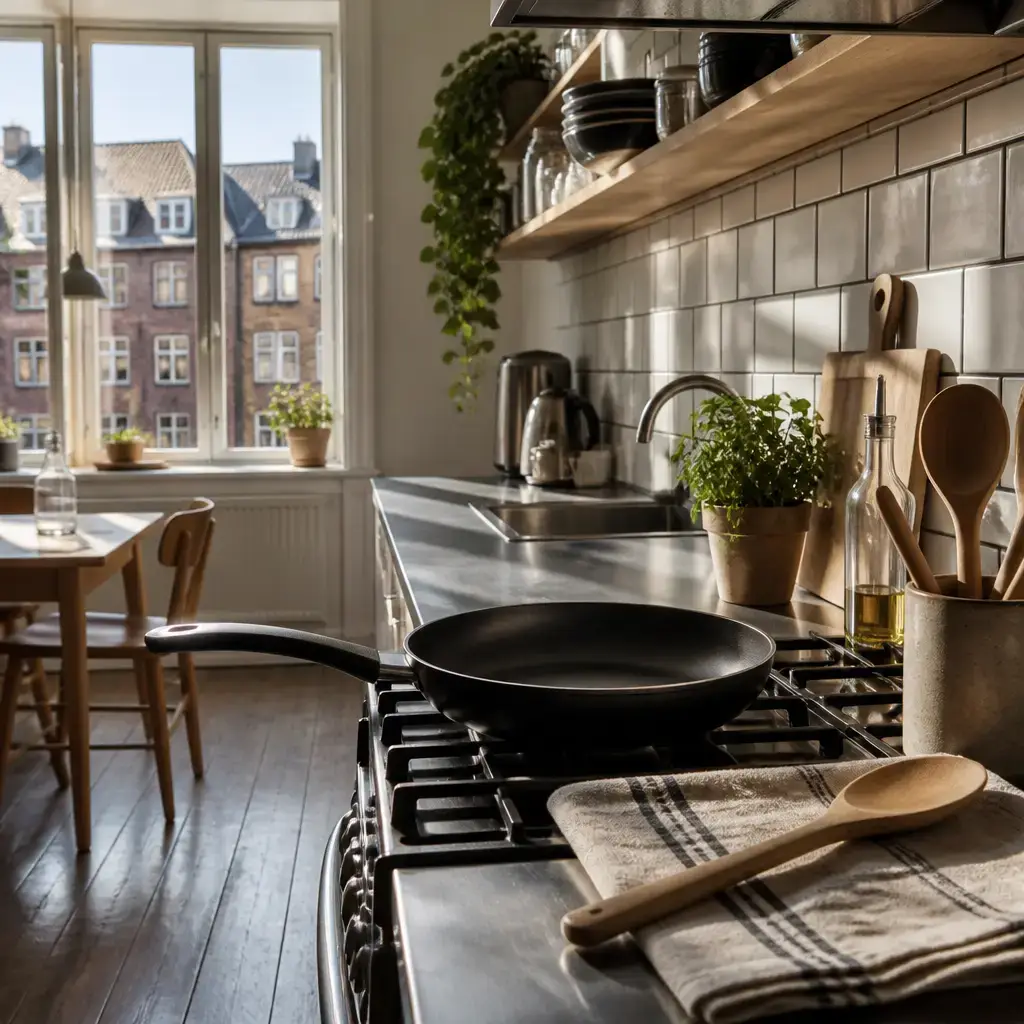
“slip-let-pande” means non-stick pan, the item being borrowed in this kitchen conversation. It is a compound noun used to name a specific type of pan.
til
“til” introduces the purpose of the borrowing in “til noget, jeg er ved at lave”. Here it means for and is used to connect an item or action with its intended purpose.
noget
“noget” means something unspecified in “til noget, jeg er ved at lave”. It is useful when the exact thing is not named or is not important to identify.
er
“er” is the form of være used for am in “jeg er ved at lave”. Together with “ved at lave”, it describes something currently in progress and can be used when explaining what you are doing now.
ved
“ved” contributes to the ongoing-action construction “er ved at lave”, meaning that the cooking is in progress. The same construction is useful for describing an activity that is happening at the moment.
at
“at” marks the infinitive in “er ved at lave”. It connects the ongoing-action expression with the action itself and is used before the infinitive in this construction.
lave
“lave” means make or cook here, specifically in “lave” within “jeg er ved at lave”. The phrase “lave mad” is used for cooking food and appears again when the speaker describes finishing cooking.
Det
“Det” refers to the requested action in “Det må du gerne”, helping form the reply that permission is granted. The whole expression is useful when responding positively to someone’s request.
du
“du” means you and refers to the person who wants to borrow and care for the pan. It is the subject in “Det må du gerne” and is used when addressing one person directly.
gerne
“gerne” expresses willingness in “Det må du gerne”. The permission comes from the whole expression, while “gerne” shows that the speaker is willing to allow the action; this is useful in an affirmative reply to a request.
men
“men” means but and introduces a restriction after permission has been given. It links the two parts of “Det må du gerne, men brug venligst ikke...” and is used to contrast an agreement with a condition.
brug
“brug” is the command form of bruge and means use in “brug venligst ikke metalredskaber”. It gives an instruction about what someone should use and is useful in practical advice or warnings.
venligst
“venligst” means please and makes the instruction in “brug venligst ikke metalredskaber” polite. It is commonly placed with a request or command when giving careful instructions.
ikke
“ikke” means not and prohibits the action in “brug venligst ikke metalredskaber”. It is used with the command to say that the utensils must not be used on the pan.
metalredskaber
“metalredskaber” means metal utensils and is the object of “brug”. It is used when naming the kitchen tools that should not be used on the pan’s surface.
på
“på” means on in “på den”, referring to using something on the pan. It is useful for describing contact with or use on a surface.
den
“den” means it here and refers back to the pan in “på den”. It is also used for the pan as the object in “vaske den” and “aflevere den”.
vil
“vil” expresses the speaker’s intention in “Jeg vil bruge en træske”. It is followed by an action and is useful when stating what you plan or intend to do.
bruge
“bruge” means use and is the action intended in “vil bruge en træske”. It is used with the object being used, such as a utensil in this cooking situation.
en
“en” introduces one unspecified item in “en træske”. It comes before the singular noun and is useful when mentioning an item that has not yet been identified.
træske
“træske” means wooden spoon and is the tool chosen for cooking in the dialogue. It is used as the object of “bruge” when explaining which utensil will be used.
så
“så” means so that in “så jeg ikke ridser overfladen” and introduces the purpose of using a wooden spoon. It is useful for connecting an action with the result or reason intended.
ridser
“ridser” is the form of ridse used for scratch in “jeg ikke ridser overfladen”. With “ikke”, it describes the damage the speaker wants to avoid; it is used with the surface or object that could be scratched.
overfladen
“overfladen” means the surface and refers to the pan’s coating surface. It is the object of “ridser” and is useful when discussing possible damage to a known object.
Hold
“Hold” is the command form of holde and means keep or maintain in “Hold også varmen på middel”. It gives practical instructions about maintaining a particular heat level.
også
“også” means also or too and adds another care instruction in “Hold også varmen...”. It is useful when adding advice to something already mentioned.
varmen
“varmen” means the heat in “Hold også varmen på middel”. It refers to the cooking heat being controlled and is used with a setting or level.
middel
“middel” means medium in “på middel”, describing the recommended heat setting. This expression is useful when giving a cooking instruction about keeping the heat moderate.
fordi
“fordi” means because and introduces the reason for the warning about heat. It connects the advice with the explanation “fordi høj varme kan beskadige belægningen” and is used before a reason clause.
høj
“høj” means high and describes the level of the heat in “høj varme”. It is useful when warning about a high setting or level.
varme
“varme” means heat and is the noun in “høj varme”. It is used with a description such as “høj” when talking about cooking temperature.
kan
“kan” means can and expresses a possibility in “høj varme kan beskadige belægningen”. It comes before the action and is useful for stating what may happen.
beskadige
“beskadige” means damage and follows “kan” in “kan beskadige belægningen”. It is useful in warnings about harm that an action or condition may cause to an object.
belægningen
“belægningen” means the coating and refers to the protective layer on the non-stick pan. It is the object of “beskadige” and is useful when discussing care of a surface or covering.
hellere
“hellere” means rather and expresses a preference in “Jeg vil hellere spørge nu end at gætte”. The pattern is useful when choosing one action instead of another.
spørge
“spørge” means ask and is the action preferred in “vil hellere spørge nu”. It is useful when seeking information before taking an uncertain action.
nu
“nu” means now and places the asking at the present moment in “spørge nu”. It is useful when emphasizing that clarification should happen immediately.
end
“end” means than and links the two alternatives in “hellere spørge nu end at gætte”. It is used to compare the preferred action with the one being avoided.
gætte
“gætte” means guess and describes acting without knowing the correct care instructions. In “end at gætte og ødelægge den”, it is one of the actions the speaker would rather avoid.
og
“og” means and and joins “gætte” with “ødelægge den”. It is useful for connecting two related actions or consequences.
ødelægge
“ødelægge” means ruin or destroy and refers to damaging the pan in “ødelægge den”. It is used with the object that could be ruined and expresses the consequence the speaker wants to prevent.
hjælper
“hjælper” is the form of hjælpe used in “Det hjælper”, meaning that the explanation is helpful. This expression is useful when acknowledging that someone’s information or action has helped.
holder
“holder” is the form of holde used for lasts in “Den holder længere”. It describes how long the pan remains usable and is useful when talking about an object’s durability.
længere
“længere” means longer and indicates a greater duration in “holder længere”. It is useful for comparing how long something lasts under different conditions.
hvis
“hvis” means if and introduces the condition “hvis man behandler den forsigtigt”. It is useful for explaining what must be true for a result to occur.
man
“man” means one or people in a general statement, rather than naming a particular person. In “hvis man behandler den forsigtigt”, it gives general care advice that applies to anyone handling the pan.
behandler
“behandler” is the form of behandle used for handles or treats in “behandler den forsigtigt”. It is used with an object and describes the way that object is cared for.
forsigtigt
“forsigtigt” means carefully or gently and describes the manner of handling the pan in “behandler den forsigtigt”. It is also used in “Vask den forsigtigt” for gentle washing, making it useful for care instructions.
Skal
“Skal” asks whether an action is required or advisable in “Skal jeg vaske den i hånden”. It is used before the subject and an action when asking about the correct procedure.
vaske
“vaske” means wash and follows “Skal jeg” in the question about cleaning the pan. It is useful with an object when asking or explaining how something should be cleaned.
i
“i” means in and is part of the expression “i hånden”, which means by hand in this context. The expression is useful when distinguishing manual washing from using a machine.
hånden
“hånden” means the hand and completes “i hånden”. This phrase is used when saying that an item should be washed manually.
stedet
“stedet” means the place or stead, but in “i stedet for at sætte den i opvaskemaskinen” it is part of the expression meaning instead of. This expression is useful when presenting one alternative to another.
for
“for” completes the expression “i stedet for”, meaning instead of, in “i stedet for at sætte den i opvaskemaskinen”. It is used when replacing one possible action with another.
sætte
“sætte” means put or place and appears after “i stedet for at” in “sætte den i opvaskemaskinen”. It is useful when describing placing an object somewhere.
opvaskemaskinen
“opvaskemaskinen” means the dishwasher and is the destination in “sætte den i opvaskemaskinen”. It is used when talking about machine-washing dishes or kitchen items.
Vask
“Vask” is the command form of vaske and means wash in “Vask den forsigtigt i hånden”. It gives a direct care instruction and is useful when telling someone how to clean an item.
tør
“tør” is the command form of tørre and means dry in “tør den”. It gives the next care instruction after washing and is useful when preparing an item for storage or return.
før
“før” means before and introduces the time clause “før du tager den med tilbage”. It is useful for ordering one action before another.
tager
“tager” is the form of tage used in “tager den med tilbage”. In this expression it means brings or takes the pan back, and it is useful when describing carrying an item to another place.
med
“med” means with or along and contributes to “tager den med tilbage”, meaning takes it back along. It is useful in expressions about bringing or carrying something with you.
tilbage
“tilbage” means back and shows the direction of return in “tager den med tilbage”. It is useful when describing returning an object to its original person or place.
afleverer
“afleverer” is the form of aflevere used for handing back or returning the pan in “Jeg afleverer den ren”. It is useful when stating that an item will be handed to its owner or returned to a designated place.
ren
“ren” means clean and describes the condition of the pan when it is returned in “afleverer den ren”. It is useful for stating the condition in which an item is handed back.
når
“når” means when and links the return to the completion of cooking in “når jeg er færdig med at lave mad”. It is useful for connecting an action with the time it will happen.
færdig
“færdig” means finished or done in “jeg er færdig med at lave mad”. The whole expression is useful for saying that an activity has been completed.
mad
“mad” means food or a meal and appears in the expression “lave mad”, meaning cook. It is used when talking about preparing food.
Sig
“Sig” is the command form of sige and means tell or let know in “Sig til mig”. The expression is useful when asking someone to give you an update or information.
mig
“mig” means me and identifies the person who should receive the information in “Sig til mig”. It is useful after “til” when telling someone to inform the speaker.
hvordan
“hvordan” means how and introduces the question about the result in “hvordan retten bliver”. It is useful before a clause when asking about the way something turns out.
retten
“retten” means the dish and refers to the particular meal being cooked. It is the subject of “hvordan retten bliver” and is useful when asking about the result of a prepared dish.
bliver
“bliver” is the form of blive used for turns out or becomes in “hvordan retten bliver”. It is useful for asking or describing the resulting state or quality of something.