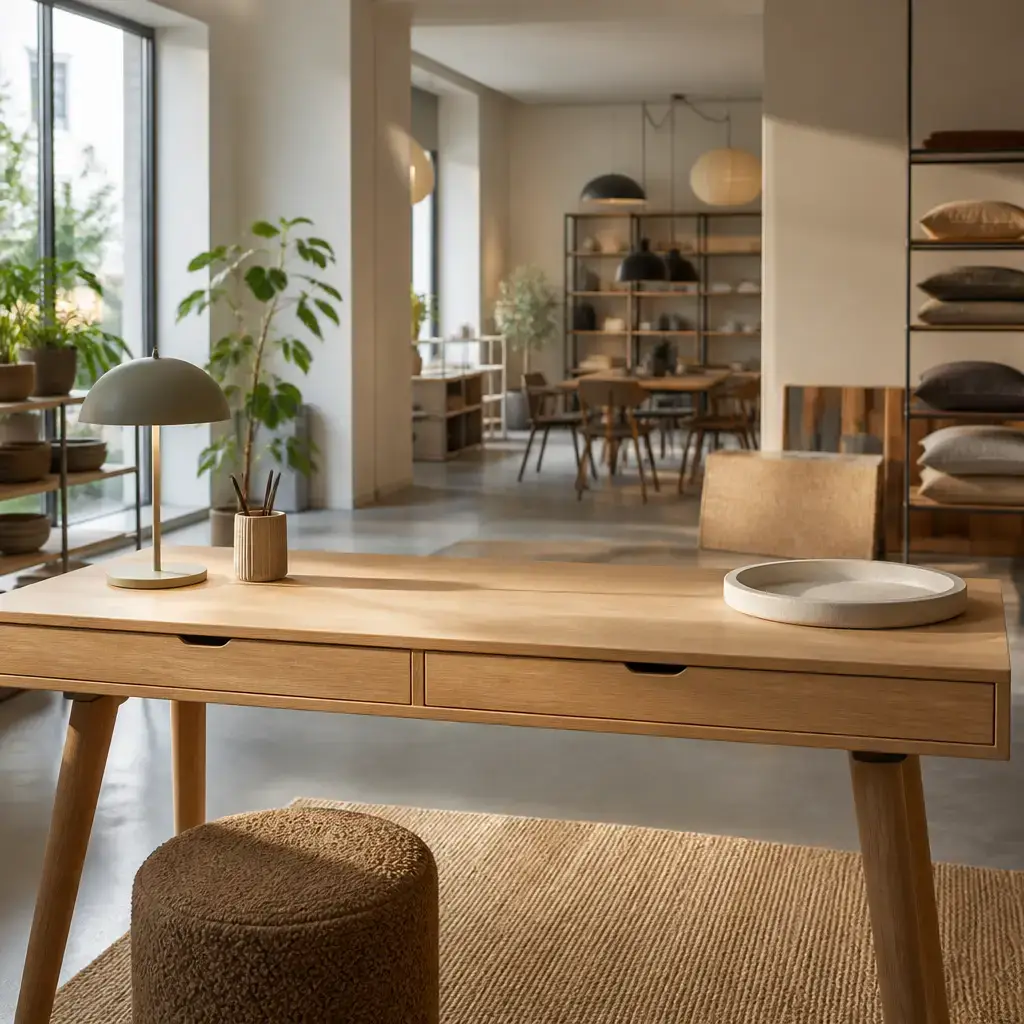
kan godt lide
“kan godt lide” means “like” in “Jeg kan godt lide dette skrivebord.” The whole expression means liking something: “kan” contributes the ability-like modal form, “godt” is part of this fixed expression, and “lide” completes the meaning. Reuse it with the thing liked after the expression, such as “kan godt lide dette skrivebord”.
dette
“dette” means “this” and points to the desk in “dette skrivebord.” It comes directly before the noun it identifies. Use it when referring to one specific nearby item.
skrivebord
“skrivebord” means “desk” in “dette skrivebord.” Here it is the object that the speaker likes and cannot carry home. Reuse it after an expression such as “kan godt lide” when talking about a desk.
men
“men” means “but” and contrasts liking the desk with not being able to carry it in “Jeg kan godt lide dette skrivebord, men jeg kan ikke bære det hjem alene.” It joins two contrasting parts of the sentence. Use it to introduce a limitation or opposing point.
Jeg
“Jeg” means “I” at the beginning of “Jeg kan godt lide dette skrivebord.” The capital letter is used because it starts the sentence; the same pronoun also appears as “jeg” later in the dialogue. It is the subject when the speaker describes their own action or situation.
kan
“kan” means “can” or “be able to” in “Jeg kan ikke bære det hjem alene” and “Kan du tjekke”. It is followed by an infinitive such as “bære” or “tjekke”; “Kan” is capitalized only because it begins the question. Use it to express ability or ask whether someone can do something.
ikke
“ikke” means “not” in “kan ikke bære”. It makes the speaker’s ability negative and follows “kan” in this sentence. Use it before the action that is being denied or excluded.
bære
“bære” means “carry” in “kan ikke bære det hjem”. It follows the modal “kan” in its unchanged action form. The reusable pattern is “kan ... bære” with the object placed between the modal and the action when needed.
det
“det” means “it” and refers to the desk in “bære det hjem”. It is the thing being carried and later delivered or assembled. Use it to refer back to the item already being discussed.
hjem
“hjem” means “home” in “bære det hjem”. It expresses the destination of carrying the desk, without a separate preposition in this phrase. Use it after a movement verb when the destination is home.
alene
“alene” means “alone” or “by oneself” in “bære det hjem alene”. It describes the speaker’s situation while carrying the desk. Use it to show that someone does an action without another person’s help or company.
Vi
“Vi” means “we” in “Vi kan arrangere levering”. It is the subject referring to the shop staff or business together. Use it before a verb when the speaker speaks for a group.
arrangere
“arrangere” means “arrange” in “kan arrangere levering”. It follows “kan” and takes “levering” as what is being arranged. Use the pattern “kan arrangere” when offering to organize a service or event.
levering
“levering” means “delivery” in “arrangere levering”. It is the service the shop can organize and the customer later asks to add. Use it as the object after a verb such as “arrangere” or “tilføje”.
hvis
“hvis” means “if” in “hvis det stadig er på lager” and “Hvis det er tilgængeligt”. It introduces a condition for the delivery or the customer’s next question; its capitalized form “Hvis” begins a sentence. Use it before the condition that must be true.
stadig
“stadig” means “still” in “stadig er på lager”. It shows that the item’s stock status is expected to remain unchanged up to this point. Use it with a continuing state or situation.
er
“er” means “is” or “are” in “er på lager”, “er tilgængeligt”, and “Er montering inkluderet”. It links the subject with a state or description; “Er” is capitalized because it starts the question. Use it with a location, condition, or description.
på lager
“på lager” means “in stock” in “det stadig er på lager”. Together, the expression describes whether the item is available in the shop’s stock: “på” forms the stock-status expression with “lager”. Reuse it after “er” when checking whether a product is available for sale.
du
“du” means “you” in “Kan du tjekke” and “tilbyder du”. It refers to the individual staff member being addressed. Use it as the subject when asking or saying what one person can do.
tjekke
“tjekke” means “check” in “Kan du tjekke”. It follows “kan” and introduces the requested investigation. Use the pattern “kan du tjekke” when politely asking someone to verify information.
om
“om” means “whether” in “tjekke, om lageret har et”. It introduces the matter being checked rather than a direct yes-or-no question. Use it after verbs such as “tjekke” when reporting or asking whether something is true.
lageret
“lageret” means “the warehouse” in “om lageret har et”. It is the place or stock location whose availability is being checked. The ending in “lageret” marks the specific warehouse referred to here; use it as the subject of an availability check.
har
“har” means “has” in “lageret har et”. It says that the warehouse possesses or holds an available item. Use it with the thing that is in stock or available after the subject.
et
“et” means “one” or “an item” in “lageret har et, der er tilgængeligt”. It stands for one desk, so the noun does not need to be repeated. Use it when the item is already clear from the conversation.
der
“der” means “that” or “which” in “et, der er tilgængeligt”. It connects “et” with the description of the item’s availability. Use it to introduce a clause that gives more information about the item just mentioned.
tilgængeligt
“tilgængeligt” means “available” in “et, der er tilgængeligt”. It describes the item that the warehouse may have. Use it after “er” when stating that an item can be obtained or is ready for use.
tjekker
“tjekker” means “am checking” in “Jeg tjekker lagerlisten nu”. It presents the staff member’s current action, with “Jeg” as the subject. Use it with an object such as “lagerlisten” when checking information at the present moment.
lagerlisten
“lagerlisten” means “the stock record” in “Jeg tjekker lagerlisten nu”. It is the specific list the staff member consults to verify stock. The ending in “lagerlisten” marks the particular stock list being checked; use it after a checking verb.
nu
“nu” means “now” in “Jeg tjekker lagerlisten nu”. It places the checking action at the present moment. Use it to emphasize that an action is happening immediately.
hvilke
“hvilke” means “which” in “hvilke leveringsmuligheder”. It asks the staff member to select or describe options from a group. It comes directly before the plural noun “leveringsmuligheder” here.
leveringsmuligheder
“leveringsmuligheder” means “delivery options” in “hvilke leveringsmuligheder tilbyder du”. It refers to the different ways delivery can be provided. Use it after “hvilke” when asking which delivery choices a shop offers.
tilbyder
“tilbyder” means “offer” in “hvilke leveringsmuligheder tilbyder du”. It is the action the staff member or shop performs toward the customer. Use it with the service or options being offered and the recipient or provider as the subject.
Standardlevering
“Standardlevering” means “standard delivery” in “Standardlevering vil bringe det hjem til dig”. It names the delivery service that is being described. As the first word of the sentence, it is capitalized; use it as the subject when explaining what this service does.
vil
“vil” means “will” or “would” in “vil bringe det hjem til dig”. It presents the expected result of standard delivery. It is followed by the infinitive “bringe”; use this pattern when describing what a service is expected to do.
bringe
“bringe” means “bring” in “vil bringe det hjem til dig”. It follows “vil” and describes moving the desk to the customer’s home. Use it with the item being moved and the destination or recipient.
til
“til” means “to” in “til dig”. It introduces the recipient of the delivery. Use it before a person when stating who something is brought or delivered to.
dig
“dig” means “you” in “til dig”. It refers to the customer as the recipient of the desk. Use it after “til” when something is brought or delivered to one person.
montering
“montering” means “assembly” in “Er montering inkluderet?” and “Montering skal bestilles separat”. It names the service of putting the desk together. Use it as the subject when asking whether assembly is included or explaining that it must be ordered.
inkluderet
“inkluderet” means “included” in “montering inkluderet” and “er inkluderet”. It describes whether assembly or carrying upstairs is part of the delivery service. Use it with “er” to state that a service forms part of what is provided.
eller
“eller” means “or” in “inkluderet, eller er det kun levering til døren?”. It presents an alternative between assembly and delivery to the door. Use it to connect two possible services or answers.
kun
“kun” means “only” in “kun levering til døren”. It limits the service to delivery to the door and excludes assembly. Place it before the part that is the sole included option.
døren
“døren” means “the door” in “levering til døren”. It is the destination up to which the delivery reaches. The ending in “døren” marks the specific door referred to; use it after “til” for delivery to the door.
skal
“skal” means “must” or “is to” in “Montering skal bestilles separat”. It says that assembly has to be ordered separately. It is followed here by the passive form “bestilles”; use this pattern for a required action.
bestilles
“bestilles” means “be ordered” in “skal bestilles separat”. It focuses on the assembly being ordered rather than naming who orders it. Use it after “skal” when stating that a service or item must be ordered.
separat
“separat” means “separately” in “bestilles separat”. It says that assembly is ordered apart from the standard delivery. It modifies the ordering action and clarifies that the services are not ordered together.
at
“at” marks the infinitive in “at bære det op ad trappen”. It introduces the action of carrying, which is described as included. Use it before an infinitive when that action functions as the subject or part of a larger expression.
op
“op” contributes the meaning “up” in “op ad trappen”. Together with “ad trappen”, it describes upward movement along the stairs. Use it in a movement expression when the direction is upward.
ad
“ad” contributes the meaning “along” or “up” in “op ad trappen”. Together, “op ad trappen” describes carrying the desk upward along the stairs. Use it with a route or surface that someone moves along.
trappen
“trappen” means “the stairs” in “op ad trappen”. It is the route along which the desk is carried upstairs. The ending in “trappen” marks the specific stairs involved in the delivery.
Tilføj
“Tilføj” means “add” in “Tilføj venligst levering”. It is a direct polite request to include delivery in the order. Because it begins the sentence, it is capitalized; use it before the thing you want added.
venligst
“venligst” means “please” in “Tilføj venligst levering”. It makes the request more polite. Use it with a request or instruction when speaking to shop staff or another person.
selv
“selv” means “myself” or “oneself” in “Jeg kan selv montere det”. It emphasizes that the speaker will do the assembly personally. Use it near the person who will carry out the action when stressing personal responsibility.
montere
“montere” means “assemble” in “kan selv montere det”. It follows “kan” and names the action the speaker is able to do. Use it with the item being assembled, here “det”.
bekræfter
“bekræfter” means “confirm” in “Jeg bekræfter lagerstatus”. It describes the staff member verifying the stock status. Use it with information that needs to be checked and confirmed.
og
“og” means “and” in “bekræfter lagerstatus og tilføjer leveringsanmodningen”. It joins two actions performed by the staff member. Use it to connect related actions or pieces of information.
tilføjer
“tilføjer” means “add” in “tilføjer leveringsanmodningen”. It describes including the delivery request in the order process. Use it with the thing being added as its object.
før
“før” means “before” in “før jeg behandler ordren”. It places the processing of the order after the stock confirmation and delivery request. Use it before a clause or action that has not yet happened at that point.
behandler
“behandler” means “process” or “handle” in “jeg behandler ordren”. It describes dealing with the order in the shop’s ordering procedure. Use it with an order or another matter being handled.
ordren
“ordren” means “the order” in “jeg behandler ordren”. It is the specific order that the staff member will process. The ending in “ordren” marks the particular order being handled.