Onlineannoncen
“Onlineannoncen” means “the online listing” in this dialogue. The ending marks the specific listing, and you can use the same definite pattern when referring to one particular item.
er
“Er” means “is” in “Onlineannoncen er nyttig.” It links the subject to a description, as in “X er nyttig” when saying that something is useful.
nyttig
“Nyttig” means “helpful” or “useful” here. It describes something that provides practical help, such as an online listing or information.
Men
“Men” means “but” and introduces a contrast with the previous statement. Use it at the beginning of a sentence when adding a different preference or limitation.
jeg
“Jeg” means “I” and is the person who wants to try the backpack. It is used as the subject when talking about your own actions or opinions.
vil
“Vil” expresses “want to” in “jeg vil prøve”. It is followed by an infinitive when stating an action you want to do, such as “vil prøve”.
prøve
“Prøve” means “try” in “vil prøve rygsækken”. After “vil”, it names the action the speaker wants to carry out; use it when testing or attempting something.
rygsækken
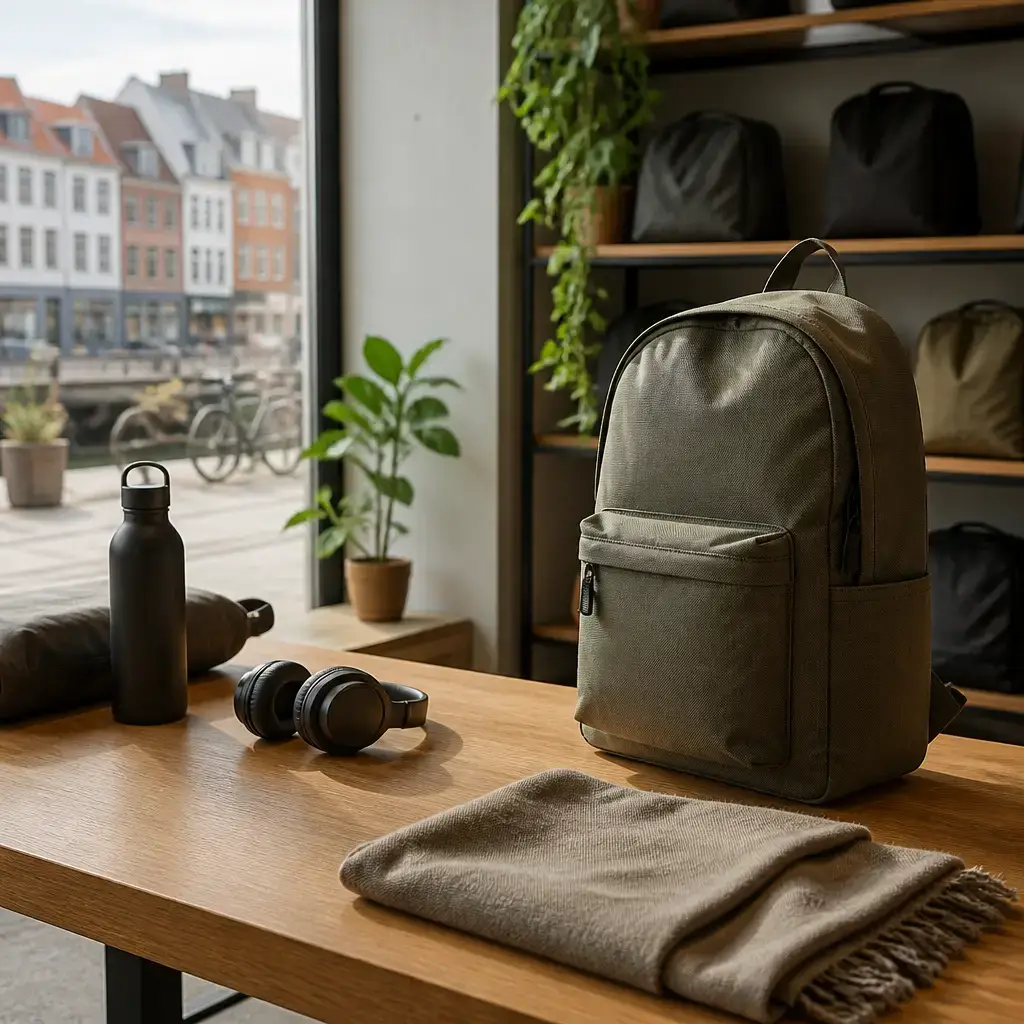
“Rygsækken” means “the backpack” in this dialogue. It refers to the specific backpack being considered, and the definite form is useful when both speakers know which item they mean.
i
The lowercase “i” means “in” in “i butikken”, while the capitalized form “I” begins the sentence “I butikken”. Use “i” with a place to say where something happens.
butikken
“Butikken” means “the shop” in “i butikken”. It refers to the particular shop being visited, and you can use it after “i” to describe being or doing something in the shop.
kan
“Kan” means “can” in “kan du undersøge”. It expresses ability or possibility and is followed by an infinitive when saying what someone can do.
du
“Du” means “you” and addresses the other person directly. It is the subject in “du undersøge” after the modal “kan”, and is useful when giving advice or asking someone to act.
undersøge
“Undersøge” means “examine” or “check” in “kan du undersøge”. It is used after “kan” for a careful inspection, often followed by the thing being checked.
stropperne
“Stropperne” means “the straps” of the backpack. The form refers to the specific straps being inspected, and it can be used as an object after a verb such as “undersøge”.
lynlåsen
“Lynlåsen” means “the zipper” in the shop inspection. It refers to one specific zipper, and it can follow an examination verb when checking how an item works.
og
“Og” means “and” and joins “stropperne, lynlåsen og materialet”. Use it to connect items in a list or link two related actions or descriptions.
materialet
“Materialet” means “the material” of the backpack. It refers to the material of the item being checked, and it can be listed with other parts after an inspection verb.
grundigt
“Grundigt” means “thoroughly” or “carefully” in “undersøge ... grundigt”. It tells how the inspection should be carried out, and you can place it after an action to emphasize a detailed check.
Flere
“Flere” means “several” in “Flere anmeldelser”. It indicates more than one without giving an exact number, and it can come before a plural noun.
anmeldelser
“Anmeldelser” means “reviews” in this dialogue. These are written opinions about the product, and the plural form can be used when referring to comments from multiple customers.
nævner
“Nævner” means “mentions” in “anmeldelser nævner svage lynlåse”. It says that the reviews refer to a particular issue, and it can be followed by the subject being mentioned.
svage
“Svage” means “weak” and describes the zippers in “svage lynlåse”. It is placed before the plural noun to identify their quality, and the same pattern works with other adjective-plus-noun descriptions.
lynlåse
“Lynlåse” means “zippers” in the general plural expression “svage lynlåse”. It refers to more than one zipper, such as several zippers mentioned in reviews.
så
“Så” means “so” and introduces the consequence of the reviews mentioning weak zippers. Use it to connect a reason with the action that follows.
teste
“Teste” means “test” in “jeg vil teste den del”. It names the action the speaker wants to perform after “vil”, specifically checking whether the zipper works well.
den
The lowercase “den” refers to “the part” in “den del”, while the capitalized “Den” refers to “the one” in “Den her”. In both cases it points back to a known item or part instead of repeating the noun.
del
“Del” means “part” in “den del”, referring to the zipper section of the backpack. It is useful when identifying one section of a larger object.
prøv
“Prøv” means “try” as a direct instruction in “Prøv at åbne den”. Use this form when telling someone to attempt an action.
at
“At” marks the infinitive in “at åbne”. It connects the instruction “prøv” with the action to be attempted, and the pattern “prøv at” is used for telling someone to try doing something.
åbne
“Åbne” means “open” in “at åbne den”. It is the action being attempted, and it can be used after “at” when describing what someone should try to do.
et
“Et” means “a” or “one” in the expression “et par gange”. Together with “par”, it forms a small quantity, so it is useful when saying that something should happen a few times.
par
“Par” means “couple” or, in “et par gange”, “a few”. The expression “et par” gives an approximate small number and can be used before a plural noun.
gange
“Gange” means “times” in “et par gange”. It counts how often the action should be repeated, so the phrase is useful when giving a repetition instruction.
Spørg
“Spørg” means “ask” as a direct instruction in “Spørg om reglerne”. Use it when telling someone to request information from another person.
om
“Om” means “about” after “Spørg” in “Spørg om reglerne”. The pattern “spørg om” introduces the information or subject someone wants to ask about.
reglerne
“Reglerne” means “the rules” and refers here to the shop’s exchange policy. The definite form points to the particular rules for exchanging the product, and it follows “om” in the question pattern.
for
“For” means “for” in “reglerne for ombytning”. It links the rules to the activity they regulate, and the pattern can be used for rules for a particular process.
ombytning
“Ombytning” means “exchange” in “reglerne for ombytning”. It refers to replacing the purchased item, especially under a shop’s stated rules.
før
“Før” means “before” in “før du beslutter dig”. It introduces the action that should happen earlier, and it is useful when setting a condition or sequence.
beslutter
“Beslutter” expresses “decide” in the expression “beslutter dig”. Together with “dig”, it describes making a decision, such as deciding which product to choose.
dig
“Dig” means “yourself” in “du beslutter dig”, where it is part of the expression for making a decision. Use this form when the action is directed back to the person making the decision.
her
“Her” means “here” in “Den her”, pointing to the item present in the shop. Use it to identify something located at the speaker’s current place.
føles
“Føles” means “feels” in “Den her føles stærkere”. It describes the impression an object gives through touch or general experience, such as when comparing products in a shop.
stærkere
“Stærkere” means “stronger” and compares the backpack here with another one. Use this comparative form when saying that one item has greater strength than another.
selv
“Selv” means “even” as part of “selv om”, meaning “even though”. This expression introduces a fact that contrasts with the main statement, such as the website being clearer despite the shop item feeling stronger.
hjemmesiden
“Hjemmesiden” means “the website” in this dialogue. It refers to the specific website showing the product options, and it can be the subject of an action such as “viser”.
viser
“Viser” means “shows” in “hjemmesiden viser farvemulighederne”. It describes what the website presents to the viewer, and it can be followed by the information or item being shown.
farvemulighederne
“Farvemulighederne” means “the color options”. It refers to the available colors shown on the website, and it functions as the object of “viser” in the comparison.
tydeligere
“Tydeligere” means “more clearly” in “viser ... tydeligere”. It compares how clearly the website presents the options, and it can modify a verb that describes showing or explaining.
Brug
“Brug” means “use” as an instruction in “Brug hjemmesiden”. Use it when telling someone to make practical use of a tool, source, or place.
til
“Til” expresses purpose in “til at se mulighederne”. The pattern “brug ... til at” explains what something should be used for, here using the website to view the options.
se
“Se” means “see” in “til at se mulighederne”. It names the purpose of using the website, and it follows “at” as the infinitive action.
mulighederne
“Mulighederne” means “the options” in “se mulighederne”. It refers to the particular choices displayed on the website, and it is the object of “se”.
besøget
“Besøget” means “the visit” in “besøget i butikken”. It refers to the specific shop visit, and it can be used as something that helps someone assess a product.
vurdere
“Vurdere” means “assess” or “judge” in “til at vurdere kvaliteten”. It describes forming an opinion about quality, and it follows “til at” when stating the purpose of an action.
kvaliteten
“Kvaliteten” means “the quality” of the product. It is the thing being assessed in “vurdere kvaliteten”, and the definite form refers to the product’s particular level of quality.
Det
“Det” means “that” or “it” in “Det giver mig”. Here it refers to the combined use of the website and the shop visit, and it can point back to an idea just mentioned.
giver
“Giver” means “gives” in “Det giver mig en tydeligere måde”. The pattern “giver nogen noget” describes providing someone with something, here providing a clearer way to compare.
mig
“Mig” means “me” and identifies the person receiving the benefit in “giver mig”. It is used after verbs when the action or result is directed toward the speaker.
en
“En” means “a” in “en tydeligere måde”. It introduces one unspecified way, and it comes before the noun phrase being described.
måde
“Måde” means “way” in “en tydeligere måde at sammenligne dem på”. It describes how an action is carried out, and this construction is useful for explaining a method.
sammenligne
“Sammenligne” means “compare” in “at sammenligne dem”. It names the action of considering two or more things together, and it follows “at” in the phrase describing the way to do this.
dem
“Dem” means “them” in “sammenligne dem”, referring to the products being compared. It is used as the object after a verb when the action concerns several known items.
på
“På” completes the construction “en tydeligere måde at sammenligne dem på”, meaning “a clearer way to compare them”. In this pattern, it marks the way in which the action is carried out and comes at the end of the expression.
Vælg
“Vælg” means “choose” as a direct instruction in “Vælg den”. Use it when telling someone to select one option from several possibilities.
der
“Der” means “that” or “which” in “den, der føles pålidelig”. It introduces the clause describing which one should be chosen, and it links the item to its qualities.
pålidelig
“Pålidelig” means “reliable” in “føles pålidelig”. It describes an item that seems dependable, and it can be used after a verb such as “føles” to give an assessment.
stadig
“Stadig” means “still” in “stadig har den stil”. It shows that the item continues to have the desired style in addition to feeling reliable.
har
“Har” means “has” in “har den stil”. It expresses possession or a characteristic, and it can be followed by the thing or quality an item possesses.
stil
“Stil” means “style” in “den stil, du gerne vil have”. It refers to the visual or personal style the learner wants, and it can be used after “have” to describe what an item possesses.
gerne
“Gerne” expresses “would like to” in “du gerne vil have”. Together with “vil”, it softens the statement into a preference, and the phrase can be used when describing something someone wants.
have
“Have” means “have” in “du gerne vil have”. It is the action after “vil” and refers here to possessing or choosing the style the person wants.