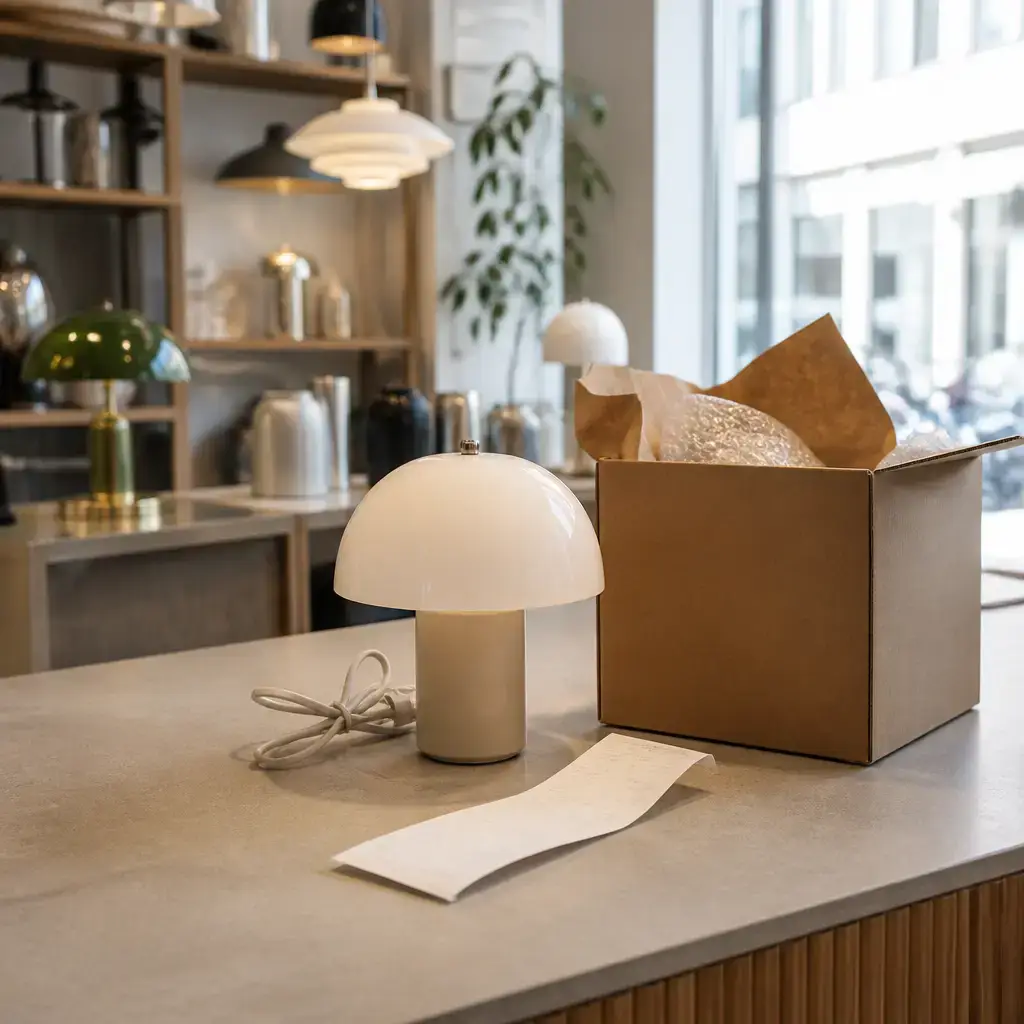
Denne
Denne means “this” in Denne lampe and points to the lamp being discussed. It comes directly before the noun; a reusable pattern is Denne + noun when identifying one specific thing nearby. You could use it when showing a product in a shop.
lampe
lampe means “lamp” in Denne lampe. It is the noun for the faulty item, and it can be used after a demonstrative or article, as in Denne lampe. Use it when describing or asking about a lamp.
holdt
holdt helps express that the lamp stopped functioning in holdt op med at virke. Together with op med at virke, it describes the point when an activity or function ended. This is useful when reporting that a device stopped working.
op
op is part of holdt op med at virke, where it helps express stopping rather than simply meaning “up.” Keep it with holdt op med at virke when saying that something stopped working. Use the construction when reporting a device failure.
med
med is part of the stopping construction holdt op med at virke. Here it connects op with the activity that stopped, so it should be learned as part of the whole expression rather than as “with.” Use this pattern to say that someone or something stopped doing an activity.
at
at introduces virke after holdt op med and marks the activity that stopped. In this dialogue, the exact pattern is holdt op med at virke. Use at before a following verb in this kind of construction.
virke
virke means “work” or “function” in at virke, referring to the lamp functioning properly. It follows at in holdt op med at virke. Use it when describing whether a device or object functions.
efter
efter means “after” in efter kort tid and places the stopping later than a period of time. It comes before the time expression kort tid. Use efter + a time expression to say when something happened.
kort
kort means “short” in kort tid and describes the limited length of the time period. It comes before tid in this expression. Use it with a time noun when saying that a period was brief.
tid
tid means “time” in efter kort tid, referring to a short period before the lamp stopped working. In this expression it follows the adjective kort. Use kort tid when describing a brief period.
Har
Har asks whether someone has something in Har du en kvittering med dig? It is placed at the beginning of the question before du. Use Har du ...? when asking whether someone possesses or has brought something.
du
du means “you” as the person being asked in Har du en kvittering med dig? It follows the question-initial verb Har. Use du when addressing one person directly.
en
en is the indefinite article before kvittering in en kvittering, meaning “a receipt.” It introduces one receipt that has not yet been identified. Use en before a singular noun in a similar indefinite phrase.
kvittering
kvittering means “receipt” in en kvittering. It names the proof of purchase requested by the shop employee. Use it when discussing a receipt for a purchase.
dig
dig means “you” in med dig, referring to the person who has the receipt with them. It follows the preposition med in this expression. Use med dig when asking or saying that someone has something with them.
Jeg
Jeg means “I” and is the speaker of Jeg har kvitteringen og den originale emballage. It functions as the person who has brought or possesses the listed items. Use Jeg + verb to describe your own actions or possessions.
kvitteringen
kvitteringen means “the receipt,” referring to the specific receipt the customer has. The ending makes it the definite form of kvittering, and it follows har in Jeg har kvitteringen. Use this form when the receipt is already identifiable.
og
og means “and” and joins kvitteringen with den originale emballage. It connects two items in the same statement without changing their individual meanings. Use og to link nouns, phrases, or clauses.
den
den marks the packaging as a specific item in den originale emballage. It comes before the adjective originale and the noun emballage. Use den in a similar definite noun phrase when identifying one particular item.
originale
originale means “original” and describes the packaging in den originale emballage. It appears between den and emballage as part of the specific noun phrase. Use it when distinguishing the original packaging from other packaging.
emballage
emballage means “packaging” in den originale emballage. It identifies the material or box that came with the lamp. Use it when discussing packaging brought back with a product.
Så
Så means “then” in Så kan vi tjekke and presents checking as the next step after receiving the receipt. It comes at the start of the sentence before kan. Use Så + sentence to introduce a consequence or next action.
kan
kan means “can” in Så kan vi tjekke, expressing that the shop staff are able to check something. It is followed by vi and the verb tjekke. Use kan + subject + verb when describing ability or possibility.
vi
vi means “we” in Så kan vi tjekke, referring to the shop staff together with the speaker. It follows kan in this question-free statement. Use vi when the speaker includes themself and at least one other person.
tjekke
tjekke means “check” in kan vi tjekke, referring to examining whether a replacement is possible. It follows the modal verb kan. Use kan + tjekke when saying that someone can check something.
om
om introduces the question-like clause in tjekke, om en ombytning er mulig, meaning “whether a replacement is possible.” It follows tjekke and introduces the matter being checked. Use tjekke, om + clause when checking whether something is true or possible.
ombytning
ombytning means “replacement” or “exchange” in en ombytning, referring to exchanging the faulty lamp for another one. It is introduced by en because this is the first mention of the possible exchange. Use it when discussing a product exchange in a shop.
er
er means “is” in en ombytning er mulig and links the replacement with the description mulig. It appears before the adjective in this statement. Use er + adjective to describe a situation or option.
mulig
mulig means “possible” in er mulig, describing the replacement as something that may be available. It follows er in en ombytning er mulig. Use er mulig when discussing whether an action or option can be carried out.
vil
vil expresses the customer’s wish in Jeg vil helst have en ombytning. It comes before the preferred action or outcome. Use Jeg vil ... when stating what you want or intend.
helst
helst means “preferably” or “would rather” in vil helst have en ombytning, showing the customer’s preference. It is placed after vil and before have. Use vil helst + verb when expressing a preferred choice.
have
have means “have” or “get” in vil helst have en ombytning, referring to receiving a replacement. It follows vil and is part of the expression for stating a desired outcome. Use vil have + object when saying what you want to receive or obtain.
st stadig
The supplied unit corresponds to stadig in the dialogue, which means “still” in Jeg har stadig brug for den samme type lampe. It shows that the need continues despite the faulty lamp. Use stadig before the relevant verb phrase when saying that a situation remains true.
brug
brug contributes to the meaning “need” in har brug for, as in har stadig brug for den samme type lampe. The full construction is har brug for + object, not brug alone. Use this pattern when explaining that you need an item or service.
for
for is part of har brug for, the construction meaning “need” in har stadig brug for den samme type lampe. It comes after brug and before the thing that is needed. Keep the object after for in this reusable pattern.
samme
samme means “same” in den samme type lampe and identifies a lamp of the previously mentioned type. It comes before type and is part of the noun phrase. Use samme when referring back to something already identified.
type
type means “type” or “kind” in den samme type lampe, specifying which sort of lamp is needed. It is followed by the noun lampe. Use type + noun when identifying a category or kind of product.
Det
Det refers to the customer’s request or situation in Det lyder rimeligt, meaning “that” or “it.” It serves as the subject of the evaluation. Use Det + verb when commenting on a situation or statement.
lyder
lyder means “sounds” in Det lyder rimeligt, where the speaker evaluates the request as reasonable. It is followed by the describing word rimeligt. Use Det lyder + adjective when giving an impression or reaction.
rimeligt
rimeligt means “reasonable” in Det lyder rimeligt and describes the customer’s request as fair or acceptable. It follows lyder in this evaluation. Use lyder rimeligt when agreeing that a proposal or request seems fair.
bør
bør means “should” in Vi bør teste varen først, expressing a recommendation or appropriate next step. It is followed by the verb teste. Use bør + verb when suggesting what ought to happen.
teste
teste means “test” in bør teste varen først, referring to checking the product before handling the exchange. It follows bør and takes varen as its object. Use bør teste + object when recommending that an item be tested.
varen
varen means “the item” or “the product” in teste varen først, referring to the faulty lamp brought to the shop. The ending makes it a specific item. Use it when referring to a particular product in a shop context.
først
først means “first” in teste varen først and sets the order of actions. It indicates that testing should happen before the exchange is handled. Use it to mark the action that should come before another action.
tog
tog means “took” or “brought” in Jeg tog også kablet med, describing the customer bringing the cable along. With med, it expresses taking something with you. Use took ... med when explaining that an additional item was brought along.
også
også means “also” or “as well” in tog også kablet med, adding the cable to the items already brought. It comes before the object kablet in this sentence. Use også when adding another person, item, or action.
kablet
kablet means “the cable,” referring to the specific cable belonging with the lamp. It is the object of tog ... med. Use this definite form when the cable is identifiable from the product or situation.
hvis
hvis means “if” or “in case” in hvis det hjælper, introducing a possible helpful result. It begins the conditional clause. Use hvis + clause when offering something conditionally or explaining a possible circumstance.
hjælper
hjælper means “helps” in hvis det hjælper, referring to whether bringing the cable is useful for solving the problem. It follows det in the conditional clause. Use hvis det hjælper when offering information or an item that may be useful.
skal
skal expresses what is needed or required in det, vi skal bruge, referring to the items necessary for the check. It is followed by bruge. Use skal bruge + object when saying what someone needs for a task.
bruge
bruge means “use” in det, vi skal bruge, where the full expression means “what we need.” It follows skal and refers to the items required for the task. Use vi skal bruge + object when stating what you need.
bekræfte
bekræfte means “confirm” in for at bekræfte problemet, describing the purpose of having the items available. It follows for at and takes problemet as its object. Use for at bekræfte + object when explaining that something is done to confirm a fact.
problemet
problemet means “the problem,” referring to the lamp’s failure. It is the object of bekræfte and uses the definite form because the problem is already known in the conversation. Use this form when referring to a specific problem under discussion.
gennemføre
gennemføre means “carry out” or “complete” in gennemføre ombytningen, referring to completing the product exchange. It takes ombytningen as its object. Use gennemføre + process or action when saying that a procedure will be completed.
ombytningen
ombytningen means “the replacement” or “the exchange,” referring to the specific exchange discussed earlier. The definite form marks it as the already identified procedure. Use it when referring back to a particular exchange that is being handled.