Gæsterne
“Gæsterne” means “the guests” expected for the dinner. It is the definite plural form related to “gæst” and is the subject of “Gæsterne kan måske komme”. Use it when referring to the guests as a known group.
kan
“kan” expresses possibility here, especially together with “måske” in “Gæsterne kan måske komme”. It is followed by the infinitive “komme”. Use it when saying that an event may happen.
måske
“måske” means “perhaps” and makes the arrival sound possible rather than certain. In “kan måske komme”, it softens the prediction. Use it when you are unsure whether something will happen.
komme
“komme” means “come” or “arrive” in “Gæsterne kan måske komme”. It is the infinitive after “kan”. Use it for someone arriving at a place or event.
mens
“mens” means “while” and connects two events happening at the same time in “mens hovedretten stadig er ved at blive tilberedt”. Use it to describe an action that overlaps with another ongoing situation.
hovedretten
“hovedretten” means “the main course” in this dinner context. It is the definite form related to “hovedret” and is the thing that is still being prepared. Use it when referring to the main dish of a meal.
stadig
“stadig” means “still” and shows that the preparation has not finished in “hovedretten stadig er ved at blive tilberedt”. It highlights that the situation continues at that time. Use it with an ongoing state or activity.
er
“er” means “is” in “er ved at blive tilberedt”. Together with the rest of that expression, it describes the main course as currently in the process of being prepared. Use it to state a current condition or situation.
ved
In “er ved at blive tilberedt”, “ved” is part of the expression for an action that is in progress. It connects “er” with the activity that follows. Use this expression when something is currently being done.
at
“at” introduces the verb phrase “at blive tilberedt” after “ved”. Here it marks the infinitive form that completes the expression for an ongoing process. Use it before an infinitive in this type of construction.
blive
In “at blive tilberedt”, “blive” helps express that the main course is being prepared or cooked. It comes before “tilberedt” in this passive construction. Use it when describing something that undergoes an action.
tilberedt
“tilberedt” means “prepared” or “cooked” in “blive tilberedt”. It describes the preparation of the main course. Use it for food that has been prepared or cooked.
Så
At the beginning of “Så kan du servere”, “Så” means “then” and moves the conversation to a suggested next action. The lowercase form “så” in “så vent” means “so” and introduces a consequence or instruction. Use “Så” to connect a previous point with what should happen next.
du
“du” means “you” and addresses the person responsible for serving in “kan du servere”. It is the person being given the dinner advice. Use it when speaking directly to one person.
servere
“servere” means “serve” in “kan du servere en enkel forret”. It is the infinitive after “kan” and takes “en enkel forret” as its object. Use it when offering food or drinks to guests.
en
“en” introduces the single starter in “en enkel forret”. It appears before the noun phrase describing what will be served. Use it before a singular noun in a phrase such as this one.
enkel
“enkel” means “simple” and describes the starter in “en enkel forret”. It presents the food as uncomplicated and easy to serve. Use it before a noun when describing something as simple.
forret
“forret” means “starter” or “appetizer” in “en enkel forret”. It is the first course suggested for the guests. Use it when talking about the first dish of a meal.
folk
“folk” means “people” in “så folk kan finde sig til rette”. It refers to the dinner guests as a group. Use it when speaking generally about people rather than naming individuals.
finde sig til rette
“finde sig til rette” means “settle in” or “make oneself comfortable”. In this expression, “finde” contributes the idea of finding, “sig” refers back to oneself, and “til rette” completes the idea of becoming comfortably situated. Use the whole expression when guests arrive and begin to feel comfortable.
Jeg
“Jeg” means “I” in “Jeg kan have salat og brød klar”. It identifies the speaker as the person who will prepare the food. Use it as the subject when talking about your own action or responsibility.
have
In “have salat og brød klar”, “have” means to have something available and ready. The food is not merely possessed; it is prepared for use before the guests arrive. Use it when saying that something will be ready at a particular time.
salat
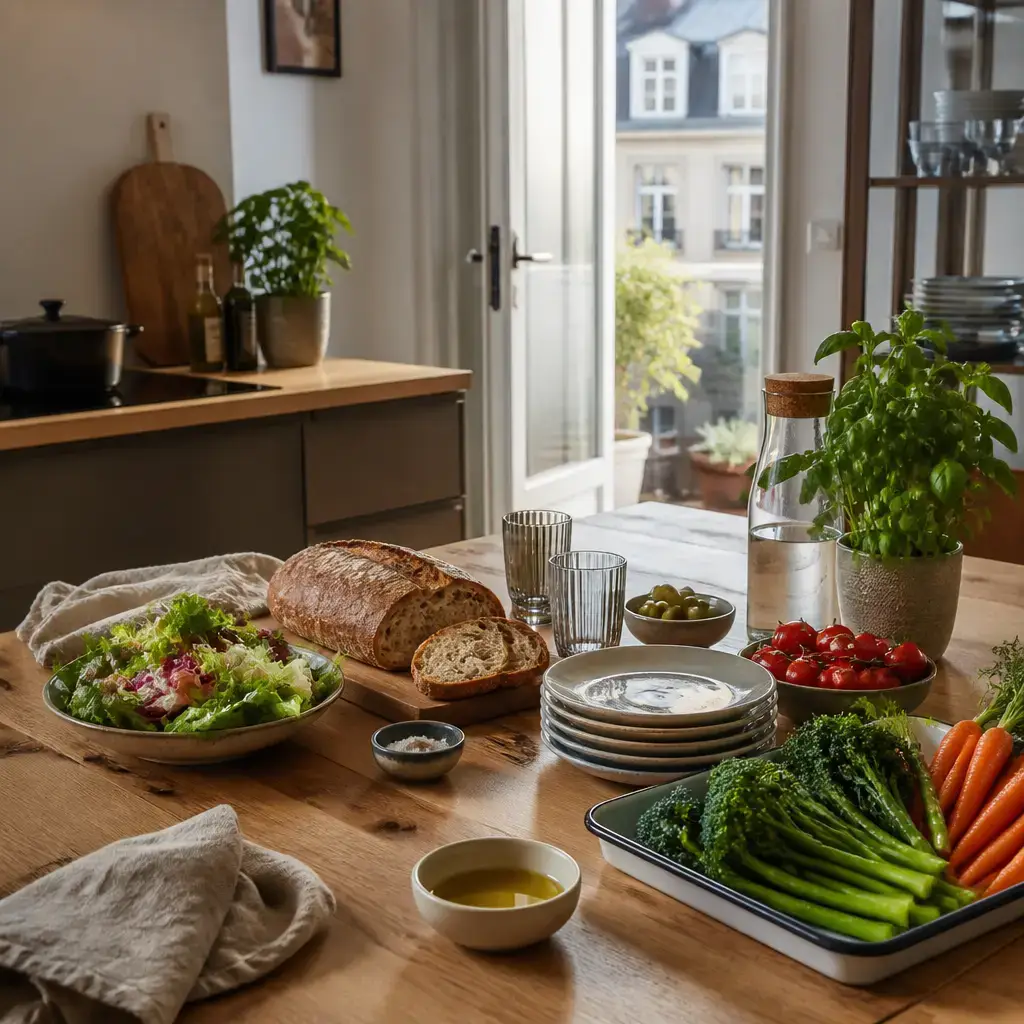
“salat” means “salad” and is one of the foods the speaker will have ready. It appears together with “brød” in “salat og brød”. Use it when referring to salad as part of a meal.
og
“og” means “and” and links “salat” with “brød” in “salat og brød”. It joins two items in the preparation list. Use it to connect words or phrases that belong together.
brød
“brød” means “bread” and is the second food item in “salat og brød”. It is something prepared before the guests arrive. Use it when referring to bread served with a meal.
klar
“klar” means “ready” in “have salat og brød klar”. It describes the condition in which the food should be available. Use it after an object when saying that something is ready for use.
før
“før” means “before” and introduces the time condition in “før de kommer”. It places the preparation earlier than the guests’ arrival. Use it to connect an action with an earlier time.
de
“de” means “they” in “før de kommer”. It refers to the guests who are expected to arrive. Use it as the subject when referring to several people already understood from the context.
kommer
“kommer” means “come” or “arrive” in “før de kommer”. It is the finite form related to “komme” and describes the guests’ arrival. Use it when talking about people arriving somewhere.
Det
“Det” refers to the preceding arrangement in “Det giver hovedretten lidt ekstra tid”. In “Det føles stressende”, the same form means “it” in the statement about hosting. Use it to refer to a situation or idea already mentioned.
giver
“giver” means “gives” in “Det giver hovedretten lidt ekstra tid”. It describes the preparation as providing more time for the main course. It is the present form related to “give”. Use it when one thing provides something to another.
lidt
“lidt” means “a little” in “lidt ekstra tid”. It indicates a small amount of additional time. Use it before an amount or quantity when the amount is limited.
ekstra
“ekstra” means “extra” in “lidt ekstra tid”. It shows that the time is added to the time already available. Use it before something that is additional.
tid
“tid” means “time” in “lidt ekstra tid”. Here it is the time given to the main course while the starter is served. Use it when discussing available time for an action or process.
uden
“uden” means “without” in “uden at det får middagen til at virke forsinket”. It introduces something that does not happen as a result. Use it when describing an action completed without a particular consequence.
får
In “får middagen til at virke forsinket”, “får” means “makes” or “causes”. It connects the situation with the result that the dinner seems delayed. Use “får” in a causative pattern when one thing causes someone or something to do or seem something.
middagen
“middagen” means “the dinner” in “får middagen til at virke forsinket”. It is the meal whose timing should not appear delayed. It is the definite form related to “middag”. Use it when referring to a particular dinner.
virke
“virke” means “seem” or “appear” in “til at virke forsinket”. It describes how the dinner appears to the guests rather than stating that it is actually delayed. Use it when describing an impression or appearance.
forsinket
“forsinket” means “delayed” in “virke forsinket”. It describes the unwanted appearance the serving plan is meant to avoid. Use it for something that seems later than expected.
Skal
“Skal” means “should” or “shall” in the question “Skal jeg tilberede grøntsagerne”. It asks whether the speaker ought to take that action at a certain time. Use “Skal jeg” when asking whether you should do something.
tilberede
“tilberede” means “prepare” or “cook” in “Skal jeg tilberede grøntsagerne”. It is the infinitive after “Skal jeg” and refers specifically to preparing the vegetables. Use it for preparing food, especially as part of cooking.
grøntsagerne
“grøntsagerne” means “the vegetables” in “tilberede grøntsagerne”. It is the definite form related to “grøntsag” and names the food to be cooked. Use it when referring to particular vegetables planned for the meal.
når
“når” means “when” in “når alle er kommet”. It introduces the time at which the vegetables should be prepared. Use it to connect an action with the time another event occurs.
alle
“alle” means “everyone” in “når alle er kommet”. It refers to all the expected guests as a group. Use it when including every person in a group.
kommet
“kommet” means “arrived” in “alle er kommet”. It is the completed form related to “komme” and describes the guests as having arrived. Use it after “er” when stating that the arrival has happened.
smager
“smager” means “taste” in “De smager bedre”. It describes the quality of the vegetables when freshly cooked. It is the present form related to “smage”. Use it when saying how food tastes.
bedre
“bedre” means “better” in “De smager bedre”. It compares the taste with another preparation or timing. Use it when saying that one option gives a better result than another.
frisklavede
“frisklavede” means “freshly prepared” in “når de er frisklavede”. It describes the vegetables when they have just been made. Use it for food whose freshness comes from recent preparation.
vent
“vent” means “wait” in “så vent med at lave dem”. It is an instruction to delay preparing the vegetables. Use it when telling someone not to act until a later time.
med
In “vent med at lave dem”, “med” is part of the expression for delaying an action. It links “vent” with “at lave dem”, meaning to wait before doing that action. Use this pattern when telling someone to postpone an activity.
lave
“lave” means “make” or “prepare” in “at lave dem”. Here it refers to preparing the vegetables. It is the infinitive after “at” and is also used in “at lave mad”. Use it for making or preparing food.
dem
“dem” means “them” in “at lave dem”. It refers to the vegetables and functions as the object of “lave”. Use it when referring back to several things as the object of an action.
næsten
“næsten” means “almost” in “til du næsten skal servere dem”. It indicates that serving time is very near but has not yet arrived. Use it for an event that is close to happening.
føles
“føles” means “feels” in “Det føles stressende”. It describes the speaker’s experience of hosting guests. Use it in statements about how a situation feels.
stressende
“stressende” means “stressful” in “Det føles stressende at have gæster”. It describes hosting as demanding or difficult to manage emotionally. Use it to describe an activity or situation that creates stress.
fordi
“fordi” means “because” and introduces the reason in “fordi det er sværere”. It explains why hosting feels stressful. Use it to give a reason for a statement.
sværere
“sværere” means “harder” or “more difficult” in “sværere ... end at lave mad”. It compares managing the timing with cooking. It is the comparative form related to “svær”. Use it when comparing the difficulty of two activities.
få styr på
“få styr på” means “get control of” or “get a handle on”. In the expression, “få” contributes the idea of getting, “styr” refers to control or order, and “på” completes the relation to what is being managed. Use the whole expression before the thing you want to organize, as in “få styr på tiden”.
tiden
“tiden” means “the time” in “få styr på tiden for det hele”. It refers to the schedule that must be managed for all parts of the dinner. It is the definite form related to “tid”. Use it when referring to a particular schedule or amount of time.
for
“for” means “for” in “tiden for det hele”. It shows what the time concerns: all the parts of the dinner. Use it to connect a time or plan with the activity or things it belongs to.
hele
“hele” means “the whole” or “all of” in “det hele”. It groups all the dinner tasks into one complete set. It is related to “hel”. Use it when referring to an entire situation or collection as one unit.
end
“end” means “than” in the comparison “sværere ... end at lave mad”. It introduces the activity used as the comparison point. Use it after a comparative expression when comparing two things.
mad
“mad” means “food” in “at lave mad”. Together with “lave”, it refers to cooking or preparing food. Use it in this common expression when talking about cooking.
Lav
“Lav” means “make” or “create” in the instruction “Lav en enkel plan”. It tells the listener to create a plan for serving. Use it at the beginning of a direct instruction.
plan
“plan” means “plan” in “Lav en enkel plan for serveringen”. It is the organized sequence for drinks, the starter, and the main course. Use it for an intended order of actions or events.
serveringen
“serveringen” means “the serving” or “the service” in “plan for serveringen”. It refers to the order in which the meal will be served. It is the definite form related to “servering”. Use it when discussing how food or drinks are served.
drikkevarer
“drikkevarer” means “drinks” or “beverages” in the serving list. It is the first category in “drikkevarer, forret og så hovedret”. It is the plural form related to “drikkevare”. Use it when referring generally to drinks served at a meal.
hovedret
“hovedret” means “main course” in the list “forret og så hovedret”. It names the final course in the suggested serving order. Use it as a meal-course term when listing or discussing the main dish.
den
In “den tjekliste”, “den” points to the checklist being kept near the stove. In “Den burde hjælpe dig”, the capitalized form refers back to that checklist and means “it”. Use it to identify or refer back to a particular item.
tjekliste
“tjekliste” means “checklist” in “den tjekliste”. It is the written list the speaker plans to keep nearby. Use it for a list of items or actions to check during a task.
liggende
In “have den tjekliste liggende”, “liggende” describes the checklist as kept lying or placed in a particular location. It helps express that the checklist remains available by the stove. Use it when describing something being kept in a place.
komfuret
“komfuret” means “the stove” in “ved komfuret”. It is the place where the checklist will be kept during cooking. It is the definite form related to “komfur”. Use it when referring to a particular stove.
burde
“burde” means “should” or “ought to” in “Den burde hjælpe dig”. It expresses an expected helpful result rather than a firm command. Use it before an infinitive when saying what is expected to happen.
hjælpe
“hjælpe” means “help” in “burde hjælpe dig med at holde fokus”. It describes the checklist’s intended benefit for the speaker. Use it in the pattern “hjælpe” someone “med at” do something.
dig
“dig” means “you” in “hjælpe dig”. It is the person who receives the help from the checklist. Use it when “you” is the object of an action.
holde
“holde” means “keep” or “maintain” in “holde fokus”. It describes maintaining attention during the dinner preparations. Use it in this expression when staying attentive to a task.
fokus
“fokus” means “focus” in “holde fokus”. It is the attention the checklist should help the speaker maintain while people arrive. Use it with “holde” when talking about staying concentrated.