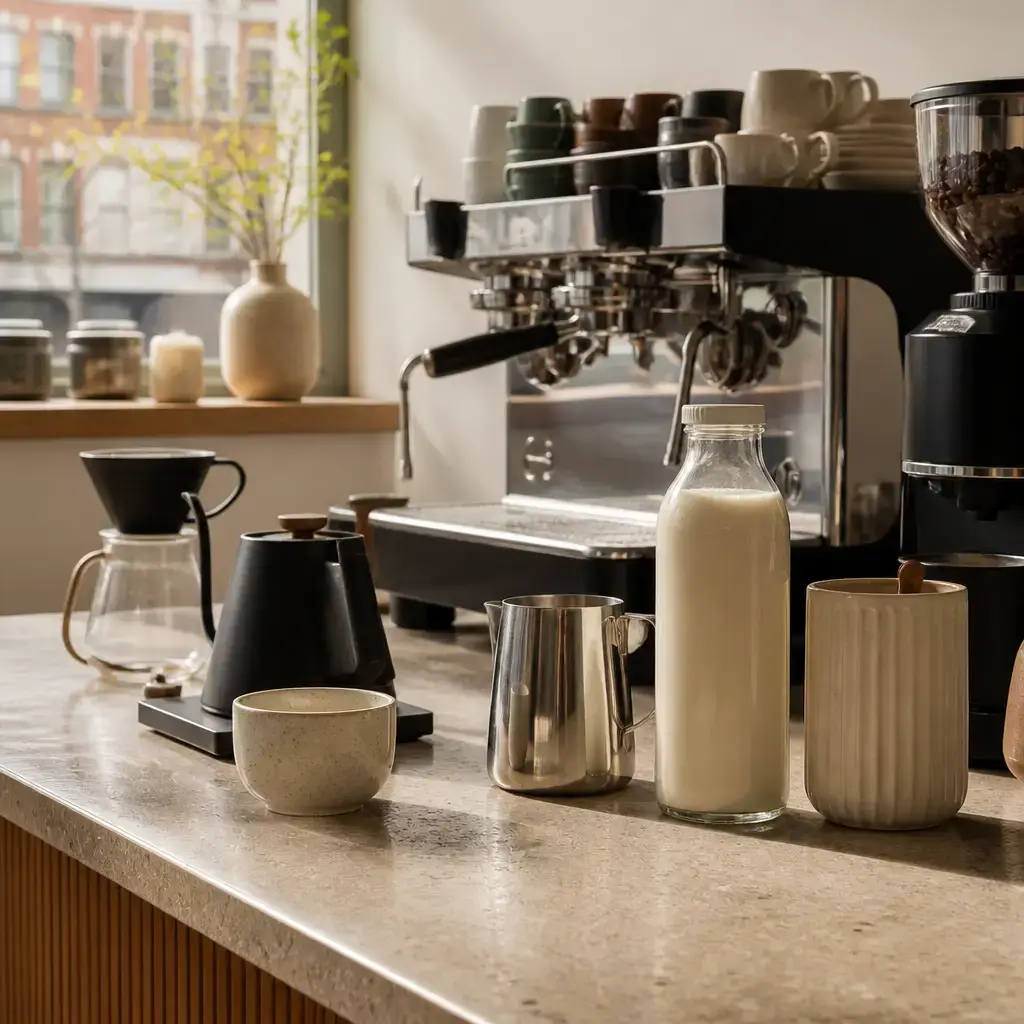
About This Lesson
Use Ordering a latte and checking milk options to practice Danish conversation, pronunciation, vocabulary, grammar, and quizzes.
Dialogue
A
Må jeg få en latte med havremælk, hvis du har det?
moh yai foh en LAH-deh meh HOW-reh-melk, ves doo hah deh? Could I have a latte with oat milk if you have it?
B
Det har vi. Vil du have den sædvanlige mængde skum?
deh hah vee. vel doo HAY-vah den SED-vahn-lee MENG-uh skoom? We do. Would you like the usual amount of foam?
A
Mindre skum ville være bedre. Jeg undgår almindelig mælk i dag.
MEN-druh skoom VEL-uh VAIR BED-uh. yai oon-GOH AL-men-lee melk ee DAI. Less foam would be better. I'm avoiding regular milk today.
B
Jeg laver den med mindre skum.
yai LAY-vuh den meh MEN-druh skoom. I'll make it with less foam.
A
Det er alt, hvad jeg har brug for.
deh air ALT, vah yai hah broo for. That's all I need.
B
Jeg laver den nu og tjekker etiketten, før jeg giver dig den.
yai LAY-vuh den NOO oh CHEK-uh eh-TEE-duh, fur yai GEE-vuh dai den. I'll prepare it now and check the label before I hand it over.Word by Word
Må
Må asks for permission in the polite request Må jeg få en latte med havremælk...? It is used here at the beginning of a request to a café worker; the full request expresses the desired action.
jeg
jeg means I and identifies the customer as the person making the request in Må jeg få en latte...? It is used as the subject before the request verb, a common pattern when asking for something.
få
få contributes the idea of getting or receiving in Må jeg få en latte...? Together with Må jeg, it forms a polite request for an item. This is useful when ordering or asking whether you may receive something.
en
en introduces latte as one nonspecific item in en latte. It comes directly before the noun in this order, as in an order for one café drink.
latte
latte names the drink the customer wants in en latte. It is used as the ordered item after få and can be used when specifying a coffee order.
med
med means with and adds the requested milk option in med havremælk. It commonly introduces an ingredient or accompanying feature when ordering food or drinks.
havremælk
havremælk means oat milk and specifies the milk used in the latte. It is the object after med, so this form is useful when asking for a drink with a particular milk option.
hvis
hvis means if and introduces the condition in hvis du har det. It is useful when making a request that depends on availability, such as asking for an option only if the café has it.
du
du means you and refers to the café worker in hvis du har det. It is the subject of the availability clause and is used when addressing one person directly.
har
har means have in hvis du har det, where it asks whether the café worker has the requested option available. It follows du in the clause and is useful for checking availability.
det
det refers back to the requested option in hvis du har det, meaning it in this context. The same form also refers back to that option in Det har vi, so it is useful for referring to something already mentioned.
vi
vi means we and refers to the café staff in Det har vi. It is the subject of the reply confirming availability and is used when a speaker represents a group or business.
Vil
Vil introduces the café worker’s polite question about the customer’s preference in Vil du have den sædvanlige mængde skum? It comes before du and the following verb in this question pattern, used when asking what someone would like.
have
have contributes the idea of having or receiving in Vil du have den sædvanlige mængde skum? It follows Vil in the question and helps ask about the customer’s preferred amount.
den
den identifies the specific amount being discussed in den sædvanlige mængde skum. It belongs with the following noun phrase and is useful when referring to a particular item or amount.
sædvanlige
sædvanlige means usual in den sædvanlige mængde skum. It describes the amount of foam that normally comes with the drink and is useful for asking about a standard option.
mængde
mængde means amount and names the quantity being discussed in den sædvanlige mængde skum. It is followed by what is being measured, skum, and is useful when specifying quantities.
skum
skum means foam and refers to the foam on the latte in mængde skum and mindre skum. It is used after an amount word when discussing how much foam a drink should contain.
Mindre
Mindre means less in Mindre skum ville være bedre and specifies a reduced amount of foam. It comes directly before skum and is useful when changing the amount of an ingredient or feature.
ville
ville expresses would in Mindre skum ville være bedre, presenting the customer’s preference as a polite assessment. It is used with være and is useful when suggesting that one option would be better.
være
være means be in Mindre skum ville være bedre and links the requested amount to the evaluation bedre. It follows ville in this conditional-sounding preference statement and is useful for describing what an option would be.
bedre
bedre means better and evaluates mindre skum as the preferred option. It comes after være in this statement and is useful when politely comparing a requested option with the usual one.
undgår
undgår means avoid in Jeg undgår almindelig mælk i dag. It states the customer’s current choice not to use regular milk and is useful for explaining a food or drink restriction.
almindelig
almindelig means regular or ordinary in almindelig mælk. It distinguishes the milk mentioned here from the requested oat milk and is useful when identifying the standard version of an ingredient.
mælk
mælk means milk in almindelig mælk. It is the item being avoided today and can be specified with a describing word when discussing drink ingredients.
i
i means in as part of the time expression i dag. Together with dag, it places the customer’s choice within the current day and is useful in expressions referring to a time period.
dag
dag means day in i dag, which means today in this dialogue. It completes the time expression after i and is useful when stating that a choice or situation applies today.
laver
laver means make or prepare in Jeg laver den med mindre skum and Jeg laver den nu. It describes the barista preparing the latte and is useful for saying what someone is preparing.
er
er means is in Det er alt, hvad jeg har brug for. It links Det to the statement about what the customer needs and is useful for identifying or describing something.
alt
alt means all or everything in Det er alt, hvad jeg har brug for. It marks the complete amount of what the customer needs and is useful when saying that nothing more is required.
hvad
hvad introduces the part after alt in alt, hvad jeg har brug for, referring to what the customer needs. The whole expression means all that I need, and this form is useful for connecting an amount such as alt with its content.
brug
brug is part of the expression har brug for in hvad jeg har brug for, which means need in this dialogue. The full expression keeps for after brug and is useful for stating that someone needs a particular thing.
for
for completes har brug for, the expression meaning need in hvad jeg har brug for. It comes after brug and before the thing needed in this construction, so it should be retained when reusing the expression.
nu
nu means now in Jeg laver den nu and places the preparation at the present moment. It is useful when saying that an action is happening immediately or at this time.
og
og means and and links the two actions in Jeg laver den nu og tjekker etiketten. It is used between coordinated actions and is useful for describing steps that happen together or in sequence.
tjekker
tjekker means checks in tjekker etiketten and describes the barista examining the label. It comes before the object etiketten and is useful when verifying information on packaging.
etiketten
etiketten means the label in tjekker etiketten. The form refers to a specific label, namely the one the barista checks before handing over the drink, and is useful when checking product information.
før
før means before and introduces the timing condition in før jeg giver dig den. It places checking the label before handing over the latte and is useful for ordering two actions in time.
giver
giver means gives or hands over in jeg giver dig den. It describes the barista transferring the prepared drink to the customer and is useful when stating that someone hands an item to another person.
dig
dig means you as the person receiving the drink in jeg giver dig den. It follows giver and identifies the recipient, a useful position when describing handing something to someone.
Grammar Points
have brug for + substantiv
har brug for havremælk
hah broo for HOW-reh-melkneed oat milk
Danish expresses “need” with the fixed phrase have brug for, followed by the thing needed.
Danish Vocabulary
almindelig
adj
AL-men-lee
regular; ordinary
bedre
adj
BED-uh
better
få
verb
foh
get; have
have
verb
HAY-vah
have
har
havremælk
noun
HOW-reh-melk
oat milk
hvis
conj
ves
if
latte
noun
LAH-deh
latte
mindre
adj
MEN-druh
less
Mindre
mængde
noun
MENG-uh
amount
skum
noun
skoom
foam
sædvanlig
adj
SED-vahn-lee
usual
sædvanlige
undgå
verb
oon-GOH
avoid
undgår
Quiz
Word Order
Arrange the words in the correct order.
I'll make it with less foam.
Show Answer
Jeg laver den med mindre skum.Spelling
Tap the letters to spell the word.
amount
Show Answer
mængdeusual
Show Answer
sædvanligeless
Show Answer
Mindrefoam