Næste
“Næste” means next in “Næste uge”, referring to the week after the current one. It is used directly before a time expression such as “Næste uge”.
uge
“Uge” means week in “Næste uge”. It names a period of seven days and commonly follows a word describing which week, such as “Næste”.
ser
“Ser” means looks or seems in “ser travl ud”. Together with “ud”, it describes how something appears. A reusable pattern is “ser ... ud”, followed by a description.
travl
“Travl” means busy in “ser travl ud”, describing the coming week. It can be used after “ser ... ud” to describe how a period or situation appears.
ud
“Ud” is the particle that completes “ser travl ud”, giving the meaning looks or seems busy. The reusable expression is “ser ... ud”, with the description placed between “ser” and “ud”.
så
In “så det ville hjælpe”, “så” means so and introduces the result of the week looking busy. In “så det er nemt at vælge”, it means so that and introduces a purpose or intended result.
det
In “det ville hjælpe”, “det” means it and refers to preparing meals in advance as a helpful measure. In “Det fungerer”, the capitalized form means that or it and refers to the suggested meal-preparation plan.
ville
“Ville” presents the result as a hypothetical or suggested outcome in “det ville hjælpe”. The pattern “det ville hjælpe at ...” is useful when explaining what would be helpful.
hjælpe
“Hjælpe” means help in “det ville hjælpe at tilberede nogle måltider”. It follows “ville” here, and the pattern “ville hjælpe at ...” introduces an action considered helpful.
at
The first “at” introduces the action “tilberede” after “ville hjælpe”. It also introduces “spise” in “at spise” and commonly comes directly before the verb in these constructions.
tilberede
“Tilberede” means prepare or cook in “at tilberede nogle måltider”. It is used for preparing food and is followed here by the object “nogle måltider”.
nogle
“Nogle” means some in “nogle måltider”. It indicates an unspecified amount and is placed before the food items being prepared.
måltider
“Måltider” means meals in “nogle måltider”. It is the object of “tilberede” and refers to the food prepared for the busy week.
på forhånd
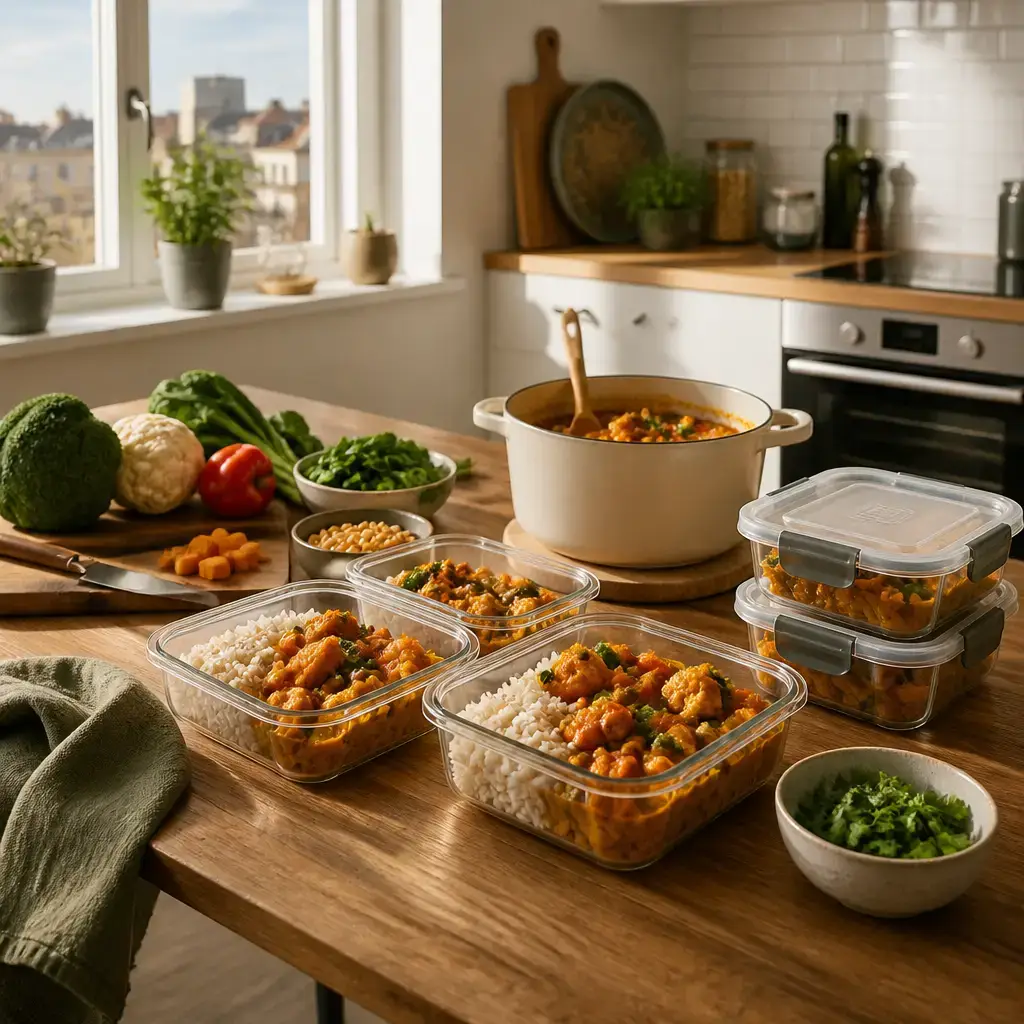
“På forhånd” means in advance in both “tilberede nogle måltider på forhånd” and “Madlavning på forhånd”. The whole expression describes doing the preparation before it is needed; “på” and “forhånd” work together in this fixed expression.
Madlavning
“Madlavning” means cooking or meal preparation in “Madlavning på forhånd”. It names the activity being planned and can be combined with “på forhånd” to describe preparing food early.
vil
“Vil” means will in “Madlavning på forhånd vil hjælpe”, presenting meal preparation as something that will be helpful. It is followed here by “hjælpe” to describe the expected result.
men
“Men” means but and introduces a limitation to the suggestion in “vil hjælpe, men undgå ...”. It links two contrasting pieces of advice.
undgå
“Undgå” means avoid in “undgå at spise det samme hver dag”. It gives advice not to do the action introduced by “at spise”.
spise
“Spise” means eat in “at spise det samme hver dag”. It follows “at” after “undgå”, and the reusable pattern is “undgå at spise ...”.
samme
“Samme” means same in “det samme”. It shows that the food is identical to what was already mentioned, and it commonly appears with “det” before the thing being referred to.
hver
“Hver” means each or every in “hver dag”. It describes the repeated time unit and comes directly before “dag” in this expression.
dag
“Dag” means day in “hver dag”. The expression “hver dag” means every day and describes how often the same food should not be eaten.
Jeg
“Jeg” means I in “Jeg tænkte på ...” and “Jeg har også brug for ...”. It identifies the speaker as the person thinking about the meal and needing lunch.
tænkte
“Tænkte” means thought or was thinking in “Jeg tænkte på at lave ...”. The pattern “tænkte på at ...” introduces an idea the speaker was considering.
på
In “tænkte på at lave”, “på” connects the thought to the action being considered. It also appears in the fixed expression “på forhånd”, meaning in advance; the meaning depends on the expression it forms.
lave
“Lave” means make in “at lave en stor portion grøntsagscurry”. It follows “at” and takes the food being made as its object.
en
“En” means a in “en stor portion”. It introduces one unspecified portion and comes before the description “stor” and the noun “portion”.
stor
“Stor” means big or large in “en stor portion”. It describes the size of the portion and is placed before “portion”.
portion
“Portion” means portion or batch in “en stor portion grøntsagscurry”. It refers to an amount of prepared food and is followed by the food it contains.
grøntsagscurry
“Grøntsagscurry” means vegetable curry in “en stor portion grøntsagscurry”. It names the dish being made and specifies what the portion consists of.
fungerer
“Fungerer” means works in “Det fungerer”. It says that the suggested plan is suitable or effective, and it can be followed by an explanation introduced with “hvis”.
hvis
“Hvis” means if in “hvis du fordeler den ...” and introduces the condition under which the plan works. It is placed at the beginning of the conditional clause here.
du
“Du” means you in “hvis du fordeler den ...” and “opbevarer den sikkert”. It identifies the person carrying out the portioning and storing.
fordeler
“Fordeler” means distributes or portions out in “fordeler den i passende portioner”. It describes dividing the curry into portions and is followed by what is divided and the resulting portions.
den
“Den” refers to the curry in “fordeler den” and “opbevarer den sikkert”. It avoids repeating the dish and functions as the object of both actions.
i
“I” means into in “i passende portioner”, showing where the curry is divided. It introduces the portions that receive the food.
passende
“Passende” means suitable or appropriate in “passende portioner”. It describes portions that have an appropriate size for storing the meal.
portioner
“Portioner” means portions in “fordeler den i passende portioner”. It names the separate amounts into which the curry is divided.
og
“Og” means and in “fordeler den ... og opbevarer den sikkert”. It joins the two actions that make the meal-preparation plan work.
opbevarer
“Opbevarer” means stores or keeps in “opbevarer den sikkert”. It describes keeping the prepared food in a safe place and takes “den” as its object.
sikkert
“Sikkert” means safely in “opbevarer den sikkert”. It describes how the food should be stored and follows the storage verb.
Skal
“Skal” asks whether something should be done in “Skal jeg fryse noget af det ned ...?”. The pattern “Skal jeg ...?” is useful for asking for advice or permission about an action.
fryse
“Fryse” means freeze in “fryse noget af det ned”. It describes putting some of the food in frozen storage and is completed by the particle “ned” here.
noget
“Noget” means some or something in “noget af det”. Together with “af det”, it refers to an unspecified part of the prepared food.
af
“Af” means of or from in “noget af det”, marking a part taken from the whole. The reusable pattern is “noget af ...” when referring to some part of something.
ned
“Ned” is the particle in “fryse noget af det ned”, completing the idea of freezing food down for storage. It belongs to the action phrase with “fryse” rather than describing the food itself.
opbevare
“Opbevare” means store or keep in “opbevare resten i køleskabet”. It is used after “skal jeg” and takes “resten” as the thing being stored.
resten
“Resten” means the rest in “opbevare resten i køleskabet”. It refers to what remains after some of the food has been frozen.
køleskabet
“Køleskabet” means the fridge or refrigerator in “i køleskabet”. It names the place where the remaining food should be stored, following “i”.
Frys
“Frys” gives the direct instruction freeze in “Frys nogle få portioner ned”. It is used at the start of advice or an instruction, followed by the portions to freeze.
få
“Få” means a few in “nogle få portioner”. Together, “nogle få” refers to a small number of portions, not all of them.
Mærk
“Mærk” means label or mark in “Mærk hver beholder”. It gives an instruction to put identifying information on each container.
beholder
“Beholder” means container in “hver beholder”. It refers to the item holding each food portion and follows the word “hver”.
er
“Er” means is in “det er nemt at vælge”. It connects the situation with the description “nemt” and introduces what is easy.
nemt
“Nemt” means easy in “det er nemt at vælge”. The pattern “det er nemt at ...” describes an action that can be done without difficulty.
vælge
“Vælge” means choose in “at vælge”. It names the action made easy by labeling the containers and follows “at” in the expression “det er nemt at vælge”.
har
“Har” means have in “Jeg har også brug for ...”. With “brug for”, it forms the expression for needing something.
også
“Også” means also in “Jeg har også brug for ...”. It adds the need for a balanced lunch to the other meal-preparation needs.
brug for
“Brug for” means need in “har også brug for noget afbalanceret”. The whole expression is used in “have brug for + noun”; “brug” contributes the idea of need and “for” links it to what is needed.
afbalanceret
“Afbalanceret” means balanced in “noget afbalanceret til frokost”. It describes the kind of food wanted for lunch and follows “noget”.
til
In “til frokost”, “til” means for and connects the food with its intended meal. It also appears in “lyst til at spise”, where it is part of the expression for feeling like doing something.
frokost
“Frokost” means lunch in “til frokost”. It identifies the meal for which the balanced food is needed and follows “til”.
ikke
“Ikke” means not in “ikke bare ris”. It negates the idea that rice alone is enough and is placed before the phrase being limited.
bare
“Bare” means just or only in “ikke bare ris”. Together, “ikke bare” means not only, showing that lunch should contain more than rice.
ris
“Ris” means rice in “ikke bare ris”. It names one food that should not be the only part of the lunch.
Tilføj
“Tilføj” means add in “Tilføj æg, bønner eller kylling”. It gives an instruction to include one or more additional foods.
æg
“Æg” refers to eggs in “Tilføj æg”. It is one of the foods suggested as an addition to the lunch.
bønner
“Bønner” means beans in “Tilføj ... bønner”. It names another possible food to add to the lunch.
eller
“Eller” means or in “æg, bønner eller kylling”. It presents alternatives among the foods that can be added.
kylling
“Kylling” means chicken in “Tilføj ... kylling”. It is one possible addition to make the lunch more balanced.
alt efter
“Alt efter” means depending on in “alt efter hvad du har lyst til at spise”. The whole expression introduces a choice that changes according to what the person wants to eat; “alt” and “efter” work together in this construction.
hvad
“Hvad” means what in “hvad du har lyst til at spise”. It introduces the thing that determines which food should be added.
lyst til
“Lyst til” expresses feeling like doing something in “har lyst til at spise”. “Lyst” contributes the desire, while “til” links that desire to the following action; the reusable pattern is “have lyst til at” plus a verb.
resterne
“Resterne” means the leftovers in “Hvis resterne virker kedelige”. It refers to the prepared food remaining after an earlier meal.
virker
“Virker” means seem or feel in “virker kedelige”. It describes the speaker’s impression of the leftovers and is followed by the description “kedelige”.
kedelige
“Kedelige” means boring in “virker kedelige”. It describes how the leftovers seem and follows “virker”.
kan
“Kan” means can in “kan jeg ændre tilbehøret”. It presents the speaker’s ability or possibility to change the side dish.
ændre
“Ændre” means change in “ændre tilbehøret”. It describes making the side dish different and takes “tilbehøret” as its object.
tilbehøret
“Tilbehøret” means the side dish or accompaniment in “ændre tilbehøret”. It refers to the food served alongside the main part of the meal.
Små
“Små” means small in “Små ændringer”. It describes changes that are limited rather than major and comes directly before “ændringer”.
ændringer
“Ændringer” means changes in “Små ændringer”. It refers to modifications such as changing the side dish to make prepared meals more enjoyable.
gør
“Gør” means make in “gør det sjovere at spise måltider ...”. The pattern “gør ... sjovere” describes something causing an activity to become more enjoyable.
sjovere
“Sjovere” means more enjoyable in “gør det sjovere at spise”. It expresses an increased level of enjoyment and follows “gør det” in this construction.
der
“Der” means that or which in “måltider, der er lavet på forhånd”. It introduces the information describing which meals are meant.
lavet
“Lavet” means made or prepared in “er lavet på forhånd”. It describes the meals as already prepared in advance and appears with “er” in the relative clause.