Der
In “Der er travlt i det fælles vaskerum i dag”, “Der” introduces the statement that the laundry room is busy. In “tøj, der bliver liggende i maskinen”, “der” introduces the clause describing the clothes.
er
“Er” states that something exists or is the case, as in “Der er travlt” and “Der er en ledig vaskemaskine”. It is the present form of “være” and is commonly used in “Der er” to say that something is available or happening.
travlt
“Travlt” describes the laundry room as busy in “Der er travlt i det fælles vaskerum i dag”. The pattern “Der er travlt i ...” is useful when a place has a lot of activity.
i
“I” means in and places the activity inside “det fælles vaskerum”. It is commonly used before a place, as in “i maskinen” later in the dialogue.
det
In “det fælles vaskerum”, “det” means the and accompanies the noun phrase. In “Det burde få det hele til at fungere godt”, “Det” refers to the situation or the actions just discussed.
fælles
“Fælles” means shared and describes the laundry room in “det fælles vaskerum”. It is used before a noun when something belongs to or is used by several people.
vaskerum
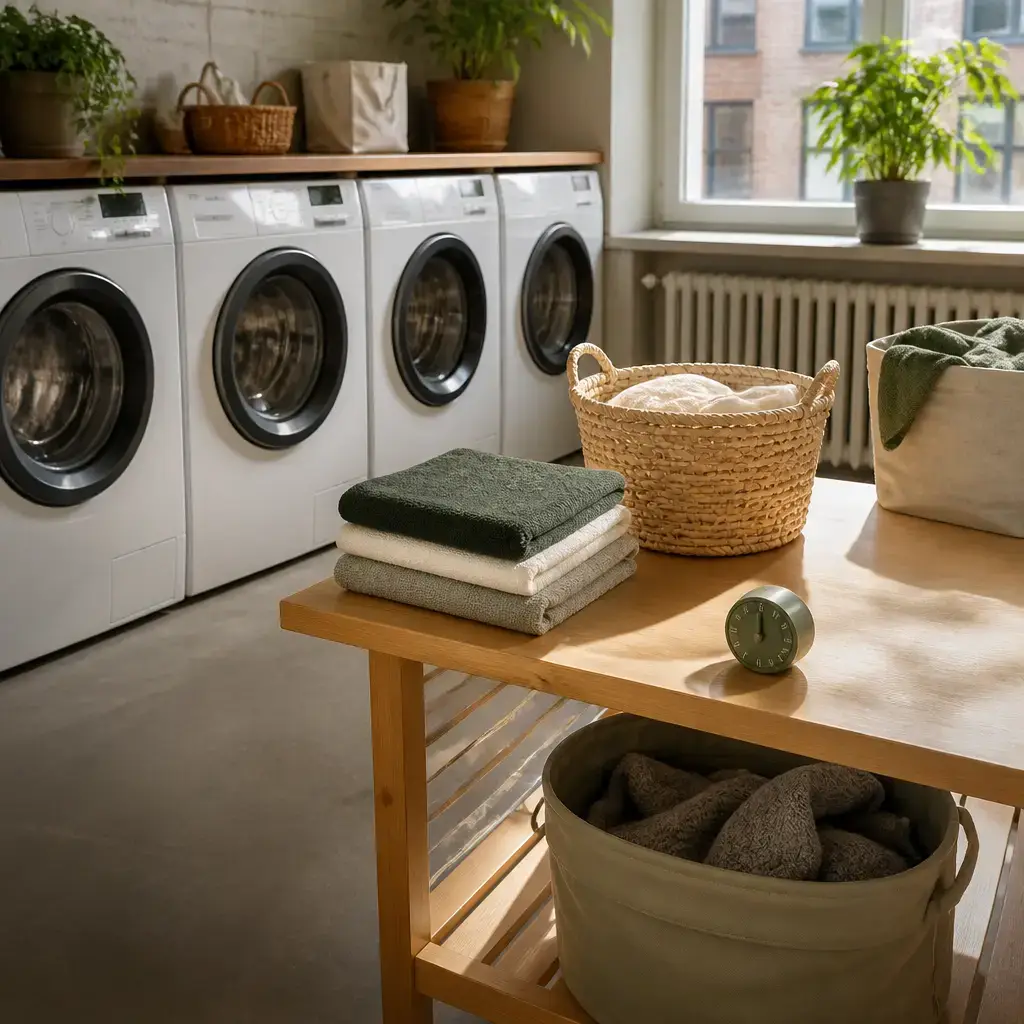
“Vaskerum” means laundry room, the shared place where the washing machines are located. The word is used as the place after “i” in “i det fælles vaskerum”.
dag
“Dag” means day, and in “i dag” the whole expression means today. “I dag” is a common time expression for saying when something is happening.
Skriv
“Skriv” tells someone to write or put something in writing, here in “Skriv dit navn på planen”. It is the command form of “skrive” and can be followed by the thing to write.
dit
“Dit” means your in “dit navn”. It is used with this noun in the reusable pattern “dit navn” when asking someone to identify something as theirs.
navn
“Navn” means name and is the information that should be written on the schedule in “Skriv dit navn på planen”. The pattern “skrive dit navn på ...” is useful when adding your name to a list or document.
på
“På” means on and shows where the name should be written: “på planen”. It is commonly used with a surface, list, or document where information is placed.
planen
“Planen” means the schedule in this dialogue, specifically the laundry-use schedule. It is the definite form related to “plan”, and “på planen” means on the schedule.
før
“Før” means before and introduces the action that must happen earlier in “før du starter en vask”. It is commonly followed by a clause describing what happens before another action.
du
“Du” means you and is the subject of “starter” in “før du starter en vask”. The pattern “før du” is used to tell someone what should happen before they do something.
starter
“Starter” means starts in “før du starter en vask”. It is the present form of “starte”, and “du starter” identifies the person beginning the wash.
en
“En” means a in “en vask” and introduces one unspecified wash or laundry load. It is used before this noun in the pattern “starte en vask”.
vask
“Vask” means a wash or laundry load in “starte en vask”. The expression “starte en vask” is used when beginning a washing-machine cycle.
ledig
“Ledig” means available or free in “en ledig vaskemaskine”. It describes the machine as not currently being used, and it comes before the noun it describes.
vaskemaskine
“Vaskemaskine” means washing machine in “en ledig vaskemaskine”. The phrase “en ledig vaskemaskine” is useful when talking about a machine that can be used.
senere
“Senere” means later in “senere i eftermiddag”. It places the available time after the present moment and can be combined with another time expression.
eftermiddag
“Eftermiddag” means afternoon in “i eftermiddag”, which means this afternoon. The pattern “senere i eftermiddag” gives a later time within that part of the day.
Sæt
“Sæt” means set in the instruction “Sæt en timer”. It is the command form of “sætte” and is followed here by the thing being set.
timer
“Timer” means timer in “en timer”, referring to a device or countdown that gives a reminder. The common expression “sætte en timer” means to set a timer.
Så
In “Så den næste person ikke skal vente”, “Så” introduces the intended result or purpose of setting a timer. In “så snart vasken er færdig”, it is part of the time expression meaning as soon as.
den
“Den” means the in “den næste person”. It comes before this singular noun phrase and helps identify the particular next person in the shared laundry room.
næste
“Næste” means next and identifies the person who will use the machine after the current user. The pattern “den næste person” is useful when referring to the following person in a sequence.
person
“Person” means person in “den næste person”. Here it refers to the next user of the washing machine, and the phrase “den næste person” identifies that user.
ikke
“Ikke” means not and makes “skal vente” negative in “ikke skal vente”. It commonly appears before the verb phrase that is being negated.
skal
“Skal” expresses what someone is expected or required to do in “ikke skal vente”. It is followed by the infinitive “vente” in the reusable pattern “skal vente”.
vente
“Vente” means wait in “ikke skal vente”. It follows “skal”, and “skal vente” describes whether someone is expected to wait.
jeg
“Jeg” means I and is the subject in both “Skal jeg flytte mit tøj” and “Jeg tager min kurv med ned”. It identifies the speaker as the person asking or taking action.
flytte
“Flytte” means move in “Skal jeg flytte mit tøj”. It is used after “Skal jeg” and takes “mit tøj” as the thing being moved.
mit
“Mit” means my in “mit tøj”. It identifies the clothes as belonging to the speaker and is used directly before this noun.
tøj
“Tøj” means clothes or clothing in “mit tøj”. In this dialogue it is the laundry being moved from the machine, and it also appears in “vådt tøj”.
snart
“Snart” means soon and appears in the time expression “så snart vasken er færdig”. The whole expression means as soon as, introducing an event that should happen immediately after another event.
vasken
“Vasken” means the wash or washing cycle in “så snart vasken er færdig” and “før vasken er færdig”. It is the definite form related to “vask” and refers to the particular cycle being discussed.
færdig
“Færdig” means finished in “vasken er færdig”. The pattern “er færdig” is used to say that an activity or process has ended.
Ja
“Ja” is an affirmative yes in “Ja, gør det”. It confirms the question about moving the clothes and can introduce a direct response or instruction.
gør
“Gør” means do in “Ja, gør det”, referring back to the action of moving the clothes. It is the command form of “gøre” and is used here with “det” for the previously mentioned action.
vådt
“Vådt” means wet and describes the clothes in “vådt tøj”. The pattern “vådt tøj” is useful when talking about clothing that has just come out of washing.
bliver
“Bliver” helps express that the clothes remain in place in “der bliver liggende i maskinen”. It is the present form of “blive”, and the pattern “bliver liggende” describes something that stays where it is.
liggende
“Liggende” describes the clothes as lying or being left in place in “der bliver liggende i maskinen”. Together with “bliver”, it forms the reusable pattern “bliver liggende” for something that remains where it was put.
maskinen
“Maskinen” means the machine in “i maskinen”, referring here to the washing machine. It is the definite form related to “maskine”, and “i maskinen” means in the machine.
får
“Får” means causes or makes in “får alle til at vente”. It is the present form of “få” and appears in the pattern “får nogen til at ...” when one situation causes someone to do something.
alle
“Alle” means everyone or all people in “får alle til at vente”. It refers to all the people using the shared laundry room and is the person affected by the situation.
til
“Til” is part of the causative expression “får alle til at vente”. In this pattern it links the people affected to the action they are caused to perform.
at
“At” introduces the infinitive “vente” in “til at vente”. The pattern “til at” is used here after “får” to express the action caused by something.
tager
“Tager” means takes or brings in “Jeg tager min kurv med ned”. In this context, the speaker takes the basket along and brings it down before the wash finishes.
min
“Min” means my in “min kurv”. It identifies the basket as belonging to the speaker and comes directly before the noun.
kurv
“Kurv” means basket in “min kurv”. Here it is the basket the speaker brings down for the laundry, and “min kurv” identifies whose basket it is.
med
“Med” means with or along in “tager min kurv med ned”. It shows that the speaker brings the basket along while going down.
ned
“Ned” means down in “tager min kurv med ned”. It gives the direction of the movement and combines with “med” to describe bringing something down along with you.
burde
“Burde” expresses should or ought to in “Det burde få det hele til at fungere godt”. It presents the result as an expected or likely outcome and is followed here by “få”.
få
“Få” means make or cause in “få det hele til at fungere godt”. The pattern “få noget til at fungere” is used when actions make a situation or system work.
hele
“Hele” means whole in “det hele”, which refers to everything or the whole situation. The expression “det hele” is useful when referring collectively to all the relevant things.
fungere
“Fungere” means function or work in “til at fungere godt”. It follows “til at” and describes the result expected for the whole laundry arrangement.
godt
“Godt” means well in “fungere godt”, describing how the arrangement should function. The pattern “fungere godt” is used to say that a system, plan, or situation works successfully.