Jeg
In Jeg har brug for et stille rum, Jeg means “I,” the person who needs the room. It is used as the subject of a statement about yourself, as in Jeg har brug for ... .
har brug for
The exact expression har brug for means “need” in Jeg har brug for et stille rum. It is built from har (“have”), brug (“use” or “need”), and for (“for”), and the whole expression is used with the thing needed: Jeg har brug for X. You can use it when stating a practical need, such as needing a room for a call.
et
In et stille rum, et is the indefinite article meaning “a” or “an.” It introduces the room as one not yet identified, and it is used directly before the noun phrase et stille rum.
stille
In et stille rum, stille means “quiet,” describing the room as suitable for a call. It comes before the noun in the pattern stille + noun, such as stille rum.
rum
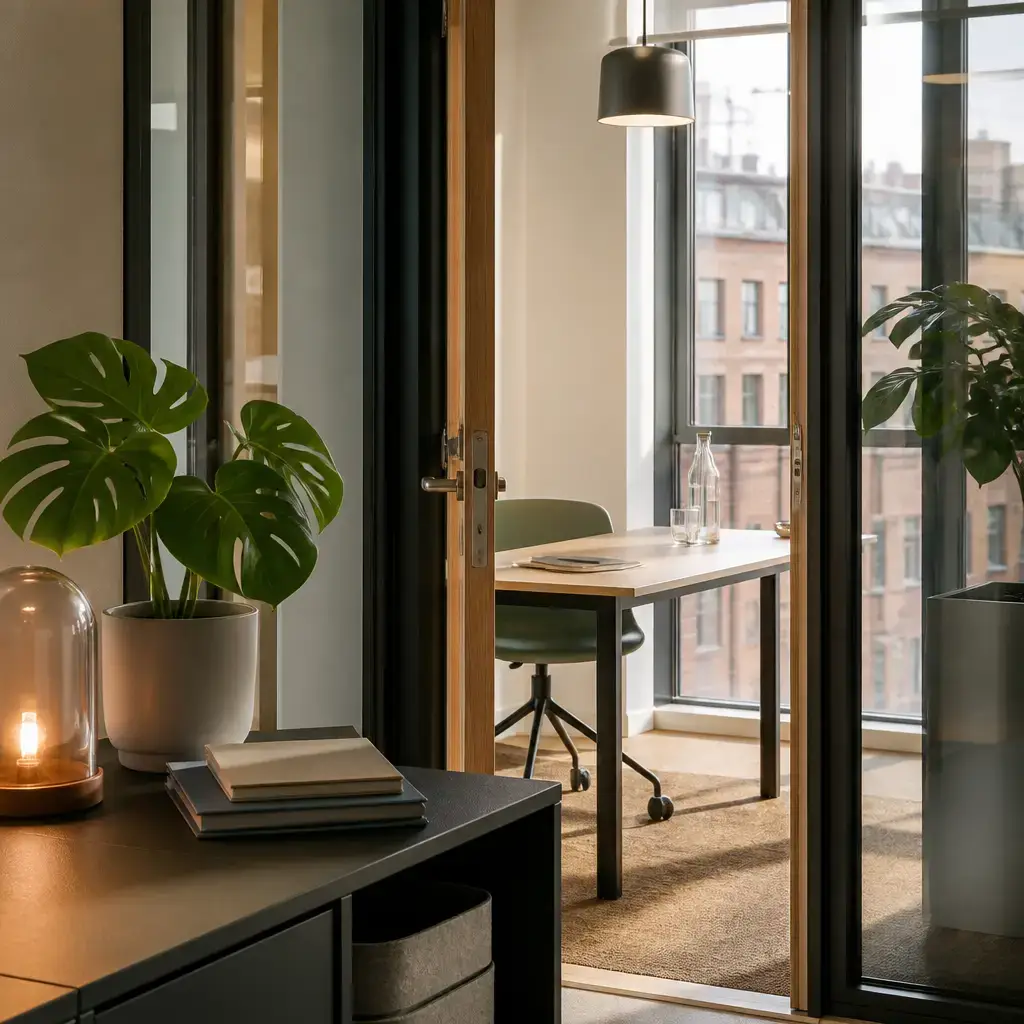
In et stille rum, rum means “room,” the physical space needed for the call. It can be used after a description and an article, as in et stille rum.
til
In til et opkald, til shows the purpose of the room: it is for a call. A useful pattern is til + a purpose or activity, as in til et opkald.
opkald
In et opkald, opkald means “call,” specifically the call for which the room is needed. The form appears after et in the indefinite noun phrase et opkald, and the same word can be used when arranging a call.
Tjek
Tjek tells the other person to check something, here the shared office calendar. It is used before the object in Tjek den fælles kontorkalender, and you can use Tjek + thing when giving a direct instruction.
den
In den fælles kontorkalender, den means “the” and points to a specific calendar. It comes before the description and noun in the pattern den + adjective + noun.
fælles
In den fælles kontorkalender, fælles means “shared” or “common,” showing that the calendar belongs to or is used by several people. It comes before the noun and can describe a shared resource, as in fælles kontorkalender.
kontorkalender
In den fælles kontorkalender, kontorkalender means “office calendar,” the calendar used for the shared office. It is a compound noun used after the article and adjective, and it names the resource to check for room availability.
først
At the end of Tjek den fælles kontorkalender først, først means “first” and gives the order of the action. It is useful for telling someone what to do before taking the next step.
Det
At the beginning of Det lille rum ser ledigt ud, Det refers to the small room. It is the subject of the sentence, and the same pronoun can refer to a neuter noun such as rum.
lille
In Det lille rum, lille means “small” and describes the room. It appears between the article-like form Det and the noun rum in the pattern lille + noun.
ser
In ser ledigt ud, ser contributes the meaning “looks” or “appears,” describing how the room seems. The reusable expression is ser + description + ud, used when judging an apparent condition.
ledigt
In ser ledigt ud, ledigt means “available” or “free,” so the room appears to be unoccupied. The form describes the room in the expression ser ledigt ud and can be used when discussing whether a resource is available.
ud
In ser ledigt ud, ud completes the expression meaning “looks” or “appears”; it does not mean physical movement out in this sentence. The pattern ser + description + ud is useful when something seems to have a particular condition.
i
In i eftermiddag, i places the event in the time period “this afternoon.” It is used in this time expression before the period named, as in i eftermiddag.
eftermiddag
In i eftermiddag, eftermiddag means “afternoon,” the time when the room appears available. It follows i in the time expression i eftermiddag, which is useful when arranging something later that day.
Føj
In Føj bookingen til kalenderen, Føj tells someone to add the booking to the calendar. A reusable instruction pattern is Føj X til Y, with the item after Føj and the destination after til.
bookingen
In Føj bookingen til kalenderen, bookingen means “the booking,” referring to the reservation being added. The ending -en marks the specific booking, and the form can be used as the object of an instruction such as Føj bookingen til ... .
kalenderen
In til kalenderen, kalenderen means “the calendar,” the specific calendar receiving the booking. The ending -en marks the definite form, and it follows til when naming the destination in Føj bookingen til kalenderen.
før
In før du bruger rummet, før means “before” and introduces the action that must happen first. It is used before a clause or event to set the order of actions.
du
In før du bruger rummet, du means “you,” the person who will use the room. It is the subject before the verb in the clause du bruger rummet, and the same form is used when addressing one person directly.
bruger
In du bruger rummet, bruger means “use,” referring to using the room. It appears after the subject du, and a useful pattern is bruger + an object, such as bruger rummet.
rummet
In bruger rummet, rummet means “the room,” referring back to the room being booked. The ending -et marks the specific room, and the form is used as the object after bruger.
Skal
At the beginning of Skal jeg gøre noget efter opkaldet?, Skal asks whether the speaker should do something. The pattern Skal jeg + action? is useful when asking what is expected or necessary.
gøre
In Skal jeg gøre noget, gøre means “do,” describing the action the speaker may need to take. It follows Skal jeg in the pattern Skal jeg gøre ... ?, which is useful when asking whether an action is required.
noget
In Skal jeg gøre noget?, noget means “something,” and in this question it corresponds to “anything” in English. It is used after gøre when the speaker asks whether any action is needed.
efter
In efter opkaldet, efter means “after” and places the action later than the call. It is used before the event that provides the time reference, as in efter opkaldet.
opkaldet
In efter opkaldet, opkaldet means “the call,” referring to the call already discussed. The ending -et marks the specific call, and the form follows efter in a time expression.
Ryd
In Ryd skrivebordet, Ryd tells someone to clear or tidy the desk. It is used before the object in the instruction pattern Ryd + object, especially when asking someone to remove things from a surface.
skrivebordet
In Ryd skrivebordet, skrivebordet means “the desk,” the surface that should be cleared. The ending -et marks a specific desk, and the form is the object after Ryd.
og
In Ryd skrivebordet, og tag dine ting med dig, og means “and” and connects two instructions. It is useful for joining actions that should be carried out together or in sequence.
tag
In tag dine ting med dig, tag means “take,” telling the person to take their belongings along. It comes before the object dine ting, and the pattern tag + object + med dig is useful for telling someone to take something with them.
dine
In dine ting, dine means “your” and identifies the things as belonging to the person being addressed. It comes before the plural noun ting, in the pattern dine + plural noun.
ting
In dine ting, ting means “things,” referring here to the person's belongings. It follows the possessive dine, and the phrase dine ting can be used when referring to someone's belongings generally.
med
In med dig, med means “with” and shows that the person takes the things along. The reusable pattern med + person is used to express being or going with someone.
dig
In med dig, dig means “you” after the preposition med, giving the meaning “with you.” The fixed phrase med dig is useful when saying that something accompanies the person being addressed.
efterlader
In Jeg efterlader det ryddeligt, efterlader means “leave” in the sense of leaving something in a particular state. It is used with the thing being left and a description of its condition, as in efterlader det ryddeligt.
ryddeligt
In efterlader det ryddeligt, ryddeligt means “tidy,” describing the state in which the room or area is left. It completes the pattern efterlader + object + description, used when saying how something should be left.
går
In før jeg går, går means “go” or, in this context, “leave.” It is used after før to say that the tidying will happen before the speaker leaves: før jeg går.
hjælper
In Det hjælper den næste person, hjælper means “helps” and describes the benefit for the next person. It is used with the person or group receiving help, as in hjælper den næste person.
næste
In den næste person, næste means “next” and identifies the person who will use the room afterward. It comes before the noun in the pattern den næste + noun.
person
In den næste person, person means “person,” referring to the next user of the room. It follows the description næste and can be used after an article and adjective in a noun phrase.
at
In med at komme godt i gang, at marks the infinitive phrase that explains the help being given. It comes before the verb in the pattern med at + action, as in med at komme godt i gang.
komme godt i gang
The expression komme godt i gang means “get started smoothly” or “make a good start.” Here komme means “come” as part of the expression, godt adds the idea of doing so well or smoothly, i means “into” in the phrase i gang, and gang contributes the idea of activity being underway. A reusable pattern is komme godt i gang med + activity or task.