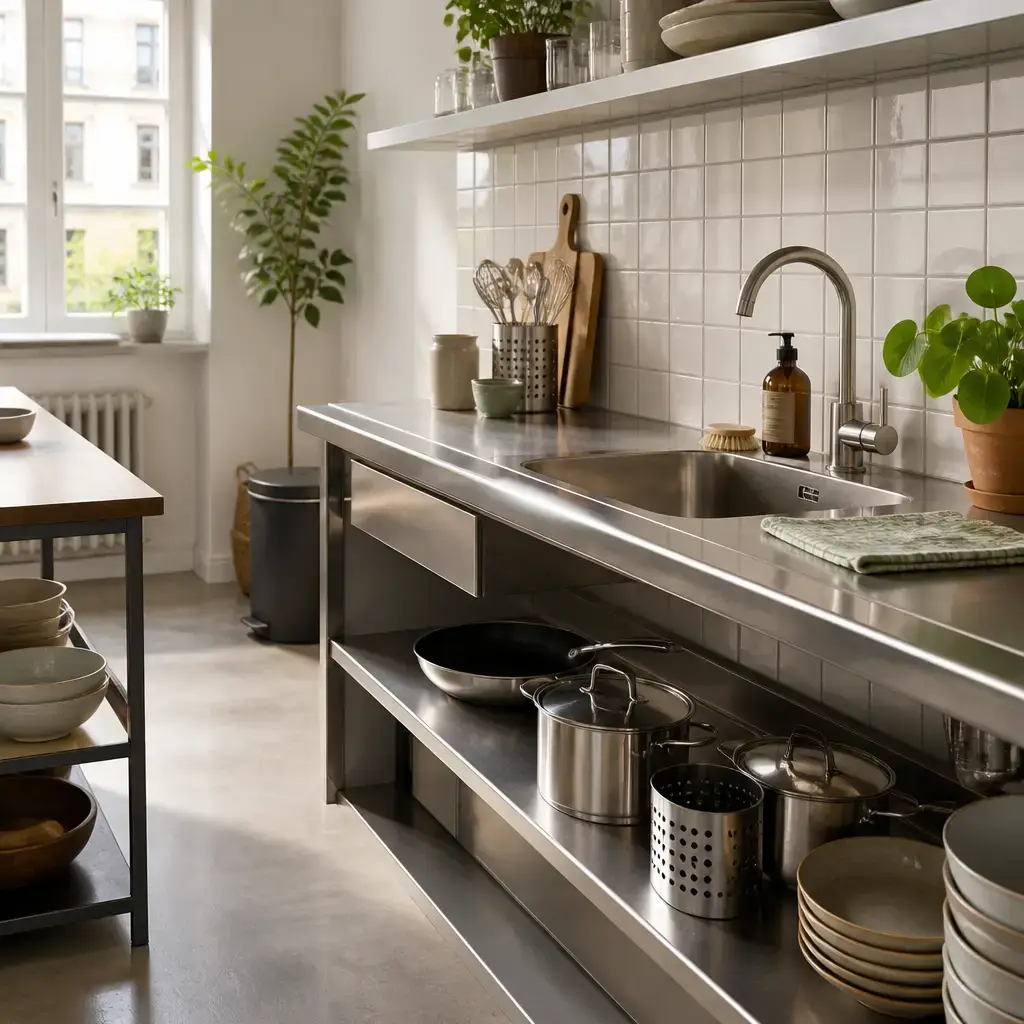
Jeg
“Jeg” means “I” here and identifies the person speaking. It is used as the subject in “Jeg er ny”. In this lesson, a new kitchen user uses it to introduce themselves.
er
“er” means “am” in “Jeg er ny” and links the speaker with the description “ny”. It is used before a description such as “ny”. In this dialogue, it states the speaker’s situation in the shared kitchen.
ny
“ny” means “new” here, describing someone who has recently started using the kitchen. It appears in “Jeg er ny i det fælles køkken”. The pattern “ny i” is useful when saying that someone is new to a place or activity.
i
“i” means “in” in “i det fælles køkken”, locating the speaker in the shared kitchen. It is used before the place phrase “det fælles køkken”. A person can use this pattern when saying they are new in a place.
det
“det” helps form the definite phrase “det fælles køkken”, meaning “the shared kitchen”. It appears before the adjective and noun in that phrase. This is useful when referring to a specific shared place that both speakers know.
fælles
“fælles” means “shared” or common to several people, describing the kitchen in “det fælles køkken”. It is placed before “køkken” inside the noun phrase. The word is useful when discussing facilities or spaces used by more than one person.
køkken
“køkken” means “kitchen” in “det fælles køkken”. It names the place where the conversation takes place. It can be reused when identifying a kitchen or discussing activities there.
Hvad
“Hvad” means “what” and introduces the question “Hvad skal jeg vide?” It asks for information about the rules or expectations. This question word is useful when asking what someone needs to know.
skal
“skal” expresses what the speaker should or needs to do or know in this dialogue. In “Hvad skal jeg vide?” it comes before “vide”, and it also appears before “tjekke” in “jeg skal tjekke”. A learner can use it when asking about an obligation or expectation.
vide
“vide” means “know” in “Hvad skal jeg vide?” and names the information the speaker should have. It follows “skal” in this question. The phrase is useful when asking what information or rules you need to know.
Hold
“Hold” means “keep” here and gives a direct instruction in “Hold køkkenbordene fri”. It tells the listener to maintain the counters in a clear condition. In this lesson, it is used for a shared-kitchen rule.
køkkenbordene
“køkkenbordene” means “the counters” in “Hold køkkenbordene fri”. It refers to the kitchen work surfaces that should remain clear. The word is useful when giving instructions about several counters in a kitchen.
fri
“fri” means “clear” or free of things in “Hold køkkenbordene fri”. Together with “Hold”, it describes the condition the counters should remain in. This usage is practical when asking people to keep a surface or area unobstructed.
og
“og” means “and” and connects the two instructions in “Hold køkkenbordene fri, og ryd op”. It links related actions in the same rule. In this dialogue, it connects keeping the counters clear with cleaning up.
ryd op
“ryd op” means “clean up” or tidy things away after cooking. In this expression, “ryd” supplies the clearing or tidying action, while “op” completes the verb expression. The reusable pattern “ryd op lige efter madlavningen” is useful when giving a clean-up instruction.
lige
“lige” adds the meaning “right” or “immediately” in “lige efter madlavningen”. It emphasizes that the clean-up should happen without delay. This is useful when telling someone to do something right after another activity.
efter
“efter” means “after” in “efter madlavningen” and places the clean-up later than the cooking. It is followed here by “madlavningen”. The phrase is useful when describing when an action should happen.
madlavningen
“madlavningen” means “the cooking” or the cooking activity in “lige efter madlavningen”. It identifies the activity that has just finished. In this lesson, it gives the time reference for cleaning up in a shared kitchen.
Hvor
“Hvor” means “where” and asks for a location in “Hvor skal jeg stille en pande?” It introduces the question about where the pan belongs. This is useful when asking where to place or find something.
stille
“stille” means “put” or “place” in “Hvor skal jeg stille en pande?” It follows “skal” and names the action of placing the pan. The question pattern is useful when asking where an object should be placed.
en
“en” means “a” in “en pande”, introducing one pan that has not yet been specified. It comes directly before “pande”. This is useful when mentioning an individual object for the first time.
pande
“pande” means “pan” in “en pande”. It names the kitchen item the speaker wants to store. In this dialogue, it is first introduced as an unspecified pan and later referred to as “panden”.
når
“når” means “when” and introduces the condition “når panden er tør”. It connects the pan’s dry condition with the time for putting it away. This is useful when explaining when an action should take place.
har
“har” helps express that the washing has been completed in “har vasket den”. It appears together with “vasket” before the later action of placing the pan. The pattern is useful when describing something that has been done before another action.
vasket
“vasket” means “washed” in “har vasket den”. Together with “har”, it says that the speaker has washed the pan. In this dialogue, it describes the completed washing that comes before storing it.
den
In “har vasket den”, “den” means “it” and refers back to “en pande”. In “den nederste hylde”, it is part of the phrase meaning “the lower shelf”. These uses are helpful when referring back to a known object or identifying a specific noun phrase.
Brug
“Brug” means “use” here and gives the instruction to use a particular shelf. It is followed by “den nederste hylde”. In this lesson, it tells the new kitchen user where to store the dry pan.
nederste
“nederste” identifies the shelf at the lower or bottom position in “den nederste hylde”. It describes which shelf to choose. This word is useful when distinguishing the lowest item in a set of shelves or levels.
hylde
“hylde” means “shelf” in “den nederste hylde”. It names the storage place beside the sink. In this situation, it is used to give a precise place for putting away the pan.
ved siden af
“ved siden af” means “beside” or “next to” in “ved siden af vasken”. “ved” gives the relation to a place, “siden” refers to the side, and “af” completes the fixed expression. The phrase is useful when locating something next to another object.
vasken
“vasken” means “the sink” in “ved siden af vasken”. It identifies the reference point for the shelf’s location. In this lesson, it helps the listener find the correct storage place.
panden
“panden” means “the pan” and refers to the pan already introduced as “en pande”. It appears in “når panden er tør”, where its dry condition determines when it can be stored. This form is useful when referring to a specific pan already known in the conversation.
tør
“tør” means “dry” in “når panden er tør”. It describes the condition of the pan before it is put away. In this situation, it communicates a practical storage requirement.
tørre
“tørre” means “wipe” in “Skal jeg tørre køkkenbordet af?” It follows “skal” and names the action of wiping the counter. The reusable pattern “tørre køkkenbordet af” is useful when asking whether a surface should be wiped.
køkkenbordet
“køkkenbordet” means “the counter” in “tørre køkkenbordet af”. It refers to the specific kitchen work surface that should be wiped. In this dialogue, it is the surface the speaker checks before leaving.
af
“af” completes the wiping expression in “tørre køkkenbordet af”, giving the meaning “wipe the counter down” or off. It works together with “tørre” rather than standing alone here. This particle is useful in the pattern for wiping a surface.
før
“før” means “before” in “før jeg går”. It places the counter-wiping action before the speaker leaves. This is useful when giving a preparation or check to complete before going.
går
“går” means “go” in “før jeg går”, meaning before the speaker leaves the kitchen. It is used after “jeg” in the time clause. This pattern is useful when saying that something should happen before you leave.
sæt
“sæt” means “put” or “place” in “sæt alt det, du har brugt, på plads”. It instructs the listener to return used items to their proper places. This is useful when giving a direct instruction to put something away.
alt
“alt” means “everything” in “alt det, du har brugt”. It gives the instruction a broad scope, covering all the things the listener used. This pattern is useful when reminding someone not to leave any used items out.
du
“du” means “you” in the clause “du har brugt”. It identifies the person whose used items should be put away. In this dialogue, it addresses the new kitchen user directly.
brugt
“brugt” means “used” in “du har brugt”. It describes the items that the listener has used during cooking. This expression is useful when referring to objects someone has used and now needs to return.
på plads
“på plads” means “in place” or “away” in “sæt alt det, du har brugt, på plads”. “på” supplies the relation to a place, while “plads” names that place; together they form the meaning “put away”. A new example is: “Sæt koppen på plads.”
der
“der” forms the existential question “Er der andet”, meaning “is there anything else”. It does not point to a physical place here. This pattern is useful when asking whether something or someone is present or available.
andet
“andet” means “anything else” in “Er der andet, jeg skal tjekke?” It asks whether there is an additional task or detail to check. This is useful when making sure nothing further needs attention.
tjekke
“tjekke” means “check” in “jeg skal tjekke”. It follows “skal” and names the action the speaker may still need to do. In this situation, it is used to ask about a final inspection before leaving.
Efterlad
“Efterlad” means “leave” in the instruction “Efterlad køkkenet klar”. It tells the listener to leave the kitchen in a particular condition. In this lesson, the purpose is to make the shared space ready for the next user.
køkkenet
“køkkenet” means “the kitchen” in “Efterlad køkkenet klar”. It refers to the specific shared kitchen discussed throughout the dialogue. The word is useful when giving instructions about leaving that place.
klar
“klar” means “ready” in “Efterlad køkkenet klar”. It describes the condition the kitchen should have after the speaker finishes. In this situation, it means prepared for another person to use.
til
“til” means “for” in “klar til den næste person”. It connects the ready condition with the person who will use the kitchen next. The pattern “klar til” is useful when saying that something is ready for a person or activity.
næste
“næste” means “next” in “den næste person”. It identifies the person who will come or use the kitchen after the current user. This word is useful when referring to the following person or turn.
person
“person” means “person” in “den næste person”. It names the next user of the shared kitchen. In this dialogue, it highlights that the space should be left ready for someone else.