Min
“Min” means “my” here and identifies the battery as belonging to the speaker’s phone. It is used before “telefons batteri” in “Min telefons batteri er næsten dødt”; reuse it when identifying something as yours.
telefons
“Telefons” means “phone’s” and links the phone to its battery in “telefons batteri”. The ending shows that the battery belongs to the phone; reuse this possessive pattern with a noun followed by “batteri” when talking about a phone.
batteri
“Batteri” means “battery” in “telefons batteri”. Here it is the thing whose remaining power is being described; reuse it in “telefons batteri” when discussing a phone’s battery.
er
“Er” means “is” and links the battery with its condition in “er næsten dødt”. It is useful for describing a current state, as in the pattern “er + description”.
næsten
“Næsten” means “almost” and shows that the battery is very close to being dead, but not completely dead yet. Reuse it before a description, as in “næsten dødt”, when something is close to a state.
dødt
“Dødt” means “dead” here, referring to a battery with almost no usable power. In “er næsten dødt” it describes the battery’s condition; this pattern is useful when reporting that a device has nearly stopped working.
Har
“Har” means “have” in the question “Har du en oplader eller en powerbank med dig?”. At the beginning of this question, it asks whether the other person possesses or has something available; reuse “Har du ...?” to ask what someone has.
du
“Du” means “you” and is the person being asked in “Har du en oplader eller en powerbank med dig?”. It is the subject of the question; reuse it when asking one person about something they have or can do.
en
“En” introduces one item in “en oplader” and “en powerbank”. Here it presents a possible charger or power bank as an available object; reuse it before a singular item such as “en oplader”.
oplader
“Oplader” means “charger”, the device used to provide power to the phone. In “en oplader” it names one possible solution to the battery problem; use it when asking for or discussing a charger.
eller
“Eller” means “or” and presents two alternatives in “en oplader eller en powerbank”. It connects options in a question; reuse it when offering or asking about one thing or another.
powerbank
“Powerbank” means “power bank”, a portable source of power for the phone. In “en oplader eller en powerbank” it is the second charging option; use it when discussing portable phone power.
med
“Med” means “with” in the expression “med dig”. Together with “dig”, it asks whether the other person has the item with them now; reuse “med dig” for something someone is carrying or has present.
dig
“Dig” means “you” in “med dig”, referring to the person who may have a charger or power bank with them. With “med”, it forms the location or possession expression “med dig”; use it when asking what someone has with them.
Jeg
“Jeg” means “I” and marks the speaker as the subject in “Jeg lod begge dele blive hjemme” and “Jeg skal ringe”. Reuse it at the start of a sentence when describing your own action, need, or situation.
lod
“Lod” means “left” or “let remain” in “lod begge dele blive hjemme”. It says that the charger and power bank were allowed to remain at home; reuse the complete pattern “lod ... blive hjemme” when explaining that something was left at home.
begge
“Begge” means “both” and refers to the two items mentioned in “begge dele”. It indicates that the statement applies to the two items together; reuse “begge dele” when referring to two previously mentioned things.
dele
“Dele” means “things” or “items” in the expression “begge dele”. Together, “begge dele” refers to both the charger and the power bank without repeating their names; use this expression after two things have been mentioned.
blive
“Blive” means “remain” in “blive hjemme”. With “lod”, it describes the items staying at home rather than being brought along; reuse “blive hjemme” when something or someone remains at home.
hjemme
“Hjemme” means “at home” in “blive hjemme”. It identifies the place where the charger and power bank remained; reuse it when describing someone or something being at home.
skal
“Skal” expresses “need to” in “Jeg skal ringe, det haster”. It presents calling as the speaker’s immediate necessity; reuse “skal” with an action when saying what you need to do.
ringe
“Ringe” means “call” or “phone” in “skal ringe”. It names the action the speaker needs to carry out; reuse it after “skal” when talking about making a phone call.
det
“Det” is “it” in the expression “det haster”. Together, “det haster” means that the situation is urgent, so the word should be understood as part of that expression rather than as “urgent” by itself.
haster
“Haster” means “is urgent” in “det haster”. The complete expression communicates that something needs attention soon; use “det haster” when explaining why an action cannot wait.
Der
“Der” introduces the existence of something in “Der er en stikkontakt ved siden af vinduet”. Here it directs attention to an outlet that is available at a particular place; reuse “Der er ...” when pointing out that something exists or is located somewhere.
stikkontakt
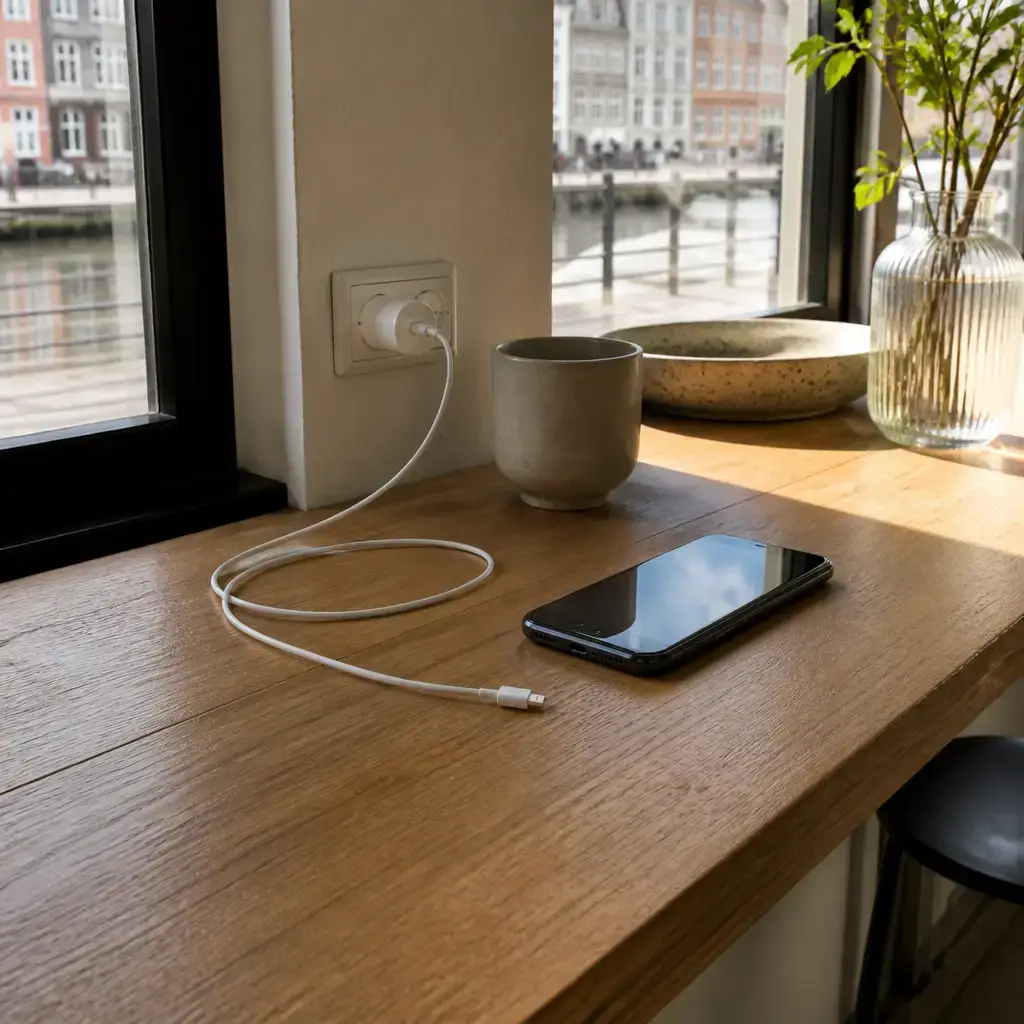
“Stikkontakt” means “power outlet” or “socket”. In “en stikkontakt ved siden af vinduet” it identifies the place where the phone can be connected; use it when locating an electrical outlet.
ved
“Ved” contributes the meaning “beside” or “by” in the location phrase “ved siden af vinduet”. The complete phrase locates the outlet next to the window; reuse “ved siden af” when describing something’s position beside another thing.
siden
“Siden” means “side” within the fixed location phrase “ved siden af vinduet”. Together with “ved” and “af”, it helps express that the outlet is beside the window; learn it as part of “ved siden af” for location descriptions.
af
“Af” completes the location phrase “ved siden af vinduet”, which means “beside the window”. It does not mean “of” independently in this dialogue; reuse the full phrase “ved siden af” when locating something next to another object.
vinduet
“Vinduet” means “the window” and is the reference point in “ved siden af vinduet”. It identifies the specific window next to which the outlet is located; use it when pointing out that window as a place reference.
Må
“Må” means “may” or “can I” in the permission question “Må jeg bruge dit kabel i et par minutter?”. It politely asks whether the speaker is allowed to use something; reuse “Må jeg ...?” when requesting permission.
bruge
“Bruge” means “use” in “Må jeg bruge dit kabel”. It describes using the other person’s cable for the phone; reuse it after “Må jeg” when asking permission to use an object.
dit
“Dit” means “your” and identifies the cable as belonging to the person being addressed in “dit kabel”. It links the person addressed with the object; reuse it before “kabel” when referring to that person’s cable.
kabel
“Kabel” means “cable” in “dit kabel”. Here it is the item the speaker wants to borrow for charging the phone; use it when asking about or referring to a cable.
i
“I” means “for” when it introduces the duration in “i et par minutter”. It shows how long the cable would be used; reuse it before a time expression when describing a duration.
et
“Et” is part of the quantity expression “et par minutter”, meaning “a few minutes”. Its meaning here comes from the complete expression rather than from “et” alone; reuse “et par” before a small number or amount.
par
“Par” means “a few” in “et par minutter”. Together with “et”, it gives an approximate short duration; use “et par” when referring to a small number of items or units.
minutter
“Minutter” means “minutes” in “i et par minutter”. It measures the short period for which the cable will be used; reuse it after a number or quantity expression when talking about time.
kan
“Kan” means “can” in “Du kan bruge det”, expressing permission in this reply. It tells the other person that using the cable is allowed; reuse “kan” with an action when granting or describing permission.
længe
“Længe” means “long” as a measure of time in “længe nok til at ringe”. It describes the available duration of cable use; reuse it with “nok” when saying that a period is sufficient for an action.
nok
“Nok” means “enough” in “længe nok til at ringe”. It says that the available time reaches the required amount for making the call; reuse the pattern “længe nok til at ...” for a sufficient duration.
til
“Til” introduces the purpose or result in “til at ringe”. Together with “at ringe”, it means “to make the call” and explains what the available time is sufficient for; reuse “til at” before an action when expressing purpose.
at
“At” marks the action form in “til at ringe”. Together, “til at ringe” expresses the purpose of using the cable; reuse it after “til” before an action in this type of purpose expression.
giver
“Giver” means “give” or “return” in “giver dig det tilbage”. In this dialogue, the speaker promises to return the cable to the other person; reuse the full pattern “giver dig det tilbage” when saying that you will return something to someone.
tilbage
“Tilbage” means “back” in “giver dig det tilbage”. It shows that the item is being returned to its previous owner; reuse it with an action of returning something to someone.
så
“Så” is part of the time expression “så snart”, meaning “as soon as”. In “så snart min telefon tænder”, it introduces the condition that triggers the return; reuse “så snart” when describing an action that happens immediately after another event.
snart
“Snart” means “soon” within “så snart min telefon tænder”. Together, “så snart” means “as soon as”, setting the time for returning the cable; use this expression when one action will follow another promptly.
telefon
“Telefon” means “phone” in “min telefon tænder”. It is the device whose power state changes; reuse it with a possessive such as “min” when talking about your phone.
tænder
“Tænder” means “turns on” in “min telefon tænder”. It describes the phone becoming operational again; use it when saying that a device turns on.
Lad
“Lad” means “keep” or “let” in the instruction “Lad den være tilsluttet”. Here it tells the listener not to disconnect the cable; reuse “Lad ... være ...” when instructing someone to leave something in a particular state.
den
“Den” means “it” and refers to the cable in “Lad den være tilsluttet”. It prevents the speaker from repeating “kabel”; reuse it when referring back to that cable in the instruction.
være
“Være” means “be” in “være tilsluttet”. Together with “tilsluttet”, it describes the state the cable should remain in; reuse “være” when telling someone to maintain a state.
tilsluttet
“Tilsluttet” means “plugged in” or “connected” in “være tilsluttet”. It describes the cable’s required connection to the power source; use it when talking about a device or cable remaining connected.
indtil
“Indtil” means “until” and introduces the endpoint in “indtil du har nok strøm på batteriet”. It says that the cable should remain connected up to the point when the battery has enough charge; reuse it before an endpoint or stopping condition.
strøm
“Strøm” means “power” or “charge” in “nok strøm på batteriet”. Here it refers to the amount of energy available in the battery, not to a general electrical action; reuse “strøm på batteriet” when discussing battery charge.
på
“På” contributes the relation in “strøm på batteriet”, describing charge available in the battery. Its meaning here comes from this battery expression; reuse “strøm på batteriet” when saying that a battery has enough or too little power.
batteriet
“Batteriet” means “the battery” in “nok strøm på batteriet”. It refers to the specific phone battery already being discussed; reuse it when referring back to that battery as the source of the phone’s remaining power.